PROLOGUEAn Ordinary City
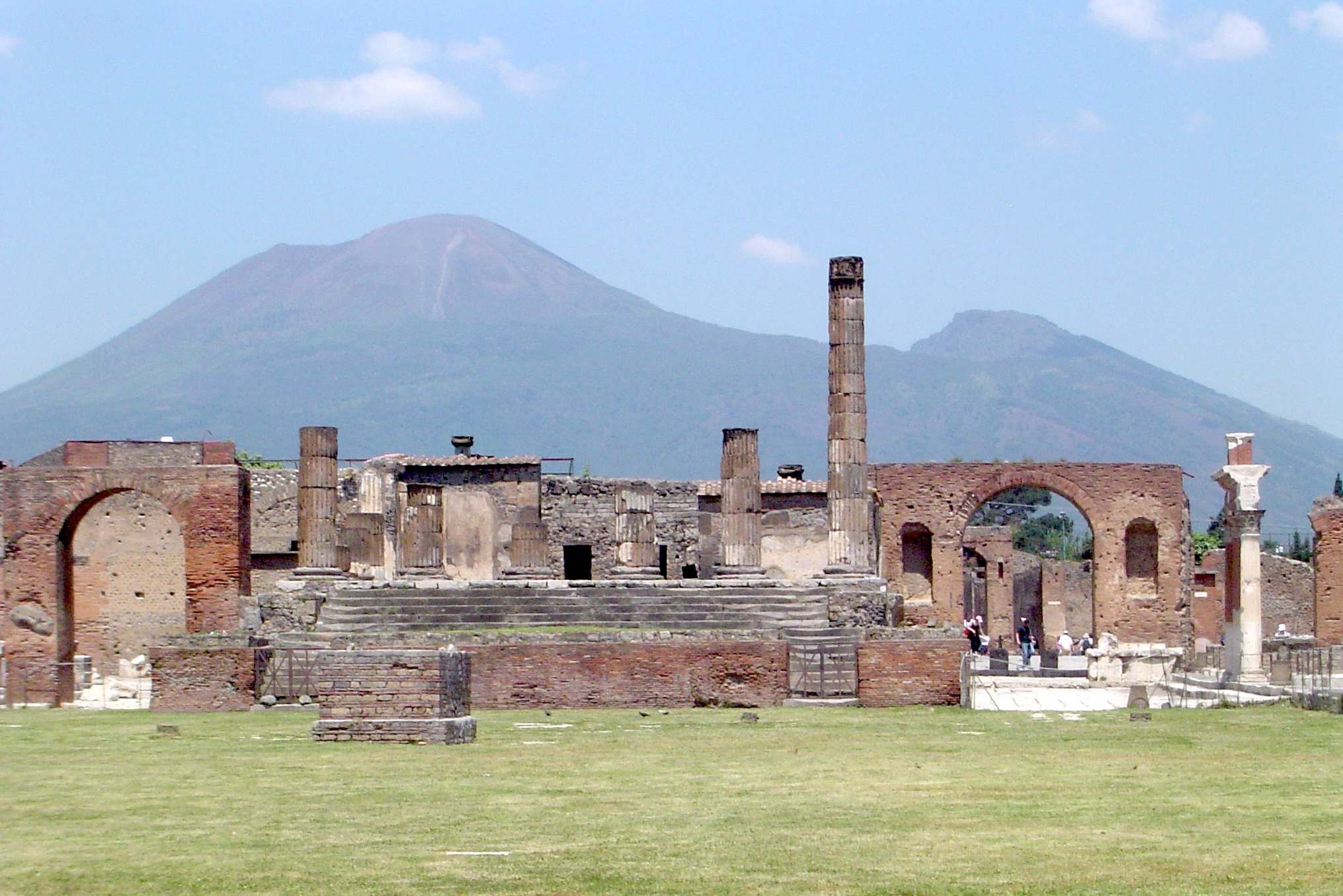
Pompeii was not a city built for disaster. It stood on an old lava plateau beside the Bay of Naples, about eight kilometres from Mount Vesuvius, facing the sea with the volcano at its back. Its history was far longer than its disaster: people had settled there by the seventh or sixth century BC — Oscans first, then Samnites, and finally Romans. By AD 79 it was a city more than six hundred years old, its walls enclosing sixty-four to sixty-seven hectares, home to about eleven thousand people.
It was not Rome, not the heart of any empire. It was a middling port town that lived on wine, olive oil and fish sauce, with a forum, temples, baths, a theatre and the oldest surviving stone amphitheatre in the Roman world. Rich men lived in great houses; the poor lived in small rooms upstairs; the streets held bakeries, taverns, laundries and a brothel. It was ordinary, like any Roman town. And that ordinariness is what gives its fate its weight: what time sealed away was not a palace, but the everyday life of a city.
CHAPTER ONESeventeen Years After the Earthquake
Before the disaster came, Pompeii had already been shaken once. On 5 February AD 62, a great earthquake struck the city hard; Seneca recorded it in his Natural Questions. Temples fell, houses cracked, even the arches of the amphitheatre were damaged. The people did not leave. They began to rebuild. The amphitheatre was among the first buildings restored, and seventeen years later scaffolding and half-finished walls were still everywhere in the city.
Looking back, the earthquake reads like a warning. No one read it that way at the time. Vesuvius had slept for centuries, its slopes covered in vineyards, and the Romans took it for an ordinary mountain. The geographer Strabo had written that its summit looked as though it had been eaten by fire, but he recorded it as a curiosity of the landscape. No one connected the earthquake with the volcano. The people of Pompeii repaired the theatre, repainted their walls, and went on with their lives. They were not foolish. Like everyone living in a quiet age, they believed tomorrow would be much like yesterday.
CHAPTER TWOThat Day
The traditional account dates the eruption to 24 August AD 79. The date comes from two letters the younger Pliny wrote to the historian Tacitus, the only eyewitness account to survive. But in 2018 archaeologists found a line of charcoal writing on the wall of a house that was being renovated when the eruption struck, dated 17 October; the fruit, the clothing and a coin minted after September all point to autumn as well. Most scholars now lean towards late October, and the exact date remains unsettled. Even the day a city died is still argued over — that, too, belongs to the story of Pompeii: what we take for certain is often only the version that was copied most often.
Shortly after midday that day, from Misenum across the bay, the seventeen-year-old Pliny the Younger saw a cloud rising above Vesuvius, shaped like a pine tree, its trunk shooting straight up and its top spreading out in all directions. His uncle, Pliny the Elder — commander of the fleet and the naturalist who wrote the Natural History — at once ordered ships out, to observe at close hand and to rescue people on the shore. The younger Pliny stayed behind with his books and did not go. The elder Pliny landed at Stabiae, breathed in ash and poisoned air, and died there that night. Some twenty-five years later his nephew wrote it all down for Tacitus, producing the first scientific description of a volcanic eruption in history — and giving this kind of eruption its name: Plinian.
The eruption lasted nearly two days. The column of ash rose more than thirty kilometres into the sky, and pumice fell like hail on the roofs of Pompeii, piling up thicker and thicker. Many people escaped in the pauses between the falls, and the streets slowly emptied. Then the surges came — searing flows of gas and ash sweeping down the mountainside, swallowing the whole city in minutes. Pompeii was buried under four to six metres of ash and pumice; Herculaneum was buried deeper still, under nearly twenty metres. About 1,150 sets of remains have been found at Pompeii so far; the true death toll is still unknown, estimated at between 1,500 and 16,000. Most of the inhabitants did get away. Those who stayed were the ones who moved too slowly, who could not bear to leave, or who simply did not believe such a thing could happen.
CHAPTER THREEThe Everyday Life Left Behind
The most moving thing about Pompeii is not how it was destroyed, but what it was before the destruction. The ash fell like a rough but honest hand, pressing down on a city in the middle of its day. The paving stones of the streets still carry the ruts of cart wheels, and stepping stones stand in the middle of the road so that pedestrians could cross without stepping into the mud when it rained. In the bakeries, loaves of bread still lie charred in the ovens; on the tavern counters, jars for food are still set into the stone; on the walls, posters urge citizens to vote for one candidate or another for town councillor.
The rich lived in houses as large as palaces. The largest house in the city is the House of the Faun, named for a bronze of a dancing faun in its atrium. In the reception hall its owner laid a great mosaic showing Alexander the Great meeting Darius III of Persia at the Battle of Issus, the armies of two empires crashing together. That mosaic is now in the Archaeological Museum in Naples. At the door of another house, a small mosaic of a dog carries a warning that needs no translation even now: beware of the dog.
The amphitheatre was built around 70 BC, the oldest surviving stone amphitheatre in the Roman world, holding some twenty thousand spectators — more than the population of the whole town. In AD 59, spectators from Pompeii and the neighbouring town of Nuceria came to blows at the games, and the fighting turned bloody enough for the Senate in Rome to close the theatre for ten years. These details are precious because they are not the history of emperors and generals, but the history of ordinary people. Pompeii left behind no great speeches and no treaties. It left bread, a dog, election posters, and a brawl at the games. That is the history most people actually lived.
CHAPTER FOURThe People in Plaster
After it was buried, the world forgot Pompeii for more than sixteen centuries. In the 1590s, workmen digging a water channel kept striking walls, and the architect Domenico Fontana simply ran his tunnel straight through them; no one knew a city lay underfoot. Herculaneum was dug first: in 1738 the King of Naples ordered systematic digging there. In 1748 the diggers moved to Pompeii, at first believing they had found a different town, until in 1763 an inscription naming the "republic of the Pompeians" settled the question.
What turned Pompeii from treasure hunting into science was an archaeologist named Giuseppe Fiorelli. In 1863 he took charge of the dig, and his workmen had long noticed hollows in the hardened ash, sometimes with bones at the bottom — the moulds left by bodies that had decayed after burial. Fiorelli ordered liquid plaster poured into the hollows; when it set, the ash was chipped away. In February 1863, in a lane later called the Street of the Skeletons, the first four people came back into view in this way: a man, two women and a young girl, still in the positions in which they had died. In the century and more since, over a hundred casts have been made by this method.
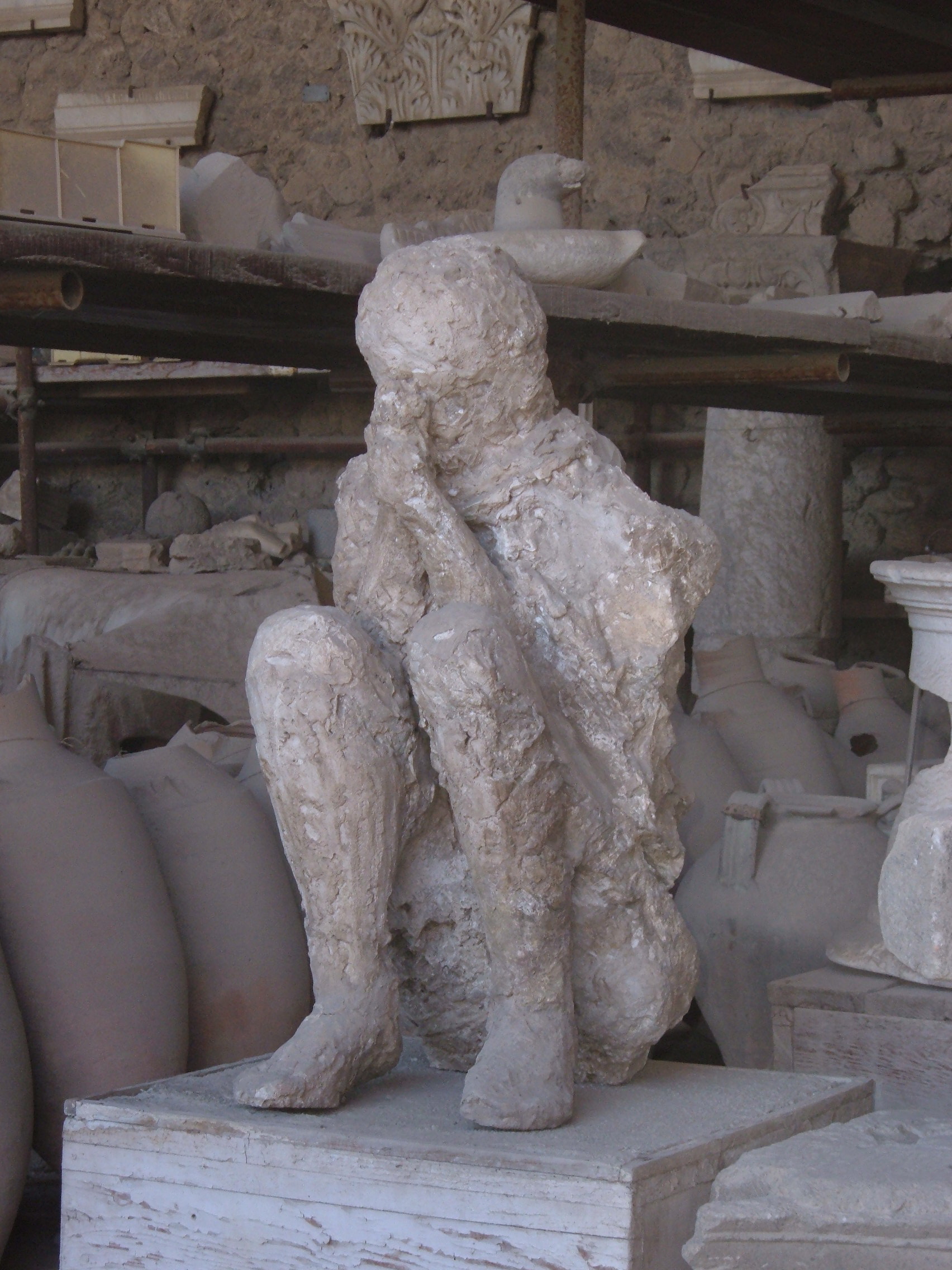
The casts are not the bodies themselves, but the shapes the bodies left behind. The plaster filled the space where the body had decayed, and sometimes even the folds of clothing and the lines of hair survived. In 1961, thirteen casts were found together in the Garden of the Fugitives — a family fleeing together, falling in the same place. In 2024, scientists extracted DNA from several casts and tested the relationships between them, finding that some remains long assumed to be one family were not related by blood at all. Pompeii is still correcting what we thought we knew. The hardest thing about looking at the casts is not that these people died, but that the poses in which they died look so much like living: one curled up, one with a hand over the face, one holding a child tight. The ash left them no last words — only postures.
CHAPTER FIVEThe Volcano Is Still There
Vesuvius did not go quiet after AD 79. It has erupted more than forty times since, most recently in 1944. It is still an active volcano, and one of the most dangerous in the world — because people live at its foot. About 670,000 people live inside the red zone, and the Italian government keeps a full evacuation plan ready. The tragedy of Pompeii never became a distant legend; it is still a risk being managed today.
Pompeii itself has not finished being dug. About two-thirds of the city has been uncovered; the remaining third still lies underground. In 1997 Pompeii, Herculaneum and Torre Annunziata were inscribed together on UNESCO's World Heritage List. Millions of visitors walk into the city every year, through its streets, its houses, past its casts. Since 2018, digging in Regio V has brought new finds: richly decorated houses, walls covered in writing, even a fast-food shop preserved almost whole. Pompeii is not a finished story. It is still being dug out of the ground.
EPILOGUETwo Kinds of Time
There are two kinds of time in the story of Pompeii. One is the time of destruction: in less than two days, a city that had lived for six hundred years stopped. The other is the time of preservation: more than sixteen centuries later, the city came back in another form, its streets, its bread, its election posters and the postures of its dead still there. The volcano did two things at once: it killed a city, and it gave it a funeral so long that the city has outlived every city of its age.
We read Pompeii not only to watch a disaster, but to see the weight of ordinary days. The history books are full of emperors, wars and treaties, but most lives are made of smaller things: the bread bought in the morning, the dog at the door, a line of writing on a wall, a fight with the neighbours at the games. Pompeii kept those small things, and reminds us that a civilisation is not made of monuments, but of days.
And the volcano is still there. It reminds us that the ground under a prosperous life was never guaranteed. The people of Pompeii repaired the theatre the earthquake had cracked, believing life would go on. They were wrong, but understandably wrong. We, too, live beside our own volcanoes, only under different names: climate, war, the things we are sure will never happen. What Pompeii leaves us is not an empty exhortation to treasure every day, but a concrete image: a city died in a single day, and the day it died looked no different from the day before.
Questions That Remain Open
In honesty, the following three things have no settled answer, and this essay does not pretend otherwise:
- On which day did Pompeii actually die? Tradition says 24 August AD 79, from the letters of Pliny the Younger; but charcoal writing found in 2018 bears the date 17 October, and the fruit, clothing and coins found also point to autumn. Most scholars now favour late October, and the exact date is still unsettled.
- How many people actually died in Pompeii? About 1,150 sets of remains have been found, but the true death toll is still unknown, estimated at between 1,500 and 16,000.
- How were the people in the plaster casts actually related to one another? In 2024 scientists extracted DNA from several casts and found that some remains long thought to be one family were not blood relations at all; Pompeii is still correcting what we thought we knew.