PROLOGUEA Man Who Would Not Take Office
In the middle of the Warring States period, the realm was in chaos. Feudal lords annexed one another, wars were frequent, and a hundred schools contended, their doctrines rising and falling like hawkers' cries in a market. In such a time, in the territory of Meng in the state of Song, there lived a man named Zhuang Zhou. He had held only a minor post overseeing a lacquer garden, and never held high office in his life, yet he left behind a book in which readers more than two thousand years later still look for a way forward. The book is called the Zhuangzi, also known as the Nanhua Zhenjing. Even Sima Qian, in the Records of the Grand Historian, gave its author only a little more than two hundred characters: Zhuangzi was a man of Meng, named Zhou; Zhou once served as a lacquer-garden official in Meng, and lived at the same time as King Hui of Liang and King Xuan of Qi. As for the years of his birth and death, the records give no certain account; we can only infer from his contemporaries that he lived in the middle of the Warring States period. A person's dates can be vague, while the questions a book asks can stay clear for two thousand years.
What Zhuangzi saw was a world bound by fame, profit, right and wrong, and fear. People were busy competing, busy arguing, busy proving themselves useful, too busy to ask the simplest question: living like this, are we free? His answer was not a system, but a state of being, called xiaoyao — free wandering. It is not idleness, and not escape from responsibility, but a ease that is not pulled about by external things. If a person can keep an open space in his heart, not stuffed with fame and profit, not tied down by right and wrong, he can still walk his own road in a disordered age.
CHAPTER ONEIn the Northern Sea There Is a Fish: Freedom Begins with Imagination
The Zhuangzi opens with an impossible scene: In the Northern Sea there is a fish, and its name is Kun. Kun is so large that no one knows how many thousand li it measures. It turns into a bird, and its name is Peng. Peng's back is so large that no one knows how many thousand li it measures. When it rises in flight, its wings are like clouds hanging from the sky. A great fish becomes a great bird, beats the water into waves three thousand li wide, rides the wind up ninety thousand li, and heads for the southern sea, the Pool of Heaven. The numbers defy common sense, and Zhuangzi writes them deliberately, because his first point is that imagination itself is freedom. A person who does not even dare to imagine greatly will forever circle in a small puddle.
But Zhuangzi does not stop at grandeur. He turns his brush and writes of the cicada and the little dove laughing at Peng: we leap up and land on an elm branch, and that is happiness enough — why fly ninety thousand li? The passage is humorous, yet it hides a serious question: great and small — who decides? From the cicada's point of view, Peng's long journey is unnecessary; from Peng's point of view, the cicada's contentment is narrow. Zhuangzi does not ask us to take sides, but to see that every point of view has its own boundary. Free wandering begins with admitting that boundaries exist, and then refusing to be trapped by them. Small knowledge cannot reach great knowledge; a short life cannot reach a long life. A person who knows how little he knows can let go of the compulsion to win every argument.
The end of Free Wandering sets out three states: the Perfected Person has no fixed self, the Spiritual Person has no attachment to achievement, the Sage has no craving for fame. These sentences sound lofty, but they speak of something practical: a person is unfree most often not because the outer chains are heavy, but because the inner grip of the self is too tight. Let go of attachment to the self, to achievement, to fame, and a person grows lighter and can fly further. How much of our anxiety comes not from truly lacking anything, but from being unable to let go of the self that must win and must be seen?
CHAPTER TWOOn the Equality of Things: Beyond Right and Wrong, Another Way of Listening
If Free Wandering speaks of the state of freedom, On the Equality of Things speaks of the way to reach it. To equalise things is not to press everything flat into sameness, but to see that things are already equal: right and wrong, great and small, beautiful and ugly, life and death have no absolute boundary in the light of the Way. The chapter opens with Nan Guo Ziqi leaning on his armrest, sighing up at the sky, as if he had lost his companion. A student asks him why, and he answers: today I have lost myself. A person suddenly finds that the self that chatters all day in his heart is gone. This is not losing one's mind, but a release: when the self loosens, the world grows quiet, and a person can hear other sounds.
Zhuangzi then writes of three kinds of piping: the piping of humans, the piping of earth, and the piping of Heaven. The piping of humans is the sound of flutes; the piping of earth is the wind blowing through hollows in the hills; the piping of Heaven is the sound things make by themselves, with no instrument at all. People are used to understanding the world through the piping of humans: I speak, you listen, I am right, you are wrong, let us settle who wins. Zhuangzi reminds us that there is another way of listening, the piping of Heaven: do not rush to judge, but first let things speak for themselves. The wind blowing through different hollows makes different sounds, and every sound is real. Arguments over right and wrong never end because each person hears only the sound in his own hollow and mistakes it for the whole. On the Equality of Things does not ask us to give up judgement and become indifferent. Precisely because right and wrong are relative, we need to be more careful, and to leave room for different views.
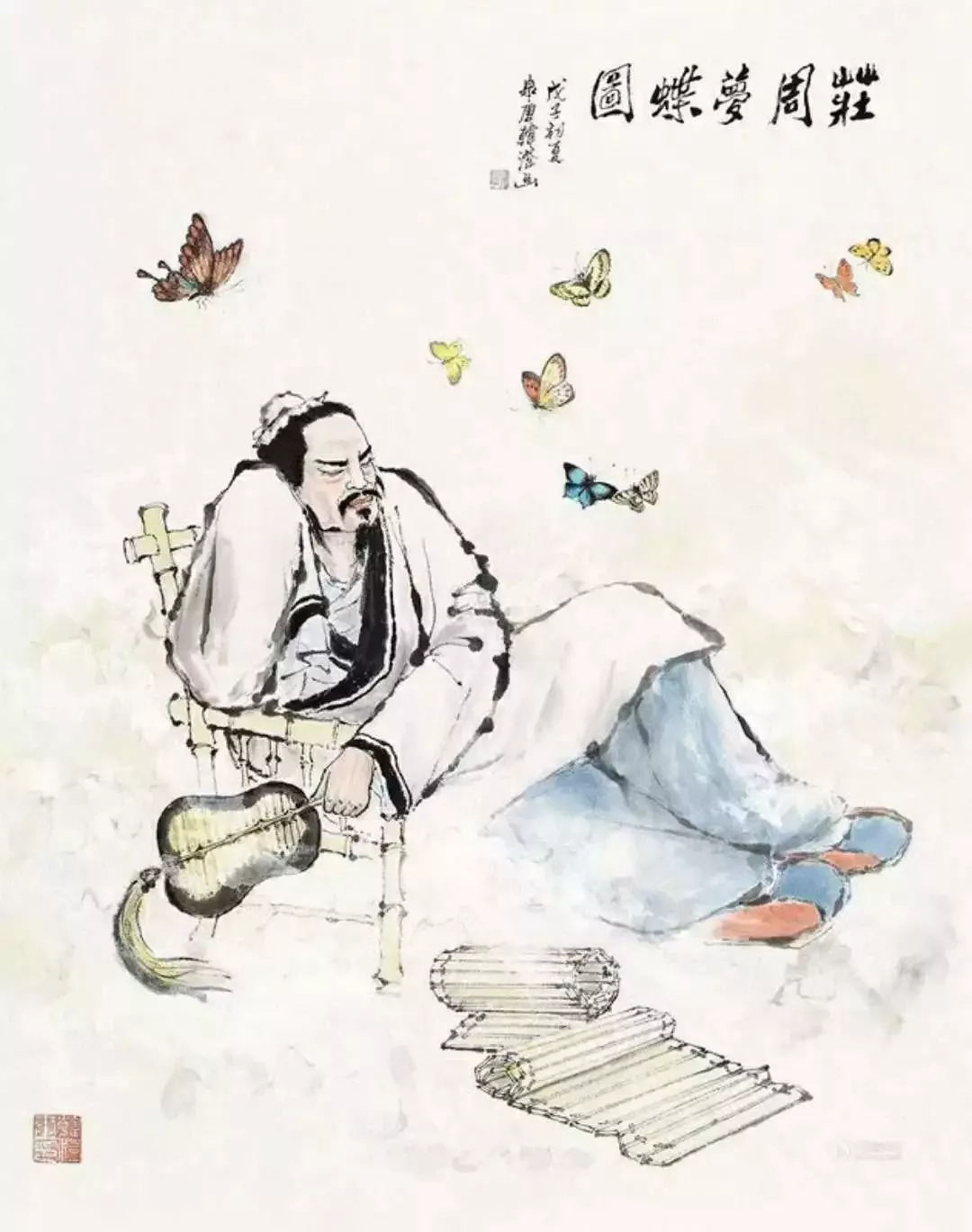
CHAPTER THREEZhuang Zhou Dreams of a Butterfly: Who Am I, and Who Is Me?
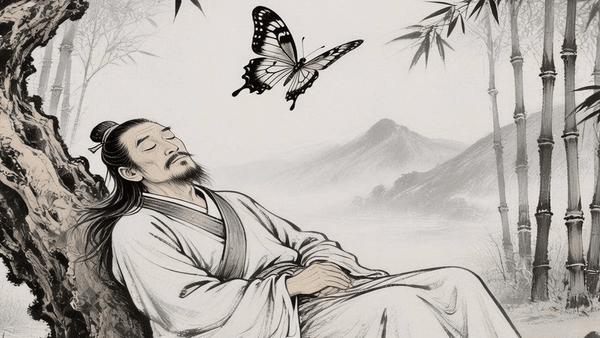
The end of On the Equality of Things hides the most famous passage in the whole book, only about a hundred characters, yet readers have turned it over for two thousand years: Once Zhuang Zhou dreamed he was a butterfly, a butterfly fluttering about, content with itself, with no idea that it was Zhou. Then he awoke, and there he was, unmistakably Zhou. He did not know whether it was Zhou who had dreamed he was a butterfly, or a butterfly dreaming it was Zhou. Between Zhou and the butterfly there must be a distinction, and this is called the transformation of things. One day Zhuang Zhou dreamed he had become a butterfly, dancing in the air, happy with itself, entirely forgetting it was Zhuang Zhou. Suddenly he woke and found himself plainly Zhuang Zhou. So he asked: was it Zhuang Zhou dreaming he had become a butterfly, or a butterfly dreaming it had become Zhuang Zhou? This is called wuhua, the transformation of things.
The power of this passage is that it asks the heaviest question in the lightest way: who am I? In ordinary life we are sure of our identity: I am this person, with this name, this body, this past. Yet a single dream can shake that certainty. The butterfly in the dream is happily and confidently real, never feeling false; the awakened Zhuang Zhou is also confidently real, never feeling false. Both states are so real — which one is true? Zhuangzi gives no answer. What he gives is a stance more important than an answer: there is no need to rush to a verdict. Between Zhou and the butterfly there must be a distinction, but that distinction is not for ranking true against false; it reminds us that the self is not a fixed stone, but a flowing change. The word wuhua is worth savouring. All things are in transformation: Zhuang Zhou can become a butterfly, and a butterfly can become Zhuang Zhou. A person who can accept that change will not fear loss so much. To lose an identity is not to lose oneself; to change a way of life is not to betray oneself. Freedom is not only going where you wish, but not being bound by one fixed answer to who you are.
CHAPTER FOURCook Ding Carves the Ox: The Way Inside a Craft
The third Inner Chapter, Mastering Life, opens with the words: Our lives have a limit, but knowledge has none. To pursue the limitless with the limited is dangerous. Since the pursuit can never be finished, why not live differently? What follows is the most famous parable in the book: Cook Ding carves an ox.
Cook Ding carved an ox for Lord Wenhui. Where his hand touched, where his shoulder leaned, where his foot stepped, where his knee pressed, the blade sang with a swish, every movement in rhythm, like the dance of the Mulberry Grove, like the music of the Jingshou. A cook carving an ox for his lord, every motion in time, the sound of the knife like music, like dancing. Lord Wenhui watched, entranced, and asked how he did it. Ding answered: What I love is the Way, which goes beyond skill. When I first began carving oxen, all I saw was the whole ox; after three years, I no longer saw the whole ox. Now I meet it with spirit rather than sight; the senses stop, and the spirit moves. I follow the natural grain, cut through the great gaps, guide the blade through the great hollows, and go by what is already there. I follow the ox's own pattern, letting the blade fall in the spaces between the joints.
Ding's knife had been used for nineteen years and had carved thousands of oxen, yet its edge was as sharp as if it had just come off the whetstone. A good cook changes his knife once a year, because he slices; an ordinary cook changes his once a month, because he hacks. Ding's blade never dulled because he never forced it: between the joints there is space, and the blade is so thin it has almost no thickness; with what has no thickness entering what has space, the blade has ample room to wander. This is the origin of the saying "to have room to spare." Yet Ding also said that whenever he came to a place where the sinews crossed and the cut was hard, he would grow watchful, slow his movements, and cut very lightly, and the ox would fall apart. This story is not about cooking, but about nurturing life — how to preserve it. True mastery is not brute force, but going with the grain: the grain of the ox, the nature of things, the rhythm of life. A person who always forces his way, always cutting against the grain, will dull even the sharpest blade. If instead you can see the gaps, find the grain, and slow down, you can keep room to move in a complicated world. Lord Wenhui said: Excellent! Hearing Cook Ding, I have learned how to nurture life. Freedom is not forcing everything, but knowing where to press and where to stop.
CHAPTER FIVEThe Use of Uselessness: The Great Tree Nobody Wanted
Zhuangzi and Huizi were famous friends, and famous rivals. Huizi was a leading figure of the School of Names, skilled in debate and devoted to logic. Their arguments left many brilliant dialogues, the most famous of which is about the useful and the useless. Huizi said to Zhuangzi: the King of Wei gave me seeds of a great gourd; they grew into gourds of five shi. Fill one with water, and it is too heavy to lift; cut it open for a ladle, and it is too big to hold anything. So large and so useless, I smashed it. Zhuangzi answered: you really do not know how to use large things. In Song there was a man skilled at making a salve that kept hands from chapping, and his family had made a living washing silk for generations. Someone offered a hundred pieces of gold for the recipe, took it to persuade the King of Wu to go to war, won a great victory, and was granted land. The same salve, used differently, was worth differently. Why could the great gourd not be made into a boat to float on the rivers and lakes? It is you who do not know how to use it, not that it is useless.
The other argument was about a great tree. Huizi said: I have a great tree, people call it a chu. Its trunk is swollen and does not fit the carpenter's line; its branches are twisted and do not fit the square. It stands by the road, and no carpenter looks at it twice. Your words are great and useless, and everyone abandons them. Zhuangzi answered: why not plant it in the land of Nothing-Whatsoever, in the wilds of the Vast Expanse, wander beside it, and sleep freely beneath it? No axe will cut it down, nothing will harm it; with no use, what trouble can there be? A tree lives long precisely because it is useless; a person who measures everything by useful and useless will cut down many truly precious things.
Read today, these two arguments still sound as if they were about us. Modern society is skilled at measuring everything by usefulness. Zhuangzi reminds us that this measuring is itself a narrowness. The value of many things lies not in being immediately useful, but in letting a person stop, catch his breath, and see the world with different eyes. The use of a great tree is that a person can sleep beneath it. A person who wanders freely is not a person who does nothing, but a person who knows how to leave blank space. He knows that life must contain some useless moments, or usefulness will drain it dry.
EPILOGUETwo Thousand Years Later, the Lesson Goes On
After Zhuangzi, his thought did not disappear. It entered the pure conversation of the Wei and Jin scholars, the poetry and painting of Tang and Song writers, the koans of Chan Buddhism, and the nights of countless ordinary readers. A person who has failed in office reads Free Wandering and remembers he still has a sky; a person tangled in right and wrong reads On the Equality of Things and remembers another way of listening; a person who has spent all his strength at work reads Cook Ding and remembers he can follow the grain instead of forcing his way. Zhuangzi's influence was not handed down through institutions, but rediscovered, again and again, in such concrete moments.
Return to the first question: what did this lesson in freedom actually teach us? First, imagination: the great fish and bird of the Northern Sea tell us the world is larger than we thought, and the heart can be larger too. Second, loosening: right and wrong, fame, the self — loosen the grip a little, and a person has room to breathe. Third, going with the grain: Cook Ding's knife tells us freedom is not opposing everything, but finding one's road within the grain of things. Fourth, accepting change: the transformation of butterfly and Zhuang Zhou tells us that loss and change are not exceptions to life, but life itself.
Two thousand years have passed, the world has changed a great deal, and Zhuangzi's questions have not grown old. We still ask: what counts as living freely? How can we avoid being bound by fame and profit? Zhuangzi gave no standard answer; he gave a set of images to carry with us: a great Peng, a butterfly, a knife used for nineteen years, a great tree nobody wanted. The next time you feel stuck, think of one of those images and ask yourself: could I live differently, like that tree, standing in the land of Nothing-Whatsoever, sleeping freely in my own shade?
Questions That Remain Open
In honesty, the following two things have no settled answer, and this essay does not pretend otherwise:
- When was Zhuangzi born, and when did he die? Even Sima Qian gave him little more than two hundred characters in the Records of the Grand Historian; the records give no certain account of his dates, and we can only infer from his contemporaries that he lived in the middle of the Warring States period.
- Was it Zhuang Zhou dreaming he was a butterfly, or a butterfly dreaming it was Zhuang Zhou? Zhuangzi posed the question and gave no answer — only that Zhou and the butterfly must be distinct — and readers have been turning over the same passage for two thousand years.