PROLOGUEEveryone Wanted a Share
In June 1720, the coffee houses of Exchange Alley were packed to bursting. Duchesses and maids, clergymen and sailors, members of Parliament and apprentices crowded around the same tables, talking about the same thing: a share in the South Sea Company. In January it had been worth £128; by the end of June, a single share was changing hands for more than £1,000. People mortgaged their houses, sold their annuities, borrowed money to buy in, only to sell on to the next person. Nobody asked whether the company actually made money — the price was the answer, and a rising price was the proof.
The mania lasted a single summer. In September the share price fell below £300; by the end of the year it was £124, almost exactly where it had started. Thousands were ruined. A Postmaster General poisoned himself. The company's directors were arrested, Parliament opened an inquiry, and Britain's first de facto prime minister picked through the wreckage. Even Newton — the man who had worked out how the heavens move — lost most of a lifetime's savings in the bubble.
The South Sea Bubble was not the first time human beings lost their heads. It was the first time so many people, with so much money, lost them together in so short a time — and left behind a complete record of prices, a parliamentary inquiry and the account books of the people involved. It is worth reading not because it is strange, but because it is not strange at all: every part of it has been repeated since.
CHAPTER ONEFrom National Debt to Shares
The story begins with a war's unpaid bill. In August 1710, Robert Harley became Chancellor of the Exchequer and inherited a mess: the War of the Spanish Succession had been running for nearly a decade, and the government owed more than £9 million of unfunded debt, with no revenue set aside to repay it. Britain had no central bank that could print money at will; borrowed money had to be repaid slowly from taxes, and the taxes had already been mortgaged away.
Harley and the merchant John Blunt devised a scheme: form a new company, and let every holder of government debt hand that debt to the company in exchange for company shares. The government would pay the company a fixed sum each year — £568,279, equivalent to 6 per cent interest — and the company would distribute it to shareholders as dividends. Creditors would hold shares they could buy and sell instead of debt, and the government's burden would become a single fixed annual payment. In January 1711 the South Sea Company was founded in this way, receiving its royal charter that September.
The "South Sea" in the company's name meant the waters around South America. Under the Treaty of Utrecht in 1713, Britain obtained from Spain a prize: the Asiento de Negros, the monopoly on supplying enslaved Africans to Spain's American colonies. It sounded like a great business. In practice it barely happened. Britain and Spain were at war as often as at peace, trade was repeatedly interrupted, the first annual ship did not sail until 1717, and the following year trade stopped again when the two countries fell out. The company's shares were valuable not because of what it earned, but because of what stood behind it — the credit of the state. It held government debt, it paid dividends, and it looked as solid as a rock.
CHAPTER TWOThe Grand Scheme
In 1719 the company's directors proposed something bolder still: take over the entire national debt, some £31 million. The Bank of England wanted the business too; the two sides bid against each other, and the South Sea Company won with the better terms. On 2 April 1720 the South Sea Bill passed through Parliament. The moment the news broke, the share price began to climb.
The logic sounded elegant. Creditors would exchange their annuities and bonds for South Sea shares; the company would pay dividends out of the interest the government paid it each year; the higher the share price, the cheaper the conversion, and the faster the national debt would be cleared. The catch was that the price had to keep rising for the game to go on. The directors knew this, so they set about pushing it up: the company used its own money to buy its own shares; it lent money to share buyers, taking the very shares as collateral, and the borrowed money went to buy more shares; insiders used advance knowledge of the debt conversions to buy up debt cheaply beforehand. Every means, legal and otherwise, pointed in one direction: get the price up.
In March the price stood at £330. In May, £550. A saying began to circulate in the market: South Sea stock had no ceiling.
CHAPTER THREESummer in Exchange Alley
London had no stock exchange; trading happened in the coffee houses along Exchange Alley. At Jonathan's, brokers stood on chairs to call out prices, and buy and sell orders passed from hand to hand on slips of paper. By that summer there were not enough chairs to stand on. Maids put up their savings, clergymen put up church money, and people who had never seen a share began asking where they could buy one.
The company obliged with round after round of subscriptions: April, May, June, August, each priced higher than the last. The final round, on 24 August, was priced at £1,000 a share, with only £200 due up front and the rest payable in instalments. Instalments meant that even the poor could join in — pay the deposit, and you could claim to own £1,000 of stock. Meanwhile, more than a hundred new "bubble companies" appeared, some promising new machines, some a way of extracting salt from seawater, some with nothing to say at all beyond a prospectus and a grand name.
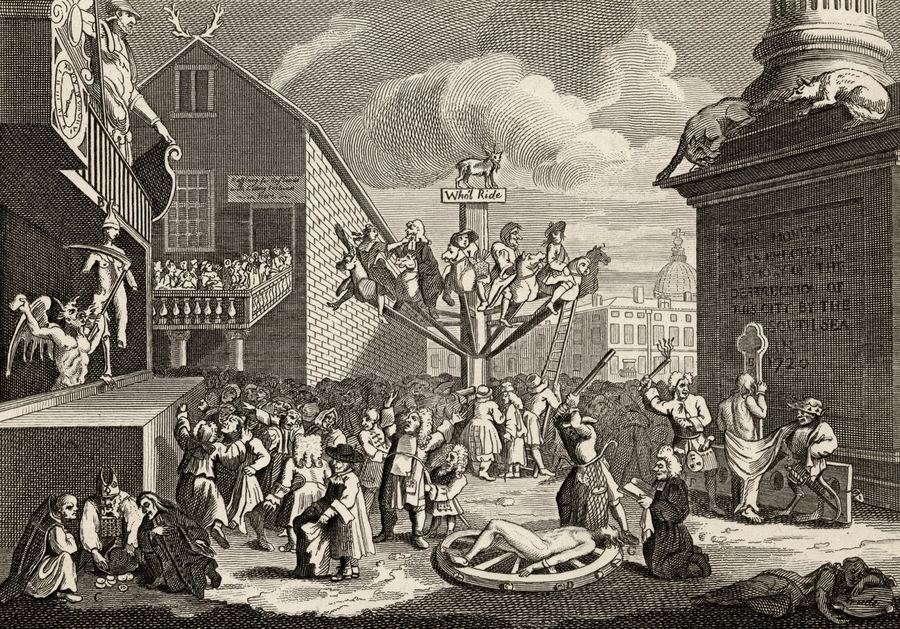
By the end of June the price had broken £1,000; a satirical print of the time records a high of £1,050. On the share price alone, the company's paper value had swollen to around £300 million, close to ten times the national debt. A company that barely traded was worth, on paper, more than the debts of the entire nation. By now even the firmest sceptics were wavering: perhaps this time really was different.
CHAPTER FOURNewton's Two Decisions
Isaac Newton was the cleverest man in Britain, and one of its most careful investors. He had run the Royal Mint and looked after the nation's money; for years he had spread his investments across government bonds and shares, and by the start of 1720 he was worth about £32,000 — a considerable fortune.
In April and May, with the price around £350, Newton decided to take his profit and sold 8,000 shares, making at least £20,000. It was a perfect exit. He could have stopped there. But the price did not stop. It kept climbing — to £500, £700, £1,000. Watching everyone around him grow rich, Newton panicked. On 14 June he put the money back in, and more besides — £26,000 in all — at a price of about £700 a share, twice what he had sold for.
When the price collapsed in the autumn, Newton lost more than 70 per cent on that purchase. Andrew Odlyzko, a mathematician at the University of Minnesota, reconstructed Newton's trades for the Royal Society in 2019 and put his losses at no less than £12,000, probably nearer £14,000; the traditional figure, handed down from Newton's niece, is £20,000. Whichever number is right, it was more than ten years' salary. A remark is often attributed to Newton: "I can calculate the motions of the heavenly bodies, but not the madness of people." The earliest version of the line comes from an anecdote manuscript of 1756, published in 1820, and says only: "I cannot calculate the madness of people." The half about the heavenly bodies was added later, by other hands. But the story itself is true: the man who worked out universal gravitation could not work out when he himself would grow greedy.
That same summer, one man made the opposite decision. Thomas Guy, a bookseller, sold off his South Sea shares between April and June — a little over £50,000 of stock — and took home more than £250,000. When the bubble burst he was untouched. The following year he used the money to found Guy's Hospital, which still treats patients in London today. The difference between Newton and Guy was not intelligence. It was the exit: one sold while prices were rising, the other bought back in.
CHAPTER FIVEThe Act, the Crash and the Reckoning
Ironically, the break began with a law the South Sea Company itself had pushed through. To kill off the rival "bubble companies" stealing its investors, the company lobbied Parliament for the Bubble Act, which banned the creation of joint-stock companies without a royal charter. The Act passed in June 1720 and took effect in July; more than a hundred small companies became illegal overnight. People who had bought their shares lost everything, and to cover their losses they had to sell their South Sea stock. The company had lit its own fuse.
In August the price began to slip. In September panic took hold. By the end of the month the price was below £300; in October it fell to £200; by the end of the year it was £124. In a matter of months, more than four-fifths of the market's value had evaporated. Banks that had lent against shares as collateral could not collect, and failed one after another. James Craggs the Elder, the Postmaster General, poisoned himself. Furious investors surrounded Parliament and demanded an inquiry.
Parliament appointed a Committee of Secrecy, and its findings were unsparing: the directors had traded on inside information, manipulated the price and bribed members of Parliament; even the King's mistress was implicated. The directors were arrested and their property confiscated in proportion to their gains. John Blunt's fortune was cut from more than £180,000 to £1,000, according to contemporary accounts. The clean-up fell to Robert Walpole — the man who had opposed the scheme and now had to save the country from it. He had the Bank of England guarantee much of the South Sea Company's capital, rearranged the national debt and steadied the nation's credit. In doing so he secured his own power, becoming Britain's first de facto prime minister.
CHAPTER SIXAfter the Bubble
The South Sea Company did not vanish at once. Restructured, it lived on for more than a century; after 1748 it effectively stopped trading and remained only as a shell for managing government debt, until it was formally dissolved in 1853. Strangely, the company behind the most famous bubble in history ended not in bankruptcy but in a quiet old age: it did not go bust, it simply grew old and died.
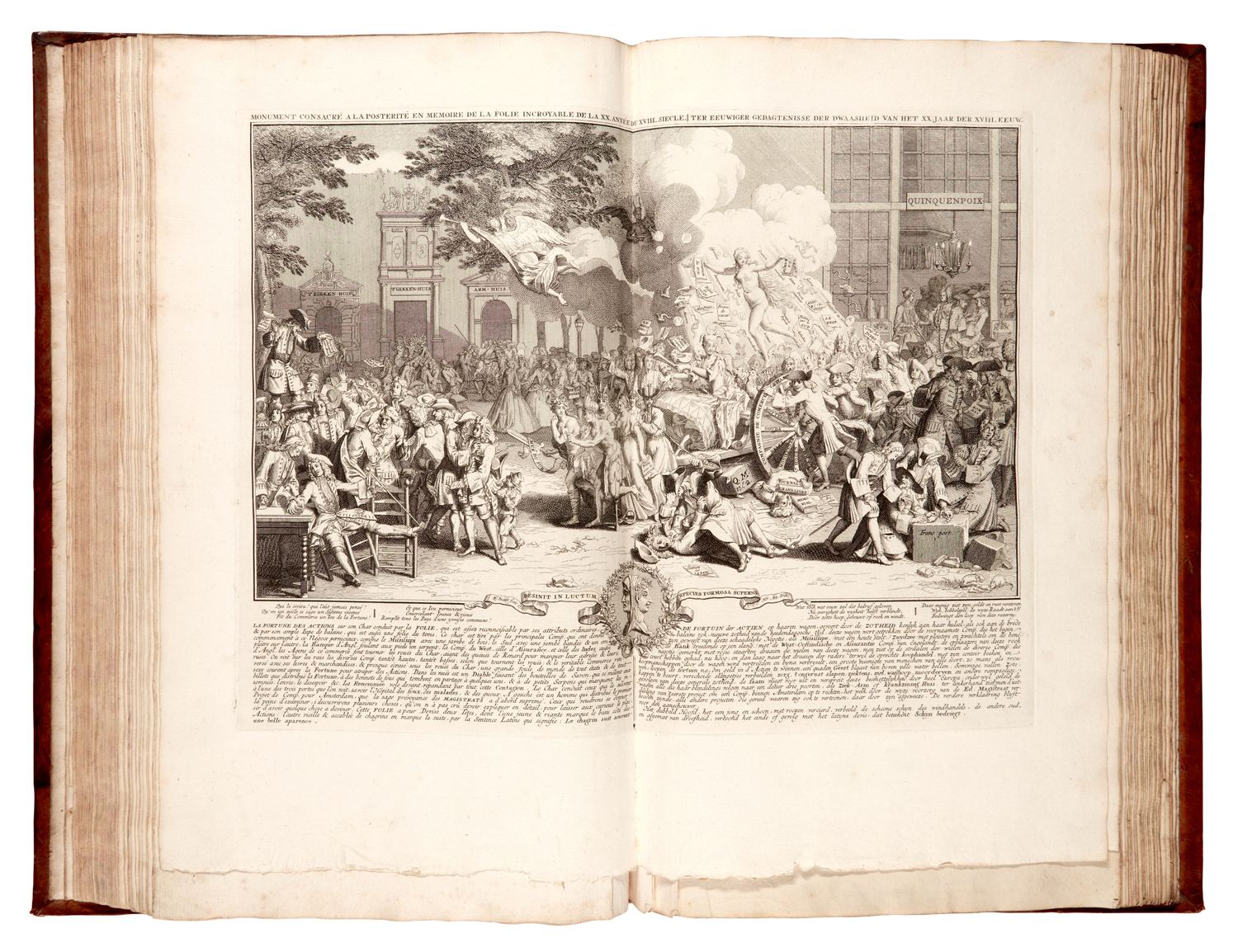
And 1720 was not London's year alone. In the same year, France's Mississippi Scheme was collapsing too: John Law's paper-money empire and the South Sea Company's share empire rose together in one summer and fell together. Amsterdam was swept by the same speculative fever. Economic historians call 1720 the first global financial bubble: for the first time, the markets of three nations boiled and cooled on the same sentiment.
After the bubble, the lessons Britain took away were concrete: the creation of joint-stock companies was strictly controlled, and the Bubble Act stayed on the books until 1825; investors learned to ask where a company's money actually came from; the Bank of England's role in a crisis was written into the system. But the deeper lesson was not a law. It was a recognition: prices can lie, and the more people believe the lie, the truer it looks.
EPILOGUEWhy It Happens Again
More than three hundred years have passed since the South Sea Bubble. Shares have become numbers on a screen, the coffee houses have become chat groups on a phone, the subscription forms have become links — but the structure of the game has not changed: a compelling story, an asset that can be passed on, a crowd afraid of missing out, and a little borrowed money. The story does the believing, the passing-on does the rising, the fear of missing out does the buying, and the borrowing magnifies the rise and the fall alike.
Newton's story has been told for three hundred years not because of how much money he lost, but because of what it proved: cleverness does not protect a person, and caution only protects halfway. His first sale was right; his second purchase was wrong; the two decisions were less than two months apart, and the difference between them was not intelligence but emotion. A man can calculate the motions of the heavenly bodies and still not calculate what he will think when he watches other people grow rich.
South Sea stock ended the year at £124, almost exactly where it had begun it. From start to finish, the company's business never changed. Only what people were willing to pay for it changed. That is the simplest lesson the bubble left us, and the hardest to remember: price is not value, noise is not prosperity, and when everyone is talking about the same stock, the question to ask is not "how much higher can it go?" but "what is it actually selling?"
Questions That Remain Open
In honesty, the following two things have no settled answer, and this essay does not pretend otherwise:
- How much did Newton actually lose in the South Sea Bubble? Andrew Odlyzko's 2019 reconstruction puts his loss at at least £12,000 and probably close to £14,000, while the traditional figure of £20,000 comes from his niece's account; the two figures still stand side by side.
- What were Newton's actual words? The familiar version runs "I can calculate the motions of the heavenly bodies, but not the madness of men", yet the earliest version, from an anecdote manuscript of 1756, says only "I cannot calculate the madness of men" — the half about the heavens was added later by others.