PROLOGUEA Door in the Desert
On a map, Dunhuang is only a dot; in history, it is a crossroads. At the western end of the Hexi Corridor, snow water from the Qilian Mountains meets the yellow sand of the Gobi. To the west lies the Taklamakan, to the east Chang'an, to the south the Tibetan Plateau, to the north the steppe. Caravans, monks, envoys and refugees all stopped here to drink, to change a camel, to leave a word — or to leave an entire sutra. The Mogao Caves were carved out little by little in this way. They were not the whim of a single emperor, but the result of a thousand years in which countless ordinary people carved their faith, fear and hope into a cliff. And in the deepest part of this cave complex there was an even smaller stone chamber, stuffed with manuscripts, paintings and account books, like a library forgotten by time. Its door was bricked up, then buried in sand, and it waited quietly for nearly nine hundred years, until a Daoist priest clearing away drifted sand knocked open that wall.
This essay tells the story behind that door: how a library came into being, how it was sealed, how it was discovered in the least fitting of ages, how it was carried away and studied, and how it finally became a field of learning. It is also a story about memory — a civilisation that wrote itself down, hid itself away, almost lost itself forever, and in the end returned in another form.
CHAPTER ONEHow the Caves of a Thousand Buddhas Were Carved
According to legend, the Mogao Caves began with a vision. In 366, in the second year of the Jianyuan era of the Former Qin, the monk Yuezun was walking near the Singing Sand Dunes when, at dusk, he saw golden light shimmering on Mount Sanwei across the way, as if a thousand Buddhas had appeared. Moved by the sight, he carved the first cave into the cliff on the west bank of the Daquan River, to practise meditation there. The legend may not be fact, but the date is broadly credible: by the middle of the fourth century, Buddhism was travelling east along the Silk Road, and Dunhuang was its last stop before entering China — and its first. Monks translated, preached and copied sutras here; merchants made offerings, fulfilled vows and prayed for safety; and so the caves appeared, one after another.
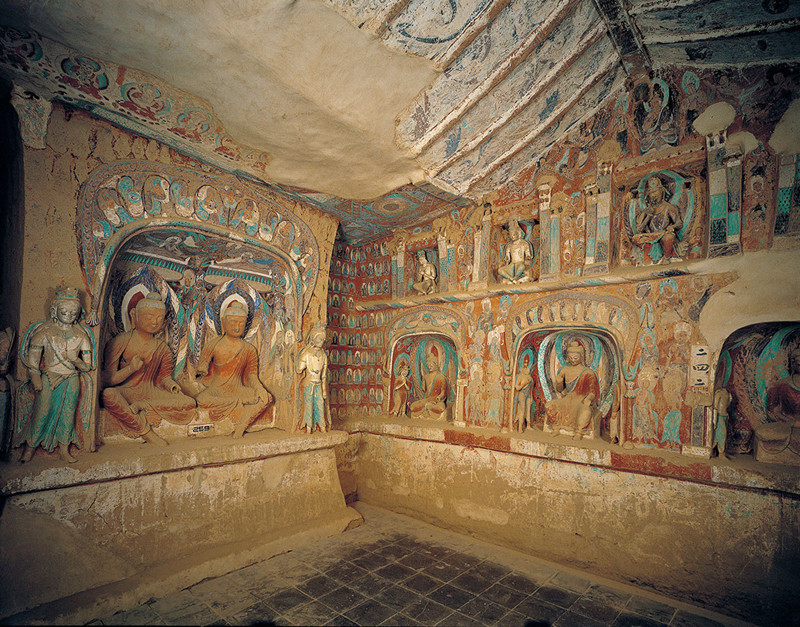
For the next thousand years, through the Sixteen Kingdoms, the Northern Dynasties, the Sui, Tang, Five Dynasties, Western Xia and Yuan, construction at Mogao never truly stopped. The cliff stretches for more than 1,600 metres. Today 735 caves survive, of which about 492 contain murals or painted sculpture, with murals covering 45,000 square metres and more than 2,400 painted statues. Behind the numbers are human faces: donor portraits show envoys of Tibetan rulers, Uyghur princes, Han military governors and their wives and daughters, while the murals show musicians, dancers, farmers, caravans, battlefields and heavenly palaces. The early Tang, roughly the first decades of the seventh century into the early eighth, was Mogao's most brilliant period, when sculpture and painting reached their peak. These caves were temples, but also family memorial halls, places of prayer for caravans, and schools for monastic communities. The carving of a cave usually meant that a family or a monastic community had put down roots here.
Dunhuang could become such a place because of its geography. It was the throat of the Silk Road and a meeting point of many civilisations. Chinese, Tibetan, Sanskrit, Sogdian, Uyghur, Khotanese and Tocharian were all written here. Buddhism came from India, Zoroastrianism and Manichaeism from Persia, the Church of the East from Syria, and Confucianism and Daoism from central China. They did not meet in books, but on the same street, in the same monastery, on the same contract. The murals of Mogao therefore belong not only to the history of Buddhist art, but to the history of the whole medieval world.
CHAPTER TWOCave Seventeen: A Memorial Hall Turned into a Storehouse
The Library Cave is known today as Cave 17, a small square chamber about 2.6 metres long, 2.6 metres wide and 3 metres high, set into the north wall of the passage of Cave 16. It was not built to hold books. It was originally the memorial hall of Hongbian, a leading monk of late Tang Dunhuang. Hongbian was the foremost Buddhist leader in ninth-century Dunhuang. After Zhang Yichao led the people in expelling the Tibetans and recovering Hexi in 848, Hongbian, who was close to Zhang, was appointed by the court around 851 as chief monk of Hexi, in charge of Buddhist affairs across the whole Hexi Corridor. He managed several caves at Mogao, and Cave 17 was the memorial hall he prepared for himself after death. It once held a life-sized statue of him, with bodhi trees and attendants painted on the rear wall and portraits of disciples and donors on the side walls.
But this memorial hall soon acquired a second use: storing things. Monks put damaged sutras, worn-out scriptures, used documents and broken painted banners into the little room, batch after batch. The documents in the Library Cave span the fourth to the eleventh centuries and cover an extraordinary range: about ninety percent are Buddhist texts, and the rest are Daoist scriptures, Confucian classics, histories, medical books, calendars, contracts, account books, letters, poems, popular literature, and even handwriting practice sheets and personal effects. They were clearly not packed in on a single day, but accumulated over more than a hundred years. Monks of the Three Realms Monastery, such as Daozhen in the tenth century, were still using the chamber. The latest document with a clear date was written in 1002, in the fifth year of the Xianping era of the Northern Song.
When, then, and why was it sealed? There is still no settled answer. One view is that it was sealed to escape war: in about 1006 the Karakhanids destroyed the Buddhist kingdom of Khotan; the Western Xia expanded westward from the end of the tenth century and occupied Dunhuang in 1036; monks, fearing the scriptures would be seized, bricked up the entrance and disguised it as an ordinary wall. Another view holds that the cave was simply a repository for worn-out sutras and sacred objects, sealed naturally once it was full, with no panicked flight involved. Others point out that the documents inside had been sorted, apparently arranged by the Thousand Character Classic, and that the entrance was sealed with clay and painted over — not the work of a hurried moment. The reason for the sealing may never be proven, but one thing is clear: after it was sealed, those who knew of the chamber soon disappeared, wind-blown sand covered the passage layer by layer, dynasties rose and fell, and it remained quietly in place for nearly nine hundred years.
CHAPTER THREE1900: The Door Is Opened, and the Books Are Carried Away
On 22 June 1900, the twenty-sixth day of the fifth lunar month in the twenty-sixth year of the Guangxu reign, the Daoist priest Wang Yuanlu, who lived at Mogao, was clearing drifted sand from the passage of Cave 16 when he noticed a crack in the north wall. Peeling it open, he found a small bricked-up door. Behind it lay Cave 17, its interior piled high with bundles of manuscripts and printed texts wrapped in white cloth — some 50,000 items, covering seven centuries of documents and artefacts from the Sixteen Kingdoms to the Northern Song. Wang did not know their value. He reported the find to the Dunhuang county magistrate and others, but received no proper response. China at the time was in the midst of the Boxer Uprising and the invasion of the Eight-Nation Alliance; the court could barely look after itself, and local officials were powerless to act.
Once word spread, foreign expeditions arrived first. In 1907 the British archaeologist Aurel Stein came to Dunhuang and obtained from Wang twenty-nine cases of manuscripts, silk paintings and textiles, including twenty-four cases of manuscripts and five large cases of paintings and silk, among them more than 7,000 ancient manuscripts and printed scrolls. He returned in 1914 and took away more than 570 complete Chinese manuscripts. In 1908 the French sinologist Paul Pelliot arrived at Mogao. Fluent in Chinese, he spent three weeks selecting texts by candlelight in the cave, exchanging 500 taels of silver for more than 6,000 of the finest manuscripts, over 200 paper and silk paintings, more than twenty wooden carvings and a large number of banners and silk textiles — mostly the texts of the highest scholarly value. Afterwards came the Japanese Otani expedition, the Russian Oldenburg expedition, the American Langdon Warner, and others. Between 1907 and 1925, foreign expeditions carried away about 35,000 items from the Library Cave, roughly two-thirds of the whole.
In 1910 the Qing government finally ordered the surviving manuscripts to be taken to Beijing. More than 9,000 scrolls were counted at departure; only just over 8,000 arrived at the Metropolitan Library. Today the British Library holds more than 13,000 Dunhuang manuscripts, the St Petersburg branch of the Institute of Oriental Studies of the Russian Academy of Sciences holds more than 10,000, the National Library of France holds more than 5,700, and the National Library of China holds the largest collection within China. The figures speak for themselves: most of the finest pieces of this hoard are no longer in the land where they were found.
How should we judge Wang Yuanlu? Later generations have both praised and condemned him, calling him a guardian or a criminal. But it is unfair to blame a single illiterate Daoist priest for a catastrophe that spanned the decline of an empire and the expansion of colonialism. He did sell manuscripts, and he did use the money to repair caves and maintain offerings; he also reported the find to the authorities several times, and no one acted. The real problem was not one man, but an age: when a civilisation's treasure was discovered, the institutions, the learning and the national strength needed to protect it were simply not there. Stein and Pelliot certainly used deception and bargain prices, but behind them stood imperial archaeological institutions, universities and museums — an organised system of acquiring knowledge. Behind Wang, there was nothing.
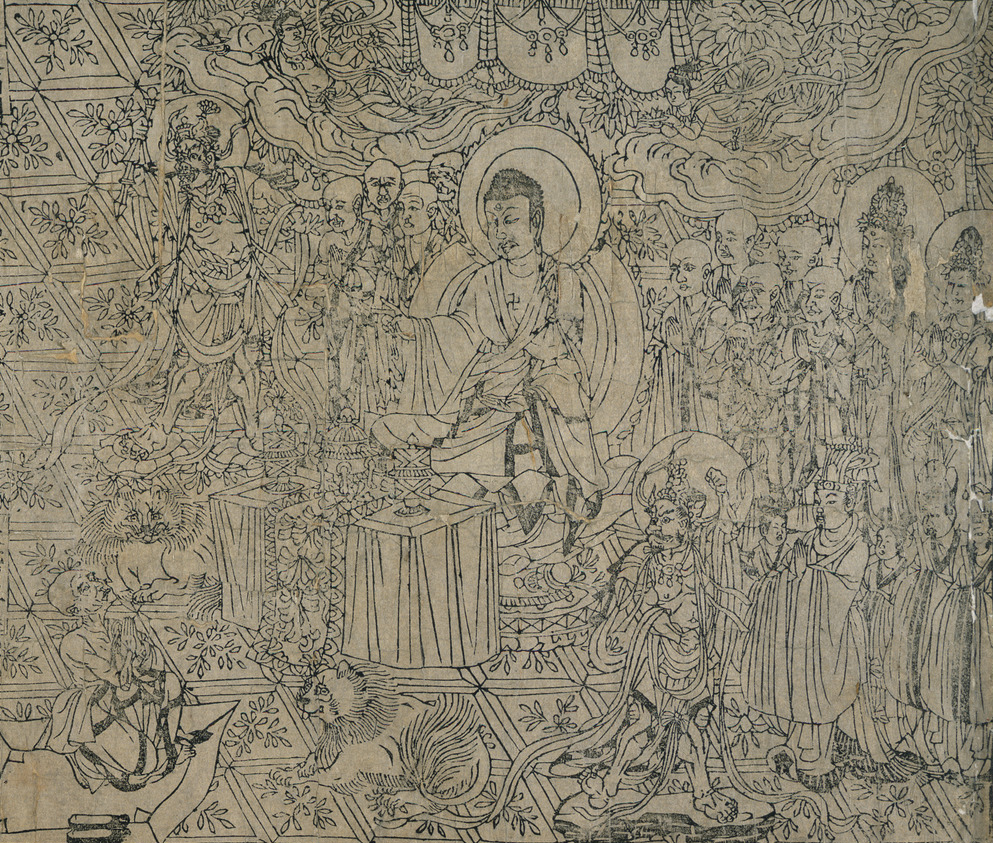
The most famous single object from the Library Cave is the Diamond Sutra, printed in 868 and now in the British Library. Its colophon states that it was reverently made for universal free distribution by Wang Jie on behalf of his parents, printed on the fifteenth day of the fourth month in the ninth year of the Xiantong era. It is the earliest surviving printed work with a clear date, nearly six hundred years before the Gutenberg Bible. Made of seven sheets of paper pasted into a long scroll, it opens with a finely engraved frontispiece of the Buddha preaching, and remains a landmark in the history of printing. A sutra and a donor's vow show us not only the maturity of printing technology, but the intention of an ordinary believer: he paid to print a sutra not to make a name for himself, but for his parents and for all beings. That intention is closer to the heart of faith than any imperial edict.
CHAPTER FOURFrom Calamity to Scholarship: The Birth of Dunhuang Studies
The dispersal of the Library Cave was a catastrophe, yet it unexpectedly gave birth to a field of learning. In 1909 Pelliot showed some of the Dunhuang manuscripts he had brought with him to Luo Zhenyu and others, and Chinese scholars realised for the first time what a treasure Dunhuang held. In the same year Luo published A Catalogue of the Books in the Dunhuang Stone Chamber and Their Discovery and Secret Records of the Mogao Stone Chamber, beginning the systematic study of the Dunhuang documents, and Wang Guowei and others went on to publish Surviving Books from the Dunhuang Stone Chamber, laying the foundations of Dunhuang Studies. Over the following decades, Luo Zhenyu, Wang Guowei, Jiang Fu, Chen Yuan, Xiang Da, Wang Zhongmin and other scholars organised the surviving manuscripts in China while travelling to Britain and France to copy, photograph, catalogue and annotate the texts that had been taken away, bringing them back, piece by piece.
In 1930 Chen Yinke, in his preface to Chen Yuan's Records of the Surviving Dunhuang Manuscripts, gave the field its name. He wrote that the scholarship of an age must have its new materials and new questions; to take up these materials and study these questions is the tide of the scholarship of that age, and Dunhuang Studies is the new tide of world scholarship today. Around the same time, a corresponding term appeared in English. It should be noted that scholars have debated who first used the term: some point out that the Japanese scholar Ishihama Juntaro had already used it in 1925. But whoever first spoke the word, Chen Yinke's preface set the direction of the field: Dunhuang Studies is not the connoisseurship of collectors, but scholarship that uses new materials to study new questions.
The value of the Dunhuang manuscripts lies precisely in their miscellaneous, everyday character. Beyond the sutras, they preserve a wealth of secular documents: land sale contracts, divorce papers, loan accounts, association records, astrology and calendars, medical prescriptions, primers, transformation texts and popular songs. Through these documents, scholars have been able to reconstruct the social economy, legal system, religious life and popular beliefs of medieval China, and even the languages and exchanges of the peoples along the Silk Road. The Dunhuang manuscripts are therefore counted, together with the oracle bones of Yin Ruins, the Han wooden slips of Juyan, and the Ming and Qing archives of the Grand Secretariat, as the four great discoveries of ancient Chinese documents in the early twentieth century,. In his 1930 preface Chen Yinke quoted a saying then in circulation, that Dunhuang was the sorrowful history of Chinese scholarship, its finest pieces gone abroad, only the dregs left behind; but he immediately refuted it with evidence, giving many examples to show that the more than 8,000 scrolls held in China were of great value, in no way inferior to those held abroad or in private hands. That passage has been quoted again and again, but often only its first half is cited, and the refutation in the second half forgotten — itself a reminder to read a quotation to the end before repeating it.
CHAPTER FIVEA Relay of Guardians
After the Library Cave was discovered, Mogao endured decades without proper management. It was not until 1944 that the National Dunhuang Art Institute was founded, with Chang Shuhong as its first director, and Mogao came under state ownership, ending nearly four hundred years without management. In 1984 the Dunhuang Cultural Relics Institute was expanded into the Dunhuang Academy; in 1987 Mogao was inscribed by UNESCO on the World Heritage List, among the first Chinese sites to receive that honour. Since then, generations of scholars and conservation workers, including Duan Wenjie and Fan Jinshi, have carried on the work of guarding the caves — restoring murals, monitoring the environment, and digitising the site amid the desert wind and sand.
Digitisation is the newest turn in this story. From the 1990s the Dunhuang Academy introduced digital technology, and in 2006 it formally established cooperation with the International Dunhuang Project at the British Library to promote the global digital sharing of the Library Cave's contents. In 2016 the Academy released to the world high-resolution digital content and panoramic tours of thirty classic caves for the first time. Manuscripts scattered across London, Paris, St Petersburg and Beijing can now be compared side by side on a single screen, and a reader far away in Kaohsiung or Taipei can zoom in on the handwriting and corrections of a copyist from more than a thousand years ago. This cannot undo the pain of dispersal, but it means that study and viewing are no longer limited by geography or national borders. The library has reunited in another form, even though its shelves are in the cloud rather than in the rock at Dunhuang.
EPILOGUEWriting Oneself Down Is a Courageous Act
The most moving part of the story of the Library Cave is not the treasure, but the people who hid it. They did not expect to be remembered by history; they simply wrote down what mattered and put it away, believing that later generations would need it. They were right — only it took nine hundred years. Every document we read today is an entrustment across time: the letter-writer did not know who would receive the letter, the copyist did not know who would read the sutra, the person who drew up a contract did not know that a thousand years later someone would study his transaction. But they wrote anyway.
For readers, Dunhuang leaves two lessons, bound together. The memory of a civilisation lives not in palaces, but in everyday life. The value of a library lies not in how many sacred texts it holds, but in the fact that it kept the account books, the family letters and the handwriting practice sheets as well. If we remember only emperors and wars, we miss most of history. And guarding memory requires institutions, not only goodwill. Wang Yuanlu's tragedy was that he faced the vacuum of an entire age alone; the achievement of Chang Shuhong and Fan Jinshi was that they turned guardianship into an institution, into scholarship, into work that could be passed on. One person can discover a library, but only an institution can keep it alive.
In the end, the Library Cave tells us this: a civilisation is at its most resilient not when it conquers the world, but when it writes itself down, hides itself away, and trusts that someone in the future will come and read. The door was opened, the books were carried away, but scholarship remained. And we are still reading.
Questions That Remain Open
In honesty, the following three things have no settled answer, and this essay does not pretend otherwise:
- When and why was the Library Cave sealed? The three accounts given here — flight from war, a repository sealed once full, and a deliberate sealing after the documents were sorted — remain unsettled, and the reason for the sealing may never be proven.
- Who first used the term "Dunhuang Studies"? Chen Yinke set the direction of the field in his preface of 1930, yet scholars still debate the first use, and some point out that the Japanese scholar Ishihama Juntaro had already used the term in 1925.
- Is the founding legend of the Mogao Caves true? The story of the monk Yuezun seeing a vision of a thousand Buddhas over Mount Sanwei may be legend rather than fact; only its date is broadly credible.