PROLOGUEA Sheet of Paper That Caged a King
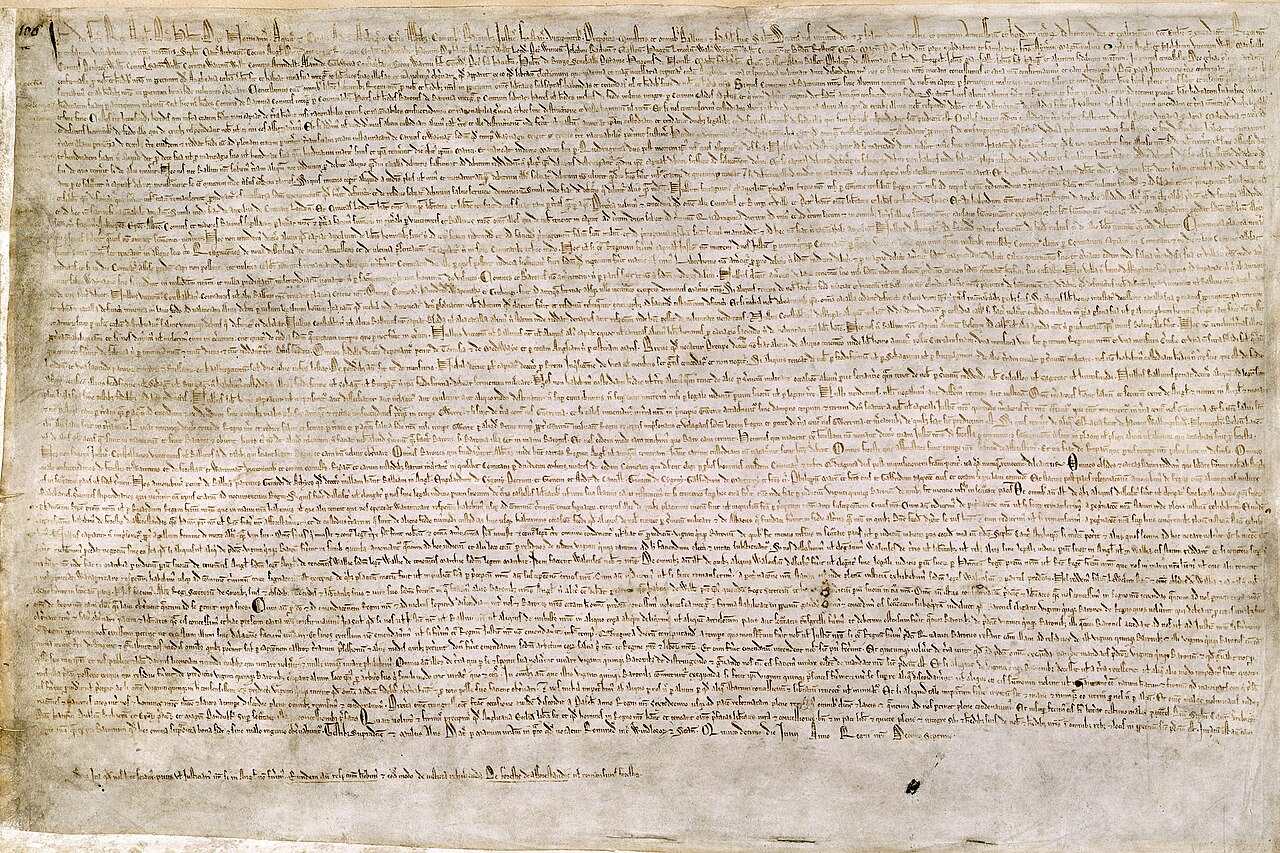
In the British Library there lies a sheet of parchment, barely half a metre long, covered in Latin written in one continuous flow — no title, no divisions, no signature. Below the text hangs a wax seal: the great seal of King John of England, pressed there eight hundred years ago. It looks unremarkable, like an old title deed, or an account book gone wrong.
Yet this sheet changed what the world thought power was. Before it, the king's will was law, and the king's word, once spoken, could not be taken back. After it, people began to believe in another possibility: that a king could be held inside a sentence, governed by a rule written down. The sheet's name is known to the whole world now — Magna Carta.
Its story is not a romantic one. It was no declaration of human rights drawn up by idealists. It was a ceasefire drafted at the edge of a broken negotiation, a bargain struck between a king who had lost a war and a group of furious barons. Most of its clauses are about money: how much an heir should pay, whether a widow might remarry, how debts were to be reckoned, whether fish weirs should be torn down. Ten weeks after sealing it, the king changed his mind; the Pope declared it void; the country fell into civil war. By all rights it should have died in its cradle.
It did not die. Instead it lived for eight hundred years, becoming the English-speaking world's byword for liberty, and the ancestor of the American Constitution and the Universal Declaration of Human Rights. This essay tells how it survived — and what gave a sheet of paper the strength to cage a king.
CHAPTER ONEA King Who Lost a Continent
John was the youngest son of Henry II. His elder brothers divided the lands between them; he inherited almost nothing, and men called him John Lackland. In 1199 his brother Richard the Lionheart died on campaign, and the throne fell to him by surprise. What he inherited was an empire that straddled the Channel: in France the King of England held Normandy, Anjou, Poitou and more — lands larger than the French king's own domain.
He could not keep them. In 1204 Philip II of France took most of Normandy; ten years later John staked everything on one campaign to win it back, and on 27 July 1214 the Anglo-German army he had paid for was crushed by the French at Bouvines. The dream of recovering the continent died there. Worse, to pay for the war, he had squeezed England to its limit.
A medieval king could not simply take money from his barons at will; feudal custom drew a line. The relief an heir paid to inherit, the scutage paid in place of military service — all had precedents. John trampled them one by one. In 1214 he demanded scutage at three marks per knight's fee, a rate never seen before; the highest on record until then was two. Reliefs became extortion: William Fitz Alan was charged 10,000 marks to succeed to his barony; John de Lacy paid 7,000 marks for the honour of Pontefract; widows were charged as much as £1,000 to keep their dowries and not be married off against their will. When the money ran short, the king seized men, lands and castles. The barons discovered that loyalty to such a king cost them their fortunes.
At the same time John was at war with the Church. He refused to accept Stephen Langton, whom Pope Innocent III had appointed Archbishop of Canterbury; in 1208 the Pope laid England under interdict — churches closed, sacraments suspended — and excommunicated John himself. After five years of stalemate John gave in: in 1213 he surrendered England and Ireland to the Pope as a papal fief, paying a yearly tribute of 1,000 marks, in exchange for reconciliation. Langton finally returned to England that July — and the archbishop would become a key figure on the barons' side.
A king who had lost his lands, drained his subjects and offended the Church had little left but a reckoning with his barons.
CHAPTER TWONegotiation on the Meadow
In November 1214 the barons gathered at the abbey of Bury St Edmunds. They did not raise an army at once. Instead they produced an old document: the Charter of Liberties that Henry I had issued on taking the throne in 1100, promising the king would not plunder his subjects. Before the altar they swore an oath: after Christmas they would go to the king and demand he confirm those ancient liberties; if he refused, they would withdraw their allegiance and make war.
The talks dragged on for half a year. In January 1215 John stalled, sending Langton to parley with the barons; on 5 May the barons formally renounced their allegiance and chose Robert Fitzwalter as their leader, styling him "Marshal of the Army of God and Holy Church". On 17 May London opened its gates to the barons' army. John fell back to Windsor with almost no soldiers left — only the negotiating table.
On 10 June the two sides met on the water-meadow at Runnymede, on the Thames between Windsor and Staines. John rode over from Windsor each day with only a handful of followers; facing him stood the barons in full force. The barons handed him the Articles of the Barons, forty-eight demands set down in black and white. John accepted them the same day, and scribes at once began turning the articles into a formal royal charter. On 15 June John set his seal to it; by 19 June the final text was complete.
He did not sign it — medieval kings did not sign; the seal was the assent. With that seal, a King of England admitted in writing, for the first time, that his power had limits.
CHAPTER THREEWhat the Sixty-Three Clauses Say
When we say Magna Carta has sixty-three clauses, we are using a later numbering. The original is a single stretch of Latin with no divisions and no numbers; the numbering was added in 1759 by the jurist William Blackstone when he prepared a critical edition. Read the clauses and you will find a striking contrast: most of them are crushingly mundane, and only a handful shine.
The mundane part is the barons' account book: reliefs capped at precedent, widows free to marry as they wished, guardians forbidden to sell off their wards' property, debts to the Crown payable in instalments, one standard of weights and measures for the whole realm, fish weirs on the Thames and the Medway to be torn down, royal officials forbidden to seize goods by force. Not one of these clauses speaks of liberty or human rights. They speak of money and land.
But buried among the trivialities are sentences that changed history. Clause 1 declares that the English Church shall be free, its elections unimpeded. Clauses 12 and 14 provide that the king may levy no extraordinary tax without the consent of the great council of the realm — the seed of "no taxation without consent", though it was dropped from later reissues.
The most famous are clauses 39 and 40. Clause 39 reads: "No free man shall be seized or imprisoned, or stripped of his rights or possessions, or outlawed or exiled, or deprived of his standing in any other way, nor will we proceed with force against him, or send others to do so, except by the lawful judgment of his equals or by the law of the land." Clause 40 is shorter still: "To no one will we sell, to no one deny or delay right or justice." Two sentences — one establishing due process, the other that justice must not be bought and sold. Eight centuries later, the rule of law still stands on those two sentences.
The most radical was clause 61, the "security clause". It created a council of twenty-five barons to watch over the king's compliance; if he broke the charter, the council could seize his castles and lands until he made amends. Rebellion itself was written into the charter. Later versions deleted the clause — no king would ever seal it again — but the fact that it existed at all was enough.
Its limits must be stated plainly. The "free men" of the charter were a minority in England: most people were villeins, bound to the manor's soil and outside its protection; women had almost no independent legal standing; Jews were excluded altogether. It was not a declaration of human rights, but a list of baronial claims. Its greatness does not lie in what it was born as, but in what later generations kept reading into it.
CHAPTER FOURWaste Paper and Civil War
Ten weeks after the sealing, Magna Carta was dead — or so it seemed. On 24 August Pope Innocent III issued a bull declaring the charter, extracted under duress, null and void. John turned at once, raising mercenary troops; that autumn he laid siege to Rochester Castle and retook the road to London. The barons, seeing their cause lost, chose another king: they invited Louis, the eldest son of the King of France, across the Channel, and in May 1216 Louis was proclaimed king in London. England fell into the First Barons' War, with half the country in French hands.
Then fate intervened for the charter. On the night of 18 October 1216 John fell ill at Newark and died of dysentery, aged forty-nine. According to the chroniclers, not long before, his baggage train had been lost crossing the tidal sands of the Wash, the crown jewels sinking into the mud with it. A king who had been at war a month earlier suddenly ceased to exist.
The throne passed to his nine-year-old son, Henry III. The regent, William Marshal, and the papal legate made a shrewd decision at once: to reissue Magna Carta in the boy king's name. On 12 November 1216 a new version appeared, shorn of the security clause and the most radical provisions, but keeping most of the rest. On 20 May 1217 Henry's forces defeated Louis's army at Lincoln; that September the two sides signed the Treaty of Lambeth, and Louis sailed home. In November 1217 the charter was issued again — and this time it was first called "Magna Carta", the Great Charter, to distinguish it from the smaller Charter of the Forest issued alongside it.
On 11 February 1225 Henry III issued Magna Carta a third time at Westminster, in exchange for the realm's agreement to a tax. This version became the definitive text. Seventy years later his son Edward I confirmed it again in 1297 and entered it into England's statute law. From that moment Magna Carta was no longer the product of one negotiation; it was law.

CHAPTER FIVEEight Hundred Years of Echoes
The second half of Magna Carta's life is more extraordinary than its birth. Three clauses of the 1225 text remain on the statute book of England and Wales today: by the numbering of the 1297 version, clause 1, the freedom of the Church; clause 9, the liberties of the City of London; and clause 29 — the due process guarantee into which clauses 39 and 40 of 1215 were merged — still cited by judges. A sheet of parchment eight hundred years old is still live law.
In the seventeenth century the jurist Edward Coke rediscovered it. He invoked Magna Carta in the Petition of Right of 1628 against Charles I's arbitrary taxation and imprisonment; the Habeas Corpus Act of 1679 and the Bill of Rights of 1689 both carry its imprint. In the eighteenth century the American colonists raised it against the Crown, and the Fifth Amendment to the United States Constitution — "nor shall any person be deprived of life, liberty, or property, without due process of law" — is the direct descendant of clause 39.
Its echo crossed oceans and languages. In 1948, when the United Nations drafted the Universal Declaration of Human Rights, Eleanor Roosevelt, who chaired the drafting committee, and her colleagues looked back along the long line that began at Runnymede: no one may be seized at will, no one condemned without trial, and power must answer to rules written down.
The four surviving originals of 1215 are still with us: two in the British Library, one at Lincoln Castle, one at Salisbury Cathedral. In 2009 UNESCO entered them on the Memory of the World register; on 3 February 2015, to mark the eight-hundredth anniversary of the sealing, all four were displayed together at the British Library for the first time. And on the meadow at Runnymede there now stands a memorial, erected by the American Bar Association in 1957, its granite pillar inscribed: "To commemorate Magna Carta, symbol of freedom under law."
EPILOGUEThin Paper, Strong Cage
Magna Carta teaches three things. The first is that power must be written down. A spoken promise can be broken; a sealed promise can be broken too — John broke his within ten weeks. But a written thing has a power no spoken promise has: it can be copied, carried, read aloud in a county court, and held up before a king by generation after generation, saying: you promised.
The second is that writing it down is not enough; there must be a way to enforce it. The council of twenty-five in clause 61 existed only on paper, but it named the essential problem: a rule with no one to enforce it is only paper. It took the English centuries to move that enforcement from the barons to Parliament and the courts, and every reissue and confirmation of the charter added new teeth to the page.
The third may matter most: liberty is not won in a single negotiation. The Magna Carta of 1215 protected only the barons' purses and the Church's privileges; villeins, women and Jews were outside it. It became great because later people kept coming back to it and reading more into it than the generation before: seventeenth-century lawyers used it against a king, eighteenth-century colonists against an empire, twentieth-century drafters to write a universal declaration. Each generation found more in the same sheet than the last.
A sheet of parchment, thin enough to roll up and fit in a chest, light enough for one person to carry. What it caged was never only King John, but an idea: that no one — not even a king — stands above the law. In 1215 that was only a bargaining chip; eight hundred years later it is the starting point of the rule of law everywhere. Thin paper, strong cage. As long as someone is still willing to read it aloud, it will not break.