PrologueQianling: A Stele With No Words
In Qian County, Shaanxi, at the foot of Mount Liang, a stone stele 7.53 metres tall stands before a tomb. Its face is smooth. Not a single character is carved on it.
It is the tombstone of Wu Zetian. She was the only woman in Chinese history to formally take the throne as emperor: in 690 she changed the Tang dynasty into the Zhou, reigned for fifteen years, and on her death ordered her imperial title removed, to be buried beside her husband, Emperor Gaozong. For 1,300 years, people have argued over the blank stone. Some say she knew her merits and faults could not be settled, and left the verdict to posterity. Some say her achievements were too great for words. Others say the blankness itself is the answer.[8]
This is not an essay that starts by guessing at the riddle of the stele. It starts with the woman: how she walked, step by step, from a fourteen-year-old concubine to the throne — and how, at eighty-two, she gave it all back. A woman who reached the summit of power left a tombstone she did not dare inscribe — or one nobody would have believed had she inscribed it. The answer is not on the stone. It is in the fifty years she walked.
Chapter OneThe Concubine
Wu Zetian was born around 624. Her father, Wu Shihuo, was a founding minister of the Tang dynasty and Minister of Works. At fourteen — in 637 — she entered the palace as a concubine of Emperor Taizong, a fifth-rank cairen, the lowest rank among imperial consorts. The histories record no year for her birth; 624 is the date scholars work back from her age at death, and the most commonly used.[6]
Her background was not aristocratic. Her father, Wu Shihuo, came from a merchant family and rose by following Li Yuan, the founder of the Tang, eventually becoming Minister of Works. A merchant household teaches calculation and nerve, not lineage and blood. From her father she inherited a merchant's eye: she could see an opportunity, and she could see its price. Before entering the palace she had already learned to read and write — uncommon for a girl of her time — and her fine handwriting became her first asset at court.
Twelve years as a concubine left almost no trace. In Taizong's old age she was only a young literate woman in the harem. In 649, Taizong died, and by custom, childless consorts were sent to become nuns — she was dispatched to Ganye Temple, to candles and chanting, waiting to be forgotten by the world.
The temple was her lowest point, and her turning point. Crown Prince Li Zhi — the future Emperor Gaozong — came to the temple to pay respects, and an old affection rekindled. In 650, she returned to the palace as a former emperor's consort — a grave breach of ritual. The rules of the palace were written for everyone to see, but she had learned her first lesson: rules are made by people, and people can change them.
It took her five years to walk from a nun at Ganye Temple to the position of empress. In 655, Empress Wang was deposed, and Wu took her place. What happened to her infant daughter remains disputed — the Old Book of Tang and the New Book of Tang contradict each other, and the matter has never been settled. Even the people who wrote her life could not agree on this passage.[1][2]
Chapter TwoThe Empress
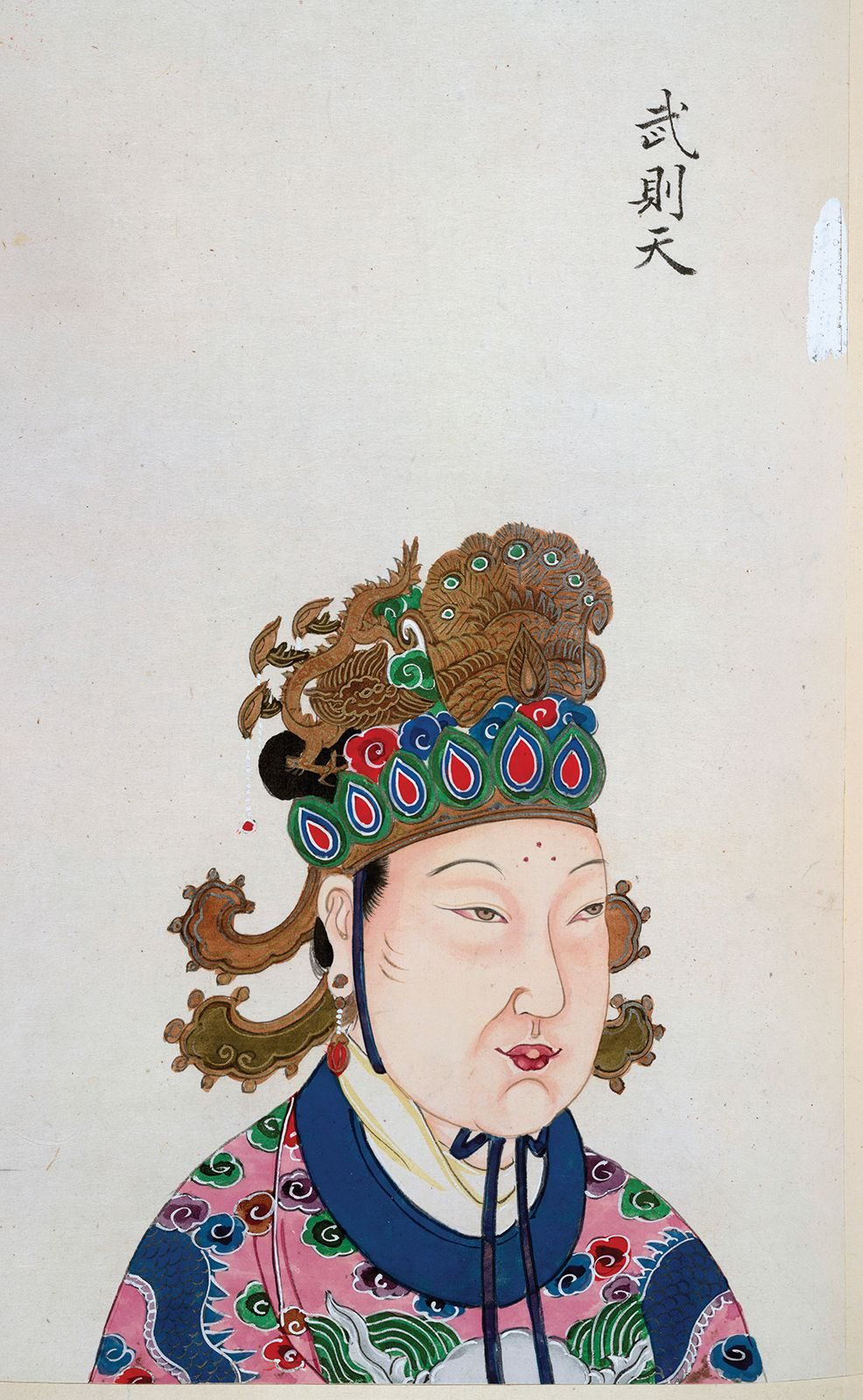
From 660, Gaozong was crippled by illness and failing eyesight, and Empress Wu began to govern in his place. The court called it the rule of the "Two Sages": memorials were presented to the emperor and the empress together. The balance of power had quietly shifted. From that year on, the empire's daily business passed through her hands.
She promoted officials who had risen through the civil service examinations, against the entrenched Guanlong aristocracy. She also employed ruthless officials and set up bronze boxes to encourage anonymous denunciations — the same machinery that opened a path upward also opened the door to wrongful convictions. Her way of using people was never a choice between "good" and "bad." It was a calculation of "useful" and "useless."
In 683, Gaozong died. She deposed Emperor Zhongzong, installed Ruizong as a puppet, and ruled as regent. In 684, Xu Jingye raised an army in Yangzhou; his proclamation spread across the empire, and his rebellion was crushed in three months. One opponent after another fell. The road narrowed as it climbed. By 690, nobody stood in the way — only one question remained: would she sit on the throne herself?
In an empire built for men, a woman reaching this point needed more than skill. Her opponent was not any one person. It was the entire apparatus of ritual, lineage, and historiography — every piece of it telling her she did not belong there. She spent thirty years moving those pieces aside, one by one.
Chapter ThreeChanging the Dynasty
On September 9, 690, Wu Zetian, aged sixty-seven, proclaimed herself emperor in Luoyang, changed the dynastic name to Zhou, and made Luoyang the sacred capital — the only female emperor in Chinese history, formally enthroned. Fifty-three years had passed since she entered the palace in 637.[1]
She changed one thing after another: era names, official titles, the calendar, and even the written characters themselves. In 689 she promulgated a set of new characters she had devised — among them zhao, "the sun and moon in the sky," which became her own name. She was not merely changing labels. She was changing how the world was allowed to see her: even the script had to be written her way.[9]
In 690, she personally examined candidates in the palace hall at Luocheng — the beginning of the palace examination. She created the military examination and promoted examination graduates from humble families in large numbers. From then on, the civil service examination was no longer a decoration for aristocrats; it was a road a person could actually walk. For the first time, a poor scholar could enter the centre of power on the strength of one examination paper.[1]
The people she promoted became the backbone of the Tang dynasty: Di Renjie, Lou Shide, Yao Chong, Song Jing — the team behind the Kaiyuan era of prosperity was almost entirely chosen by her. The modern scholar Guo Moruo later judged her with eight characters: "her rule opened the Kaiyuan era; her governance continued the Zhenguan era." The golden age began in her court.
She also built on a grand scale: the Bright Hall, the Heavenly Pivot, and the great Vairocana Buddha of the Longmen Grottoes — completed in 675, standing 17.14 metres tall. Legend says the Buddha's face was modelled on her own. There is no proof, but people in Luoyang have told the story for more than a thousand years. Whether it is true hardly matters. What matters is that people wanted to tell it: that Buddha was her.
These buildings were not mere display; they were politics. The Bright Hall was where the Son of Heaven worshipped Heaven and proclaimed policy — the taller it stood, the harder her legitimacy was to question. The Heavenly Pivot was a monument to her achievements, carved with the names of civil and military officials and envoys from every state — each name an act of allegiance. Buildings speak, and they speak louder than edicts.
Chapter FourCruel Officials and Denunciations
Only half the story has been told. The other half of the Zhou dynasty was terror. The cruel officials Lai Junchen and Zhou Xing compiled a manual on fabricating charges; the idiom "please step into the jar" comes from Zhou Xing being undone by his own invention. Lai Junchen asked Zhou Xing for a way to deal with a prisoner; Zhou Xing suggested a great jar ringed with burning charcoal, with the man placed inside. Lai Junchen replied: please step into the jar yourself.[6]
Bronze boxes stood on four sides to receive anonymous denunciations, no signature required. At court and in the provinces, everyone lived in fear. Wrongful convictions happened silently, one after another. The logic of denunciation is simple: make everyone afraid of being denounced, and everyone becomes a denouncer. Terror needs few executioners. It only needs everyone to believe the person next door may already have written a letter.
In her old age, she favoured the brothers Zhang Yizhi and Zhang Changzong, and government decayed. A woman who rose by iron grip was, in the end, trapped by the iron grip around her. She knew how to judge people, but she also trusted the wrong ones. The late years of power are always like this: only flatterers remain at one's side, and those who tell the truth have long since been frightened away.
Merit and fault in her case are not two accounts. They are one. The same machinery of appointments that promoted Di Renjie also bred Lai Junchen. Once a system rewards only "loyalty to me" and never "right or wrong," talent and cruelty are two faces of the same people. Her court proved one thing: a system can produce wise ministers and cruel officials at once. It depends on what it rewards.
Chapter FiveGiving It Back
In February 705, Chancellor Zhang Jianzhi and the palace guards staged the Shenlong Coup, killed the Zhang brothers, and forced her to abdicate. Emperor Zhongzong was restored, and the dynastic name returned to Tang. Fifteen years of Zhou came to an end.[1]
She did not resist. She did not plead. An eighty-two-year-old woman handed the throne back to her son. A person who had fought all her life, at the very last moment, fought no more.
On December 16, 705, she died at the Shangyang Palace in Luoyang, aged eighty-two. Her will: remove the imperial title, bury her with Gaozong at Qianling, and observe the rites of an empress in the ancestral temple and the tomb. A woman who had reigned as emperor for fifteen years asked, in death, only for the honours of an empress.[1]
Before her tomb stand two steles. One, for Gaozong, is carved with some 8,000 characters singing his praises. The other is the wordless stele. The two stand side by side like a debate with no conclusion — one says too much, the other says nothing at all.
EpilogueThe Questions She Left
Wu Zetian left posterity more than fifteen years of a dynasty. She left a set of questions with no standard answers. Can a woman be emperor? She proved it is possible — and that it can be done well. At what price? Cruel officials, denunciations, wrongful convictions, and a court ruled by fear. Both things are true at once, and that is exactly what makes her so hard to write about.
After her death, the Tang changed the dynastic name back, the era names back, the official titles back — everything that could be changed was changed. What could not be changed was the examination system, the men she had promoted, and the one thing she had proven: power does not recognise sex, only ability.
Her real legacy may not be the imperial title, but the examination system. She shifted recruitment from bloodline to examination, letting scholars from humble families enter the centre of power in large numbers for the first time. The Tang dynasty lived on that road for the next two hundred years. Sometimes the lifespan of a dynasty depends on whether it is willing to let strangers in.
The wordless stele still has no answer. Perhaps she understood long ago that writing merits and faults on stone is useless — time writes them by itself. Thirteen hundred years have passed. The stone is still blank, and the commentary has never stopped. The most powerful thing about that stele is that it says nothing, yet makes everyone want to write.
History gave her the posthumous title "Zetian, Great and Sage Empress." Zetian means taking Heaven as the model. A woman spent her life proving those words were not presumption, but description.