PROLOGUEAn Empire of Land, Asking Why It Should Sail
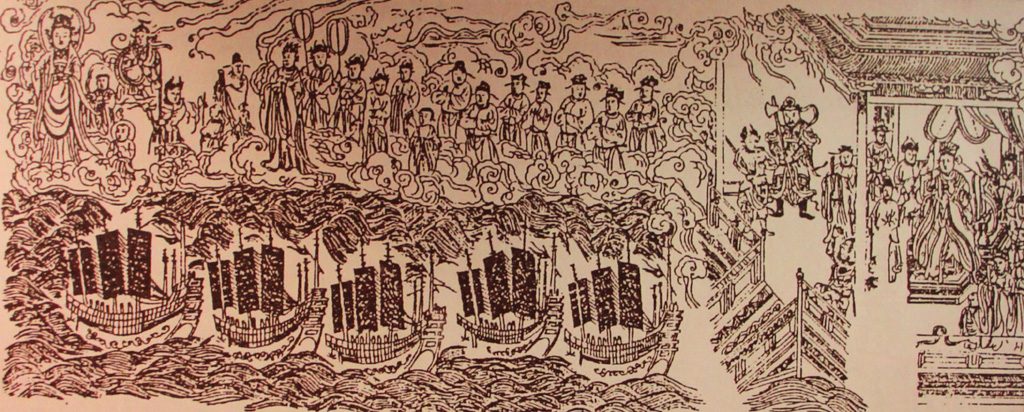
On 11 July 1405, in Nanjing, an imperial edict went out, and a fleet set sail from Liujiagang, down the Yangtze and out to sea, heading south-west. It numbered 317 ships and carried nearly 28,000 men. Its commander was a eunuch named Zheng He. Over the next twenty-eight years, fleets like this one would sail seven times, reaching as far as the Arabian Peninsula and the east coast of Africa, bringing home envoys from more than thirty countries — and a giraffe.
Set against world history, this is a strange thing. China was an empire of land. Its threats had always come from the steppe to the north; its wealth had always come from the soil and the canals. The sea, to China, had always been the margin — the place of exiles and pirates. Yet in the early fifteenth century, this empire suddenly built the largest fleet the world had ever seen and threw its strength at the sea, for a whole generation.
Stranger still is how it ended. After seven voyages, the fleet was disbanded, the archives were burned, and the shipbuilding plans were lost. Within a century, the official histories of China carried almost no complete record of the fleet. An empire had walked out to sea, and then walked itself back.
The story of Zheng He, then, is not only the story of a seafarer. It is a story about choice: about a country that had the power to do a thing and decided not to do it any more. What happened in between is worth reading slowly.
CHAPTER ONEFrom Yunnan to the Household of the Prince of Yan
Zheng He was born Ma He in 1371, in Kunyang, Yunnan. His family were Muslims. His father, Ma Hajji, had served as an official under the Yuan dynasty, and the family line could be traced back to Sayyid Ajjal Shams al-Din Omar, who had governed Yunnan in the early Yuan. Yunnan at the time was the edge of the empire, one of the last strongholds of the Mongol Yuan.
The year the Ming army took Yunnan, Ma He was barely past ten. He was captured, taken into the palace, and made a eunuch. Later he was assigned to the household of Zhu Di, the Prince of Yan, the prince who guarded the northern frontier from Beiping against the Mongols. Ma He grew up there, learning horsemanship and campaigning, and learning how to survive beside power.
In 1399 Zhu Di rose in the Jingnan campaign against his own nephew, the Jianwen Emperor, for the throne. Four years of war followed, and Ma He fought in them and earned distinction. In 1402 Zhu Di took Nanjing and ascended the throne as the Yongle Emperor, and gave Ma He the surname Zheng. From then on, Ma He was Zheng He.
This beginning matters. Zheng He was not a scholar-official who had passed the examinations, nor the son of a great house. He was a boy whose family the empire had destroyed, and whom the empire had then remade. His loyalty rested not on blood or learning but on something close to personal dependence on the emperor. The Yongle Emperor trusted him, gave him blank edicts stamped with the imperial seal, and let him act as he saw fit at sea. That kind of trust no civil official and no general could obtain. Only he could.
CHAPTER TWOBuilding Ships at Nanjing: How Big Was a Treasure Ship?
In 1403 the Yongle Emperor ordered the building of ships. The Longjiang shipyard outside Nanjing became the heart of the project. According to the Taizong Shilu, the Veritable Records of the emperor's reign, the shipbuilding orders issued between 1403 and 1419 covered at least 2,868 ships. Timber was cut along the upper Min River and the upper Yangtze and floated down; carpenters, smiths and lacquerers were drafted from across the country. Within a few years, Nanjing had become a city that built ships.
At the centre of the fleet were the treasure ships. The History of Ming records them as 44 zhang long and 18 zhang wide — about 137 metres by more than 50. The figure has been repeated for centuries, and argued over for centuries. Modern scholars mostly doubt it: with the shipbuilding techniques and timber of the time, a wooden ship that large would have been hard to sail. Some, working from the shipyard remains and the documents, put the treasure ships at sixty to seventy-five metres. The evidence on both sides is incomplete.
Archaeology has added some weight to the argument. In 1957 a rudder post 11.07 metres long was unearthed in Nanjing; it is now in the National Museum of China. In 2003 and 2004 the Nanjing Municipal Museum excavated the Treasure Shipyard, and found Basin No. 6 to be 421 metres long and 41 metres wide. The size of the basins shows that the yard was indeed capable of building very large ships. As for exactly how large a treasure ship was, there is still no settled answer.
Behind the argument over size lies a fact more worth noticing: the sheer scale of the fleet itself. The first voyage numbered 317 ships, 62 of them treasure ships, carrying nearly 28,000 men. The ships carried not only soldiers and sailors but doctors, interpreters, craftsmen, astronomers and officials in charge of ritual. A fleet was a floating city, with its own hospital, translators, workshops and shrines.
Before sailing, the fleet made offerings to Tianfei, the goddess who protected sailors — Mazu, by her other name. The ships assembled at Liujiagang to honour her, then sailed down the coast to Taiping anchorage at Changle in Fujian, to wait for the north-east monsoon. The monsoon was the true timetable of the voyages: the north-east wind carried the fleet south in winter, the south-west wind carried it home in summer. Zheng He's fleet did not fight the ocean; it travelled on the ocean's breathing. That is written in the Changle inscription Zheng He himself had carved, and in the notebooks of the men who sailed with him.
CHAPTER THREESeven Voyages
The first voyage ran from 1405 to 1407. The fleet sailed down the coast, its first foreign port Champa, then Java and Sumatra, through the Strait of Malacca, assembling at the northern tip of Sumatra, then across the Indian Ocean to Ceylon and up the west coast of India to Calicut. Calicut was one of the great ports of the Indian Ocean trade, and it remained the fleet's terminus in India on every voyage that followed.
On the way home, the fleet met the pirate Chen Zuyi at Palembang. Chen had seized the port and preyed on shipping through the Malacca Strait. Zheng He destroyed his fleet and took him back to Nanjing, where he was executed on 2 October 1407 — the same day the fleet returned home. The Yongle Emperor appointed Shi Jinqing, a local Chinese leader, as Pacification Superintendent of Palembang, planting an ally at the throat of the Strait.
The second voyage, 1407 to 1409, dealt with a diplomatic dispute. During a civil war in Java, the King of West Java had mistakenly killed 170 members of a Ming embassy who had come ashore to trade. Zheng He reported the case to the emperor rather than taking revenge himself. The court demanded 60,000 liang of gold in compensation; the Javanese king admitted his fault and paid, and relations were restored. On the same voyage, the fleet performed the formal investiture of Mana Vikraan as King of Calicut and set up a commemorative tablet there.
The third voyage, 1409 to 1411, saw the fiercest land battle of all seven. Alakeshvara, King of the Sinhalese kingdom of Kotte in Ceylon, was hostile to the fleet. He lured Zheng He and 2,000 men ashore, then cut them off from the fleet anchored at Colombo. Zheng He turned and stormed the capital at Kotte, taking the king, his family and his ministers prisoner. On 6 July 1411 the fleet returned to Nanjing; the Yongle Emperor ordered the captives freed and installed the pro-Ming Parakramabahu VI as king in Alakeshvara's place. After that, Ceylon never again showed hostility to the fleet.
The fourth voyage, 1413 to 1415, took the fleet for the first time to Hormuz in the Persian Gulf. The interpreter Ma Huan sailed with the fleet from this voyage on, and later wrote the Yingya Shenglan, the Overall Survey of the Ocean's Shores. The fifth voyage, 1416 to 1419, reached the Arabian Peninsula and the east coast of Africa. Sekandar, the pretender who had seized Semudera in northern Sumatra, was defeated and taken back to the capital to be executed. In 1419 the fleet returned to Nanjing with envoys from many countries; their tribute included lions, leopards, dromedary camels, ostriches, zebras, rhinoceroses, antelopes and giraffes.
The sixth voyage, 1421 to 1422, was largely spent carrying the foreign envoys home, with detached squadrons sailing on to Arabia and East Africa. The seventh voyage, 1431 to 1433, came under a new emperor, Xuande. Zheng He was near sixty and in poor health, yet he sailed again with more than a hundred ships and over 27,000 men. The fleet went to Hormuz, and detached squadrons travelled to Arabia and East Africa. According to Ma Huan, a squadron sailed from Calicut to Mecca, a round trip of a year.
In 1433 Zheng He died on the voyage home and was buried at sea, off the Malabar Coast. Sources differ on the year — some say 1433, others 1435. On the southern slope of Niushou Mountain in Nanjing there is still a tomb of Zheng He: a cenotaph, rebuilt in 1985 in the Muslim style. The tomb is empty; it holds only his clothes and headgear. The man buried at sea has his grave on shore.
Seven voyages, and the motive for them is still debated. Some say the Yongle Emperor wanted to search for the missing Jianwen Emperor; some say he wanted to display the power of the Ming and bring more than thirty countries into the tribute system; some say it was about trade and intelligence. The explanations do not exclude one another, and none has decisive evidence. The one thing certain is that the emperor was not looking for a new continent. He wanted every port in the known world to know that there was an emperor in Nanjing.
CHAPTER FOURThe Giraffe and the Tribute System
Of all the things the voyages brought home, the most famous was a giraffe. On 20 September 1414, envoys from Bengal presented one to the Yongle Emperor in the name of their king, Saif Al-Din Hamzah Shah. The animal had been carried from East Africa to Bengal, and then by Zheng He's fleet to China. No one at court had ever seen such a creature, and they took it for the qilin of legend — the auspicious beast said to appear only when a sage ruled in an age of peace.
The Hanlin scholar Shen Du was ordered to paint the giraffe and compose an ode to it. The painting shows the animal led on a halter by an attendant, gentle and unhurried. Ministers pressed their congratulations on the emperor, certain that Heaven had confirmed his rule. The Yongle Emperor refused them. He would not accept the congratulations, nor admit that the giraffe was a qilin.
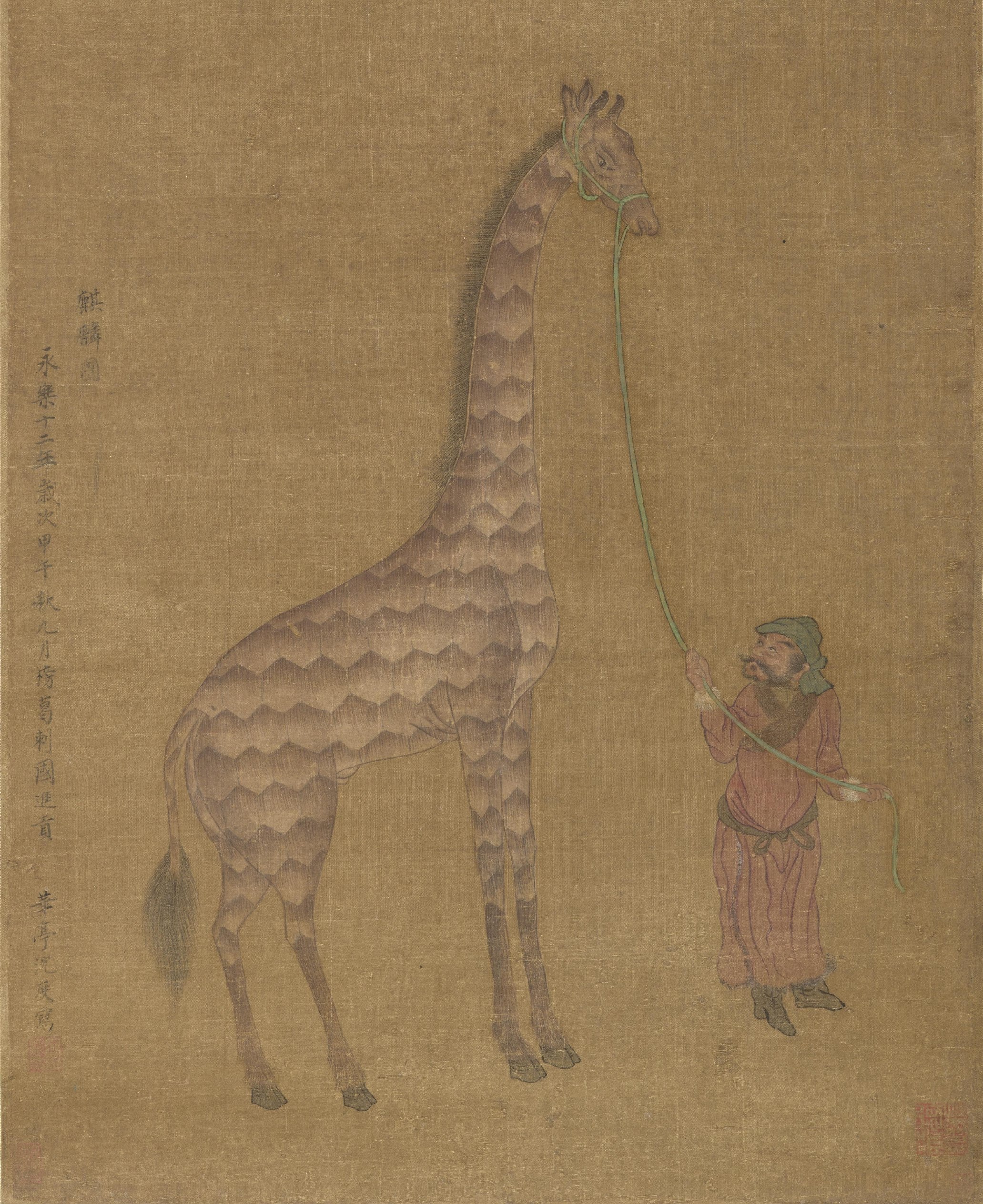
The refusal is worth pausing over. The Yongle Emperor had taken the throne by force from his nephew, and the legitimacy of his reign was always in question. A giraffe taken for a qilin should have been the best propaganda he could ask for. Yet he turned it down. Perhaps because he knew the animal had been bought overseas, not sent down from Heaven; perhaps because he understood better than his ministers that an auspicious sign, once accepted, has to be lived up to. In any case, he kept the painting and the ode, and refused the congratulations.
The giraffe tells us what the tribute system was. It was not simply trade, and not simply diplomacy. It was a language of gifts and ceremony for building order: foreign envoys brought the products of their lands, and the emperor answered with silk, porcelain and investiture. China exported order and recognition, and received acknowledgement and peace in return. Zheng He's fleet was the carrier of that language; wherever it sailed, the order of tribute extended.
Malacca is the best example of that language at work. It had been a small port, a dependency of Siam, of no account. In 1405 Zheng He arrived with a stone tablet and an imperial order, enfeoffing the Western Mountain of Malacca and raising its standing. On every voyage afterwards, the fleet assembled, supplied and traded at Malacca. Within a generation it had become the great entrepôt between the Indian Ocean and the South China Sea, prosperous for a century. China stationed no garrison there and founded no colony; investiture and trade alone changed a port's fate.
The fleet also brought back knowledge. Ma Huan's Yingya Shenglan, Fei Xin's Xingcha Shenglan and Gong Zhen's Xiyang Fanguo Zhi are first-hand accounts written by men who sailed. They record the position of ports, the price of goods, the customs and religions of the peoples they met, and the stars and waters of the voyage. They remain among the most important Chinese sources for the fifteenth-century Indian Ocean world. Ma Huan's book was first published in 1451, forty-six years after the first voyage — by then the fleet was long gone, but the book remained.
CHAPTER FIVEWhy It Stopped
After 1433, the fleet sailed no more. It was not that the ships were too small, nor the sea too rough. The wind inside the court had changed.
After the Yongle Emperor's death, the eunuch establishment lost ground and the civil officials gained the upper hand. Their objections to the voyages were practical: the fleet cost too much, the tribute returned too little, and the state's attention belonged on the northern frontier and the canals of the south. To the civil officials, the sea was not the empire's domain but its expense. Meanwhile the capital had moved to Beijing, the emperor's gaze had turned north, and the south and the sea grew ever more distant.
In the Chenghua reign, the matter reached a symbolic end. The court ordered the documents on the western voyages to be fetched from the archives of the Ministry of War. The minister, Liu Daxia, hid them and burned them. He dismissed the accounts as deceitful exaggerations of bizarre things, far removed from the testimony of people's ears and eyes. An official of the empire burned his own country's memory of the sea with his own hands.
The episode is often cited as proof that China missed its age of the sea, but the matter is not so simple. Liu Daxia burned the archives, not the shipbuilding craft; he ended the official voyages, not private trade. Merchants from Fujian and Guangdong kept sailing, only without a state fleet to guard them and without imperial envoys to open the way for them. The official sea was closed; the people's sea stayed open — only smaller, and more dangerous.
What survived is more durable than paper. The books of Ma Huan, Fei Xin and Gong Zhen survive. The stone tablets at Liujiagang and Changle survive. The Mao Kun map survives, preserved in the Wubei Zhi, the military encyclopaedia compiled in 1621 and presented to the throne in 1628 — the only surviving chart of Zheng He's routes, showing the whole passage from Nanjing to Arabia and East Africa. In 2003 the basins of the Treasure Shipyard were excavated; Basin No. 6 measures 421 metres long. The earth remembers longer than paper does.
Set the dates side by side, and the contrast is stark: Zheng He's first voyage came eighty-seven years before Columbus reached the Americas. Europe's age of exploration was only just beginning, and China had already stepped back from the sea. It was not a difference of ability but of choice. The princes and merchants of Europe saw the sea as a road to wealth; the emperors and officials of China saw it as a frontier to be controlled. One sea, two ways of seeing it, two futures.
EPILOGUEThe Sea Gave No Answer
Zheng He's tomb is empty. The fact itself reads like a metaphor: he belonged to the sea, not to the land. His fleet left no colony, no permanent base, not even a complete set of archives. It left a handful of books, a few stone tablets, a map, and a question.
The question is: how far can a country go? Zheng He's fleet proved that fifteenth-century China could carry 28,000 people to the east coast of Africa and bring them home again. In its time, no other power on earth could do that. But ability is not the same as will, and will is not the same as institution. The fleet depended on the will of one emperor, not on a system that could outlive him. While the emperor lived, the fleet sailed; when he was gone, the fleet scattered. When Liu Daxia burned the archives, no one resisted, because no institution considered it its duty to keep them.
That is the lesson most worth carrying away. We often assume that the turning points of history come from a lack of ability — ships too small, technology too weak, money too short. The story of Zheng He says the opposite: the ships were large enough, the technology good enough, the money plentiful enough. The turning point came from a choice. The most decisive moments in a civilisation's life are often not when it cannot do a thing, but when it can, and decides not to.
The sea is still there. Every winter the north-east monsoon comes, every summer the south-west wind returns, as it did six hundred years ago. The fleet is gone, but the ports remain; the archives were burned, but the map remains; the man was buried at sea, but his books remain among the living. The story of Zheng He's voyages to the Western Ocean leaves us, in the end, not with a fleet, but with a reminder: going out to sea was never only a question of technique. It was a question of how a civilisation sees itself.
Questions That Remain Open
In honesty, the following three things have no settled answer, and this essay does not pretend otherwise:
- How large were the treasure ships, really? The History of Ming records them as 44 zhang long and 18 zhang wide — about 137 metres — but modern scholars mostly doubt it, and some put them at sixty to seventy-five metres; the evidence on both sides is incomplete, and there is still no settled answer.
- In which year did Zheng He die? The sources give different accounts: one says 1433, another 1435.
- What was the Yongle Emperor's real motive for sending the fleets to the Western Ocean? Searching for the missing Jianwen Emperor, displaying imperial might, trade and intelligence — these explanations are still debated, none excludes the others, and none has decisive evidence.