PrologueThe Abandoned Boy
Temujin was nine years old when his father was poisoned. The tribe held a council and decided to abandon the family — the widow and her children were driven from camp with a tent and a few animals, left to die in the winter. By the rules of the steppe, they should have died.
They did not. His mother Hoelun kept the children alive digging wild roots and fishing along the Onon River, winter after winter. The first thing the grown Temujin did was not take revenge. It was to gather everyone else on the steppe who, like him, had no one. In 1206, at the age of about 44, he was proclaimed Genghis Khan — "universal ruler" — at a kurultai on the Onon. He ruled perhaps a million people. Twenty-five years later, the empire he left behind stretched across Eurasia, the largest contiguous land empire in history, covering some 23 million square kilometres at its peak.[1]
The question worth asking is not how many battles he won. It is how an orphan no tribe wanted persuaded dozens of tribes that hated one another to follow him. The answer is not in the sabre. It is in the institutions.
Chapter OneThe Steppe Had No Throne, Only Survival
The Mongolian steppe of the 12th century had no state, only tribes. Tribes raided one another for pasture, livestock and old grudges; yesterday's ally was today's enemy. Temujin was born into the Borjigin clan, a minor family, the son of a minor chief, Yesugei. When his father died, even his own clan walked away. On the steppe, loyalty belonged to the strong, not to blood.
The boy learned the steppe's cruellest arithmetic early: how long you live depends on how many people are willing to fight for you, and people fight for you only if you can make their lives better than anyone else can. This was not a lesson in morals. It was a lesson in survival.
In his teens he began building alliances — swearing brotherhood with Jamukha, seeking protection from Toghrul of the Keraits, borrowing soldiers, grain and reputation wherever he could. Borrowed fire must be repaid, and Temujin repaid it. He won battles, and he divided the spoils by merit, not by birth. That was heresy on the steppe, where custom gave the nobles first pick and the slaves last. Temujin reversed it: a herdsman who fought well could become a commander of a thousand; a nobleman's son who fought badly got nothing.
It took him nearly twenty years to unite the steppe — Merkit, Naiman, Kerait, Tatar, one by one defeated or absorbed, Jamukha finally beaten too. The kurultai of 1206 was not the beginning of his power. It was the moment he wrote down, as the constitution of an empire, a set of rules he had already been testing for years.
Chapter Two1206: Institutions Before Conquest
At the kurultai, Temujin did three things the steppe had never seen.
First, he appointed by merit, not by blood. The army was organised in units of ten, a hundred, a thousand and ten thousand, and its commanders included former slaves like Muqali alongside old nobles. Ability rose; mediocrity fell. The decimal system was not only military but administrative — herdsmen were enrolled by household, grazing in peace and marching in war, turning the whole society into a machine that could be mobilised.
Second, he proclaimed the Yassa, a code of law binding on everyone. Theft, adultery and betrayal of allies were punished the same for noble and commoner alike. For the first time on the steppe there was something resembling equality before the law — and it was backed by the death penalty, not by moral advice. An empire that is meant to outlive one generation cannot rest on one man's charisma. It needs rules that do not leave with the ruler.
Third, he adopted writing. The Mongols had no script of their own; Temujin ordered the Uyghur script adapted to write Mongolian. Without writing there are no tax registers, no written orders, no diplomatic correspondence — no empire beyond the next tent. Writing gave the empire a memory.
Together, these three acts were Genghis Khan's real invention. He did not first acquire an empire and then work out how to govern it. He built a governing machine first, and then used it to swallow the world. Conquest was the machine's output, not its essence.
Chapter ThreeThe War Machine: Discipline, Intelligence and Relay Stations
The Mongol army's power is often credited to horseback archery, but everyone on the steppe could shoot from a horse. What made the Mongols terrifying was discipline, intelligence and logistics.
Discipline was nearly merciless: leave the ranks in battle and die; lag behind in a charge and die; loot before the order and die. At the same time, the division of spoils was open and predictable, so soldiers knew exactly why they were risking their lives. An army that knows the rules and trusts them is far more dangerous than one that runs on courage alone.
Intelligence came first. Genghis never fought a war without a map. Before the campaigns against Western Xia in 1209 and the Jin in 1211, merchants and envoys had already brought back reports on fortifications, grain stores and court rivalries. In 1218, the city of Otrar in Khwarezmia murdered a Mongol merchant caravan of some 450 men; Genghis first sent envoys demanding the culprits, and only marched when his envoys were murdered too. This was not a crime of passion but a calculated war: the trade routes were the empire's arteries, and killing a caravan was a hand around its throat.
Logistics ran on the Yam, a relay-station system along the imperial roads. Stations stocked horses, food and guides at regular intervals, so a courier could ride day and night, changing mounts. An order crossed the empire faster than in any state before it. The Yam later became a safety net for Silk Road travellers — and the prototype of the empire's nervous system.
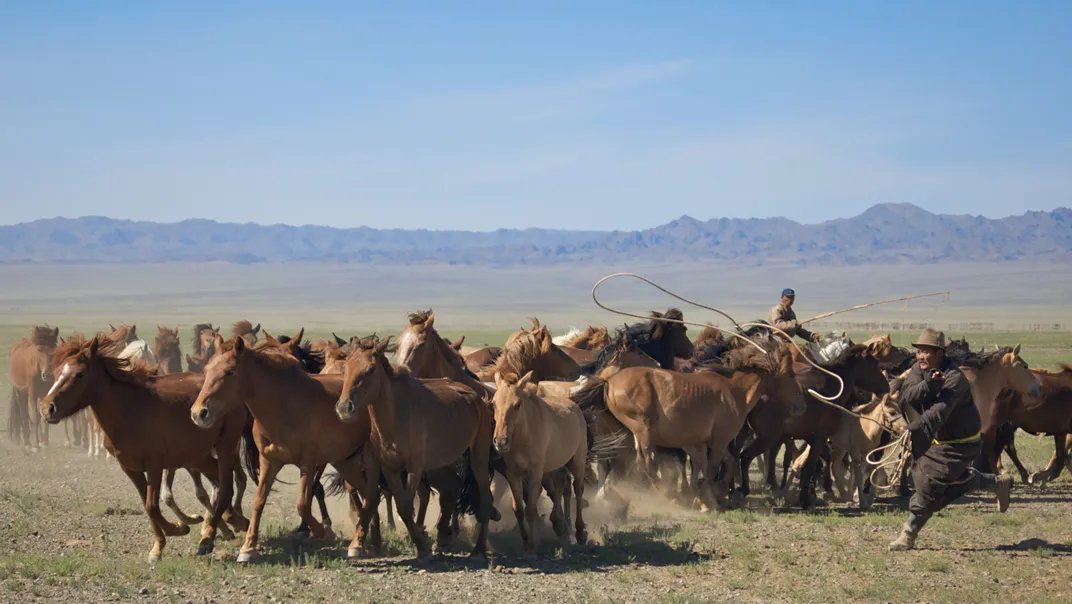
In 1215 the Mongols took Zhongdu, the Jin capital on the site of modern Beijing. Between 1219 and 1221 the Khwarezmian Empire collapsed within two years. In August 1227 Genghis Khan died on campaign against Western Xia, aged about 65. His burial place remains unknown to this day — by Mongol custom the grave was deliberately erased, leaving no trace.
Chapter FourThe Other Face of the Empire: Trade, Law and Tolerance
Remembering only the massacres gives you half of Genghis Khan. The other half is hidden in the empire's institutions, and it lasted longer.
He protected trade. Under Mongol rule Eurasia knew the Pax Mongolica: from China to the Black Sea, caravans could cross steppe no merchant had dared to travel alone. The Silk Road reopened, and Chinese gunpowder and printing travelled west while Persian astronomy and medicine travelled east along the same road. Europe's first systematic knowledge of China dates from the Mongol age — Marco Polo's father and uncle reached China along routes the Mongols kept safe.
He practised religious tolerance. Buddhists, Muslims, Nestorian Christians and Daoists were all exempt from taxation, and clergy were exempt from requisition. This was not faith but arithmetic: religion was the cheapest social glue available, and offending any faith cost more than it gained. Genghis himself worshipped the Eternal Heaven, but he never required his subjects to do the same.
He employed the conquered. Captured craftsmen, doctors, calendar-makers and astronomers were moved in whole groups to wherever the empire needed them. The Chinese minister Yelu Chucai designed his tax system; Muslim merchants ran his finances. The empire's logic was simple: talent has no enemy. Use it wherever it is found. That logic kept the Mongol Empire from stopping at plunder and gave it the skeleton of a government.
Of course, tolerance had a limit: those who resisted met annihilating retaliation, and the sack of cities really happened. Genghis Khan's tolerance was for the submissive; the defiant received terror. This was not mercy. It was a precise calculation of costs: submission must pay, resistance must be ruinous. Institutions never speak of warmth. They speak of arithmetic.
EpilogueThe Question the Conqueror Left Behind
After his death the empire kept expanding under his sons and grandsons, at its peak reaching from the Pacific coast to the plains of Eastern Europe. But it also split quickly: the four khanates went their own ways, and the Yuan dynasty in China lasted less than a hundred years. Institutions could let an orphan build an empire, but they could not solve the empire's hardest problem — succession. Genghis left behind laws, relay stations and taxes. He left no method for transferring power peacefully.
There is also a harder bill to settle. The trade routes the Mongols opened became highways for disease. The Black Death of the 14th century travelled along the trading network the Mongols had secured, and some scholars argue that the Mongol transport system accelerated the plague's spread — a point still debated, but one fact is certain: from the day the empire connected the world, the world could never go back to living in sealed compartments. Connection brought prosperity, and it brought contagion. Globalisation has carried both faces since the day it was born.
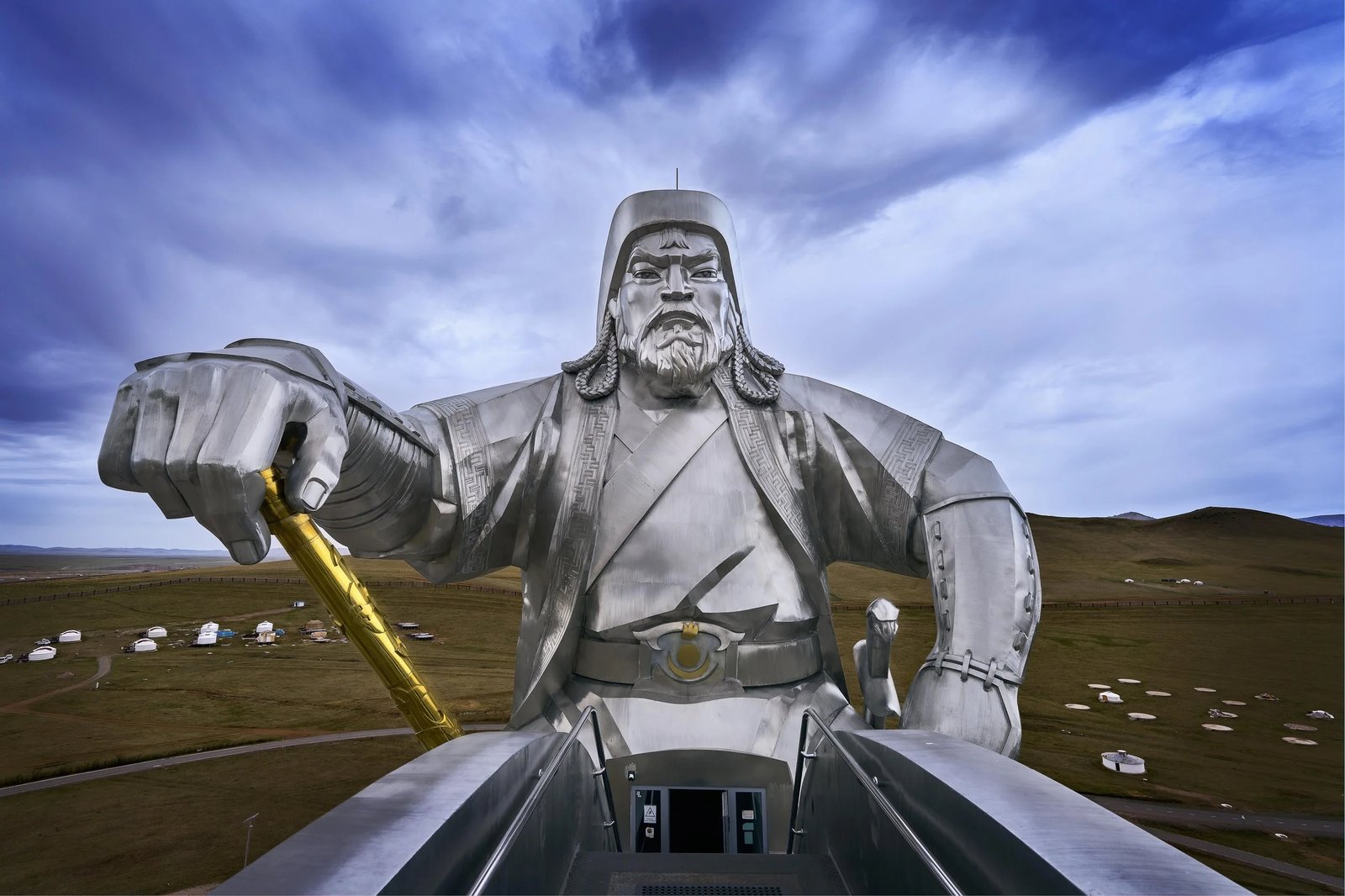
Mongolians today revere Genghis Khan as the founding father of their nation, and the great equestrian statue outside Ulaanbaatar looks out over the steppe. Historians remain divided: conqueror, butcher, lawgiver, pioneer of globalisation — every label is true, and none of them is enough.
The real question Temujin left behind is not how many people he killed. It is how a man with no birth and no patrons made a set of rules more reliable than blood. His answer was simple, and brutal: the rules must apply to everyone alike, including the man who wrote them. Only one orphan on the steppe ever managed it — and on the day he did, an empire was born.