PROLOGUEA Piece of Paper Nobody Wanted to Sell
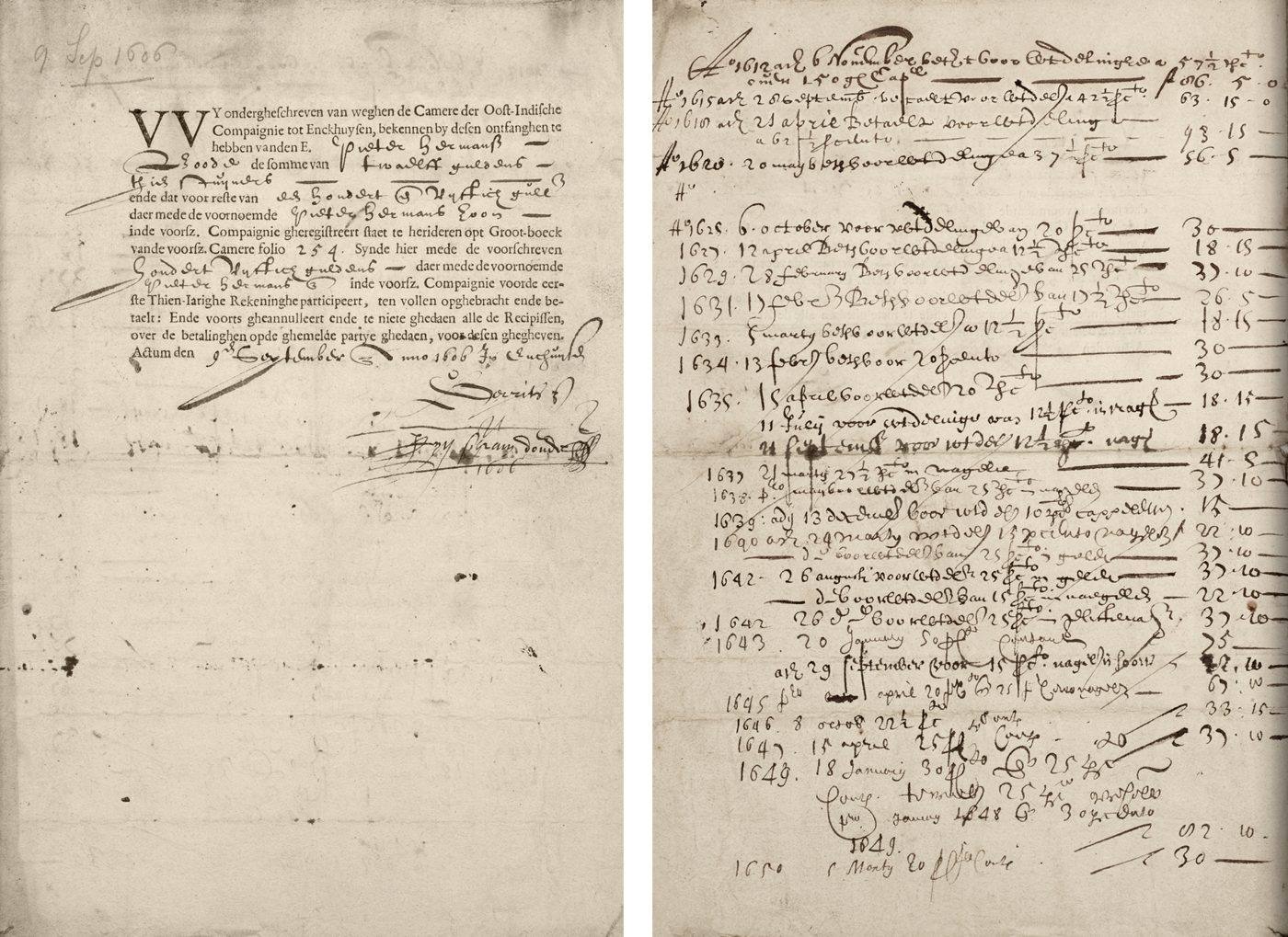
In the archive of Hoorn, a small Dutch town, there lies a sheet of paper more than four hundred years old. At the top left, someone has written by hand: “9 Sep 1606.” Below it, printed Dutch records that the Enkhuizen chamber has received a sum of money — 150 guilders, the final instalment of a share in the East India Company. The back of the sheet is more moving still: line after line of handwriting, recording the dividends this share received, from 1612 to 1650, thirty-eight years of payments.
This is the oldest surviving share in the world. In 2010, Ruben Schalk, a history student at Utrecht University, found it buried in a pile of archive papers. It is precious not because it is valuable — its owner was only a town messenger in Enkhuizen — but because of what it proves: before 1602, there was no such thing as a “share”; after 1602, humanity had a brand-new relationship. An ordinary person could own a small part of a company on the far side of the world, and could sell that small part to someone else.
This essay is about what happened in Amsterdam that year: six competing trading houses were merged into one company, a group of people invented the tradable share, a stock exchange, and a system that still runs today — and behind that system, the spice, the colonies, and the slaughter.
CHAPTER ONESpices Worth More Than Gold
It all began with spice. Nutmeg grew only in the Banda Islands; cloves only in the Moluccas — on the whole planet, only those few volcanic islands produced them. Europeans used them as medicine, as preservative, as flavouring, and in Amsterdam a small bag of spice fetched an astonishing price. Whoever could carry spice back to Europe would grow rich.
The trouble was that a voyage to the East Indies was too expensive, too far, and too dangerous. A ship might be at sea for more than a year, facing storms, pirates, and disease; if half a fleet came home, that counted as luck. No single merchant could afford a whole fleet, and no single merchant could afford to lose one.
The Dutch first tried small partnerships: a few men would pool money for one voyage, take the profit, and dissolve. Within a few years the method broke down. A dozen of these “pre-companies” bid against each other in Asia, driving the purchase price of spice up, then undercut each other back in Europe, driving the selling price down. The profit was eaten by their own competition. Worse, every voyage had to raise money and recruit men from scratch — experience, ships, and contacts never accumulated.
Everyone could see it would not last. Something bigger was needed — something that would not dissolve after every voyage, something that could simply go on existing.
CHAPTER TWOSix Companies Made Into One
On 20 March 1602, the States General of the Netherlands issued a charter. Pushed by the leading statesman Johan van Oldenbarnevelt, the dozen pre-companies were merged into one: the United East India Company, the VOC. It was the first chartered joint-stock company in history.
The charter gave the company a twenty-one-year monopoly: east of the Cape of Good Hope and west of the Strait of Magellan, only it could trade. But the charter gave far more than the right to do business — it allowed the company to build forts, raise armies, wage war, sign treaties with Asian rulers, mint its own coins, and administer justice in its own territories. A company had been given the powers of a state.
The company was run by a board of seventeen directors, the Heeren XVII, above six chambers: Amsterdam, Middelburg, Delft, Rotterdam, Hoorn, and Enkhuizen. Each chamber raised its own capital and kept its own books, but they shared one name, one fleet, and one monopoly. This “federal company” later became the template for the multinational corporation.
But what made the VOC immortal was not its fleet or its forts. It was the way it raised money.
CHAPTER THREEAnyone Could Buy a Little
In August 1602, the subscription opened. Article 10 of the charter said that any resident of the United Provinces could subscribe, in any amount. That was unheard of — trade had always been the preserve of rich merchants. What business did a craftsman, a maid, or a messenger have with the East Indies? This article was the answer.
The Amsterdam subscription was taken at the house of the merchant Dirck van Os, because the company did not yet even have an office. When the books closed at the end of August, the Amsterdam chamber alone had 1,143 subscribers, for 3,674,945 guilders. All six chambers together raised about 6.4 million guilders — 6,424,588, to the guilder. For comparison, the English East India Company, founded two years earlier, had a total capital of just over £68,000.
The money was paid in four instalments, from 1603 to 1606. The company issued no share certificates — in fact, no such thing existed yet. All you owned was a line in the chamber’s capital book. The receipt the company gave you was your only proof. Pieter Harmensz of Enkhuizen subscribed for 150 guilders, paid it in instalments over four years, and on 9 September 1606 paid the last of it; the receipt he received is the one this essay opened with. Its back later became his dividend passbook, the payments written in one by one, up to 1650.
Among Amsterdam’s thousand-plus subscribers there were rich merchants, but also craftsmen and small traders. Enkhuizen, a small town, had 538 subscribers of its own. From its very first day, the share was not a rich man’s privilege — it was a piece of paper anyone could buy a little of.
CHAPTER FOURThe Money Could Not Come Back, So It Was Sold to Someone Else
When people subscribed, the charter had promised one thing: an accounting after ten years. The money, in other words, might come back. But the directors took the money and spent it on forts, fleets, and wars — once it left Amsterdam it turned into stone and timber on the coasts of Asia, and it was not coming back. When the charter was renewed in 1623, the capital had in practice become permanent: the shareholders’ money would stay in the company forever.
With the money locked in, shareholders had only one way out: sell their shares to someone else. And so a secondary market grew by itself. Traders first met in the open air, then found a fixed place; in 1611 a purpose-built exchange opened on the Rokin canal, and VOC shares changed hands there every day. The Amsterdam Stock Exchange — the world’s first true stock exchange — was born this way.
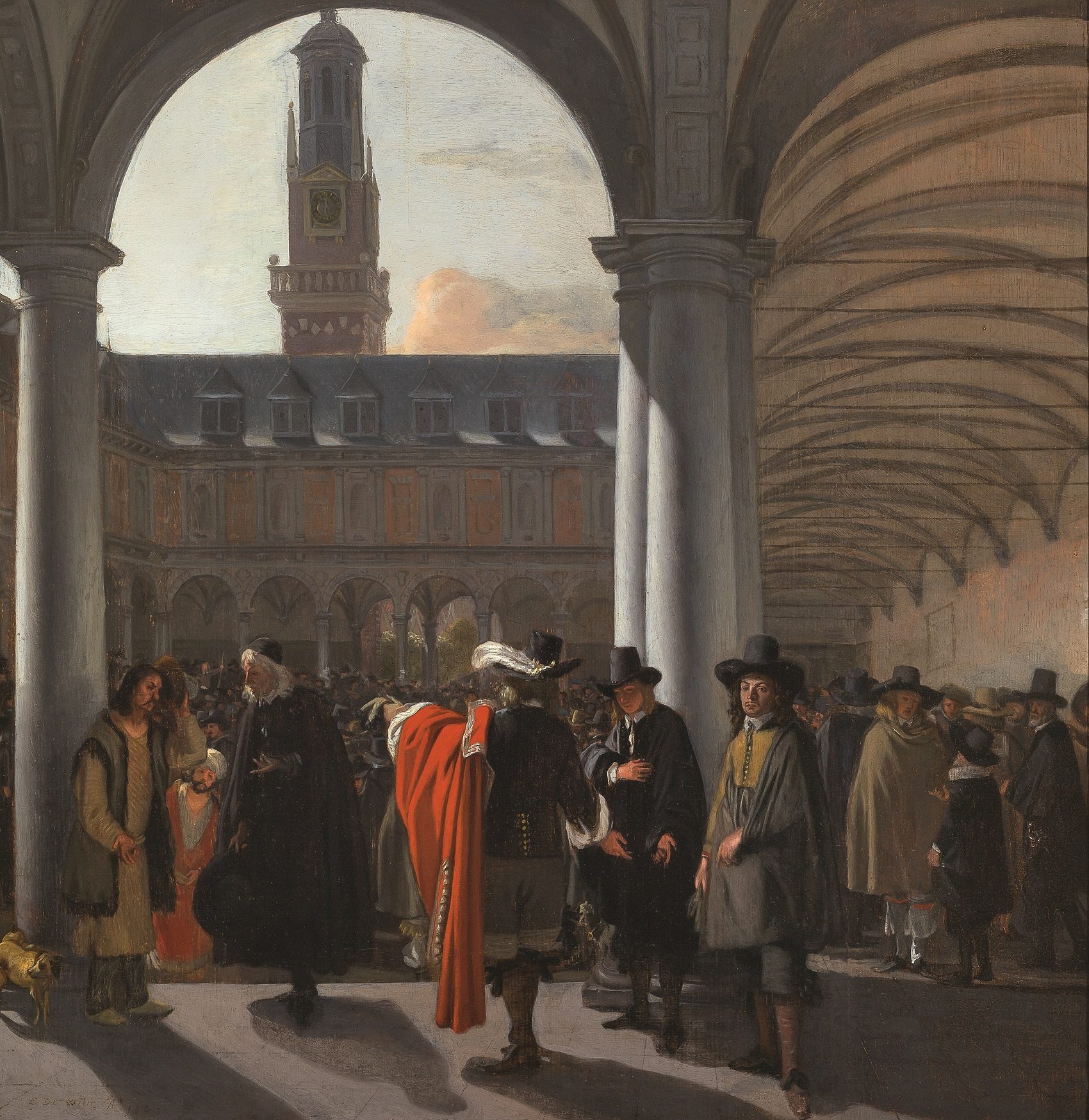
The market came with the market’s troubles. In 1609, Isaac Le Maire, one of the VOC’s largest original shareholders, fell out with the board and organised a syndicate to sell shares they did not own, betting the price would fall — the first recorded bear raid in history. The next year, the authorities issued the first ban on short selling. By 1688, Joseph de la Vega had written Confusión de Confusiones, the first book ever written about stock trading, full of the market’s excitement, rumours, and panics — a reader three centuries later will find nothing unfamiliar in it.
And the dividends? The first was not paid until 1610, and much of it was paid not in cash but in mace, the spice — that was what the company had most of. But the numbers were startling: in 1610 and 1612 together, dividends reached 162.5 per cent; by later reckoning, the company’s average annual dividend over nearly two centuries was about 18 per cent. Shareholders waited eight years for their first payment, but once it came, the money kept coming.
Scholars later took the VOC’s system apart into four components: transferable shares, permanent capital, the separation of ownership and management, and limited liability for shareholders. Limited liability for shareholders existed from the start; permanent capital took shape around 1612; limited liability for directors was only settled in 1623. Put the four together and you have the modern joint-stock company. Every share we buy today is built on the frame that was raised in Amsterdam in 1602.
CHAPTER FIVEBatavia and Banda
But only half the story of the share happened in Amsterdam. The other half happened in Asia. The company’s money became profit through monopoly, and monopoly had to be held by guns.
In 1619, Governor-General Jan Pieterszoon Coen seized the port of Jayakarta on the north coast of Java, burned the old town, and rebuilt a Dutch city on its ruins, renamed Batavia in 1621 — today’s Jakarta. From then on, the VOC had a headquarters in Asia: a walled city with docks and a governor’s residence, a capital.
Coen’s next target was the Banda Islands — the only place on earth where nutmeg grew. The Bandanese had promised to sell their nutmeg only to the Dutch, then sold it to the English, the Javanese, and the Malays as well. Coen’s answer was a fleet. In 1621, Dutch forces conquered the Banda Islands: about 2,800 islanders were killed, 1,700 enslaved, and the roughly 1,000 who remained were exiled to Batavia. The nutmeg monopoly was secured, and it held until the day the company died.
Coen was once celebrated in the Netherlands as a national hero; later his reputation collapsed completely — to wipe out the people of an archipelago for the monopoly of a spice cannot be defended in any age. His statues in the Netherlands have repeatedly become the focus of controversy, and “Butcher of Banda” is a nickname he will never shake.
This is the hardest side of the VOC to face: while shareholders in Amsterdam counted their 18 per cent, enslaved labourers sweated on the plantations of Banda. One coin, two faces: the cleverest fundraising device humanity ever invented, and colonial violence. The men who invented the share did not foresee the second face, but those who came after have no right to pretend not to see it.
EPILOGUEIt Died in 1799. The Share Lived On.
The company lived for 197 years. In its later years it grew bloated, corrupt, and deep in debt, and the Fourth Anglo-Dutch War knocked out what strength it had left. On 31 December 1799, its charter expired, the company was formally dissolved, and its debts were taken over by the Batavian Republic. The world’s first publicly traded company had run its course.
What it left behind outlived it by far. Some economic historians estimate that the VOC’s market value at its peak, translated into today’s money, was about 7.9 trillion dollars — a figure that depends heavily on how you do the conversion, and reasonable people will disagree; but the direction is not in doubt. In its own age, it was the largest enterprise in human history.
More important is the system it left. The joint-stock company, freely tradable shares, the stock exchange, the board of directors, limited liability, the dividend — the skeleton of today’s financial world is all VOC. Every time we open a trading app, we are looking at the shadow of that exchange hall in Amsterdam four hundred years ago; every time we buy a share, we are repeating what those 1,143 Amsterdammers did in August 1602: handing a little money to a group of strangers, to bet on a distant future.
The only difference is that today we know real people stand behind the rise and fall of a share price. A share is a piece of paper, and it is also a mirror: it reflects human cleverness, and it reflects human cruelty. The men who invented it taught the world how to raise capital, but they never taught the world how to face the price of raising it — a question that, four hundred years later, still has no answer.
A single share could send a city’s savings off to take a risk, or reduce an archipelago’s fate to a dividend. When we buy a small part of a company today, what exactly are we buying?