PROLOGUEA Table on the Wall
On the wall of almost every secondary-school chemistry classroom hangs the same table. Seven rows, eighteen columns, one hundred and eighteen boxes, each holding a name, a symbol and a number. Students memorise it, sit exams on it, print it on the back of their notebooks — and rarely ask where it came from.
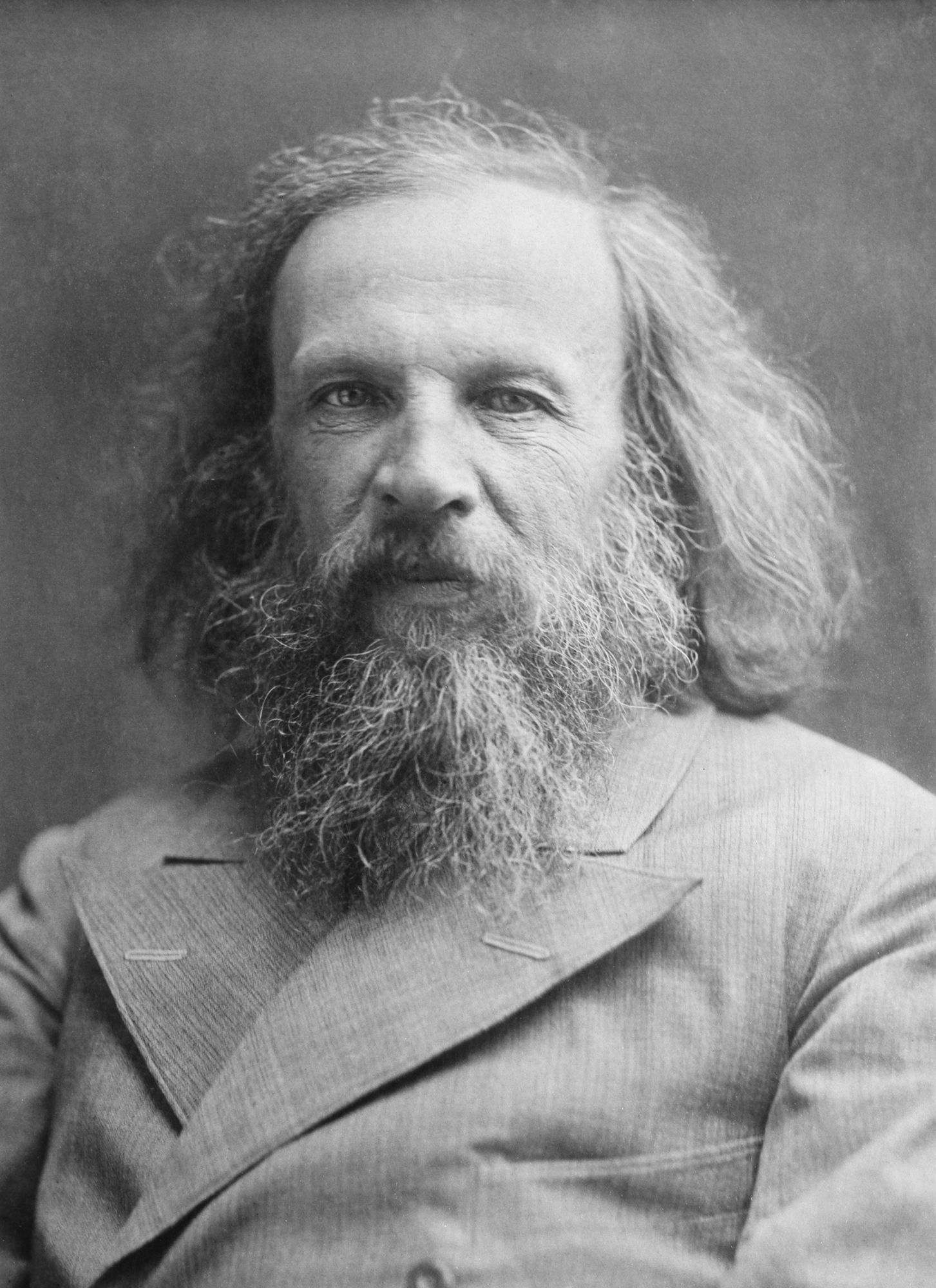
It did not fall from the sky. More than a hundred and fifty years ago, in a room in Saint Petersburg piled high with manuscripts, a bearded Russian professor of chemistry wrote the sixty-three elements then known, one by one, onto cards, and shuffled them across his desk like playing cards. He was not arranging a list of elements. He was drawing a map — a map of land no one had yet walked. In some places he deliberately left blanks, because he believed something must be there, even though no one had found it yet.
His name was Dmitri Mendeleev. Born in Siberia in 1834, he died in Saint Petersburg in 1907. He never won a Nobel Prize, and he was never elected to his own country's academy. Yet the table he left behind still hangs on the wall of every chemistry classroom in the world.
CHAPTER ONEFrom Siberia to Saint Petersburg
Mendeleev was born on 8 February 1834 in a small village near Tobolsk, the youngest of more than a dozen children. His father was the headmaster of the local gymnasium; later he went blind and lost his post. His mother, from a Tobolsk merchant family, took over the family's abandoned glass factory and kept the household alive. His father died in 1847; the glass factory burned down in 1848. Mendeleev was thirteen, and the family had nothing left except his mother's instruction: to search patiently for divine and scientific truth.
In 1849 his mother took him across Russia, from Siberia to Moscow, hoping to enrol him at Moscow University. Moscow University turned him away. Mother and son continued north to Saint Petersburg, where Mendeleev entered the Main Pedagogical Institute, his father's alma mater. His mother died that same year, aged fifty-seven. At sixteen, Mendeleev was alone, living on a scholarship and part-time teaching.
His health was poor too. Soon after graduating he contracted tuberculosis and was sent to teach at a gymnasium on the Crimean Peninsula, convalescing by the Black Sea. Doctors at one point thought he would not live long; instead he slowly recovered. In 1857 he returned to Saint Petersburg; in 1859 he went to Heidelberg in Germany to study the capillarity of liquids and the workings of the spectroscope. In 1861 he published Organic Chemistry and received the Demidov Prize of the Petersburg Academy of Sciences. In 1862 he married Feozva Leshcheva.
In 1864 he became a professor at the Saint Petersburg Technological Institute; in 1865 he took his Doctor of Science degree with a dissertation on the compounds of water with alcohol, and became a professor at Saint Petersburg University; in 1867 he received tenure and began to teach inorganic chemistry. As for whether he fixed the standard strength of vodka at forty percent — no, that is a legend invented for him afterwards. His dissertation was about how water and alcohol combine into compounds, not about the strength of drink.
CHAPTER TWOSixty-Three Elements, No Order
What Mendeleev inherited was a discipline without order. By 1863, science knew fifty-six elements, and new ones were being found at a rate of about one a year. Every element had its own atomic weight, its own properties, its own compounds — but no one could say what relation they bore to one another. A chemistry textbook was only a list: hydrogen, oxygen, nitrogen, carbon, iron, copper, gold, silver — like a telephone directory with no index.
It was not that no one had tried to bring order. In 1864 the English chemist John Newlands proposed his Law of Octaves: arrange the elements by atomic weight, and every eighth element repeats the properties of the first, like the octave in music. The idea was close, but Newlands's arrangement had too many exceptions, and the Chemical Society, hearing his paper, mocked him and asked whether he had tried arranging them alphabetically. His paper was not recognised until 1887.
The German chemist Lothar Meyer was walking the same road. In 1864 he published a table of twenty-eight elements classified by valence — but with no predictions and no blanks, only a better-organised list. A few months after Mendeleev's table appeared, Meyer published one almost identical to it. The two men arrived at the same door at almost the same moment. The difference was that only Mendeleev pushed the door open and walked through.
In 1868 Mendeleev began writing a textbook for his students, The Principles of Chemistry. The first volume ran to more than five hundred pages and covered only eight elements. At that pace, the second volume would have to cover the remaining fifty-odd, and no student could ever finish it. He needed a way to arrange the elements into a system that a student could grasp at a glance. That practical difficulty of writing a textbook was the true starting point of the periodic table.
He wrote the name, atomic weight and principal properties of each element on a card, and shuffled the cards across his desk again and again: lightest to heaviest by atomic weight, with elements of similar properties in the same column. He worked at it for days and nights. One night, so the story goes, he saw in a dream a table in which "all elements fell into place as required". Waking, he immediately wrote the table from his dream down on paper — "only in one place did a correction later seem necessary". He told this to a friend himself, and it has been handed down ever since. Dream or cards, what matters is not where the inspiration came from, but what he did after he woke.
CHAPTER THREE6 March 1869
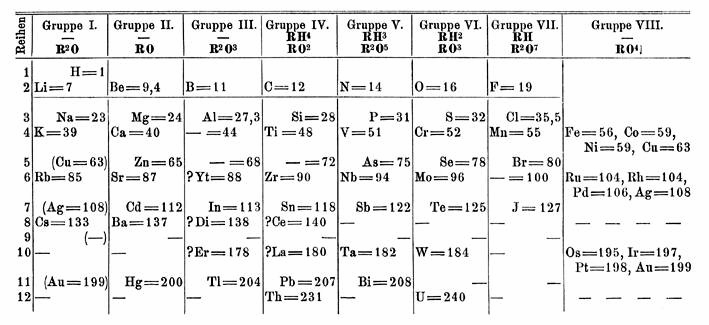
On 6 March 1869 Mendeleev presented his paper to the Russian Chemical Society, titled "The Dependence between the Properties of the Atomic Weights of the Elements". In it he set out eight conclusions, whose core was a single sentence: the properties of the elements are a periodic function of their atomic weights.
What this means is simple: arrange the elements in a row from lightest to heaviest by atomic weight, and their properties repeat at regular intervals, like the tide. Lithium, sodium, potassium, rubidium and caesium are all lively metals that react with water; fluorine, chlorine, bromine and iodine are all sharp-smelling gases or liquids that love to seize other atoms' electrons. Elements in the same column behave alike; from column to column, properties change by rule.
Mendeleev did more than organise what was known — he dared to correct it. Uranium, as then accepted, had an atomic weight of about 120 and a valence of three. Mendeleev said the figures could not fit his table and must be wrong. He doubled both: atomic weight 240, valence six. Today we know uranium's atomic weight is 238. His correction was almost exactly right.
He also dared to defy the numbers themselves. Tellurium has an atomic weight of 127.6, iodine 126.9. By weight, tellurium should come after iodine; by chemistry, iodine must stand with fluorine, chlorine and bromine. Mendeleev put tellurium before iodine, saying the measurements must be at fault and the future would prove him right. On this he was only half right: tellurium's atomic weight really is 127.6, and there was no error in the measurement. What he did not know was that the true basis of the order is not atomic weight but atomic number — an answer that would wait until 1913, when Moseley uncovered it with X-ray spectra. But at the time, valuing chemical character above the numbers was precisely what made his table better than anyone else's.
In the same paper he wrote his sixth conclusion: "We must expect the discovery of many yet unknown elements — for example, two elements, analogous to aluminium and silicon, whose atomic weights would be between 65 and 75." That sentence is the story of the next chapter.
CHAPTER FOURThe Courage to Leave Blanks
The greatest thing about Mendeleev's table was not that it arranged the elements already known, but that it left room for the ones not yet known. Below aluminium he left a gap and called it eka-aluminium; below boron, eka-boron; below silicon, eka-silicon. "Eka" was the Sanskrit prefix for "one" — the first one down. He used this Sanskrit prefix, it is said, in honour of the ancient Indian grammarian Pāṇini.
He did more than leave blanks: he wrote out, item by item, what these not-yet-existing elements should be like — their atomic weights, their densities, their melting points, the oxides and chlorides they would form.
In 1875 the French chemist Paul-Émile Lecoq de Boisbaudran discovered a new element and named it gallium. Mendeleev recognised it at once: this was his eka-aluminium. He had predicted an atomic weight of about 68 and a density of about 5.9; gallium's measured atomic weight was 69.7 and its density 5.91. More remarkable still, Boisbaudran's first measurement of the density had been only 4.7, and Mendeleev wrote to him to say the figure must be wrong. Measured again, it came out at 5.94. A man who had never seen gallium knew what gallium should be better than the man who had discovered it.
In 1879 the Swedish chemist Lars Fredrik Nilson discovered scandium, and Mendeleev's eka-boron came true. He had predicted an atomic weight of 44; scandium is 44.96. He had predicted the formula of its oxide, and scandium's oxide was exactly the one he had written down.
In 1886 the German chemist Clemens Winkler discovered germanium, and Mendeleev's eka-silicon came true. This time the match was the most complete of all: he had predicted an atomic weight of 72, and germanium is 72.6; a density of 5.5, and germanium is 5.32; that it would form a dioxide and a tetrachloride, and germanium forms germanium dioxide and germanium tetrachloride.
Three predictions, all fulfilled within seventeen years. Science rarely sees such a moment: a man writes down the names, weights and characters of three things that do not yet exist, and the world hands them over one by one. As for the fourth prediction, eka-manganese, it had to wait until 1937, when it was made artificially in a laboratory — technetium, the first man-made element in the periodic table.
CHAPTER FIVELife After the Table
Once the predictions came true, Mendeleev became one of the most respected chemists in Europe. In 1882 he received the Davy Medal of the Royal Society; in 1905 the Copley Medal, and election as a foreign member of the Royal Swedish Academy of Sciences. Yet he was never elected to the Russian Academy of Sciences in his own country — the scandal of his divorce and remarriage, together with his outspoken character, left him an outsider in his own academic world.
His closest approach to the Nobel Prize came in 1906. That year the Nobel Committee for Chemistry recommended the prize for Mendeleev, in recognition of his discovery of the periodic system. The chemistry section of the Royal Swedish Academy of Sciences supported the recommendation, but at the full meeting of the Academy, the committee member Peter Klason put forward the French chemist Henri Moissan instead, and the physicist Svante Arrhenius pressed hard against Mendeleev, arguing that the periodic system was too old to be honoured in 1906. After heated argument, the Academy chose Moissan by a margin of one vote. Mendeleev was nominated again in 1907, and opposed again. On 2 February that year he died of influenza in Saint Petersburg, aged seventy-two, six days short of his seventy-third birthday. In his funeral procession, his students carried copies of the periodic table behind him.
One thing he did not live to see, others saw for him. In 1913 the English physicist Henry Moseley used X-ray spectra to prove that what fixes an element's place is not its atomic weight but its atomic number — the number of protons in its nucleus. The tellurium-iodine puzzle was solved at last: tellurium's atomic number is 52, iodine's 53, so iodine always belonged after tellurium. A decision Mendeleev had made by chemical instinct finally received its physical explanation.
In 1955 scientists synthesised element 101 and named it mendelevium, in his honour. His name thus came to live inside the table he had drawn himself. In 2019 the United Nations proclaimed the International Year of the Periodic Table, marking one hundred and fifty years since its publication. Today's table holds one hundred and eighteen elements; the last of them are mostly made in laboratories, one atom at a time, vanishing in less than a second. But they all have their places, because the table had kept places ready for them long ago.
EPILOGUEWhat Kind of Ability Is Prediction?
Mendeleev's story is often told as the tale of a genius who had a dream. The dream was real enough — at least, he said so himself — but to hand a science over to a dream is to miss the point.
His gift was not dreaming, but daring to leave blanks. To organise what is known is one ability; to admit that something is not yet known, and to say what it should be like, is another, and harder. Most people, faced with a blank, fill it in or pretend it is not there. Mendeleev did the opposite: he drew the blank, gave it a name, wrote down its properties, and waited for the world to answer.
The table's other lesson is that pattern matters more than data. Mendeleev had no more data than his contemporaries, and some of what he had was wrong. His advantage was that he believed there was an order behind the data, and he was willing to question the data for the sake of the order. When numbers clashed with chemical character, he trusted character; when an authoritative atomic weight clashed with his table, he trusted his table. That choice took more than cleverness — it took courage, because if he had chosen wrongly, he would have been a laughing-stock who fiddled with the figures.
He also teaches us that science is never one person's work alone. Newlands saw the octaves first; Meyer drew almost the same table at almost the same time; Moseley supplied the final piece forty-four years later. Mendeleev stood on all their shoulders. The difference was that he took one step further: he did not only describe the world, he predicted it.
Today each of us holds far more data than Mendeleev ever did. The figures on our phones, the information on the internet, are more than anyone can read. But more data does not mean seeing more clearly. The question Mendeleev left us has not gone out of date: can you look at a pile of apparently unrelated things and see an order in them? And once you see the order, do you dare to leave a place open for what has not yet appeared?
The table on the classroom wall is still waiting for the next person brave enough to leave a blank.
Questions That Remain Open
In honesty, the following two things have no settled answer, and this essay does not pretend otherwise:
- Did Mendeleev really see the periodic table in a dream? "One night, so the story goes, he saw in a dream a table in which all elements fell into place" — the account is one he told a friend himself, handed down ever since, with no other witness.
- Did he choose the Sanskrit prefix eka — "one" — for eka-aluminium, eka-boron and eka-silicon in honour of the ancient Indian grammarian Pāṇini? The essay says only that "it is said" so, and the claim remains unsettled.