PROLOGUEWhy a Book Had to Wait Twenty Years
On 24 November 1859, bookshops in London received a thick volume with a title so long it was almost impossible to recite, written by a middle-aged gentleman of frail health living in the Kent countryside. The publisher, John Murray, had printed 1,250 copies, and they were all ordered on the very first day; within days he was arranging a second printing of 3,000. A man had waited more than twenty years to say what he thought, and society snatched it up in a single day. That contrast is the story of this essay. Charles Darwin did not think up the theory of evolution on that day. More than twenty years earlier, aboard a surveying ship circling the globe, he had already seen the sights that made it impossible for him to go on believing that species were fixed and unchanging. He waited because he knew that what he held in his hands was not an ordinary academic hypothesis, but a key that would unsettle the entire worldview of his age. Between seeing an idea and speaking it, the distance is seldom a matter of knowledge alone; it is a matter of courage, evidence, and timing. Darwin's life lets us weigh all three.
CHAPTER ONEA Ticket at Twenty-Two
Darwin was born on 12 February 1809 into a comfortable family; his father was a doctor. He first studied medicine, gave it up, and then went to Cambridge to read theology, but what truly absorbed him was always the stones, insects, and birds of the outdoors. His teacher, the botany professor John Stevens Henslow, saw this, and in 1831 handed him an opportunity: the Royal Navy survey ship HMS Beagle was about to sail, and her captain, Robert FitzRoy, wanted a companion who knew something of natural history. Darwin was twenty-two, newly graduated from Cambridge, and his father at first objected, fearing his son would waste his prospects on a voyage of unknown length. Darwin later wrote in his autobiography that the voyage had determined the whole course of his career, and he was not exaggerating. The ship was meant to be away for two years. Instead, from the day she left Plymouth on 27 December 1831 until her return to England on 2 October 1836, the voyage stretched to nearly five years. Of that time Darwin spent more than three years ashore and about eighteen months at sea, travelling around South America, across the Pacific, to New Zealand, Australia, and South Africa, and back to where he had begun. He was not a tourist admiring the scenery; every day he collected, dissected, recorded, and wrote in his diary, and his luggage filled with specimens and notebooks. Life aboard was hard: he suffered terribly from seasickness and often could only lie in his hammock waiting for the weather to pass. But each time he went ashore he fell upon the land like a hungry man at a table. In Argentina he dug from the rocks the fossils of gigantic extinct mammals; in Chile he saw with his own eyes an earthquake lift the coastline; high in the Andes he found the fossils of sea creatures. Put together, these sights pointed to a conclusion that most people of his time were not yet willing to accept: the earth was not a motionless stage, and life was not an unchanging backdrop. Time itself was a force, and given long enough, it could rewrite everything.
CHAPTER TWOFive Weeks, One Archipelago
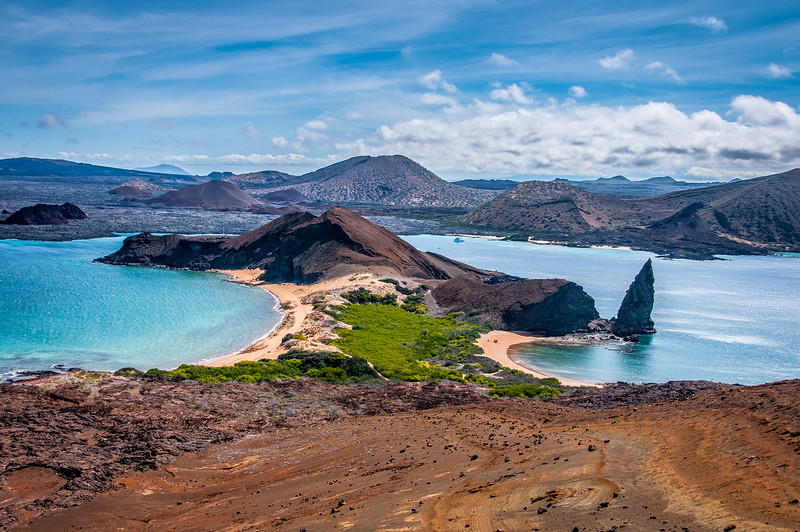
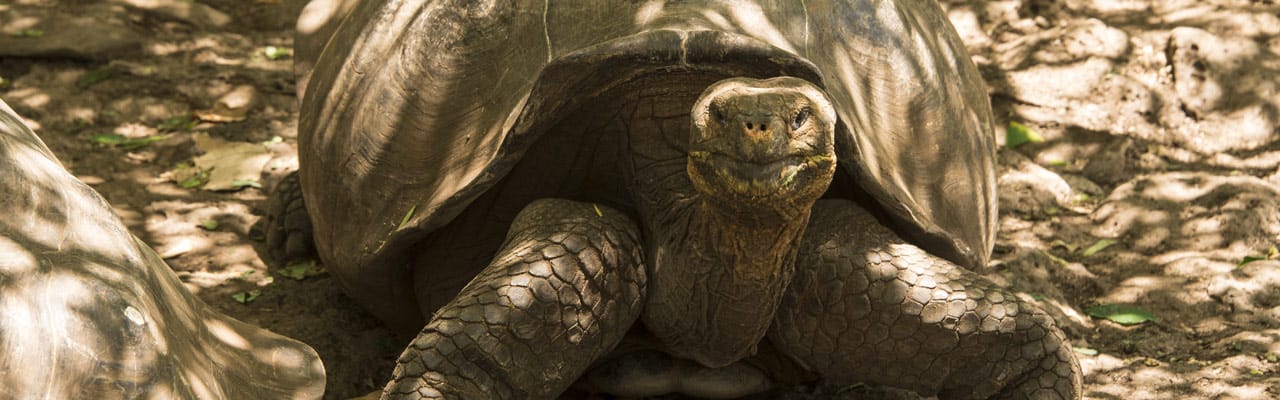
In September 1835 the Beagle sailed into the Galápagos Islands, a volcanic archipelago near the equator, more than nine hundred kilometres from the South American mainland, formed by undersea eruptions, each island separated from the next by water like a set of isolated laboratories. Darwin stayed only five weeks and visited several islands, yet he carried away questions that would take him twenty years to digest. He noticed that the tortoises and birds of the islands closely resembled the kinds found on the South American mainland, but were not quite the same; stranger still, the same kinds of creatures differed slightly from island to island. The finches are the most famous example: birds that ate seeds had thick, powerful beaks, while birds that ate insects had slender ones, and later study counted thirteen or fourteen species, all now known as Darwin's finches. They looked like one family, yet each had grown into a different shape, as though a single ancestor had been sent to different islands and each branch had learned a different way of making a living. Darwin did not grasp all of this at once; he did not even label every finch with the island it came from, an omission he later admitted. But he brought the specimens back to London and gave them to the ornithologist John Gould, who told him that the finches were indeed a closely related group, and that the mockingbirds of the islands belonged to several distinct species. Only then did the question take its true shape: if species were created once by God and never changed, why should the descendants of one ancestral group look different on neighbouring islands? And why should island creatures most resemble those of the nearest mainland, rather than those of some distant place with a similar climate? There could be only one answer: species change, and the direction of their change has to do with the place where they live. The Galápagos did not hand Darwin the theory of evolution directly; it handed him a riddle he could not solve, and an honest observer owes the rest of his life to such a riddle.
CHAPTER THREETwenty Years Back on Land
After his return to England, the first thing Darwin did was not to publish a startling claim, but to settle down to the dullest work. He sorted specimens, wrote up the voyage, married, had children, and moved to Down House in Kent, where he would live for forty years. In 1838 he read Malthus on population and food, and saw that the same struggle applied to the living world: more are born than can possibly survive, so those individuals with even a slight advantage in their surroundings are more likely to leave offspring, and the advantage accumulates, generation after generation. That was what he would later call natural selection. Once the idea had formed, he became more cautious, not less. He spent eight years studying barnacles, a creature that looks wholly unremarkable, working out their classification in full, as though he first had to prove to his colleagues that he was a meticulous taxonomist before he was entitled to speak of larger things. He wrote a sketch in 1842 and a longer essay in 1844, but published neither; he locked them in a drawer and left instructions to his wife that, should he die, someone should see them into print. Why the delay? In part it was his body: he suffered for years from stomach trouble, headaches, and vomiting, and could write only in fits and starts. In part it was that he knew how loud the opposition would be: in Victorian Britain, a literal reading of the Bible was still the bedrock of many people's convictions, and a book arguing that human beings shared ancestors with other creatures struck directly at the story of Creation. And in part it was his own standard: he did not want a flash of insight, but a whole body of evidence that could withstand challenge, from geology, fossils, embryos, geographical distribution, and artificial selection. He wanted every piece of the puzzle in place. Waiting, in this sense, was not procrastination; it was a responsible kind of slowness. A person who feels no awe before his own conclusion will speak too fast and be wrong too fast.
CHAPTER FOURA Letter from the Malay Archipelago
On 18 June 1858 a letter broke Darwin's slow rhythm. It came from Alfred Russel Wallace, a younger naturalist then working in the Malay Archipelago, and it enclosed an essay describing a mechanism of evolution almost identical to the theory Darwin had pondered for twenty years. Darwin received it while grieving: his young son had just died of scarlet fever. He wrote to his friend Lyell that his priority would probably come to nothing. Yet he still passed Wallace's letter on; he did not hide it, and he did not rush to publish first. Lyell and the botanist Joseph Dalton Hooker devised a compromise: at a meeting of the Linnean Society of London on 1 July 1858, Wallace's essay and extracts from Darwin's earlier manuscripts would be read together, so that the two men's work would stand side by side. The reading caused almost no stir at the time; the Society's president even remarked in the following year's address that the year had produced nothing of great note. But for Darwin everything had changed. He could no longer take his time over the great book he had planned; he had to write a shorter abstract first, setting out the skeleton of the theory in full. It took him thirteen months to write On the Origin of Species, a book of about five hundred pages whose full title was On the Origin of Species by Means of Natural Selection, or the Preservation of Favoured Races in the Struggle for Life. When Wallace later returned to England, he accepted the arrangement completely, acknowledged Darwin's priority for the rest of his life, and remained one of the theory's staunchest defenders. The history of science is full of priority disputes that turned ugly; this one, thanks to the character of both men, left a decent example behind: it is possible to defend one's own work and respect a rival at the same time, without losing one's sense of proportion.
CHAPTER FIVEA Book and a Debate
Once On the Origin of Species appeared, argument broke out at once, but not everyone opposed it. That the first printing of 1,250 copies sold out on the day of publication showed that readers had been waiting for such a book. Supporters quickly came forward, the most famous being Thomas Henry Huxley, who wrote in his review, in words often quoted since, that he could not understand how he had failed to think of something so simple himself. Huxley would later be called Darwin's bulldog, defending evolution again and again in public. On 30 June 1860, at a meeting of the British Association for the Advancement of Science in Oxford, Samuel Wilberforce, Bishop of Oxford, challenged the theory in public; legend has it that he asked Huxley whether it was through his grandfather or his grandmother that he claimed descent from an ape, and that Huxley replied he would rather claim an ape for an ancestor than a man who made mockery his trade. No verbatim record of the exchange survives, and eyewitness accounts differ, but the conflict it symbolised was real: on one side stood traditional natural theology, which held that species were designed and fixed; on the other, a new science which held that nature itself, given enough time, had the power to shape diversity. The opposition did not come only from the Church. The anatomist Richard Owen doubted whether natural selection could explain complex adaptations, and botanists had their own reservations about the details of the mechanism. Darwin himself did not go to Oxford to argue. His health was poor and he disliked public quarrels; he chose instead to stay in his study, revising his book edition by edition — six editions appeared in his lifetime — answering criticisms and adding evidence as he went. True acceptance was not won in a single debate; it was built up, generation after generation, as new evidence accumulated. By the end of the nineteenth century, few doubted that evolution had happened, although the mechanism of natural selection had to wait for twentieth-century genetics before it received a fuller explanation. Darwin did not live to see that day, but the method he left behind was enough: propose a mechanism, present the evidence, submit it to testing, and correct your mistakes.
EPILOGUEWhat Waiting Teaches Us
Darwin's story is easily misread in two ways: as a genius struck by sudden inspiration on an island, or as a timid scholar who took twenty years to find his voice. Neither is true. He spent five weeks in the Galápagos and twenty years thinking the problem through; it was not that he had no answer, but that he refused to trade an incomplete answer for momentary applause. For him, waiting was not empty time; it was the work of turning observation into evidence, intuition into theory, and private conviction into public knowledge. For us, the lesson lies not in the theory of evolution itself, but in an attitude towards important ideas: when you see something anomalous, write it down first and do not rush to explain it; once you have a hypothesis, go looking for evidence against it, not only for evidence in its favour; and when you are ready to publish, ask first whether the evidence is enough, not whether the audience will applaud. We live in an age that prizes speed, where ideas are published before they have taken shape and positions are taken before they have been tested. Darwin stands at the opposite end, reminding us that slowness is sometimes not backwardness but respect. A theory deserves to be taken seriously not because it is stated loudly, but because it survives the questioning of time. Darwin waited twenty years, and the world took more than a century to fully receive his idea. The reason we can stand on that understanding today is not that someone suddenly saw the light one day, but that someone was willing to work quietly at a single question for a lifetime.
Questions That Remain Open
In honesty, the following two things have no settled answer, and this essay does not pretend otherwise:
- How many species of Darwin's finches are there? Later study counted "thirteen or fourteen species", and the essay does not settle the number.
- What was actually said at the Oxford debate of 1860? The exchange between Huxley and Bishop Wilberforce has no verbatim record, and accounts of what was said on the day differ.