PROLOGUEA Promise with a Deadline
On 25 May 1961, President John F. Kennedy stood before Congress and said something that sounded almost reckless: before the decade was out, America would land a man on the Moon and bring him safely back to Earth. At that point only one American had flown in space — Alan Shepard, twenty days earlier, on a fifteen-minute suborbital hop — and no American had yet orbited the Earth. The deadline Kennedy set was not ten years. It was eight and a half. A nation made a promise to the whole world, and then spent eight years turning the promise into engineering.
The engineering was on a scale hard to imagine. At its peak the Apollo programme employed 400,000 people, drew on more than 20,000 firms and universities, and cost about $25.4 billion — roughly $180 billion in today's money. It was the largest peacetime technological mobilisation in human history. And all of it existed to do a single thing: carry three men to a rock 384,400 kilometres away, and bring them home alive.
CHAPTER ONEThree Men, One Rocket
On 16 July 1969, at 09:32 in the morning, the Saturn V lifted off from Launch Complex 39A at the Kennedy Space Center in Florida. Its thrust was 7.6 million pounds, and at 111 metres tall it was the largest rocket ever built. Atop it sat three men: Commander Neil Armstrong, 38; Lunar Module Pilot Buzz Aldrin, 39; and Command Module Pilot Michael Collins, 38. All three were test pilots, all had flown in Gemini, and they had known one another for years. Twelve minutes later they were in Earth orbit; about three hours later the third stage fired again and pushed them towards the Moon.
There was no turning back on this road. For three days the spacecraft flew at nearly 40,000 kilometres an hour, and the Earth shrank behind the window until it was a blue marble.
CHAPTER TWOThree Days Out, and One Man Alone
On 19 July, Apollo 11 entered lunar orbit. The Command Module Columbia began circling the Moon, thirty orbits in all. On 20 July, Armstrong and Aldrin climbed into the Lunar Module Eagle and separated from Columbia. Collins stayed behind, alone.
Collins later wrote that it was the most complete solitude in human history: on the far side of the Moon there were three billion people plus two; on this side, there was only him. Every time Columbia swung behind the Moon, the radio went silent, and a whole Moon stood between him and every other human being — no call for help could get through. What he recorded in his journal was not fear, but a strange calm.
CHAPTER THREEThe Descent: Alarms and Rocks
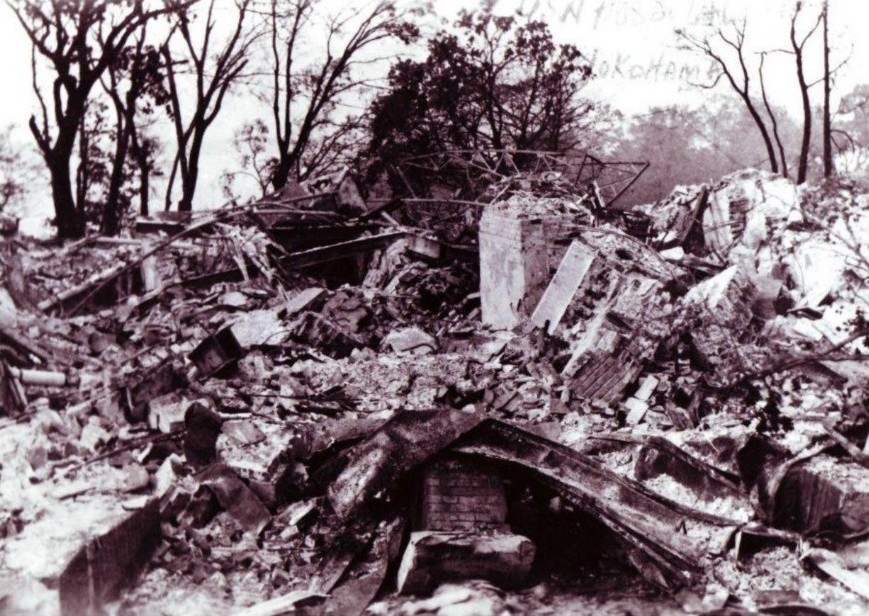
On the afternoon of 20 July, Eagle began its powered descent. About five minutes in, at roughly 10,000 metres, an alarm sounded in the cabin: program alarm, 1202. Then four more — 1202, 1201, in turn. The guidance computer was overloaded. The rendezvous radar, needed later to find Columbia again, had been left switched on as an abort precaution, and it was consuming about thirteen percent of the computer's capacity. The computer kept working, restarting itself and shedding lesser tasks, barely holding the flight together.
On the ground, a 24-year-old engineer named Jack Garman recognised the alarm: the computer was not broken; it was saying it was too busy, and that the essential guidance work was still running. Guidance Officer Steve Bales took his judgement, and CapCom Charlie Duke answered: "We're Go on that alarm, Eagle."
The alarms were not the end of it. At about 1,500 metres, Armstrong looked out of the window and saw that the computer's chosen landing spot was a field of boulders around a crater — West Crater — some of the rocks as big as cars. He took semi-manual control and flew Eagle forward, hunting for flat ground. The descent ran about forty seconds longer than planned, and the fuel kept falling. Houston called out the remaining seconds: "Sixty seconds." "Thirty seconds." Armstrong's heart rate climbed from 77 to 156 beats a minute.
At 4:17 in the afternoon, Eagle's probes touched the surface and the blue contact light came on. "Contact light," Aldrin called. Armstrong cut the engine. Duke's voice came back: "We copy you down, Eagle." And Armstrong answered: "Houston, Tranquility Base here. The Eagle has landed." The gauges showed about twenty-five seconds of fuel remaining — post-flight analysis put it closer to forty-five. Whichever number you take, the margin was measured in heartbeats.
CHAPTER FOUROne Small Step
More than six hours after landing, at 02:39 on 21 July, the hatch opened. Armstrong climbed slowly down the ladder, paused at the bottom rung, and put his left foot on the surface. The time was 02:56:15 — 10:56 p.m. on 20 July in the eastern United States. An estimated 600 million people were watching on television. He spoke the sentence: "That's one small step for [a] man, one giant leap for mankind." He had meant to say "a man"; the little word was lost in the radio, and the sentence has carried an eternal bracket ever since.
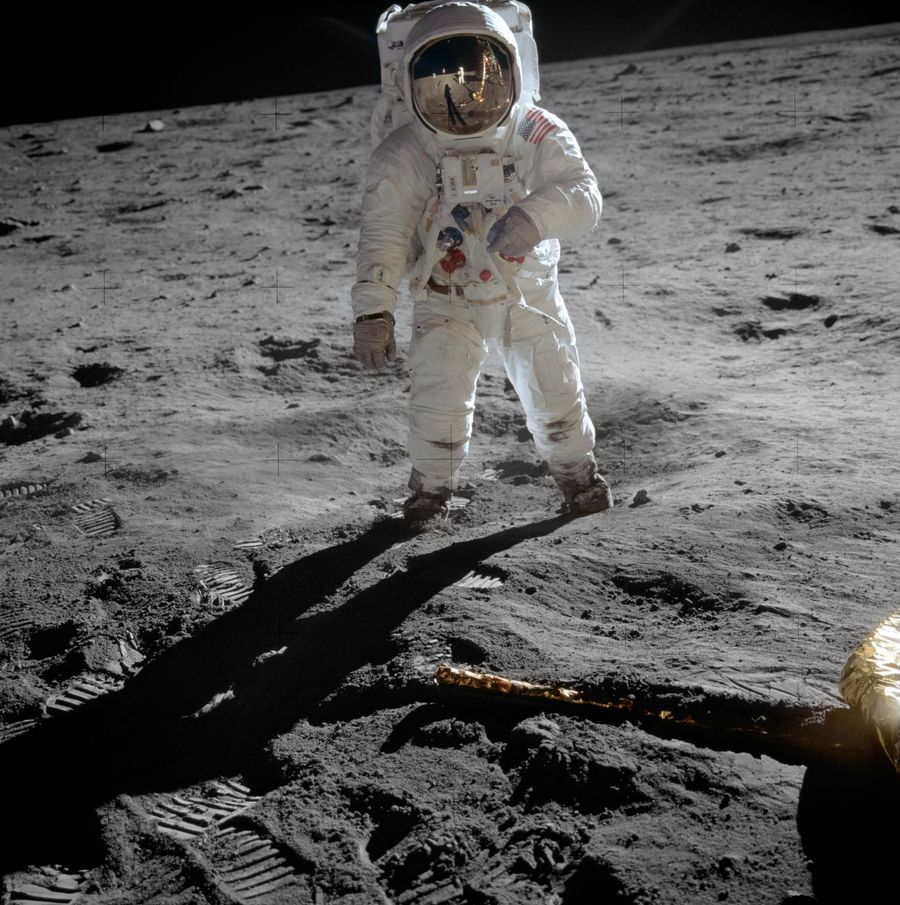
Nineteen minutes later, Aldrin stepped onto the surface and looked around: "Magnificent desolation." Before leaving the cabin, he had done something few people know about. He was an elder of his church, and he had carried bread and wine with him; in the Lunar Module, on the Moon, he took communion, and asked everyone listening to pause for a moment in their own way.
The two men worked on the surface for two hours and thirty-one minutes, collecting about 21.5 kilograms of rock and soil, setting up instruments, planting an American flag, and uncovering a plaque on the Lunar Module's leg. It read: "Here men from the planet Earth first set foot upon the Moon, July 1969, A.D. We came in peace for all mankind." Below it were the signatures of the three astronauts and President Nixon. A small silicon disc was left on the surface too, etched with goodwill messages from seventy-three countries.
That night, President Nixon telephoned from the White House — "the most historic telephone call ever made", as he put it. Few people know that the White House had also prepared a second speech, in case the two men could not come home: "Fate has ordained that the men who went to the Moon to explore in peace will stay on the Moon to rest in peace."
Armstrong took the great majority of the photographs — and he himself appears in only five of them.
CHAPTER FIVEThe Way Home
At 17:54 on 21 July, Eagle's ascent stage lifted off, returned to lunar orbit, and docked with Columbia. Collins, at last, was not alone any more. On 24 July, Columbia re-entered the atmosphere and splashed down in the Pacific, where the aircraft carrier USS Hornet recovered it. The whole mission had lasted eight days, three hours, eighteen minutes and thirty-five seconds.
The three men went straight into quarantine — at the time, no one could be entirely sure the Moon did not harbour germs the Earth had never met.
EPILOGUEThe Footprints Are Still There
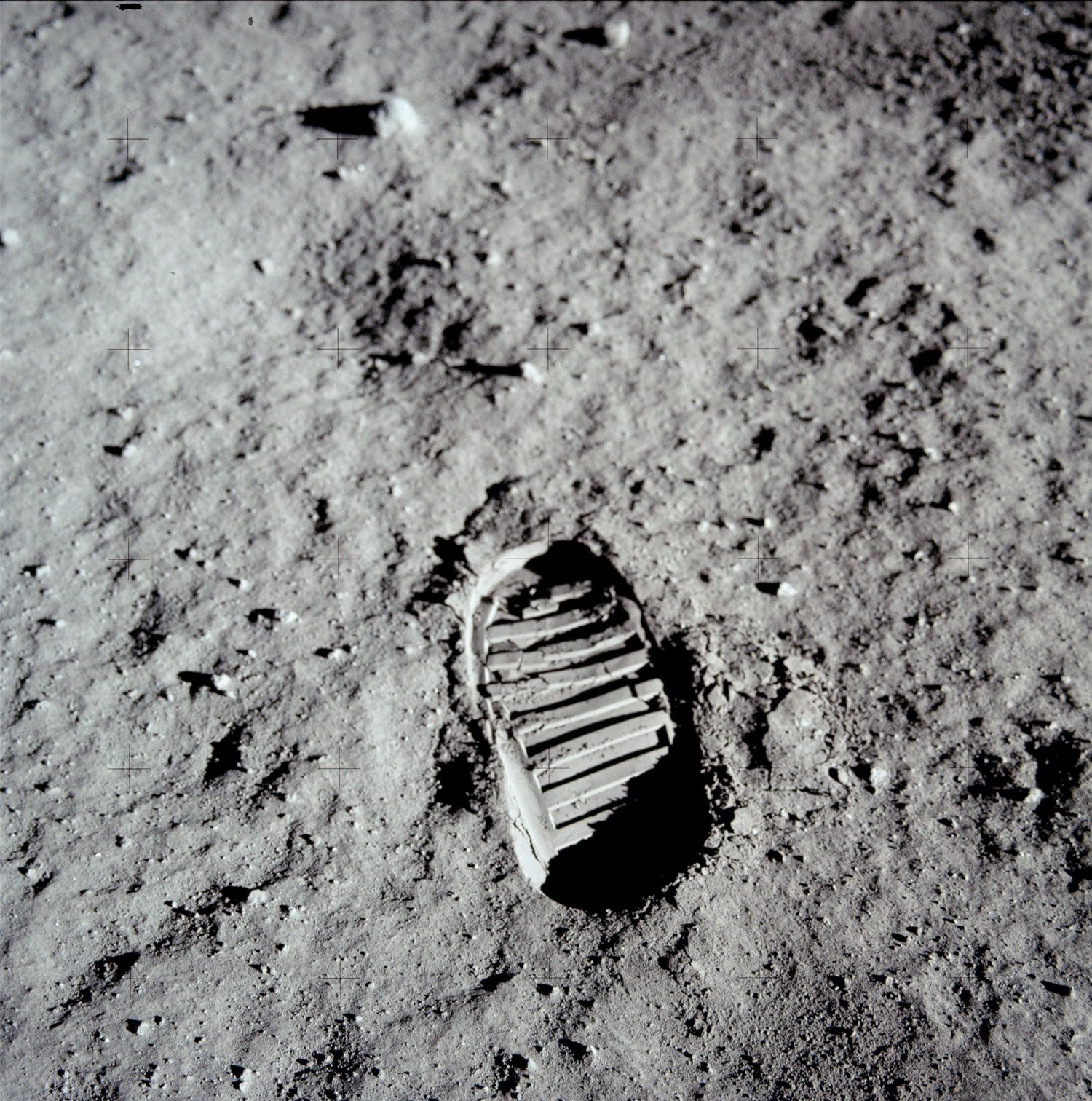
After Apollo 11, five more missions carried people to the Moon; by Apollo 17 in 1972, twelve men had walked on its surface. In the half-century since, no one has gone back. The descent stage still stands in the Sea of Tranquility, the plaque is still there, the flag is still there, and the footprints are still there — the Moon has no wind and no rain, and nothing will ever wash them away.
What Apollo 11 left behind was more than a flag and a plaque. It proved that a promise with a clear deadline can turn 400,000 strangers into a single crew; that a computer flashing alarms can still hold together to the last second, if it was designed right; and that one man's small step became a giant leap for mankind not because the step was long, but because, in that moment, 600 million people looked up at the same time, in the same direction.
Half a century has passed. The Moon is still there. The footprints are still there. And the promise is still there — waiting for the next person willing to give it a deadline.
Questions That Remain Open
In honesty, the following two things have no settled answer, and this essay does not pretend otherwise:
- How much fuel was actually left when Eagle landed? The gauges showed about twenty-five seconds remaining, while post-flight analysis put it closer to forty-five; the two figures still stand side by side.
- Did Armstrong actually say "a"? He had meant to say "for a man", but the little word was lost in the radio, and the sentence has carried an eternal bracket ever since.