PrologueThe Last Day No One Died of Smallpox
On May 8, 1980, in Geneva, delegates at the World Health Assembly rose to applaud a resolution without precedent in human history: smallpox was gone.
No fireworks went off that day, and no one quite knew what to celebrate. The last person to catch the disease naturally had already recovered in 1977; the last person to die of it had died in a laboratory accident.[2] May 8, 1980 was simply the day the world finally dared to say out loud what had already happened — a disease that had followed humanity for at least 3,000 years now existed only in two laboratories.[2]
The numbers come first, because numbers are the only scale this victory has. In the 20th century alone, smallpox killed an estimated 300 million people; in its last hundred years on Earth, it killed at least half a billion.[5] And wiping it out cost roughly $300 million in total.[9] One disease, one century, 300 million lives — $300 million. Remember that symmetry.
This is not the biography of a virus. It is the story of a psychological war: how fear tamed humanity for three thousand years, and how, within a single generation, humanity tore fear out by the roots.
Chapter 1Fear, Enthroned
Smallpox had been with us for at least 3,000 years. The mummy of the Egyptian pharaoh Ramses V still bears what look like smallpox pustules on its face, and the earliest written description of the disease comes from China in the 4th century.[2] After that it travelled with trade, war and colonisation: to Japan in the 6th century, into North Africa and Spain with Arab expansion in the 7th, back to Europe with the Crusades in the 11th, across the Atlantic in the 16th, and into North America in the 17th.[2]
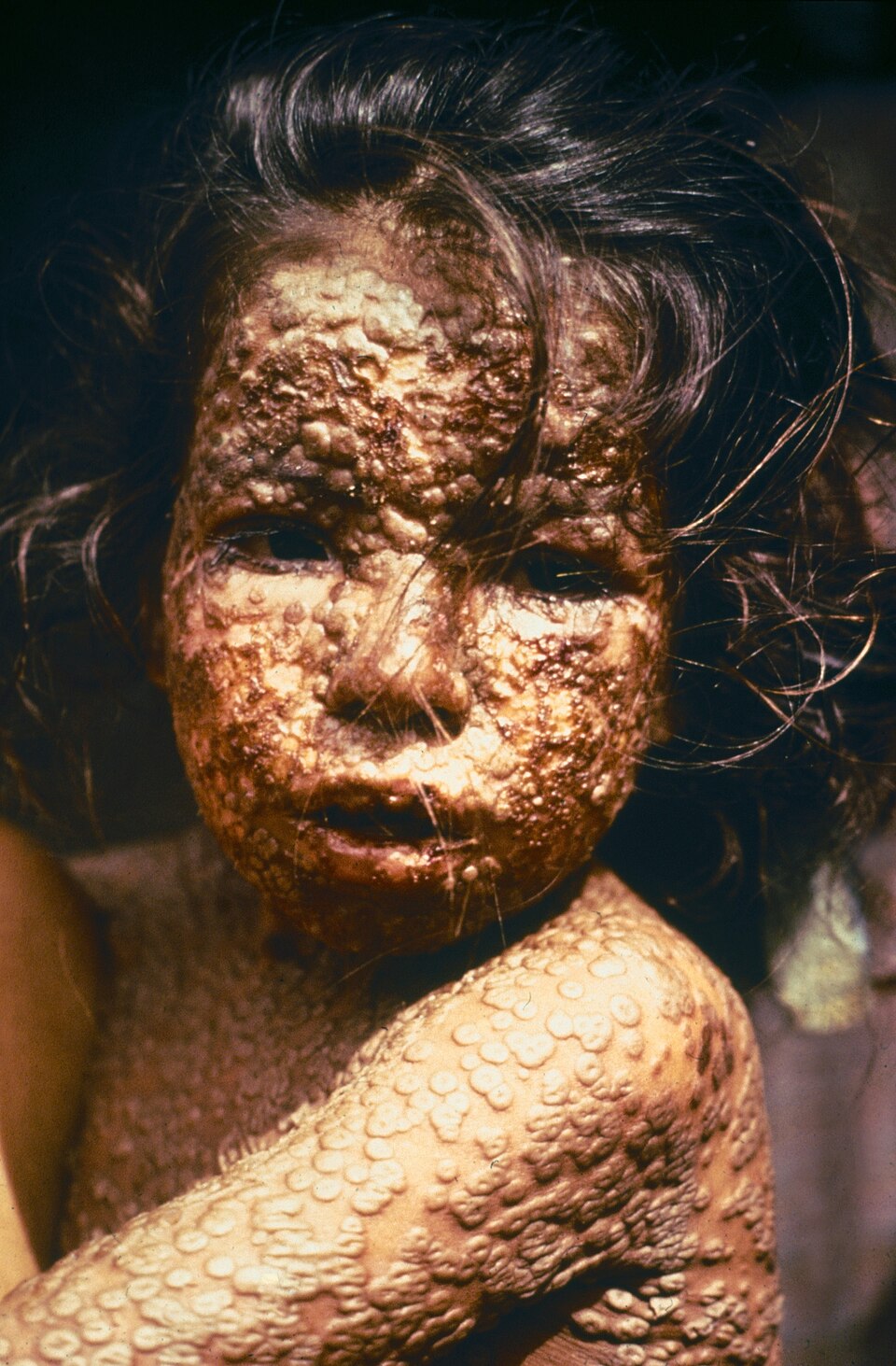
It needed no clever tricks. It infected only humans, spread through droplets and touch, hid for 10 to 14 days, then brought fever and a rash that covered the whole body within 24 hours.[5] About 3 in 10 who caught it died; those who lived carried pockmarked faces for life, and some went blind.[2] In 17th-century Britain, a child was not truly counted as a member of the family until it had survived smallpox — the death rate was so high that parents dared not invest their love too early.[5]
In 18th-century Europe, about 400,000 people died of smallpox every year.[15] That was not a wartime figure; it was the figure for ordinary years. A society losing 400,000 people a year did not collapse — because people had folded smallpox into everyday life. It was divine punishment, fate, constitution, climate — anything, except the one explanation no one wanted to face: that we could do nothing about it.
Once fear is enthroned, it stops being a problem and becomes part of the order of things. Disease becomes background, and background does not need solving. Smallpox’s cruellest talent was not killing; it was making killing seem natural. It was visible — anyone could recognise a face covered in pustules — so people learned to spot it, avoid it, isolate it, and to push the sick outside the group. A pockmarked face became a brand, a warning to everyone else: this person once stood close to death, and you should keep your distance.
Chapter 2Powder Up the Nose
The turning point came from a simple observation: those who survived smallpox never caught it again. People in China and India had noticed this before the year 1000.[5] If surviving the disease bought immunity, could you choose a milder version of the disease to survive?
The answer was variolation. Between 1567 and 1572, the practice spread across China: dried smallpox scabs were ground to powder and blown up a healthy child’s nose, or a cotton plug soaked in pus was tucked into a nostril.[20] Li Shizhen recorded the earliest written description of the method in his Compendium of Materia Medica in 1596.[20] By the end of the 17th century, the Kangxi Emperor — himself a smallpox survivor — had his whole family inoculated.[11]
Variolation was a gamble, and the stakes were not small. It used live smallpox virus; the inoculated person could fall ill and die, or pass the virus on while sick. It did not eliminate risk — it moved risk from “whatever heaven decides” to “a bet I place myself”. But that shift was itself a revolution: for the first time, humanity stopped asking “will heaven spare me?” and started asking “how much risk am I willing to take, for how much safety?”
The technique travelled west along the trade routes. In 1717, Lady Mary Wortley Montagu, wife of the British ambassador in Constantinople, saw variolation in practice; on March 18, 1718, she had the embassy physician inoculate her son, and in April 1721, back in London, her daughter.[11] Word reached the royal family, and in 1722 the two daughters of the Princess of Wales were variolated after successful trials.[5] From a nostril in Beijing to a drawing room in London, variolation took nearly 200 years to travel.
Variolation did not end smallpox. It proved only one thing: fear can be calculated. And people who can calculate fear will sooner or later find a cheaper way to do it.
Chapter 3The Milkmaid’s Hand
On May 14, 1796, Edward Jenner, a country doctor in Gloucestershire, took a little pus from a cowpox sore on the hand of the milkmaid Sarah Nelmes and inoculated it into the arm of eight-year-old James Phipps, the son of his gardener. On July 1, Jenner inoculated the boy with smallpox matter, and the boy did not fall ill. In 1798, Jenner published 23 case histories as An Inquiry into the Causes and Effects of the Variolae Vaccinae.[7]
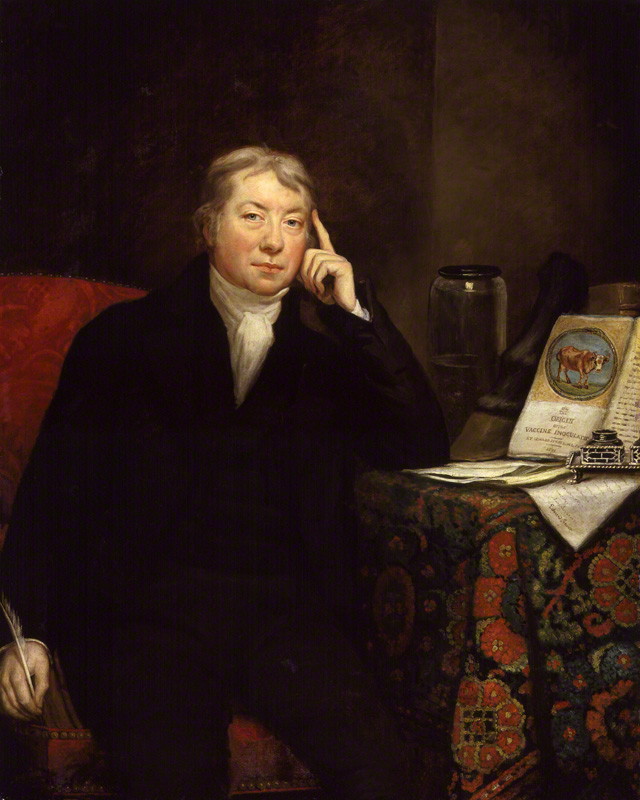
Jenner was not the first to think of cowpox. Country lore already said that milkmaids who had caught cowpox never caught smallpox. Jenner’s real contribution was not a flash of genius but turning a folk tale into something repeatable, transmissible and testable — written down, published, open to challenge.[7]
But this history has a dark side. Phipps was eight years old, a gardener’s son; by today’s standards, the experiment left no record of informed consent.[21] In 1801, Jenner wrote of his hope that “the annihilation of the smallpox, the most dreadful scourge of the human species, must be the final result of this practice.”[2] He was right about the result, but he left no defence for the way he got there. Scientific progress is often like that: the answer is correct, and the method would not survive scrutiny today. Remembering that matters more than remembering a hero.
Cowpox inoculation — soon called “vaccination”, from vacca, the Latin for cow — gradually replaced variolation. In 1853, Britain made vaccination compulsory.[18] The vaccine travelled on, to every corner where smallpox remained. The last endemic case in the United States appeared in 1949; in 1972, the United States stopped routine childhood vaccination.[17] A tool used for nearly 200 years could finally retire — but before it did, there was one hard campaign left to fight.
Chapter 4An Alliance Inside the Cold War
In 1959, the Soviet Union proposed to the World Health Assembly that smallpox be eradicated worldwide.[17] At the time it sounded almost delusional — the disease was still endemic in more than 30 countries and killing about 2 million people a year. In 1966, the Assembly approved a ten-year plan, and the American epidemiologist D. A. Henderson arrived in Geneva to run the Intensified Eradication Programme.[17]
In 1967, the year the intensified programme began, between 10 and 15 million people still caught smallpox, and about 2 million died of it.[5] Henderson’s problem was not medical but logistical and organisational: how to get vaccine into every village, find every patient, and get more than 30 governments moving at once.
The answer hid in three unglamorous tools. The first was freeze-dried vaccine: in the 1950s, Leslie Collier at Britain’s Lister Institute produced a heat-stable dried vaccine that stayed effective for 6 to 12 months at tropical temperatures — usable in villages with no refrigeration.[6] The second was the bifurcated needle: in 1968, Benjamin Rubin of Wyeth Laboratories invented a tiny forked steel needle that cost $5 per 1,000, could be reused more than 200 times, and could be mastered by a village health worker after 15 to 30 minutes of training; a single vial of vaccine costing less than $1 could vaccinate about 100 people.[6] The third was not an instrument at all but a method: surveillance and containment — find one case, vaccinate everyone around it, seal the chain of transmission. Better to find every patient than to vaccinate every person.[3]
The method had a crucial champion: the American epidemiologist William H. Foege. Working in Nigeria, he saw that instead of blanketing a whole country with vaccine, you could follow each chain of transmission to its end — find the patient, ring the patient, and the outbreak would burn itself out.[15] In 1970, an outbreak in south-west India produced more than 1,300 cases and 123 deaths; every available worker was mobilised for a house-by-house search, and the outbreak was sealed within a week.[9] That was surveillance and containment in its daily form: no miracle, only carpet-level patience.
The most extraordinary thing about this campaign was not the technology but the politics. The United States supplied money, people and organisation; the Soviet Union supplied vaccine.[9] Two nations pointing nuclear missiles at each other sat in the same room and planned how to kill the same virus. The Cold War did not stop, but in the face of smallpox the two camps signed the same battle plan. It was not goodwill; it was arithmetic. Smallpox recognised no borders — as long as one country had it, no country was safe. Once fear becomes a common enemy, even enemies can cooperate.
Progress came faster than anyone expected. South America was free of the disease in 1971, Asia in 1975, Africa in 1977.[2] The whole intensified programme cost about $300 million, two-thirds of it paid by the endemic countries themselves.[9] A disease that had killed 300 million people in a century was finished in ten years, for $300 million.
Chapter 5The Last Patient
In October 1975, on Bhola Island in Bangladesh, three-year-old Rahima Banu caught variola major — the last person in the world to be naturally infected with the deadlier strain. Health workers stood guard outside her house around the clock, vaccinated house by house within a 1.5-mile radius, and visited every home, school and meeting place within 5 miles, offering a reward for any reported case.[2]
The last patient of the milder strain hid better. On October 12, 1977, in Merca, Somalia, a hospital cook named Ali Maow Maalin rode with two smallpox patients to an isolation camp — a few minutes of contact. On October 22 he developed a fever; first he was treated for malaria, then, when the rash appeared, for chickenpox, because everyone assumed he had been vaccinated. On October 30, eradication staff finally diagnosed smallpox. Maalin was isolated and had fully recovered by the end of November.[2] He later became a polio vaccinator, and died of malaria on July 22, 2013, while working on a polio campaign.[2]
After Maalin recovered, the World Health Organization spent two years searching Africa for any face with a suspicious rash, and found nothing. On December 9, 1979, the Global Commission for the Certification of Smallpox Eradication signed its conclusion in Geneva;[3] on May 8, 1980, the World Health Assembly made it official.[2] Every day in between was the system vouching for an absence — proving that something does not exist is far harder than proving that it does.
But the victory had a tail. In August 1978, in the medical school of the University of Birmingham, medical photographer Janet Parker worked in a darkroom one floor above a laboratory studying smallpox virus. She fell ill on August 11 and died on September 11 — the last person to die of smallpox.[2] Her mother caught the disease while nursing her, and the head of the laboratory, Professor Henry Bedson, took his own life after the incident.[19] The official inquiry concluded that the virus had most likely travelled through a service duct from the laboratory below, though the exact route of infection has never been settled.[16]
After Parker, the world’s remaining smallpox samples were gathered into two places: the Centers for Disease Control and Prevention in Atlanta, Georgia, and the VECTOR institute in Russia.[2] The World Health Assembly recommended that all stocks be destroyed or transferred, but the samples in those two laboratories remain to this day.[5] Smallpox is gone from the world, but it has not left the world.
EpilogueAfter Eradication
The first lesson smallpox taught us is arithmetic. Three hundred million lives in a century; $300 million to end it — roughly a dollar a life, if you do the crude division. The figure is almost insultingly cruel, and it is also impossible to argue with: humanity was not unable to wipe out plagues. It was usually unwilling to pay for it.
The second lesson is about conditions. Eradication was not a miracle; it was a set of conditions that happened to line up: a virus that infects only humans, symptoms anyone can see, a vaccine that works and costs almost nothing, and a world willing to move at the same time. Remove any one of them and smallpox would still be with us. That is why it remains the only human disease ever eradicated — not because we do not want more, but because the conditions are so exacting.
The third lesson is about timing. On June 5, 1981, a year after smallpox was declared gone, the CDC’s Morbidity and Mortality Weekly Report carried a short item: five young gay men in Los Angeles with Pneumocystis pneumonia — a disease that only strikes the profoundly immunocompromised.[12] It was the first official report of what would become known as AIDS. A year after one plague took its bow, another one stepped onto the stage. Winning one war is not the same as winning them all.
Fear enthroned smallpox for three thousand years. What dethroned it was not courage, not prayer, not one genius’s flash of insight, but a system: numbers, maps, needles, health workers willing to walk into every village, and two hostile camps willing to call a truce against a common enemy. Systems sound boring. But a system is the only thing that can tear fear out by the roots.
No child born after May 8, 1980 has ever needed a smallpox vaccination. They will never know that their grandparents lived in a world where smallpox carried off millions of people every year. Perhaps that is what eradication really means: letting the next generation forget even the reason to be afraid.