PROLOGUEOne Dish Changed Medicine, and Took Seventeen Years to Do It
Before modern medicine, a small cut that turned septic, a bout of pneumonia, or an infection after childbirth could take a young life, and a surgeon could do nothing to stop the bacteria quietly multiplying in a wound. Penicillin changed all of that, but its story is not a fairy tale in which a genius has a flash of inspiration one morning and the world is saved from then on. It began with a petri dish forgotten in the corner of a laboratory, passed through more than a decade of indifference, then through a team in Oxford that purified the drug under the pressure of war, and finally through cooperation across the Atlantic and the industrial mobilisation of an entire country. From 1928 to 1945 — seventeen years in all — a discovery needed to travel the whole road from phenomenon to medicine, and that journey required not only one person's eyes, but many people's hands, much patience, and an age willing to pay the price. This essay tells what happened in those seventeen years, and what it leaves us to remember: a scientific breakthrough seldom belongs to one person; it belongs to a relay.
CHAPTER ONELondon, a Messy Laboratory
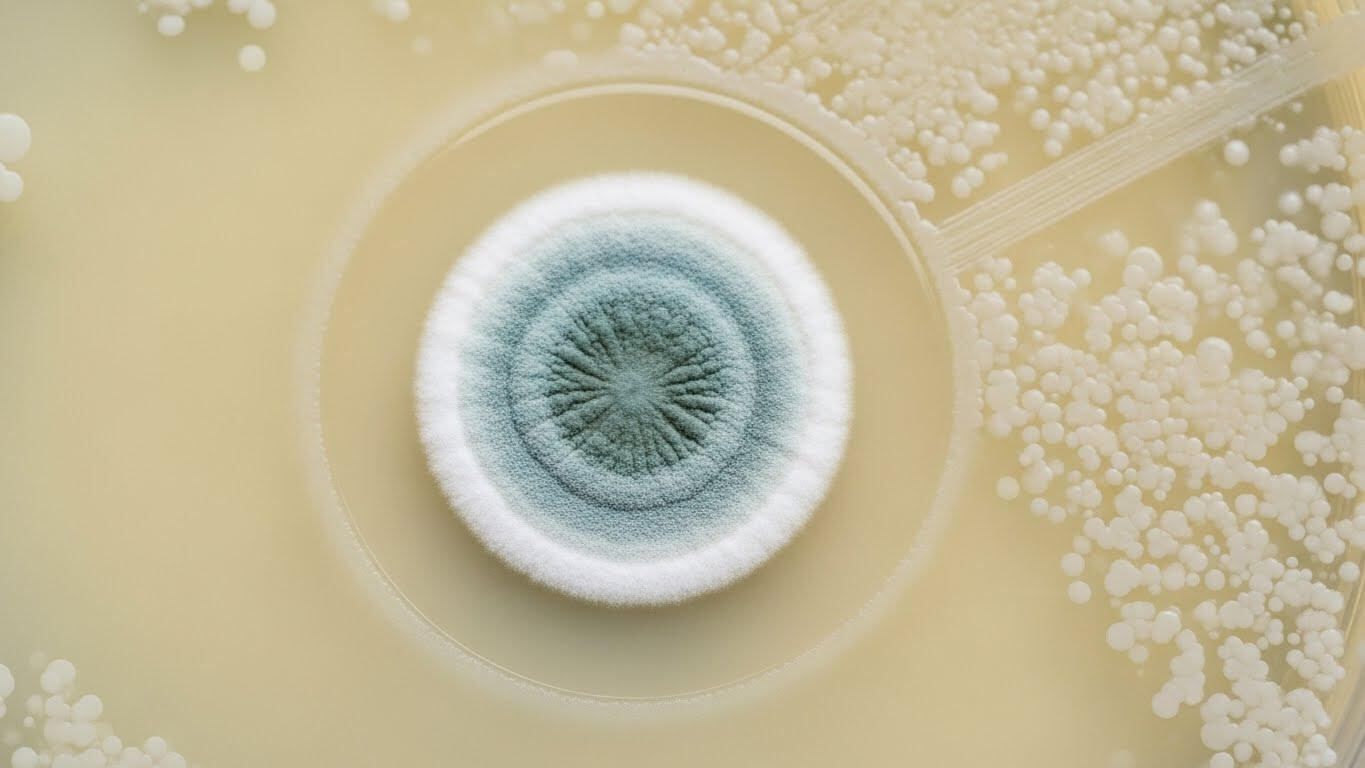
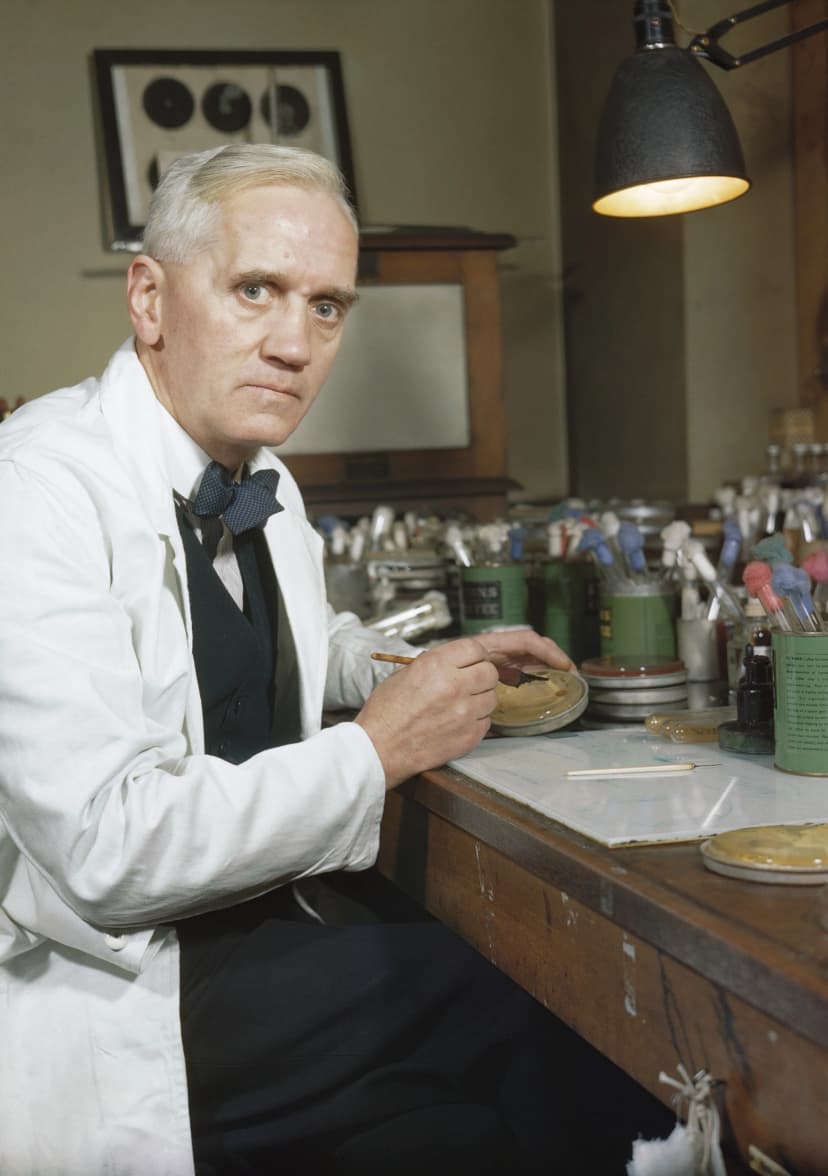
In September 1928, Alexander Fleming, a bacteriologist at St Mary's Hospital in London, came back from holiday and walked into his laboratory to tidy the pile of petri dishes on his bench. One of them, growing staphylococci, had been left beside the incubator and was meant to be thrown away. He picked it up, about to tip it out, and stopped. In one corner a tuft of green mould had grown, and around the mould the colonies of staphylococci had vanished, leaving a clean, empty ring, as though the bacteria had been held back by an invisible wall. Most people would have thrown the dish away — a contaminated sample, nothing more, to be discarded and remade. Fleming did not throw it away. He put the dish back under the microscope and looked at it again and again. He soon established that the mould belonged to the genus Penicillium, later identified as Penicillium notatum, and that it secreted some substance able to check or kill staphylococci. He named the substance penicillin and published his paper in June 1929 in the British Journal of Experimental Pathology. There he recorded that penicillin was active against a range of Gram-positive bacteria, including those that cause scarlet fever, pneumonia, gonorrhoea, meningitis, and diphtheria, and that it seemed to show no obvious toxicity to animal tissue. That was no small observation: a secretion from a mould that could kill bacteria selectively without harming the human body was exactly what medicine had long been looking for. Fleming asked several chemists to help him purify penicillin from the mould broth, but they all failed. The substance was too unstable and present in too small a quantity; the slightest handling destroyed it. In the end he could only keep the strain alive, culturing it generation after generation in his laboratory, waiting for someone he did not know would ever come.
CHAPTER TWOTen Forgotten Years
After Fleming's paper appeared, it drew almost no response. The scientific world did not oppose it; it simply did not take it seriously. In the eyes of medicine at the time, a mould juice that could not even be purified was not a drug, only a curiosity in a laboratory. What was more, chemical therapy in the 1930s was being drawn in another direction: the success of the sulfa drugs convinced many people that synthetic chemistry was the proper road against infection, and a natural secretion from a mould looked dirty and unreliable. Fleming himself did not pursue it relentlessly either; he went back to the bacteriology he knew best and set penicillin aside, taking the strain out now and then to keep it alive. Those ten years are often written up as a blank, as though nothing happened, but they show something important: the value of a discovery is not fixed at the moment it is made, but by whether anyone afterwards is willing to take it up and turn it into something usable. Many great observations die at exactly this point, not because they are wrong, but because they arrive too early, before the technique, the funding, and the attention of the time are ready to receive them. Penicillin did not die; it only slept, waiting in Fleming's laboratory for more than a decade. That the strain was preserved at all was itself a kind of foresight. Fleming applied for no patent and did not hide the strain away; when the people from Oxford came to him later, he handed it over at once. Whether a discovery travels far sometimes depends on whether its discoverer is willing to let it go.
CHAPTER THREEOxford, a Laboratory Turned into a Factory
The people who took it up appeared at the Sir William Dunn School of Pathology at Oxford. In the late 1930s, the Australian pathologist Howard Florey ran the school, and he had brought in Ernst Chain, a biochemist born in Germany, to work with him. Together they decided to study natural antibacterial substances systematically. Chain came across Fleming's 1929 paper in a pile of old literature and thought penicillin worth another try. In 1939 they assembled a small team: Chain took charge of chemical analysis and purification, Florey of the biological experiments, Norman Heatley of culturing and assay, and Edward Abraham and others joined them. The difficulties they faced were the same ones Fleming had met: penicillin was present in the broth in minute amounts, it was extremely unstable, and purification was slow and clumsy. Heatley found a way, controlling the acidity, keeping the extract cold, and repeating the extraction until the penicillin was concentrated little by little, and he devised a sensitive assay to measure the activity of each batch. The laboratory soon filled with culture dishes, and the researchers worked in shifts like factory hands, simply to gather enough drug for an animal experiment. In March 1940 Chain injected two mice with the concentrated extract and confirmed that it showed no obvious toxicity. On 25 May 1940 came the decisive day: the team injected eight mice with a lethal dose of haemolytic streptococci, and gave penicillin to four of them while leaving the other four untreated. Sixteen and a half hours later the four treated mice were alive, and the four untreated mice were all dead. On 24 August 1940 the team published the results in The Lancet, in plain language and with solid evidence. Between a contaminated petri dish and a group of cured mice lay twelve years, and what filled those years was not luck, but purification technique, assay methods, and a team willing to turn a laboratory into a factory.
CHAPTER FOURThe First Patient
Once the animal experiments had succeeded, the next step was a human being, but a human trial needed more than courage; it needed enough drug, and drug was exactly what the Oxford team lacked. On 12 February 1941 the first patient appeared: Albert Alexander, a forty-three-year-old police officer, under treatment at the Radcliffe Infirmary in Oxford. The best-known account of how he was injured says that he scratched his face on a rose thorn while pruning roses, and the wound became infected and developed into septicaemia; but later investigation and the testimony of his family indicate that he was more likely injured on 30 November 1940, when he was on support duty in Southampton during an air raid and his face was torn by the blast. The rose story circulated for decades, yet the wound from the war is closer to the truth, and the detail itself is a reminder: a moving legend is not necessarily a fact, and facts often emerge only when the people concerned and the records finally speak. Whatever the origin of the wound, Alexander's condition was by then beyond saving by any known means: abscesses covered his face and body, and he had already lost one eye. Florey's team injected him with what little penicillin they had, an initial dose of two hundred milligrams, followed by further doses every three hours. Within twenty-four hours his condition improved markedly; his temperature fell and his spirits recovered, and the team saw for the first time with their own eyes that penicillin worked inside a human body. But the improvement lasted only five days. The drug ran out, and although the researchers recovered penicillin from his urine and injected it again, it was not enough, and he died in mid-March, aged forty-three. Alexander's death was not proof that penicillin failed; quite the opposite, it proved that penicillin worked, only that there was far too little of it. A man who improves for five days and then relapses makes a more persuasive case than any paper: the question was no longer whether the drug worked, but whether it could be produced in enough quantity, fast enough. The team learned more from this painful failure than from any success. Progress in science is often not a straight line upwards, but a push forward from a failure that hurts.
CHAPTER FIVEWar, Corn, and a Rotten Cantaloupe
Britain, at war, had no capacity to mass-produce penicillin; its factories were coping with bombing, and raw materials and labour were scarce. In 1941 Florey and Heatley flew to the United States with the strain, looking for a way to industrialise it. They approached the Rockefeller Institute, the United States Department of Agriculture, and several large drug companies, and finally found their breakthrough at the Department of Agriculture's Northern Regional Research Laboratory in Peoria, Illinois. Researchers there discovered that growing the mould in corn steep liquor, a by-product of corn processing, raised yields greatly: output rose from four units per millilitre to forty, a full tenfold increase. Then came an episode that sounds almost like legend: a researcher brought back from a Peoria market a mouldy cantaloupe, and the strain of mould growing on it produced far more penicillin than Fleming's original strain, becoming the parent strain for industrial production. From small dishes in a laboratory to deep fermentation tanks, from Oxford to the American Midwest, the manufacture of penicillin moved step by step from handwork to industry. On 14 March 1942, Anne Miller of Connecticut, dying of streptococcal septicaemia, became the first patient in the United States to be cured by penicillin, and her dose was said to have used up nearly half of all the penicillin then in the country. On 6 June 1944, when the Allies landed in Normandy, the penicillin carried with the troops had, by the records, been prepared in the amount of 2.3 million doses, and wound infection, the historic killer on the battlefield, was held back on a large scale for the first time. In the same period, companies such as Pfizer built ever larger fermenters, and penicillin changed from a scarce laboratory product into a drug that could be supplied in batches. War was cruel, but it also forced a medical discovery into industrial reality with an urgency that allowed no delay. Without the pressure of war, mass production might have waited another ten years; yet precisely because of the war, penicillin reached the battlefield before it reached every ordinary person's medicine cabinet.
EPILOGUEThe Relay Is the Real Discovery
In 1945 the Nobel Prize in Physiology or Medicine was awarded to Fleming, Florey, and Chain, for the discovery of penicillin and its curative effect in various infectious diseases. Heatley received no prize, yet no one can deny that his work on purification and assay was indispensable to the whole story. The very division of the award explains the truth of penicillin: it was never one person's achievement, but a relay. Fleming saw the phenomenon; Florey and Chain turned it into a medicine; Heatley and Abraham made it measurable and purifiable; the researchers at Peoria and the American drug companies made it producible in quantity; and Alexander and Miller proved with their own bodies that it truly worked in human beings. Take away any one leg of the relay and the story breaks off halfway. We are used to writing science as the biography of geniuses, fond of a single name, a single photograph, a single flash of insight, but penicillin reminds us that what truly changes the world is often the people whose names never appear on a medal: those who took shifts culturing mould in a laboratory, who recovered the drug from a patient's urine in wartime, who brought home a rotten cantaloupe from a market. For readers today, the story carries two lessons. The first is about observation: the reason Fleming could see what others could not was not that he was especially lucky, but that he understood bacteria and knew what a clear ring meant; luck favours only a prepared eye. The second is about letting go and taking up: for a discovery to live, its discoverer must be willing to hand over the strain, those who take it up must be willing to acknowledge the work of those before them, and society as a whole must be willing to pay for research that has not yet paid anything back. Penicillin took seventeen years to travel from a forgotten petri dish to the beaches of Normandy, and not one step of those seventeen years was wasted. Many of the problems we face today, from new infectious diseases to drug-resistant bacteria, need the same kind of relay. The question is not whether we lack geniuses, but whether we have the patience to let a small, seemingly insignificant observation be passed along, hand to hand, until it becomes something that can save a life.
Questions That Remain Open
In honesty, the following two things have no settled answer, and this essay does not pretend otherwise:
- How was the first patient, Albert Alexander, actually injured? The best-known story says he cut his face on a rose thorn while pruning, but later investigation and family testimony suggest he was more likely wounded in an air raid on Southampton on 30 November 1940; the moving legend may not be the truth.
- Did Anne Miller's dose really use up nearly half of all the penicillin then in the United States? The essay says only that it was "said to have" done so, and the figure remains unverified.