Prologue11:58 a.m.: Lunchtime in Tokyo
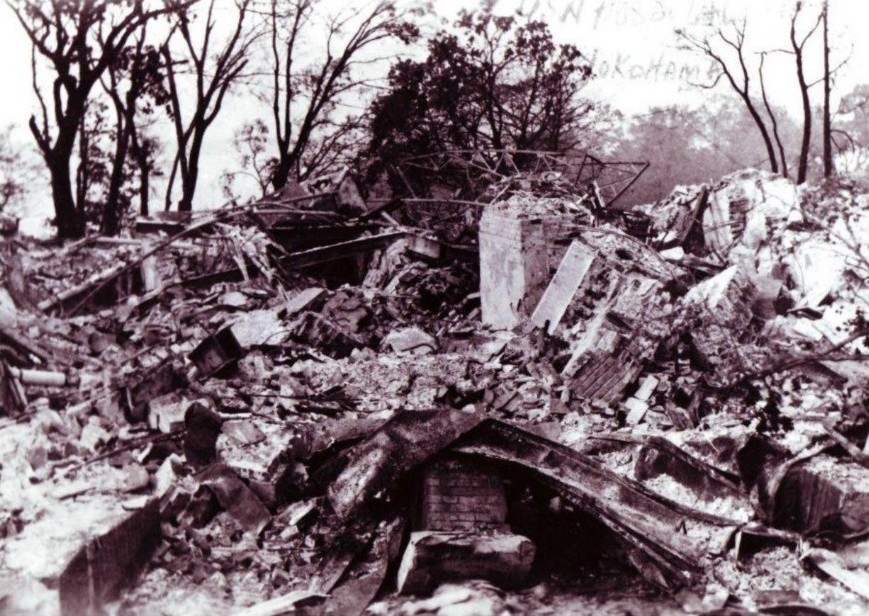
On Saturday, 1 September 1923, at 11:58 a.m., Tokyo was about to eat lunch. Beneath Sagami Bay, a fault slipped, and a magnitude 7.9 shock rolled toward Tokyo and Yokohama. Houses fell, cooking fires tipped over, and within minutes whole districts were burning.
Some 105,000 people died or went missing, about 92,000 of them in the fires; more than 370,000 houses were destroyed or damaged, and millions were left homeless.[1] On the open ground of the former Army Clothing Depot in Honjo — where people had fled believing open space meant safety — a firestorm killed about 38,000 people in a single place. It was not Japan's first earthquake, nor its last. But after the Great Kantō Earthquake, something never went back: humanity saw, with terrible clarity, how fragile a modern city is before the ground beneath it.
Fragility forced a new civilisational lesson. Not the conquest of earthquakes — no one conquers earthquakes — but learning to hear them. From a bronze vessel that spat out a ball to a global network of seismometers; from treating tremors as heaven's rebuke to giving them a number, and then to snatching a few seconds' warning before they arrive. It took humanity nearly 2,000 years to turn "the ground moves" from a terror into something measurable, warnable, and liveable. This book tells the story of that long lesson in listening.
Chapter OneThe Dragon Spat Out a Ball
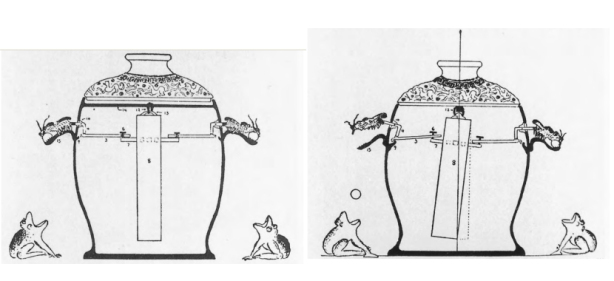
In 132 CE, in Luoyang, capital of the Eastern Han dynasty, the court astronomer Zhang Heng presented the imperial court with a strange object: the houfeng didong yi, an "instrument for measuring the seasonal winds and the movements of the Earth." It was a bronze vessel shaped like a wine jar, about two metres across, its surface decorated with mountains, tortoises, birds and beasts, and crowned with a domed lid. Around its outside stood eight dragon heads, each holding a bronze ball in its jaws; beneath each dragon squatted a toad with its mouth open. Inside hid a central pillar: when the ground moved, the pillar tripped a mechanism, a dragon's mouth opened, and the ball dropped with a clang into the toad below. Whichever dragon spat out its ball, the earthquake had come from that direction.[5]
Years later, on a day when no one in Luoyang felt the slightest tremor, a ball dropped. The court murmured that the instrument was nothing but an elaborate toy. Days afterwards, a messenger arrived from the west: an earthquake had indeed struck Longxi, some 400 to 500 kilometres away. The seismoscope had heard a sound no human ear could hear.
The story is told vividly in the Book of the Later Han, but scholars have argued about it ever since. The original is long lost, the history was compiled some 300 years after Zhang Heng's death, and no one can say how much of the tale is legend. In 2005, a team from the Chinese Academy of Sciences announced a working replica; other scholars note that a different record from the same year says the tremor was in fact felt in the capital, and that the detail of "no one felt it" may be a later embellishment. Whether or not the story is true in every detail, the seismoscope's real legacy is not its accuracy but the turn of mind it represents: an earthquake was no longer only heaven's punishment or a disturbance of yin and yang. It was an event with a direction and a distance — something that could be identified and inquired into. Humanity's first step from divination toward measurement was a bronze ball in a toad's mouth.
It was a step humanity took slowly. Europe would not build a comparable instrument until 1856, when the Italian scientist Luigi Palmieri made his own seismoscope — more than 1,700 years after Zhang Heng.
Chapter TwoGiving the Shaking a Number
In 1935, Charles Richter and Beno Gutenberg at the California Institute of Technology proposed a deceptively simple idea: give every earthquake a number. The Richter scale takes the logarithm of the amplitude of seismic waves, so that each whole step up the scale means about 32 times more energy released. From then on, an earthquake was not merely "big" or "very big"; it could be compared, ranked, and entered into tables. A city's fear finally had a scale.[2] By the late 1970s, Hiroo Kanamori and Thomas C. Hanks had developed the moment magnitude scale, which became the standard for measuring great earthquakes; the Richter scale remained the name most often heard in everyday reporting.
The numbers brought new sight. On 22 May 1960, a magnitude 9.5 earthquake struck near Valdivia, Chile — still the largest earthquake ever recorded by instruments, its rupture running for more than a thousand kilometres along the fault. It also posed a riddle: why do earthquakes cluster in certain places and not others? The answer surfaced in the same decade. In 1962, Harry Hess published The History of Ocean Basins, proposing seafloor spreading; in 1963, Vine and Matthews found symmetrical stripes of magnetic anomaly on the ocean floor; in 1968, Morgan, McKenzie and Le Pichon assembled the first complete model of plate tectonics. Alfred Wegener's theory of continental drift, proposed half a century earlier, finally had a mechanism.[3]
The crust, it turned out, is not a single hard shell but a jigsaw of a dozen or so great plates, drifting on the slowly flowing mantle. Where plates push, grind and dive beneath one another, energy gathers along their boundaries until the rock can bear it no longer and releases it all at once — that is an earthquake. Earthquakes were no longer isolated calamities but the inevitable sounds of a planet at work. Once humanity knew where the sound came from, it could begin to ask a new question: could we hear it coming?
Chapter ThreeA Few Seconds of Dignity
Seismic waves come in two kinds. Fast P-waves arrive first and do little damage; slower S-waves arrive later and do the destroying. Between them lies a gap of seconds to tens of seconds. Early warning systems bet everything on that gap: instruments near the epicentre catch the P-wave, computers estimate the magnitude and shaking at once, and the alarm reaches distant places before the S-wave does.
On 17 January 1995, a magnitude 6.9 earthquake struck Kobe, killing about 6,400 people. Japan resolved to invest heavily in warning, and on 1 October 2007 the Japan Meteorological Agency's Earthquake Early Warning went into full service — the world's first nationwide system. Taiwan followed the same road: after the 1999 Chi-Chi earthquake killed more than 2,400 people, the Central Weather Administration worked with academia to build its own system, first for institutions in 2009 and for the public in 2014 — the world's second nationwide system.[6]
One thing must be said plainly: early warning is not prediction. No one can say in advance when and where an earthquake will strike; warning can only win a few seconds after the quake has already begun, before the destruction arrives. The 2011 Tohoku earthquake reminded the world that warnings can underestimate magnitude and cry false alarms — the system is imperfect. But a few seconds are enough for a bullet train to brake, for a lift to stop at the nearest floor, for hands in an operating theatre to steady themselves, for children in a classroom to duck under their desks. Dignity lies not in controlling the earth but in refusing to be caught unprepared. A few seconds — that is the terms humanity has finally negotiated with the ground beneath it.
Chapter FourLiving with the Ground Beneath Us
Someone had warned Tokyo before the Great Kantō Earthquake. The seismologist Akitsune Imamura had argued years earlier that a great disaster would strike the Kantō region sooner or later, and urged the country to prepare.[4] The warning was issued; the city carried on building, and the cooking fires burned as usual. At noon on 1 September 1923, thousands of households were cooking at once, and when the ground moved, fire became a deadlier killer than the shaking itself. Disasters rarely come from the earth alone; more often they come from our own arrangements — dense wooden neighbourhoods, nowhere to run, news that arrives too late.
So disaster prevention was never only a matter of science; it is a matter of institutions. Seismic building codes write "it will happen again" into the bones of buildings; 1 September became Japan's Disaster Prevention Day, when the whole country rehearses evacuation; when the tsunami alarm sounds, running for high ground has become a reflex that needs no thought. On 11 March 2011, a magnitude 9.0 earthquake off Tohoku and the tsunami that followed proved again that measurement is not mastery: the warnings worked, but the sea still came over the seawalls. What survivors learned was not to build cleverer instruments but to choose building sites more humbly, to build more strongly, and to teach risk more honestly.
Living with earthquakes is a civilisational choice. Japan, Taiwan, Chile, California — all are doing the same thing: admitting that the ground beneath their feet moves, and then remaking their cities, their laws and their daily habits so that life can go on above moving ground. That is not surrender to nature. It is choosing, after accepting nature's terms, to live well anyway.
EpilogueHearing the Voice Beneath the Earth
From the bronze vessel in Luoyang to the global seismic networks of today, what humanity has learned is not how to silence the earth, but how to hear it. The seismoscope heard a quake hundreds of kilometres away; the Richter scale heard how big the shaking was; plate tectonics heard where it came from; early warning hears its footsteps approaching. Each act of listening has let humanity stand a little steadier before disaster.
Earthquakes remind us of one thing: civilisation is built on moving ground. We cannot predict when the next tremor will come, but we can decide where we will be standing when it does, what will be beside us, and whether we carry an escape route in our heads. Hearing the voice beneath the earth is not a way to abolish fear; it is a way to give fear something to do. Nearly 2,000 years of practice have taught humanity one last lesson, perhaps the simplest of all: humility is not defeat. Humility is how we survive.