PROLOGUE
How much can a flower be worth? In the Netherlands today, a bunch of tulips at the flower market is an ordinary colour of spring, sold by the bunch and by weight, and no one loses sleep over it. Yet nearly four hundred years ago, that same flower kept a group of shrewd, practical Dutchmen — people who had built a nation on trade — up at night, haggling, borrowing money, and signing written promises, only to watch those promises turn to waste paper within a few days. This is not a fairy tale but a story told and retold, and exaggerated again and again. Its real lesson is not how expensive the flower became, but how people talked themselves, step by step, into believing that a flower could keep getting more expensive for ever.
What is worth reading is not the numbers on the price list but the familiar psychology behind them: first admiration, then envy, then the fear of missing out, and finally the fear of admitting that one was wrong.
CHAPTER ONEFrom Constantinople to Leiden
The tulip was not originally a Dutch flower. In the sixteenth century it travelled from the Ottoman world into Europe, carried north through the letters and luggage of diplomats and botanists. Ogier Ghiselin de Busbecq, the Habsburg ambassador in Constantinople from 1554 to 1562, is often named as one of the key figures who brought the tulip to European attention. The man who gave it a firm place in scholarship and horticulture was the Flemish botanist Carolus Clusius. He published the first monograph on the tulip in 1576 and revised it twice over the following three decades, sending and receiving bulbs through a wide network of correspondents across Europe.
In 1593 Clusius moved to Leiden with his tulips to take charge of the university garden. The following spring the tulips flowered in Leiden, a year often taken as the beginning of tulip growing in the Netherlands. His bulbs were repeatedly stolen despite his efforts to prevent it, and the stolen bulbs became one of the earliest sources of material for the later Dutch bulb trade. A scholar's private garden thus became entangled with the commercial history of a nation.
The Netherlands at the time was on the rise in its Golden Age. Ships of the Dutch East India Company brought spices, porcelain, and wealth back to Amsterdam, and merchants' houses began to fill with rarities from far away: maps, shells, paintings, and a flower that bloomed unlike any other. At first the tulip was the plaything of scholars and wealthy collectors, a symbol of knowledge and taste.
CHAPTER TWOThe Beauty of the Broken Tulip
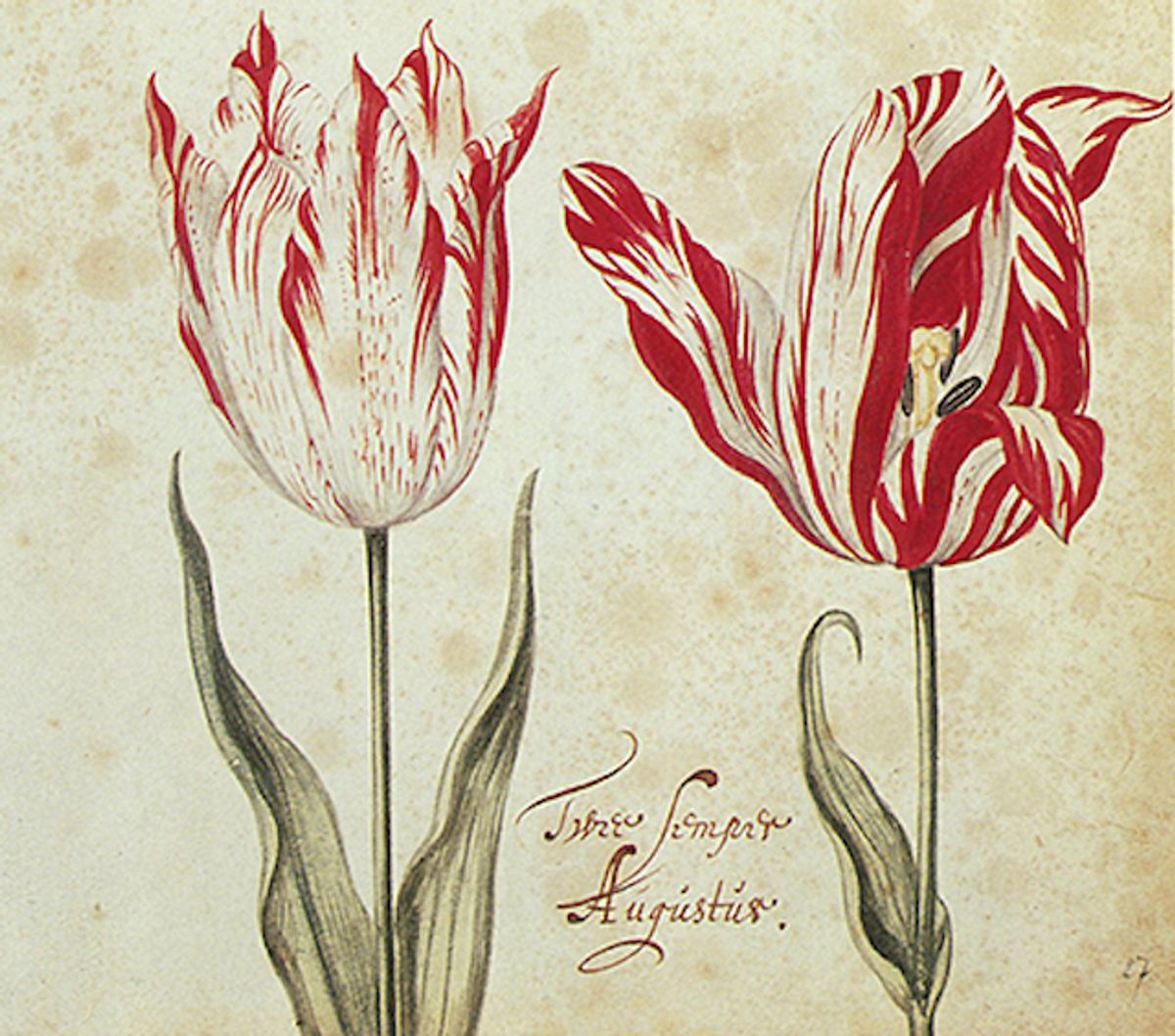
What truly sent prices soaring were the so-called broken tulips: their petals were covered in flame-like stripes, no two flowers alike, and people at the time believed this was a chance masterpiece of nature, worth a high price for beauty that could not be copied.
The answer did not arrive for nearly three hundred years. In 1928 the British mycologist Dorothy Cayley, working at the John Innes Horticultural Institution, grafted tissue from broken bulbs onto healthy ones and found that the striping travelled with the graft. It was not the result of breeding but of infection. By the 1960s researchers had confirmed the culprit as a mosaic virus spread by aphids, now known as tulip breaking virus. It disturbs the distribution of pigment in the petals, letting the underlying colour show through in streaks and creating the flame effect.
There is an irony in this truth: the most expensive flowers of the time were sick flowers. While the virus painted the petals, it gradually weakened the bulb. An infected bulb produced fewer and weaker offsets each year, generation by generation, until at last it could no longer flower and withered away. The most famous variety, Semper Augustus, white with crimson flames, was counted at only twelve bulbs in 1624, all in the hands of a single owner, and is now extinct. The Viceroy met the same fate. The rarity the market chased came precisely from this fragility that could not last.
We often assume that price reflects value, when price often reflects only scarcity and desire, and scarcity itself can come from a defect and a misunderstanding.
CHAPTER THREETrading in Winter
The tulip's rhythm of growth shaped the trade. A bulb can be dug up and delivered only during a few short months in summer; through the long autumn and winter it lies buried in the earth and cannot be moved. So buying and selling in winter meant buying not the flower before one's eyes but a promise for the following summer: a contract naming the variety, the weight, and the day of delivery, with the buyer paying a sum in advance, or only a small deposit, and settling the rest later. Seen today, this looks like an early form of a futures contract; at the time it was a practical answer to the seasons.
The practical answer itself was not wrong. What went wrong was that the answer was passed from hand to hand. In winter the contracts began to circulate in taverns and parlours: one person bought, sold days later at a higher price to the next, who sold again to the next. The bulb was still in the ground, the flower had not yet opened, but the price had already bloomed. According to price data assembled by the economist Peter Garber, a standard Semper Augustus bulb was valued at 2,000 guilders in July 1625 and at 6,290 guilders on 5 February 1637, at the height of the mania. A skilled craftsman at the time earned about 300 guilders a year, so that one bulb was worth roughly twenty-one years of wages. These are figures that survive in the records, not rumours from a tavern.
The steepest climb was concentrated between December 1636 and February 1637. Some sought-after varieties multiplied several times over in a matter of weeks. Haarlem, Amsterdam, and Alkmaar became the centres of trading, with people queuing before notaries to sign. Yet the participants were not the whole population of the imagination. The historian Anne Goldgar spent years in the notarial archives, court records, and wills of Haarlem, Amsterdam, Alkmaar, and Enkhuizen for her book Tulipmania, published in 2007, checking every transaction she could trace. She found only thirty-seven people who spent more than 300 guilders — more than a skilled craftsman's yearly income — on bulbs, and with one or two exceptions they were wealthy merchants who could afford it. The most expensive transactions with receipts behind them were around 5,000 guilders, which at the time was about the price of a well-appointed house.
A winter contract had a fatal quality: it hid the risk. The buyer thought he had only paid a deposit and was waiting for spring to receive his flower, when in fact he had staked months of his livelihood on a promise that had not yet flowered. The seller, too, had sold not merely a bulb but a future he might not be able to deliver. When everyone was looking only at the next buyer who would pay more, no one stopped to ask what the flower would be worth when spring came.
CHAPTER FOURThat Week in February
The collapse came quickly, almost without a dramatic scene. On 3 February 1637, at a routine bulb auction in Haarlem, the auctioneer kept lowering the price and no one in the room would bid. It was not a fierce sell-off but a disquieting silence. On 5 February, ninety-eight sales were still recorded, but prices had become wildly inconsistent, with the same variety fetching vastly different sums on the same day. That is how confidence breaks: not because someone shatters it, but because suddenly no one is willing to take over.
In the days that followed, the market ground to a halt. Many contracts could not be settled, buyers asked for cancellation or a discount, sellers insisted on performance, and disputes poured into town halls and courts. The cities intervened to mediate, and in Haarlem and elsewhere buyers were allowed to cancel a contract by paying about three and a half percent of the original price. No court ever enforced a tulip contract.
Unlike the legend, the Dutch economy did not collapse. Garber found no evidence of serious economic distress, and Goldgar could find no one who could be identified as bankrupted by tulips. Those truly hurt were a small number of people who had staked too much in winter, not the whole country.
A market built on the belief that the next person will pay more stops the moment there is no next person. What supported the price was never the flower, but the chain of people handing it on.
CHAPTER FIVEHow the Legend Grew
If the story had ended there, tulip mania would probably have remained a short note in Dutch local history. It became a story the whole world has heard because, two hundred years later, a Scottish journalist turned it into a moral fable. In 1841 Charles Mackay published Extraordinary Popular Delusions and the Madness of Crowds, and his chapter on tulips fixed the popular image: the whole nation mad for flowers, a sailor mistaking a bulb for an onion and eating it, bankrupts drowning themselves, commerce suffering a severe shock from which it took years to recover.
Mackay did no archival research. His material drew heavily on the German scholar Johann Beckmann's work of 1797, which in turn relied on satirical pamphlets and songs circulating around 1637. Those pamphlets were moral cartoons intended to mock speculators, not ledgers recording accounts. Mackay treated satire as reporting, and later writers treated Mackay as a source, layer upon layer, until exaggeration became common knowledge. The most often quoted list, which says that one Viceroy bulb was exchanged for two lasts of wheat, four lasts of rye, and a pile of other goods worth 2,500 guilders in total, corresponds to no recorded sale. It reads more like a price list in a fable than a line in an account book.
After the Wall Street crash, the financier Bernard Baruch had the book reissued in 1932, and from then on the tulip became the byword for every bubble.
Yet the popularity of the legend hides precisely what is worth learning. The trade in the archives was not absurd at all; it had a reasonable beginning and a logic dictated by the seasons. What went wrong was that, on a reasonable beginning, people step by step stopped asking: will anyone still want this flower next year?
EPILOGUE
The tulip itself was never at fault; it simply flowered and waited for the next spring. What went wrong was that people mistook a seasonal beauty for a wealth that could be copied without end.
The most useful thing to take from tulip mania is not the figure of 6,290 guilders but its structure: a real and scarce thing, a beauty that could not easily be copied, a market that had to trade in promises, and a group of clever people passing confidence to one another. The price was no longer the price of the flower but a measure of how much people trusted one another.
The next time you hear that something can only go up and never come down, think of that quiet auction in Haarlem: the same thought flashed through every mind — if I buy it now, whom shall I sell it to tomorrow? In the end every bubble has the same answer: no one.
Questions That Remain Open
In honesty, the following three things have no settled answer, and this essay does not pretend otherwise:
- Who actually brought the tulip into Europe? Later writers often name the ambassador Busbecq as one of the key figures, but the essay only records that he is "often named", and does not settle the claim.
- Is the most-quoted price list real? The claim that one Viceroy bulb was exchanged for two lasts of wheat, four lasts of rye and a pile of other goods worth 2,500 guilders corresponds to no recorded sale; it reads more like a price list in a fable than a line in an account book.
- How many people did the mania really reach? Goldgar found only thirty-seven people in the archives who spent more than 300 guilders, and no one who can be confirmed to have gone bankrupt over tulips — but no record in the archives is not the same as no one harmed, and the true scale of participation remains unclear.