PROLOGUE
In that week in October 1929, the weather in New York was nothing unusual. In the trading hall on Wall Street, the ringing of telephones, the ticking of the ticker tape, and the sound of footsteps blended together, much as they had on every morning of the previous ten years. What was different was that, after those few days, the way Americans talked about money changed for ever. Not because the fall on any single day was especially large, but because people suddenly discovered that what they had believed in all along had been borrowed.
Looking back at 1929 today, it is easy to think of it as a natural disaster: the market crashed, the banks failed, unemployment rose, and the ten-year Great Depression arrived. But to treat the crash as a natural disaster is to misunderstand it in the most unfair way. Before the crash, the United States had enjoyed a full decade of prosperity. Cars, radios, films, and instalment buying had entered ordinary homes, and the Dow Jones Industrial Average had risen from about 64 in August 1921 to 381 on 3 September 1929, an increase of nearly six times. At the end of the Roaring Twenties, almost everyone believed that America had found a road that only went up. The crash did not fall from the sky; it grew out of that belief.
Risk was never an abstract number but a way of life. When a society grows used to living on borrowed money, the bill will arrive sooner or later; no one knows on which day it will come.
CHAPTER ONEThe Sound of Prosperity
America in the 1920s was full of sound: jazz, films, cars, factories turning faster, and instalment buying bringing refrigerators and washing machines into middle-class homes — a new way of life: enjoy first, pay later.
The stock market became the most visible symbol of that way of life: from 1922 to 1929 the Dow Jones rose nearly fivefold, and teachers, shop assistants, and taxi drivers all began to talk about stocks. Buying shares did not require being truly rich, because there was a practice called buying on margin: with about ten percent of one's own money, one could buy a whole parcel of shares, borrowing the remaining ninety percent from a broker, with the shares themselves serving as collateral.
Put down one thousand dollars to buy ten thousand dollars of shares, and a ten percent rise in the price doubles your money. In the middle of October, the Yale economist Irving Fisher said publicly that stock prices had reached what looked like a permanently high plateau. That remark later became one of the most famous misjudgements in economic history, but it is worth remembering not because Fisher was not clever, but because at the time almost the whole of society wanted to believe it was true.
Beneath the prosperity lay two cracks that were not easy to see. First, the prices of many shares had long since run far ahead of the actual earnings of the companies behind them; people were buying not a company's future cash flow but the price the next buyer would be willing to pay. Second, the whole market was built on borrowing. According to figures from the New York Stock Exchange, brokers' loans reached a peak of about 8.5 billion dollars on 1 October 1929, more than the entire amount of currency then in circulation in the United States. Call-money rates rose to eight or nine percent in September, well above what ordinary commercial loans paid, a sign that money was already tight, yet people kept borrowing.
CHAPTER TWOBlack Thursday
The real turn came on Wednesday, 23 October 1929. In the last hour of trading that day, share prices fell suddenly, and the Dow Jones dropped by 4.6 percent, changing the mood of the market at once. The next day, Thursday, 24 October, when the opening bell rang, sell orders poured in like snowflakes, and the ticker tape could not keep up with the volume of trading, falling hours behind, so that investors across the country, looking at stale quotations, had no idea what their shares were actually worth.
That day about 12.9 million shares changed hands, a record for a single day. At noon, some of the most powerful bankers in America gathered at J. P. Morgan and Company at 23 Wall Street to discuss how to steady the market. They sent Richard Whitney, vice president of the Exchange, to the centre of the trading floor to buy a large block of United States Steel at 205 dollars a share, well above the market price. The gesture was like a carefully staged performance, intended to tell everyone that the great bankers were still there and rich men were still buying.
On that day the performance worked. The Dow Jones closed down only 6.38 points, about two percent, and the newspapers the next day wrote that the market had steadied; many people breathed a sigh of relief and thought the worst was over. But that relief came too early. Whitney's purchase bought time, not confidence. What had always supported the market was never the money of a few bankers but the belief of countless ordinary investors that tomorrow would be better. Once that belief began to shake, no single act of support could hold for more than a day.
By Monday the selling pressure returned, and investors preferred to take a loss and get out rather than wait any longer.
CHAPTER THREEBlack Monday and Black Tuesday
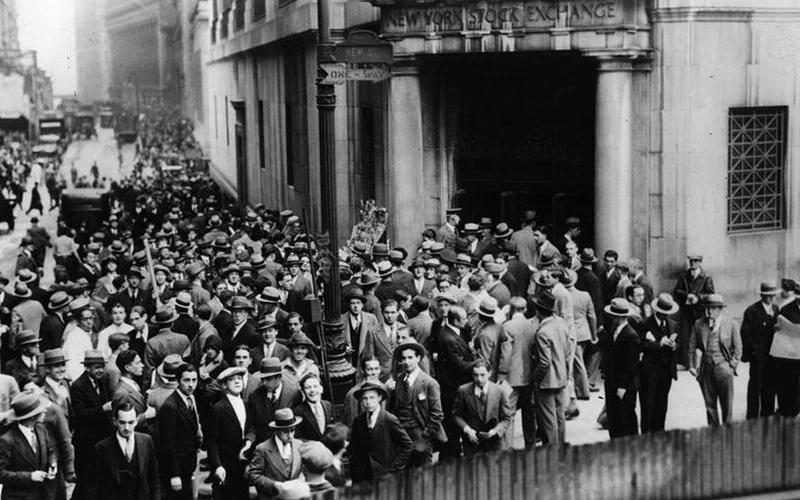
On Monday, 28 October, the Dow Jones fell 38.33 points, or 12.82 percent, the largest one-day fall on record at the time. The next day, Tuesday, 29 October, panic reached its height. For the whole day about 16.4 million shares changed hands, another volume record that would stand for nearly four decades. The Dow Jones fell a further 30.57 points, or 11.73 percent, so that over the two days it had fallen 23.05 percent in total. From the close on Wednesday, 23 October, to the close on Tuesday, 29 October, in just four trading days, the Dow had fallen by about a quarter.
The damage of those two days lay in the chain reaction it set off: when the price fell far enough, the broker would telephone with a margin call, and those who could not find the money had to watch their shares sold at the lowest point, while those forced sales pushed the price lower still, triggering the next round of calls.
Many people lost a lifetime's savings in those few days. Yet, unlike the image passed down afterwards, the crash did not bring a wave of investors leaping from windows; that story is largely an exaggerated urban legend. What is worth remembering is those who had to spend the next ten years gradually paying off debts and finding work again.
From the peak in September 1929 to the trough in mid-1932, the Dow Jones fell by more than eighty percent in total, to around 41. That peak was not regained until 1954, which means that a person who had bought at the peak in 1929 and held on would have had to wait twenty-five years to break even. In those twenty-five years America lived through the whole Great Depression, and the world lived through the Second World War. Behind the numbers lies the youth of an entire generation.
CHAPTER FOURLife After the Crash
The stock market crash itself was not the whole cause of the Great Depression, but it was its most visible trigger. The crash destroyed confidence in consumption and investment: businesses would not expand, households would not spend, banks would not lend, and the wheels of the economy stopped one by one. In 1933, the deepest year of the Depression, unemployment in the United States reached about twenty-five percent — one worker in four without a job — or about fifteen million people. Industrial production had fallen by nearly forty-seven percent from its peak, real economic activity had shrunk by about a third, prices overall had fallen by more than a quarter, and the money supply had contracted by more than thirty percent.
The wave of bank failures struck ordinary people more directly than the crash itself. Before deposit insurance was created, the failure of a bank meant that depositors simply lost their money. Between 1929 and 1933, close to ten thousand banks suspended operations, roughly one in three. Many banks had invested depositors' money in the stock market or lent large sums to speculators; when prices collapsed, the loans could not be recovered, and a run could bring down a bank that might otherwise have survived.
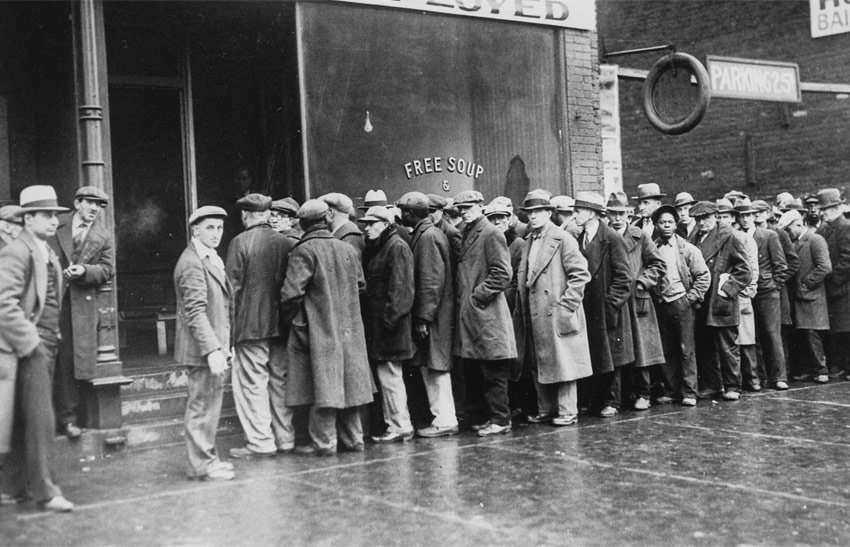
In the cities, breadlines wound around blocks; in the countryside, farmers watched grain prices fall below the cost of transport and poured away milk. Many families moved into shantytowns built from scrap wood and tin, called Hoovervilles, a name that carried a bitter joke about President Hoover. In their classic study of 1963, Milton Friedman and Anna Schwartz argued that the contraction of the money supply turned a severe recession into a historic catastrophe, which they called the Great Contraction.
But the Depression was not only despair. It forced Americans to rethink the relationship between the market and the government. Franklin D. Roosevelt took office as president on 4 March 1933, at once declared a nationwide bank holiday, and on 9 March pushed through the Emergency Banking Act, allowing the Treasury to examine banks and reopen only those that were sound. In June of the same year, Congress passed the Glass-Steagall Act, separating commercial banking from investment banking and creating the Federal Deposit Insurance Corporation, which at first insured each depositor's savings up to 2,500 dollars, so that depositors no longer needed to rush to withdraw their money for fear that a bank would fail. The Securities Act of 1933 required companies to disclose their finances honestly, and the Securities Exchange Act of 1934 created the United States Securities and Exchange Commission to regulate the market and punish insider trading and manipulation, while the Federal Reserve gained the power to set margin requirements, putting a limit on buying shares with borrowed money.
These reforms did not bring an immediate recovery, but they changed the rules of the game: from then on, deposits were insured, markets were regulated, and borrowing to speculate had a limit.
EPILOGUE
The most important lesson that 1929 leaves for later generations is not to avoid buying shares, but not to use borrowed money to pretend to be rich. The most dangerous thing about buying on margin is not that it can make you lose money, but that when you lose money it can take away even your right to choose. If the price falls ten percent, your own money is gone; if it falls further, the money you owe is still there, while your shares have been sold for you by someone else. That asymmetry is the true cost of leverage. Many people understood only after the crash that risk is not whether the price will fall, but whether, when it falls, you have the ability to wait for it to come back.
The other lesson is about confidence. Once confidence is lost, it takes ten years to rebuild. Fisher's remark about the plateau became a laughing-stock because he said what everyone at the time wanted to hear. The most dangerous moment in a market is often not when everyone is pessimistic, but when everyone believes that pessimism is impossible. When everyone believes that prices can only rise, there are no buyers left in the market, only people waiting to sell.
Margin, leverage, chasing the rise, and the fear of missing out have only changed their names; they have moved from the trading floor on Wall Street to the screen of a mobile phone. When the market is doing well, ask oneself a simple question: if it fell twenty percent tomorrow, could I still sleep at night? If the answer is no, then today's position is already too large. Respect for risk is not cowardice, but the acknowledgement of a simple fact: the market can be more patient than you, and also more ruthless. Learning that respect was what a generation of Americans spent ten years learning after the crash.
Questions That Remain Open
In honesty, the following two things have no settled answer, and this essay does not pretend otherwise:
- How much of the Great Depression was the crash itself? The essay says only that the crash "was not the whole cause of the Great Depression, but it was its most visible trigger"; what the other causes were, and how much each weighed, remains unsettled.
- Was the contraction of the money supply the key that turned a recession into a disaster? Friedman and Schwartz argued in their 1963 study that the shrinking money supply turned a severe downturn into a historic catastrophe; the essay cites that view without claiming it is the only explanation.