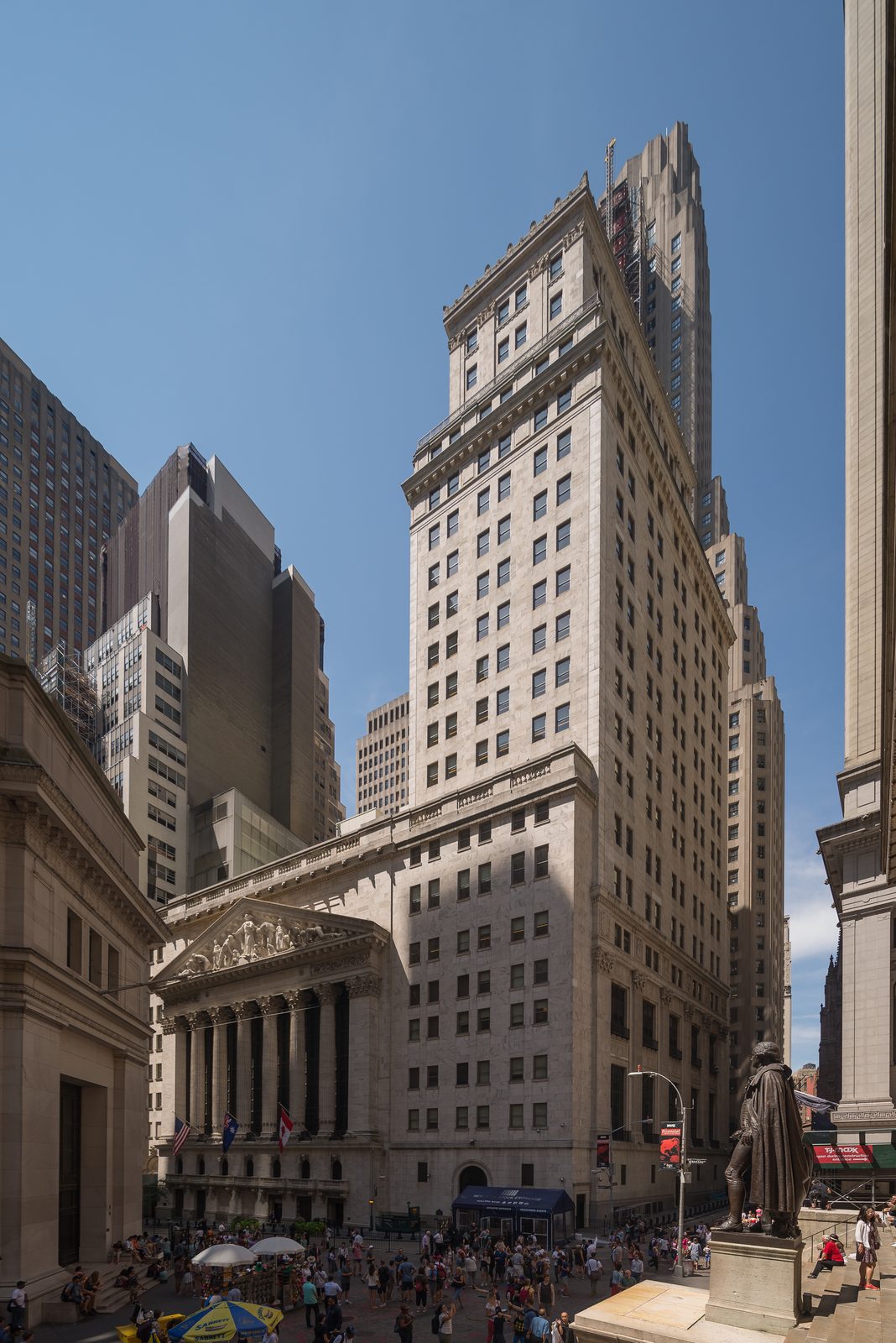
PrologueWall Street, Spring 1792
In the spring of 1792, securities prices in New York fell 30 percent in a matter of weeks. Fortunes vanished. Creditors chased debtors through the streets. The young city's credit evaporated overnight.
The panic began with one man: William Duer, a former assistant to Treasury Secretary Alexander Hamilton. Duer had tried to corner the market in government bonds and Bank of the United States stock, borrowing heavily to drive prices up. When his funds ran dry, prices collapsed. The New York legislature, furious, banned street trading and speculation — driving the market underground.[7]
The brokers realised that at this rate they would lose their livelihoods. In March they met in secret at Corre's Hotel; on May 17, twenty-four of them signed a paper beneath a buttonwood tree. The paper held only two sentences — yet it became the birth certificate of the largest stock exchange on Earth.
This is not really a story about a tree. It is a story about a question: what makes a market trustworthy? The answer of 1792 was simple — a sheet of paper, twenty-four signatures, and the words "we will deal only with each other."
Chapter OneHamilton's Gamble
Without Hamilton, there would have been no Buttonwood Agreement. In 1790, Treasury Secretary Alexander Hamilton pushed through his funding plan: the federal government would assume the states' war debts and issue new government bonds — the first time America possessed a tradable national credit. In 1791, the First Bank of the United States was chartered. Bonds, bank shares, and state debts made up the handful of securities traded in New York — only about five in all at the start.[1]
The market was the street. Brokers and auctioneers shouted prices in the open air on Wall Street, with no rules, no membership, and no guarantees. Anyone could sell; anyone could run. The Library of Congress puts it plainly: in the beginning there were five securities traded in New York City, and the first listed company was the Bank of New York.[1]
Hamilton's gamble was this: whether a newborn nation could borrow money depended on whether its bonds could be trusted. And trust needs an institution to hold it. Without one, a bond is just paper; with one, paper becomes money. In January 1790, Hamilton had laid out the plan in his Report on Public Credit: the federal government would honour its war debts at face value, turning a pile of IOUs into the foundation of national credit.
That same year, America did one more great thing. On April 2, 1792, the Coinage Act established a federal Mint, and the dollar became the nation's monetary unit. A new country invented its currency and its stock market in the same year — both sides of money, all at once.
Chapter TwoA Panic Made by Hand
Duer's scheme was not complicated. Early in 1792, he borrowed heavily to buy up 6 percent bonds and bank shares, hoping to drive prices sky-high and sell to latecomers. In March, his funding dried up, prices avalanched, and a chain of banks and merchants who had lent to him went down with him. Government bond prices fell as much as 30 percent in weeks, and the market seized up.[7][3]
The legislature answered with bans: no options trading without the underlying securities, no street trading. The bans were meant to protect the market; instead they drove trading into the dark. With the public market outlawed and private deals untrusted, auctioneers undercut commissions to zero, and nobody dared trade with a stranger.
The lesson of the panic is that markets rarely collapse because "things are not worth anything." They collapse because nobody believes the other side will perform. Once credit breaks, price is only the first domino to fall. Duer himself was soon jailed for debt — not defeated by the market, but by his own leverage.
The brokers faced a concrete problem: public outcry was banned, private trading had no trust, and commissions were being cut to nothing by auctioneers. What they needed was not more trading, but a place where trading could happen again — a circle of people who knew each other and could not simply run away.
Chapter ThreeTwo Sentences
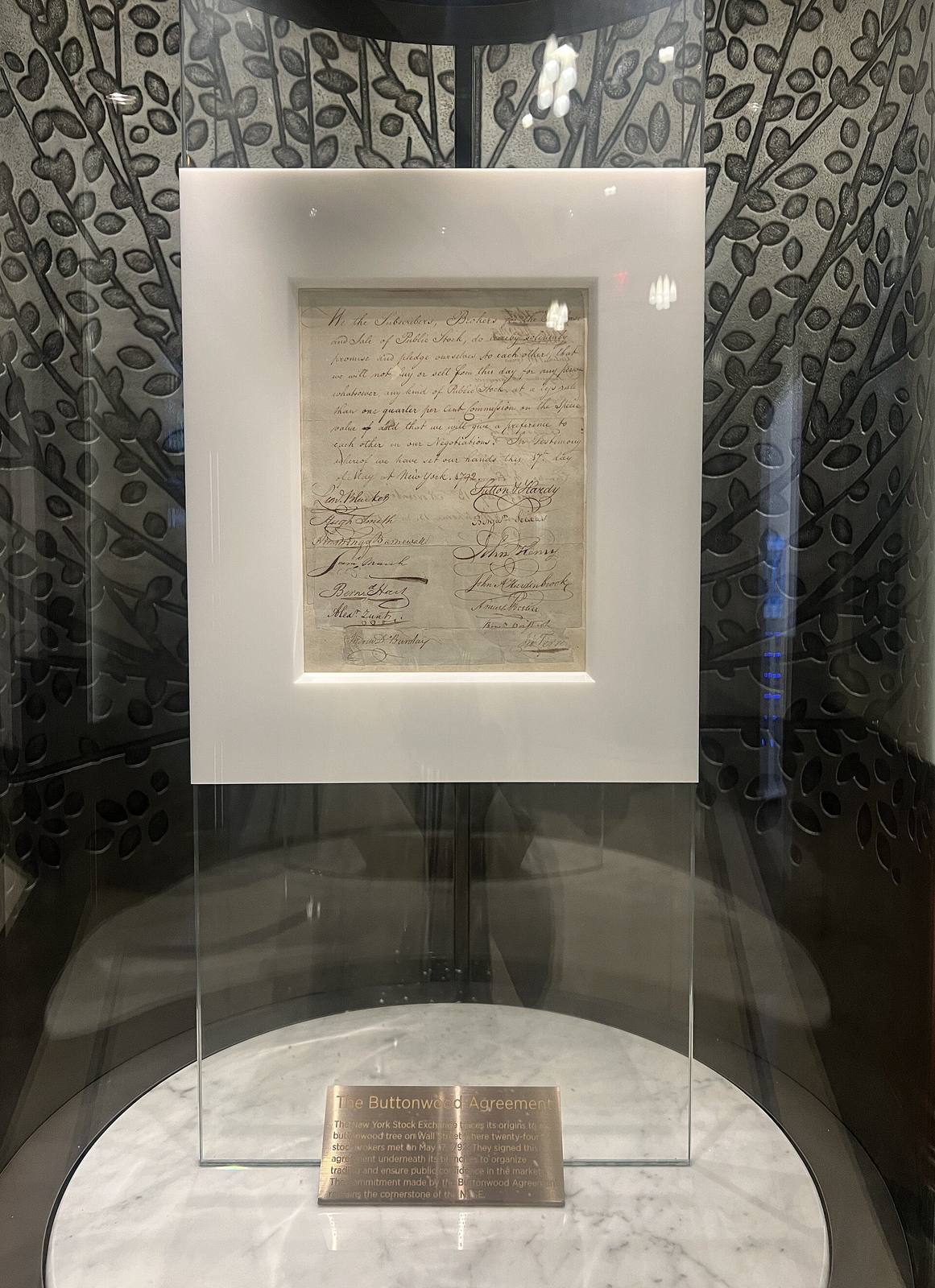
On May 17, 1792, twenty-four brokers and merchants signed beneath a buttonwood tree — an American sycamore — outside 68 Wall Street, their usual meeting place. The agreement, named after the tree, ran to exactly two sentences: first, they would trade securities only with each other; second, they would charge no less than one-quarter of one percent in commission.[6][2]
The power of those two sentences lay in the boundary they drew. The first drew a line between "us" and "them": only members could trade; auctioneers and curbstone brokers were shut out. The second fixed the price: no undercutting on commission, no racing to the bottom. The signers included Leonard Bleecker and Hugh Smith, twenty-four names in all — individuals and firms, each with an address written on the paper.[1]
Seen today, it was a cartel agreement: exclusive, price-fixing, both counts. But in 1792 it solved a more basic problem: who is my counterparty, and will they run? Trust comes before efficiency — without trust, efficiency never gets a chance to happen.
Legend says the signing took place beneath the tree itself, and the New York Stock Exchange celebrates May 17, 1792 as its birthday. Strictly speaking, the tree was their customary gathering place, and the agreement took its name from the place, not necessarily from the spot of signing. No original of the document survives; what we have are later copies and attestations. Legend loves a tree more than a document does — but the document matters more than the legend.[6]
The text can still be read in the Exchange's archive: "We the Subscribers, Brokers for the Purchase and Sale of the Public Stock, do hereby solemnly promise and pledge ourselves to each other, that we will not buy or sell from this day for any person whatsoever, any kind of Public Stock, at a less rate than one quarter percent Commission on the Specie value and that we will give preference to each other in our Negotiations." Two sentences. One club.
Chapter FourFrom the Tree to the Coffee House
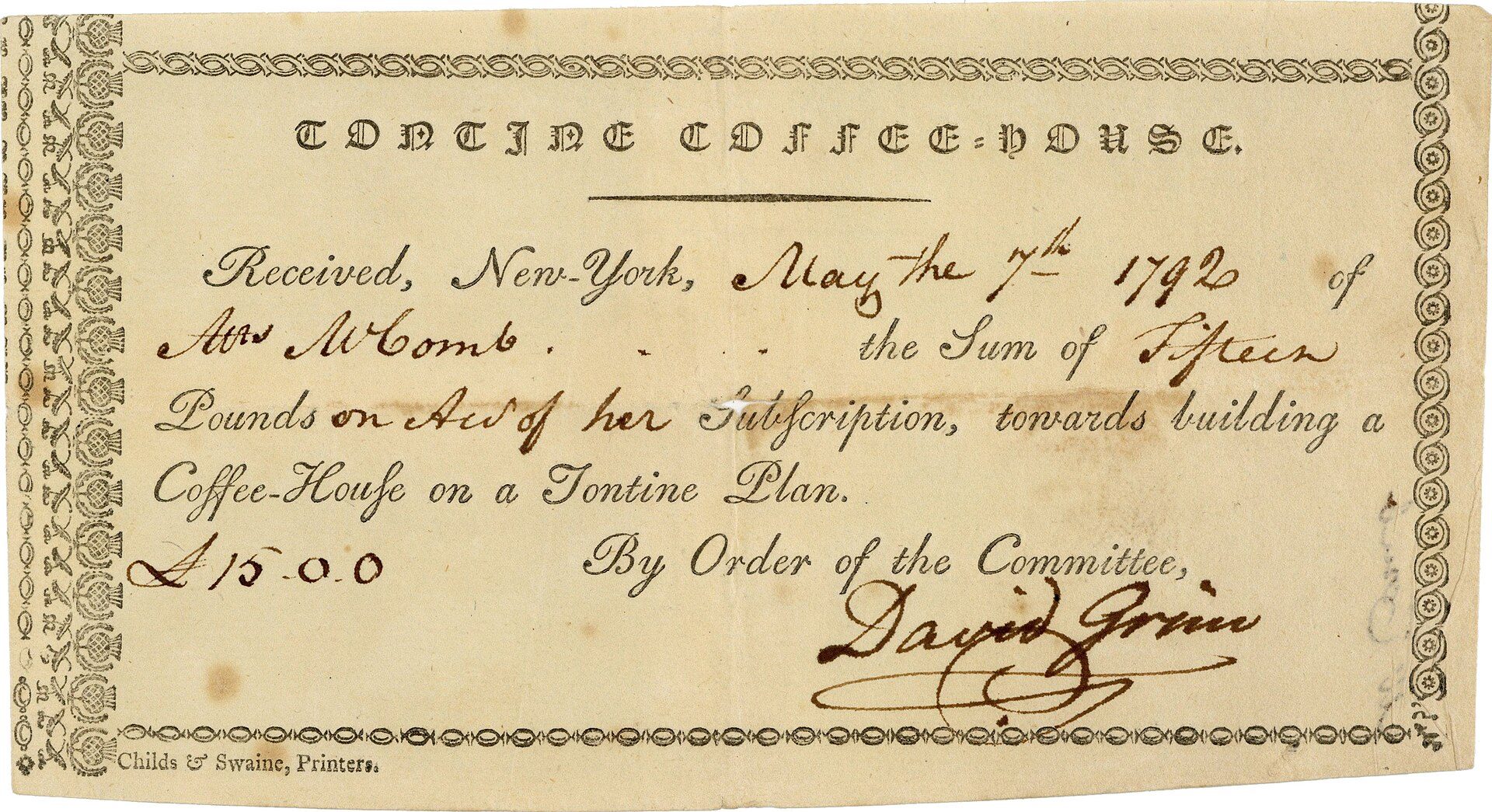
After signing, the brokers needed a fixed address. In 1793, they moved into the Tontine Coffee House at the corner of Wall and Water Streets — the coffee house was the exchange, the newsroom, and the club of its day. News, prices, and connections all flowed through the same room.[8]
In 1817, the organisation formalised: the New York Stock & Exchange Board was founded, with a constitution and membership rules. Four of the signers of the 1817 constitution had signed the Buttonwood Agreement in 1792 — an agreement made under a tree had lived twenty-five years and grown into an institution. In 1863, the organisation took the name it still holds: the New York Stock Exchange.[3]
The buttonwood tree itself fell in a storm in 1865. Today, a plaque on the wall at 68 Wall Street marks where the agreement was signed. The tree is gone; the plaque remains; and the building behind it is the largest stock exchange on Earth.
Fixed commissions lasted from 1792 until May 1, 1975, when the Securities and Exchange Commission abolished them — Wall Street called that day "May Day." The agreement's second sentence lived 183 years before retiring. The logic of its first sentence — membership, exclusion, a circle of trust — survives in new forms to this day: brokerage licences, clearing memberships, exchange seats are all its descendants.
Chapter FiveThe Two Faces of a Club
The Buttonwood Agreement had another face: exclusion. Those shut out were the auctioneers, the curbstone brokers, the small traders — the club's trust was bought with a door kept shut. To those outside, it looked less like order than privilege.
Consider the timeline. The Amsterdam Stock Exchange was founded in 1602 — 190 years before New York — the world's first. London, Philadelphia, Boston, Baltimore, and Charleston all had exchanges of their own. New York won, not because it was first, but because America's capital markets grew the largest. The twenty-four men under the tree had hitched themselves to a growing nation.[3]
The paradox of trust is exactly this: a market needs openness to grow, and closure to become trustworthy. In 1792 the twenty-four chose closure first — let trust grow, then open the door slowly. Every exchange since has copied the sequence: first draw a circle of people who can be trusted, then let the circle widen.
But a circle can also become a wall. Two centuries later, the most common charge against Wall Street is still the same one: that insiders use the rules to protect themselves and keep outsiders out. The two sentences of the Buttonwood Agreement are both the Exchange's birth certificate and the accusation it will face for the rest of its life.
The agreement was signed, but the problems did not end. The Panic of 1907, the crash of 1929 — the market proved again and again that a club cannot police its own greed. In 1934, the United States created the Securities and Exchange Commission, and the government walked onto Wall Street as a referee for the first time. From the self-made pact of 1792 to government regulation in 1934 took 142 years. In the end, even a circle of trust needs a referee standing outside the circle.
EpilogueRules Never Fall From the Sky
The Buttonwood Agreement had no constitutional authority, no act of Congress, no government blessing — only a group of merchants writing two sentences to stay alive. Nobody ordered them to do it. The collapse of the market ordered them to.
Financial history is usually told as a story of emperors and geniuses. But Wall Street began with ordinary people discovering that, rather than waiting for someone else to write the rules, they could write them themselves. Rules do not fall from the sky. They grow from the ground — from a panic, a coffee house, a tree. The twenty-four men under the tree could not have imagined that their two sentences would become the largest stock exchange on Earth. They only wanted to survive the spring.
After every financial crisis, people ask the same question: what makes a market trustworthy? The answer of 1792 was simple: a sheet of paper, twenty-four signatures, and the words "we will deal only with each other." The answer is simple enough to be unsettling — because more than two centuries later, no better answer has appeared.