PrologueMarch 1455: A Letter from Vienna
On March 12, 1455, in Vienna, the papal diplomat Enea Silvio Piccolomini wrote to a cardinal: the previous autumn, in Frankfurt, he had seen quires of a printed Bible — clean type, easy to read. The letter-writer would later become Pope Pius II; what he had seen was far bigger than he knew.
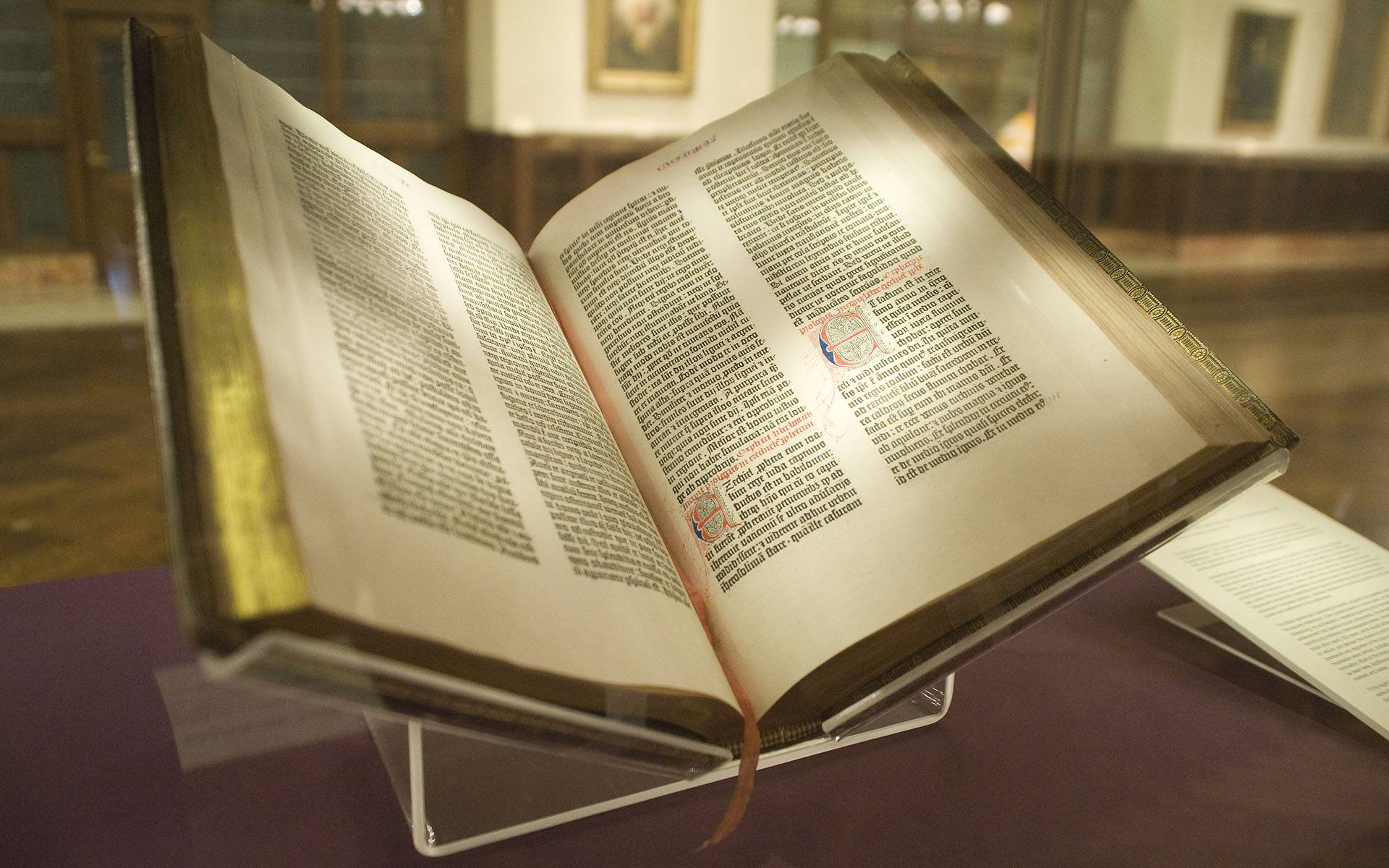
In the year he wrote, a workshop in Mainz was finishing something no one had done before: a 1,282-page Latin Bible, set in movable type that could be taken apart and reused, in an edition of about 180 copies. A scribe needed years to copy one Bible; one machine printed 180 at a stroke.
But this is not the story of a machine. It is the story of a question: when copying becomes cheap, what happens to the world? The answer starts in China — nearly 600 years before Mainz.
Chapter OneThe Answer, Six Centuries Early
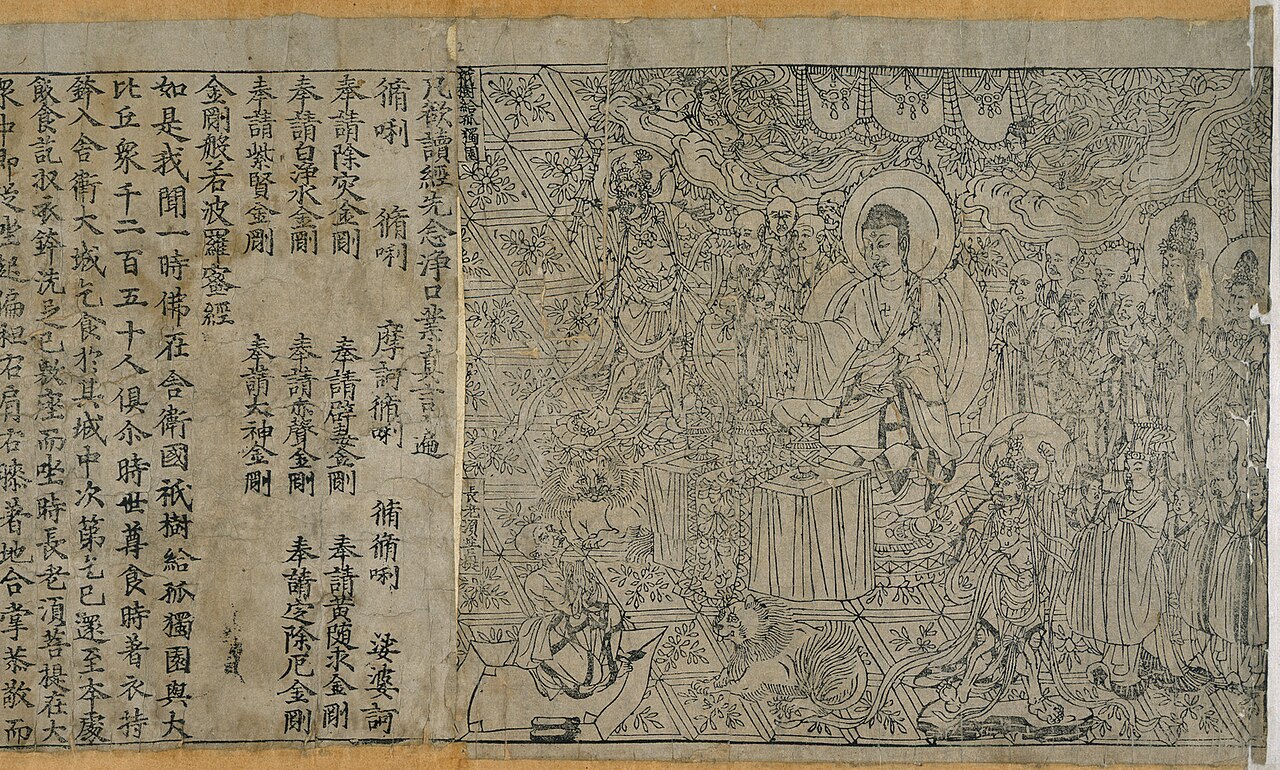
On May 11, 868, a man named Wang Jie paid to have a copy of the Diamond Sutra printed, in memory of his parents. The colophon reads "reverently made for universal free distribution" — free circulation. The scroll is about 5 metres long, seven sheets pasted together, opening with a printed image of the Buddha preaching to his disciple Subhuti. It is the world's earliest surviving dated printed book, held today by the British Library.[1]
"Reverently made for universal free distribution
by Wang Jie on behalf of his two parents."
— Colophon of the Diamond Sutra, May 11, 868
The scroll lay in the Library Cave at Mogao, near Dunhuang, for nearly 1,000 years; it was found in 1900 by the Daoist caretaker Wang Yuanlu and sold in 1907 to the archaeologist Aurel Stein. It survived a millennium of darkness thanks to printing's quietest gift: every copy comes out the same.[2]
The frontispiece of the Diamond Sutra is proof in itself: the Buddha preaching, the figures, the folds of robes, the clouds — all carved on a single woodblock, printed as one picture. By 868, block printing in China was already a mature craft, not a crude experiment.
Between 1041 and 1048, Bi Sheng of the Northern Song dynasty cut characters in sticky clay, fired them hard, and set them in an iron frame to print books. It was the world's first movable type, about 400 years before Gutenberg. Shen Kuo recorded the method in detail in his Dream Pool Essays: common characters were cut in 20 or more duplicates, and after printing the type was heated, loosened, and used again.[3]
But movable type did not change China. Why? Because there were too many Chinese characters. Cutting thousands of type pieces cost more than carving a whole page on a woodblock. A block could print one copy or a thousand with nearly the same effort; movable type only paid off when you printed many different titles in small runs. China's books were mostly classics, printed in large runs of few titles — the woodblock was the right answer. Technology is not better for being newer; it has to fit what a society actually needs.
Europe was the opposite: 26 letters, and type was absurdly cheap. The same technology, a different writing system, a completely different fate. The story of printing was never just about technology; it was about what kind of society the technology met.
Chapter TwoThe Goldsmith of Mainz
Johannes Gutenberg was a goldsmith of Mainz. A goldsmith understands metal, moulds, and pressure — he turned a wine press into a printing press, cast type from an alloy of lead, tin, and antimony, and used an oil-based ink, so that the pieces of type could be taken apart one by one and set again tomorrow as a different book.
The real invention was not the machine; it was taking things apart. A woodblock is one mould per page, useless once printed; movable type breaks writing into its smallest units, and the parts can be reused forever. Knowledge acquired reusable parts — and reusable parts are where the industrial age begins.
Curiously, Gutenberg's Bible deliberately imitated manuscripts: the type was cut to mimic the formal Gothic hand of Mainz scribes, the initials were left blank to be painted in red and blue by hand, and even the layout copied the manuscript's two columns of 42 lines. The first printed books did not want to look printed — a new technology often succeeds first by pretending to be the old one.
But invention needs money. In 1450 Gutenberg borrowed 800 guilders from the merchant Johann Fust at 6% interest; in 1452 he borrowed 800 more. On November 6, 1455, Fust sued for 2,026 guilders, principal and interest. Gutenberg lost, and handed over all his equipment and the books already printed.[5]
Fust hired Gutenberg's apprentice Peter Schöffer to take over; in August 1457 they printed the Psalter — the first book to carry a complete printed date. Gutenberg never grew rich, his name appears on none of his books, and he died in 1468 a pensioner of the Archbishop of Mainz's court.
But his Bible survived: about 180 copies, on paper and on vellum, 49 of them still known today, about 20 of them complete.[4] History sometimes works like this: the inventor loses the lawsuit, the man who wins becomes a publisher, and what changes the world is the confiscated machine.
Chapter ThreeAfter Books Got Cheap
Once the machines started running, they never stopped. Between 1450 and 1500, Europe printed about 30,000 editions — 17 to 20 million books — in 282 printing towns. Fifty years earlier, books were copied; fifty years later, they were printed.[6]
Behind the numbers were people changing. Books got cheap, and reading stopped being the privilege of a few; more readers meant more people willing to judge for themselves. Printing did not invent the Reformation, but it gave the Reformation legs.
On October 31, 1517, Martin Luther nailed his 95 Theses to the door of the Castle Church in Wittenberg. In December, printed editions appeared simultaneously in Leipzig, Nuremberg, and Basel. A friend of Luther's later wrote that hardly 14 days had passed before the propositions were known throughout Germany, and within four weeks almost all of Christendom had heard of them.[7]
A pamphlet cost about the same as a chicken, took a day or two to print, and a thousand copies took only days more. Luther's first German pamphlet, the Sermon on Indulgences and Grace, was reprinted 14 times in 1518 alone. Between 1520 and 1526, 6,000 different pamphlets were published in the German-speaking lands, and 1,700 of them were editions of Luther's works; in the first decade of the Reformation, 6 to 7 million pamphlets were printed, more than a quarter of them Luther's.[7]
This was the first time humanity saw something go viral. The author handed his manuscript to a printer, and after that nothing was under his control; local printers who saw a pamphlet sell printed their own editions. Once an opinion can be copied, it no longer belongs to the person who spoke it — a sentence that should sound familiar today.
Books did not only get cheaper; they got smaller and lighter. In 1476, William Caxton brought printing to England, setting up his press at Westminster and publishing about 90 books in his lifetime, most of them in English, including Chaucer's Canterbury Tales around 1478; in 1501, Aldus Manutius of Venice issued pocket-sized octavo editions of the classics, set in a newly invented italic type, stripped of heavy commentary — his Virgil that year ran to 1,000 copies, more than twice the usual run. Books moved from the church lectern and the scholar's desk into the traveller's bag; reading could now be a private act.[9][10]
Chapter FourThe Price of Copying
But copying does not distinguish good from bad. The church was among printing's earliest bulk customers: in the autumn of 1454, Gutenberg's Mainz workshop printed a 31-line indulgence to raise money for the King of Cyprus against the Turks — the earliest dated piece of European printing, older than the Bible itself. The same machine that printed Luther's pamphlets against indulgences also printed the indulgences.[8]
Censorship followed close behind. Church and crown quickly learned that what prints fast must also be banned fast: indexes of forbidden books, printing licences, permits for presses. Humanity's first response to a new medium was never debate; it was control.
Printing also created a new profession: the publisher. Books had once been copied on commission from church and crown; now there were people whose whole trade was choosing books, printing them, and selling them. What to print became a kind of power — not the king's power, but the market's. Readers voted with their money, deciding which ideas survived and which were forgotten.
The deeper price was paid inside the mind. In the age of copying by hand, when a book was wrong, the error existed in one copy; in the age of print, a single typo could run with the press into every copy, identically wrong. And authority unravelled the same way: copied books were each different, so you could only trust the person who copied yours; printed books were identical, so you began to trust not a person but "what is printed." The standard of truth moved from who said it to what it looked like in print.
Unanswered Questions
Did printing make people smarter, or more gullible? Books got cheap, and so did lies. Five hundred years on, the question has not aged — it has only changed its carrier.
EpilogueEveryone Has a Press Now
Today you carry a printing press in your pocket. Write a sentence, press send, and the world sees it — Gutenberg's workshop printed 180 Bibles in a year; one tap of send reaches the world in a second. The cost of copying has fallen to zero, and the question is no longer "can it be printed" but "what should be believed."
Wang Jie printed a sutra for his parents, Bi Sheng cut type to save labour, Gutenberg printed a Bible to pay his debts, Luther printed pamphlets to argue. Not one of them foresaw what they were doing. Technology never asks what it is for; people supply the purpose.
The day books learned to copy themselves, humanity learned something too: once an idea leaves a mind, it belongs to no one. It will be copied, printed, forwarded, distorted, canonised — and forgotten. All we can do is choose carefully: before the next press of send, ask yourself — is this worth copying 1,000 times?