PrologueA Winter Reading, 1008
In the winter of 1008, in the imperial palace at Heian-kyō, someone read a new story aloud to the emperor. When the reading ended, the emperor said just one thing: this lady must have been reading the Chronicles of Japan.
The story was The Tale of Genji. Its author was a lady-in-waiting to Empress Shōshi, named Murasaki Shikibu. Her diary mentions the tale that year; it was already circulating at court. Nobody knows when she began it, or how long it took. We only know that by around 1021, another woman wrote in her diary that she had finally obtained a complete copy, and was overjoyed. From that moment on, the book never disappeared.
A thousand years later, it is still called the world's first novel. The title is disputed — more on that later. But one thing is not: the novel as a form — following a group of people across the long stretch of their lives, writing their desire, their aging, and their deaths — begins here. And it was written by a woman who, in a patriarchal court, had almost no voice at all.
Chapter OneThe Woman Behind the Screen
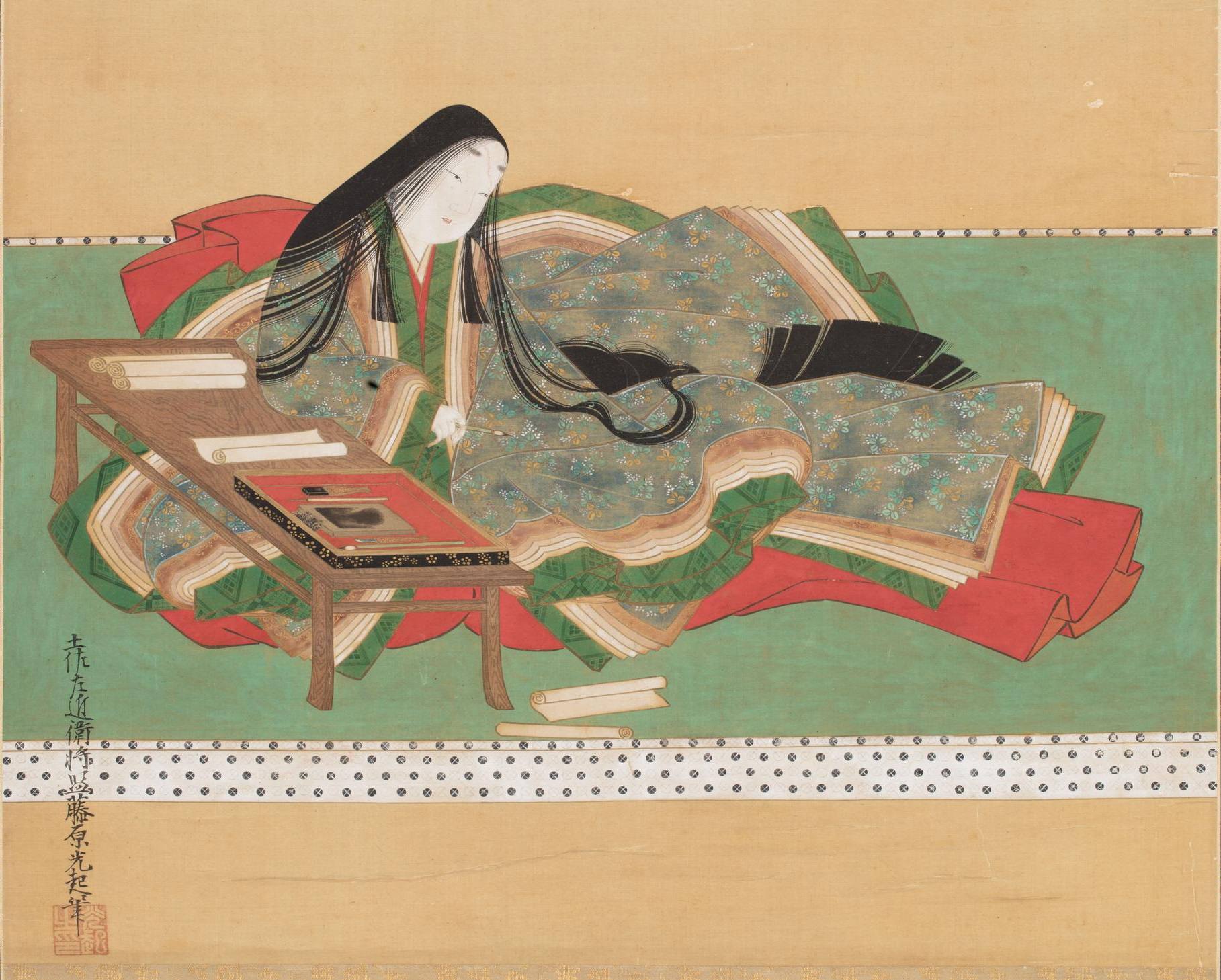
Murasaki Shikibu was born around 973, or perhaps 978, and died around 1014. Her father was a middle-ranking Fujiwara aristocrat, learned in Chinese — and in the Japan of her day, Chinese was the language of men, of office and scholarship, while women wrote in kana, the phonetic script. That division seemed to shut women out of serious writing. Instead, it left an opening: kana became the language of women's writing, and the novel grew in that opening.
She married young; her husband died in 1001, leaving her a widow. Around 1006 she was summoned to court to serve Empress Shōshi, the eldest daughter of Fujiwara no Michinaga — the most powerful man in Japan, who married three daughters into the imperial family until, by 1018, all three were empresses to successive emperors at once. Murasaki stood at the very centre of this machine of power. She stood behind a screen.
A court lady's life was lived behind curtains. She rarely showed her face; she spoke through screens, and conducted her love affairs by exchanging poems and letters. A person's quality had to be judged from a poem, from the colours of a layered robe, from the speed of a reply. Murasaki wrote this life into her novel — not as background, but as the very texture of the book. Her characters live the same way: by hints, by misreadings, by a letter that is never answered.
Legend says she found her inspiration on a moonlit night at Ishiyamadera Temple, looking out over Lake Biwa. It is only a legend — but even the legend chooses a woman alone, looking at the moon. The name she gave herself came from the most important woman in her book: Murasaki no Ue, the great love of Prince Genji's life. The author hid her name inside her heroine's — a signature only a reader could see.
Chapter TwoPrince Genji: The Shape of Desire, the Shadow of the System
The hero, Prince Genji, is the son of the emperor by a low-ranking consort, Kiritsubo. His mother was not high-born, but she alone held the emperor's love — and that love drew envy and hatred, and she died young. Genji is beautiful and brilliant, yet because of his mother's rank he cannot inherit the throne. He is demoted to commoner status and given the surname Minamoto — Genji. That opening decides the shape of the whole novel: a man who has everything, except legitimacy.
Genji's life is a history of love affairs — with married women, widows, a princess, a young girl — from his teens into his fifties. But this is not a catalogue of conquests. Murasaki's genius is that every affair collides with the wall of the system: rank, marriage, bloodline, succession. Genji can have any woman's body, but he can never have stability in any relationship — because in the Heian court, a woman is first a political token, and only second a person.
The most famous scene is the "rainy-night appraisal" in the second chapter, "The Broom Tree": several men sit together on a rainy night and rank women one by one, as if grading antiques or horses. They laugh; they do not notice how cruel the exercise is. Murasaki lets the men speak the logic themselves — then spends all 54 chapters showing the reader its price: the women's waiting, their losses, their madness, their taking of the tonsure.
Genji pays too. His secret affair with Lady Fujitsubo produces a child who later becomes emperor — which means the imperial bloodline carries a secret that can never be spoken. In middle age Genji is exiled to Suma, and spends long years by the sea; when he returns to the capital he gains power, and loses the woman he loves most. Murasaki no Ue dies in the chapter called Maboroshi — "The Illusion".
Chapter ThreeMono no Aware: How Time Entered the Novel
The tale's most famous quality has a name: mono no aware — the pathos of things. It means a sensitivity to the passing of things: cherry blossoms are beautiful precisely because they fall; people are worth gazing at precisely because they age and die. In the 18th century, the scholar Motoori Norinaga (1730–1801) argued, in his Genji Monogatari Tama no Ogushi (1796), that mono no aware is the heart of the novel. The word aware itself appears in the book more than 1,000 times — roughly once on every page.
Time is the novel's true protagonist. Fifty-four chapters cover three generations and about 75 years. Genji grows from a youth into middle age and then old age; the women he loved die, take the tonsure, or vanish one by one; his own beauty fades. No earlier work had dared to spend so much of its length following one person as he grows old. Earlier romances wrote of heroes and their adventures. Murasaki wrote of how a person is worn down by time.
The most startling stroke comes after Maboroshi. Murasaki no Ue dead, Genji resolves to take the tonsure; the next chapter, "Niou Miya" — "The Perfumed Prince" — opens after Genji is already dead. His death is never written. Between the two chapters sits one that has a title and no text at all: "Kumogakure" — "Vanished into the Clouds". A thousand years of readers have asked what that chapter contained. The answer may be: nothing. Death itself is the blank.
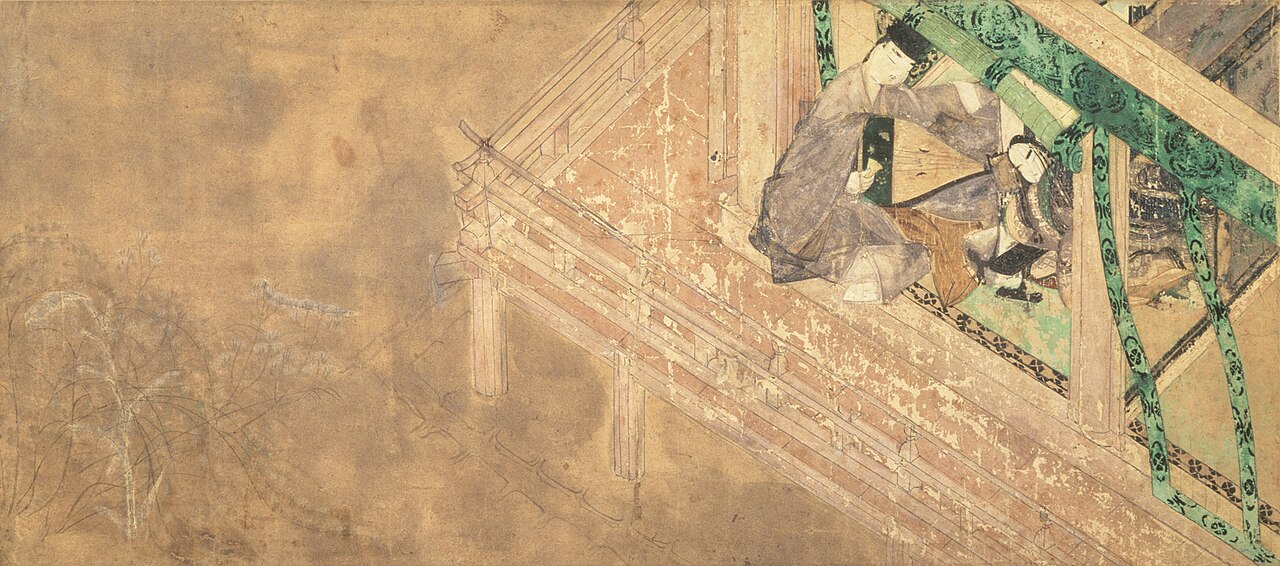
The last ten chapters, the "Uji chapters", hand the story to Genji's grandsons — above all to Kaoru. The book ends with chapter 54, "The Floating Bridge of Dreams": the heroine Ukifune has taken the tonsure, Kaoru sends a messenger to find her, and the story stops there. No ending. Only a man standing on a bridge, after a dream. It is the most famous "unfinished" ending in world literature — but perhaps it was complete all along: a life has no ending, only an interruption.
Chapter FourFrom Manuscript to the World
Murasaki's own manuscript has not survived. The earliest known text dates from around 1200 — which means the book lived by hand-copying for two centuries before leaving a text we can still see. Older still are the pictures: the Tale of Genji Scroll, painted around 1120–1140, is the oldest surviving illustrated scroll of a tale. The original was about 450 feet long, in 20 rolls, with more than 100 paintings and more than 300 sheets of calligraphy; today only 19 painted scenes survive — about 15% of the original — divided between the Tokugawa Art Museum and the Gotoh Museum, both groups National Treasures of Japan. The painted faces are almost blank; all the feeling is in posture and in the folds of robes. That is also how the novel asks to be read: nothing is spelled out; you are shown.
It took the book 900 years to leave Japan. In 1882, Suematsu Kenchō published the first English translation — a partial one. Between 1925 and 1933, Arthur Waley's six-volume English version appeared (missing chapter 38, "The Bell Cricket"), the first to let English readers meet Genji in full. In 1976, Edward Seidensticker published the first complete English translation; Royall Tyler's followed in 2001. In Chinese, Feng Zikai made the first complete translation, published by People's Literature Publishing House in the 1980s; translations by Lin Wenyue and others followed.
Hence the famous title: the world's first novel. It needs a discount. Greek romances of the 2nd and 3rd centuries — Daphnis and Chloe, the Aethiopica — came earlier; the Thousand and One Nights is a gathering of stories, not one author's long work; China's chapter novels came centuries later. But "often called the first" is itself a fact: no earlier work, by a single author's full design, follows a group of people through the long arc of their lives — with a beginning, a middle, aging, and a blank. It may not be the oldest novel. It is the earliest book in which we recognise the novel.
EpilogueAn Ending Without an Ending
Why do we still read it, a thousand years on? Because it is not about the Heian period. It is about the parts of human nature that do not expire: love without legitimacy, a fate decided by the system, beauty that is brief, and time itself. Murasaki never preached a single sentence. She only let her people live, and grow old, and die — and let the reader feel the ache.
And for a simpler reason: the book's author was not supposed to write books. She was a woman, a widow, a lady-in-waiting, writing in kana — the script then dismissed as "women's writing". She wrote beside the most powerful man in Japan and his three empress daughters. She saw everything — how power works, what desire costs, what becomes of women — and she wrote it into a book of 54 chapters and about a million characters, and handed it to the women of the court to copy.
In the winter of 1008, the emperor heard the reading and said she must have read the Chronicles of Japan. He was half right. She had read the official histories — but what she wrote was what official history never writes: how a person loves, and ages, and disappears, behind a screen. That is where the novel begins.