PrologueThe Year 629: A Monk Slips Out of the Gate
In 629, a 27-year-old monk named Xuanzang walked out of Chang'an, the capital of the Tang dynasty, in defiance of an imperial ban on foreign travel. He had no pass, no escort and no permission. He wanted only one thing: to reach India, where Buddhism had been born, and to bring back the scriptures in their original language. He would not return for 16 years.
Almost a thousand years later, that illegal journey became a novel of 100 chapters, Journey to the West — the story of a monk, a monkey, a pig and a water demon walking to India to fetch the scriptures, fighting demons all the way. The novel is one of the four great classical novels of China, and it has been retold in opera, film, television and video games for four centuries. But the book's real question is not how many demons the pilgrims defeat. It is this: why does a journey that never happened the way the book describes it feel more true than the real journey it was based on?
Chapter OneThe Real Xuanzang
The real Xuanzang (602–664) was not a man who needed a monkey to protect him. He was a scholar of formidable will. Dissatisfied with the Chinese translations of Buddhist texts available in Chang'an, he decided that the only cure was to go to the source. In 629 he slipped out of the capital, crossed the desert — he nearly died of thirst, and later wrote that he saw mirages and skeletons along the road — and spent 13 years in India, studying at the great university of Nalanda and debating rival schools of Buddhism.
He returned to Chang'an in 645, bringing back 657 Buddhist texts. Emperor Taizong received him in person and asked him to write an account of what he had seen. The result, the Great Tang Records on the Western Regions, is one of the most reliable geographical works of the medieval world: it describes the cities, climates and customs of Central Asia and India with the care of a man who was there. Xuanzang spent the rest of his life translating the scriptures he had brought home, producing 75 works in 1,335 volumes before his death in 664.
That is the true story: a scholar walks 16 years, brings back books, and translates them. It is an admirable story, but it is not a story anyone would tell their children at bedtime. The novel knew this. So it kept the outline — a monk walks west — and changed everything else.
Chapter TwoFrom the Storytellers' Stage to the 1592 Edition
Between the real journey and the novel lie nine centuries of retelling. Song-dynasty storytellers had already given the monk a monkey companion. Yuan-dynasty plays had already made the monkey the star. By the time the earliest surviving full edition was printed in Nanjing in 1592 by the Shidetang publishing house, Journey to the West had become a 100-chapter novel built from centuries of folk material.
The authorship is traditionally ascribed to Wu Cheng'en (c. 1500–1582), a Ming scholar-official from Huai'an, though recent scholarship questions the attribution: the 1592 edition was published anonymously, and much of its material came from folk tales. The doubt is part of the book's character. Journey to the West was not written by one man in one study; it was assembled by a whole culture, over centuries, each generation adding the demons and jokes it needed. That is why the book feels less like a novel and more like a shared memory.
The 1592 edition fixed the novel's shape: 100 chapters in four parts. Chapters 1 to 7 tell the story of Sun Wukong's birth from a stone and his Havoc in Heaven; chapters 8 to 12 set up the pilgrimage; chapters 13 to 99 are the journey itself, 81 ordeals along the road; chapter 100 brings the pilgrims home, each receiving a post in the celestial bureaucracy. The architecture is deliberate: a book about the search for enlightenment begins with the most unenlightened creature in heaven and ends with a bureaucracy.
Chapter ThreeFour People, Four Kinds of Human Nature
The novel's real invention is not the demons. It is the four pilgrims. Each one is a different part of human nature, and the journey is the process of getting them to walk together.
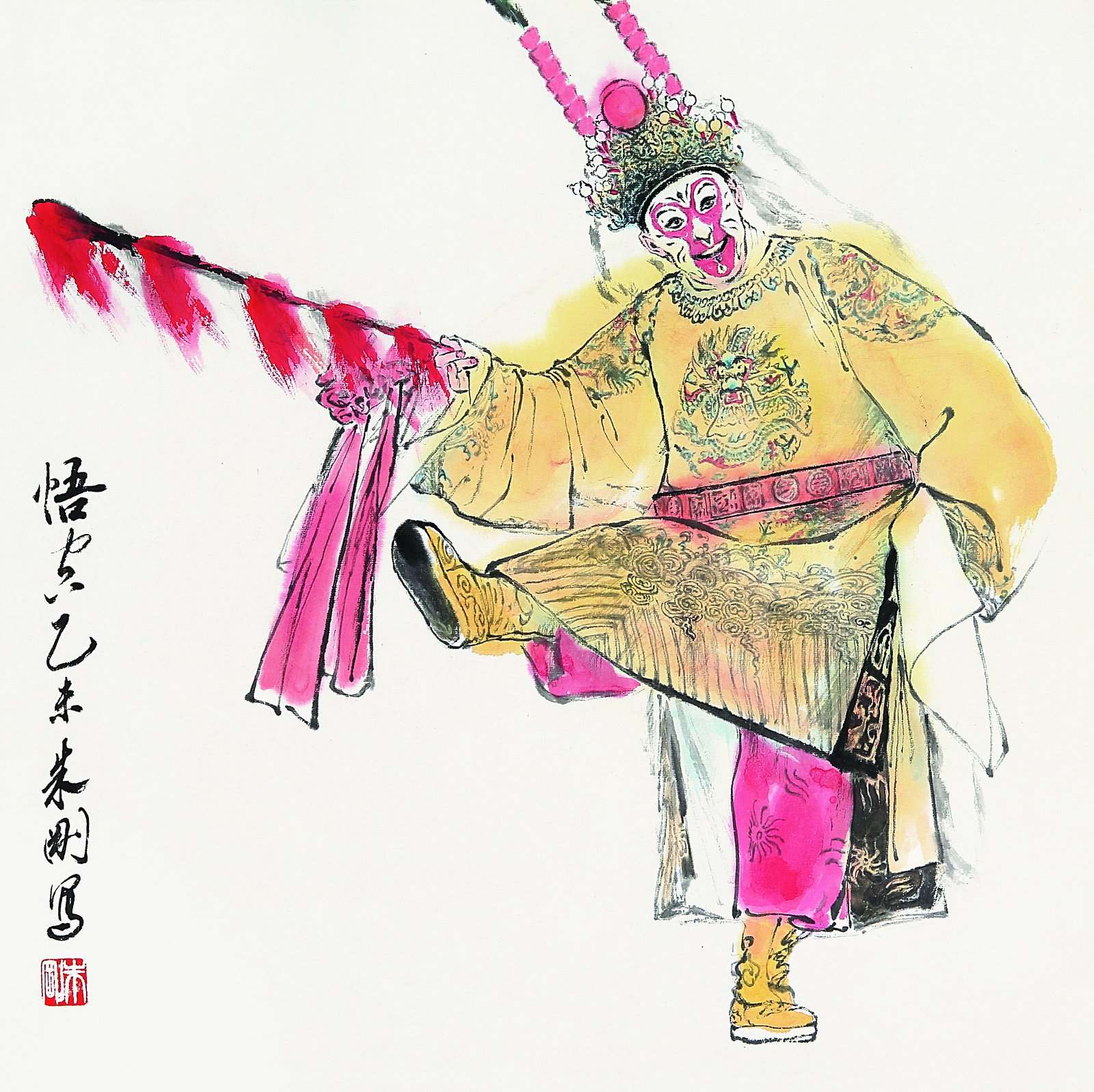
Sun Wukong, the Monkey King, is pure ability without discipline: born from a stone, master of 72 transformations, he can fly 108,000 li in a single somersault — and he uses that power to rebel against heaven itself. The Jade Emperor's court can do nothing with him; only the Buddha can pin him under a mountain for 500 years. Wukong is the part of us that is brilliant, impatient and certain it needs no one.
Zhu Bajie, the pig, is appetite without shame: food, drink, women, sleep — he wants all of them and apologises for none of them. He is lazy, cowardly and funny, and he is the only pilgrim who never pretends to be better than he is. Sha Wujing, the sand monk, is loyalty without brilliance: he carries the luggage, says little, and never leaves. And Tang Sanzang, the monk himself, is the weakest of the four in every practical sense — he cannot fight, cannot fly, and is captured by demons in almost every chapter. His only strength is that he never stops walking.
This is the book's central insight: enlightenment is not a solo achievement. It takes a team of incompatible people, each compensating for the others' defects. The monk without the monkey would be eaten by the first demon; the monkey without the monk would still be under the mountain. The journey is not a metaphor for self-improvement. It is a portrait of how a group holds together — which is to say, how any organisation, family or country holds together.
Chapter FourThe Eighty-One Ordeals: Why Demons?
The pilgrims must pass 81 ordeals before they can receive the scriptures. The number is not arbitrary: in Buddhist tradition, the path to enlightenment requires enduring a fixed number of trials, and 81 is nine times nine — completeness squared. But the demons themselves are the point. Almost every demon in the book is a distorted mirror of something human: the demon who wants to eat the monk to gain immortality is greed; the demon who impersonates the monk is vanity; the demon who builds a false paradise is the temptation of comfort.
Read this way, the book is a manual of self-knowledge disguised as an adventure story. Each demon is a problem that cannot be solved by force alone — Wukong, who can defeat any enemy in combat, repeatedly fails against demons who must be understood, not beaten. Some demons are only defeated when the pilgrims ask for help: from Guanyin, from the gods, from other pilgrims. The book's moral is unfashionable and precise: the strongest person in the room is the one who knows when to ask for help.
There is also a political joke running through the whole novel, visible to any Ming reader. Heaven is a bureaucracy: the Jade Emperor has ministries, files and officials who pass the buck. The demons are local officials who have gone rogue. The pilgrimage is, among other things, a journey through a world where the institutions above you are incompetent and the institutions below you are corrupt — and the only way through is persistence, allies and a willingness to appeal to a higher court. Ming readers laughed because they recognised their own government.
Chapter FiveAfter the Scriptures Are Fetched
Chapter 100 is the novel's quietest joke. The pilgrims arrive, receive the scriptures, and return home — only to discover that the scrolls they carried are blank. The first set of scriptures has no words on it. The monks at the temple explain, with perfect bureaucratic logic, that blank scriptures are the true scriptures: the wordless teaching is the highest teaching. The pilgrims must then go back and fetch a second set, with words, which is what ordinary people need.
It is easy to read this as a joke about corrupt monks demanding bribes — and Ming readers certainly did. But it is also the book's deepest statement: the truth you carry home from a long journey is never the thing you set out to find. Xuanzang set out to find correct texts; what he found was a life. The novel's pilgrims set out to fetch scriptures; what they fetch is themselves, 81 ordeals later.
And that is why the book has outlived every other version of the story. The historical Xuanzang's account is a masterpiece of geography. The novel is a masterpiece of something else: it understood that a journey only matters if the people who take it change along the way.
EpilogueWe Are All on the Pilgrimage Road
Four hundred years after the 1592 edition, Journey to the West is still being retold: in Peking opera, in television series watched by hundreds of millions, in films and video games, in every Chinese-speaking household where a child knows the monkey's name before they know the monk's. The story survives because its structure is honest: a long road, an impossible goal, companions you did not choose, and ordeals that repeat until you learn.
The real Xuanzang walked 16 years to bring back books. The novel's pilgrims walk 81 ordeals to bring back themselves. Between those two sentences lies the whole difference between history and literature: history tells you what happened; literature tells you what it felt like. Journey to the West is the rare book that does both — it remembers a real monk's walk, and it tells you, with demons and jokes, what a long walk does to a person.
Everyone has a west to walk to. Most of us will never know, when we set out, what the scriptures at the end will say — or whether they will be blank. The book's answer is simple: walk anyway, and bring companions. The road is long, the demons are many, and the only way to arrive is to keep walking, one ordeal at a time.