PrologueDecember 1900: A Meeting in Tokyo
On December 10, 1900, in a bank's meeting hall in Nihonbashi, Tokyo, a group of men sat around a table and founded a company with a capital of one million yen. The name was blunt: the Taiwan Sugar Manufacturing Company. What they meant to do was equally blunt: use machines to mass-produce sugar in Taiwan and sell it to Japan.
In that same year, Boxers besieged the foreign legation quarter in Peking for fifty-five days, and the Eight-Nation Alliance fought its way into the capital in August. China's old order was collapsing, while in that meeting room in Tokyo, the Japanese Empire was drawing a very different blueprint for its new colony, Taiwan — not garrisons, not moral instruction, but a stalk of sugarcane.
How much power can one stalk of cane hold? Enough to redraw the map of an island's land, to change what hundreds of thousands of farmers grew and for whom, to push railways through the fields and grow towns along the tracks, to let one industry swallow more than half of the island's entire industrial output — and then, half a century later, to all but vanish, leaving behind two factories still smoking and one little train running through a field of flowers.
This is the story of that stalk of cane: how it came to Taiwan, how it became an empire, how it withdrew — and what Taiwan had left once it was gone.
Chapter OneThe Sweet Beginning
Sugarcane arrived in Taiwan earlier than most people imagine. In the seventeenth century, when the Dutch East India Company ruled the island, sugar was already its most important export. In 1636, Taiwan shipped 12,042 catties of white sugar and 110,461 catties of brown sugar to Japan; by 1652, a year's exports reached 80,000 piculs, about 4,800 tonnes.[2]
Sugar was valuable because it was at once a luxury and a necessity. In an age without refrigeration or preservatives, sugar preserved food, brewed wine, and went into medicine; for the wealthy of Europe and Japan, it was also a mark of status. Taiwan's sun and rain suited cane perfectly, and the Dutch saw it. They encouraged Chinese settlers to plant cane and make sugar, and the tangpu — the traditional sugar mill where oxen turned a stone press and firewood boiled the juice — spread across the Chianan Plain.
Under the Zheng regime, the state briefly promoted rice for the sake of food supply, and sugar output fell; later Liu Guoxuan brought in new cane seedlings from Fujian and hired sugar masters to improve the technique, and annual output recovered to 18,000 tonnes. In 1682, Taiwan shipped 9,923 piculs of sugar to Nagasaki. What did the sugar buy in return? Copper and lead for making firearms.[2]
For the two hundred years of Qing rule, sugar, tea, and camphor were Taiwan's three great exports, and sugar always held its place. Japan had been importing Taiwanese sugar since the seventeenth century; the Qing-era gazetteer Continued Gazetteer of Taiwan Prefecture noted that Nagasaki prized Taiwanese goods above all, white and brown sugar fetching "double the price of other goods." Sometimes the fate of an island is decided by the price of a single crop.
By the end of the nineteenth century, Japan's appetite for sugar had grown beyond what it could ignore. In 1894, Japan consumed four million piculs of sugar a year and produced only 800,000 itself; the rest had to be imported — and the largest source was Taiwan. Within a year of taking the island, someone in Tokyo did the arithmetic: rather than paying for other people's sugar, why not grow and refine it in Taiwan?[1]
Chapter TwoThe Gamble of 1900
Governor-General Kodama Gentaro, who took office in 1898, and his civil administrator Goto Shinpei made industrial promotion the centre of colonial policy in Taiwan — and at the centre of industrial promotion stood sugar. Goto's arithmetic was clear: the Government-General needed fiscal independence, and it could not keep relying on subsidies from Japan. The fastest road to independence was to turn Taiwan's sugar into Japan's sugar.[3]
The question was where the money would come from. In May 1900, Governor Kodama travelled to Tokyo in person and promised the new company a subsidy of six percent of its capital for five years, 12,000 yen in the first year. With that guarantee in hand, the Mitsui zaibatsu agreed. On June 13, 1900, the promoters met at the Mitsui club in Tokyo; on December 10, the founding assembly elected Suzuki Tozaburo as the first president and Yamamoto Teijiro as manager, with a capital of one million yen — a thousand shares of it subscribed by the Imperial Household Ministry. The Taiwan Sugar Manufacturing Company was born.[3]
Construction began at Ciaozaitou — present-day Ciaotou in Kaohsiung — in the spring of 1901. To secure its raw material, the company bought up some 746 jia of surrounding land for its own plantation. On January 15, 1902, the factory opened: Taiwan's first modern sugar refinery, where machines replaced the ox-drawn stone mills and steam replaced firewood, where cane came in from the fields and white sugar went out to the ports. In June of the same year, the Government-General issued the Sugar Industry Encouragement Regulations, and the rules of the game were set.[3]
At the heart of those rules was a map. The Government-General divided the island into "raw-material collection zones," and the cane grown in each zone could be sold only to one designated factory. Farmers could not choose their buyer. The factories got a stable supply, the farmers got a stable market — but who set the price? The factory did. What farmers planted, how much, and when they harvested all had to follow the factory's schedule. From then on, a farmer's calendar was set by the factory chimney.
Capital followed quickly. Ensuiko Sugar was founded in December 1903; Meiji Sugar and Dai-Nippon Sugar entered Taiwan in December 1906. By 1905, the island already had seven modern refineries; from 1906, sugar exports overtook tea as Taiwan's most valuable export. By the end of the colonial era, the Taiwan Sugar Company alone controlled every refinery and collection zone south of the Zengwen River — one company's territory was half of southern Taiwan.[3][1]
This was the "rice-sugar conflict": rice fed people, cane made money, and the two crops fought over the same land. Farmers were caught in between — rice paid steadily but little; cane paid whatever the factory decided. Between 1900 and 1925, the Government-General subsidised the sugar industry to the tune of 24.7 million yen, about 5.7 percent of output value. Where did the subsidy come from? From Japanese taxpayers' pockets, and from cane prices kept low for Taiwanese farmers. The empire's arithmetic was never free.[1]
Chapter ThreeThe Island the Railways Drew
The refineries' hardest problem was not refining sugar. It was transport. Once cut, cane loses its sugar content by the hour and must reach the factory within a day. Ox carts were too slow and roads too few. The only answer was rail — not a trunk line like the main railway, but a narrow, 762-millimetre light railway built for cane alone.
In 1905, Yamamoto Teijiro, the manager of the Ciaozaitou factory, went to Hawaii to study the cane railways there and came home to apply for one at once. In 1906, Ciaotou laid its first rails, drawn at first by water buffalo; on September 15, 1907, Taiwan's first sugar railway officially opened, switching to steam locomotives that November. The little trains were nicknamed wufenche — "five-part cars" — because their gauge was about half that of standard track.[4][5]
The five-part cars carried more than cane. On May 20, 1909, Ensuiko's line from Sinying to An-nei began carrying passengers, and farmers, students, and pilgrims all rode the factory's trains. In 1911, Dai-Nippon's line from Beigang to Huwei opened, and thousands of worshippers rode the little trains to the Chaotian Temple in Beigang. The railways radiated from the factories like a spider's web across the Chianan Plain, joining the trunk line so that cane fields, refineries, and harbours became one continuous line. Wherever a refinery stood, a town grew — Huwei, Sinying, Suantou, Xihu: towns on today's map that began with a factory and only later acquired streets.[4][5]
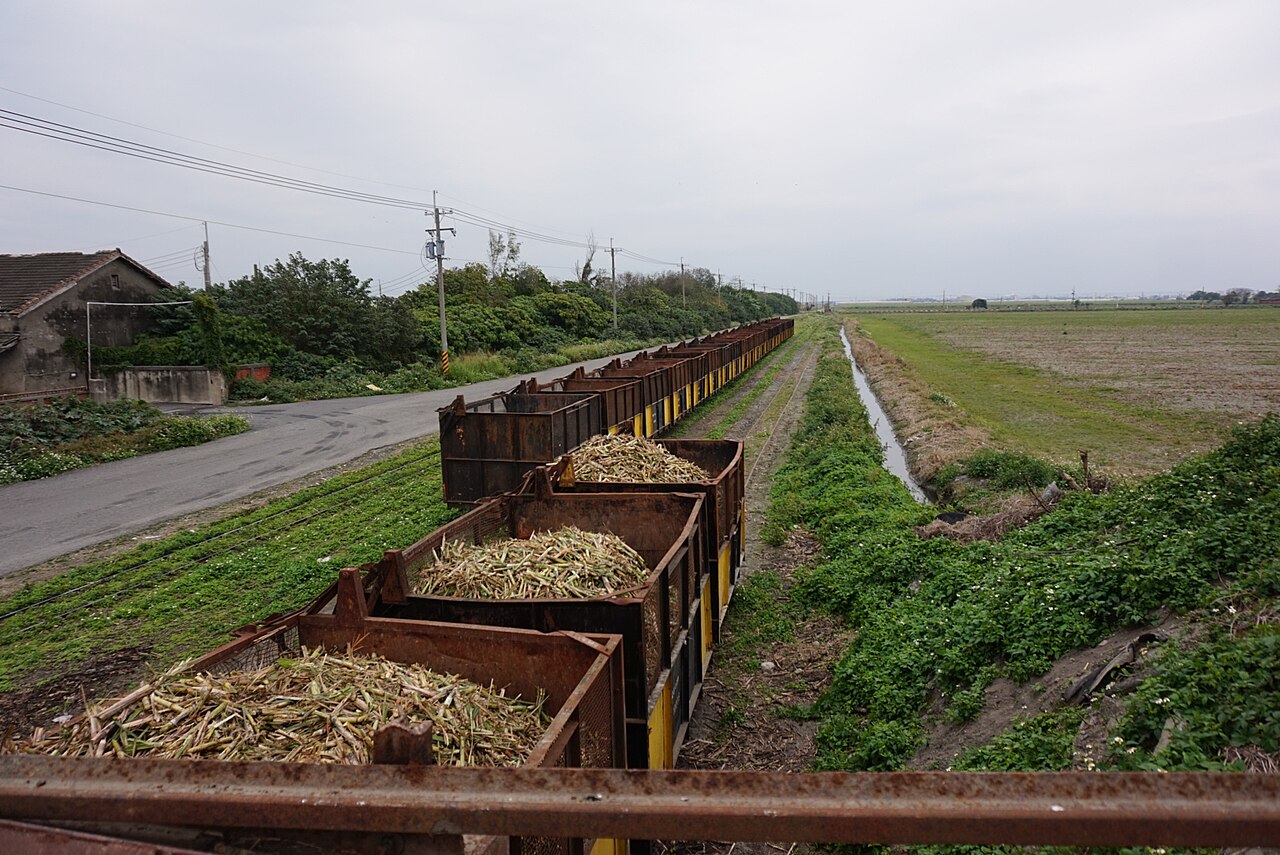
At their peak, Taiwan's sugar railways ran some 1,600 kilometres, about 400 of them carrying passengers. In 1939, the island's sugar output reached 1,418,731 tonnes, the highest ever recorded. In 1917, sugar accounted for 65.7 percent of the island's entire industrial output; in 1925, sugar was worth 162 million yen, 54.3 percent; in 1937, 56.4 percent. More than 90 percent of the sugar Taiwan made went to Japan — one island growing cane to sweeten an empire.[1][2][5]
But the other face of prosperity was dependence. Farmers' land was drawn into collection zones, cane prices were set by the factories, and even the harvest had to follow the factory's timetable. When the chimney smoked, the farmers earned; when it stopped, the whole village stopped. The tracks of the five-part cars drew towns, but they also drew a border — on one side, the company's world; on this side, the farmers' world. Both lived off the same stalk of cane, and they were never equals.
Chapter FourTwilight of the Empire
War ended it all. Late in the Pacific War, the refineries supplied ethanol to the military and became bombing targets; plants and railways were badly damaged, and output collapsed. When Japan surrendered in 1945, the Nationalist government took over all four sugar companies' assets in Taiwan; at the end of that year, the state-run Taiwan Sugar Corporation was established, merging thirty-six refineries into a single nationalised enterprise. A private sugar empire had become a public monopoly.[1][2]
At first, the post-war Taiwan Sugar Corporation was still the island's economic pillar. In 1951, its output was worth about 20 percent of the value of the island's major manufactured goods. Between 1946 and 1949, most of Taiwan's sugar went to Shanghai; farmers were paid under a profit-sharing system, keeping roughly half the sugar. The foreign exchange sugar earned bought back machinery, fertiliser, and food, sustaining an island rebuilding from ruins.[1]
But the rules of the game had changed. When the Nationalist government retreated to Taiwan at the end of 1949, the island was no longer part of the Japanese economic sphere; from 1950, the Taiwan Sugar Corporation had to compete head-on in the world market with sugar from Brazil, Cuba, and Java, while its own costs were higher and its tariff protection was gone. In 1960, sugar still made up 44 percent of exports; by 1970, only 3.2 percent; by 1978, 0.55 percent. Sugar's share of manufacturing output fell from 20 percent in 1951 to 5 percent in 1965 and 0.8 percent in 1978. The numbers do not lie: the age of sugar was over.[1]
The refineries closed one by one. The Ciaotou factory stopped production in 1999 — Taiwan's first modern refinery, after ninety-seven years in operation. In 1977, the island's sugar output had briefly recovered to 1,069,547 tonnes, a final flash of light. After that, Taiwan went from a region that exported sugar to one that imported it. By the 2010s, only three cane refineries were still running — Huwei, Nanching, and Shanhua — plus the Siaogang refinery, and Nanching had stopped refining in 2009.[2][5]
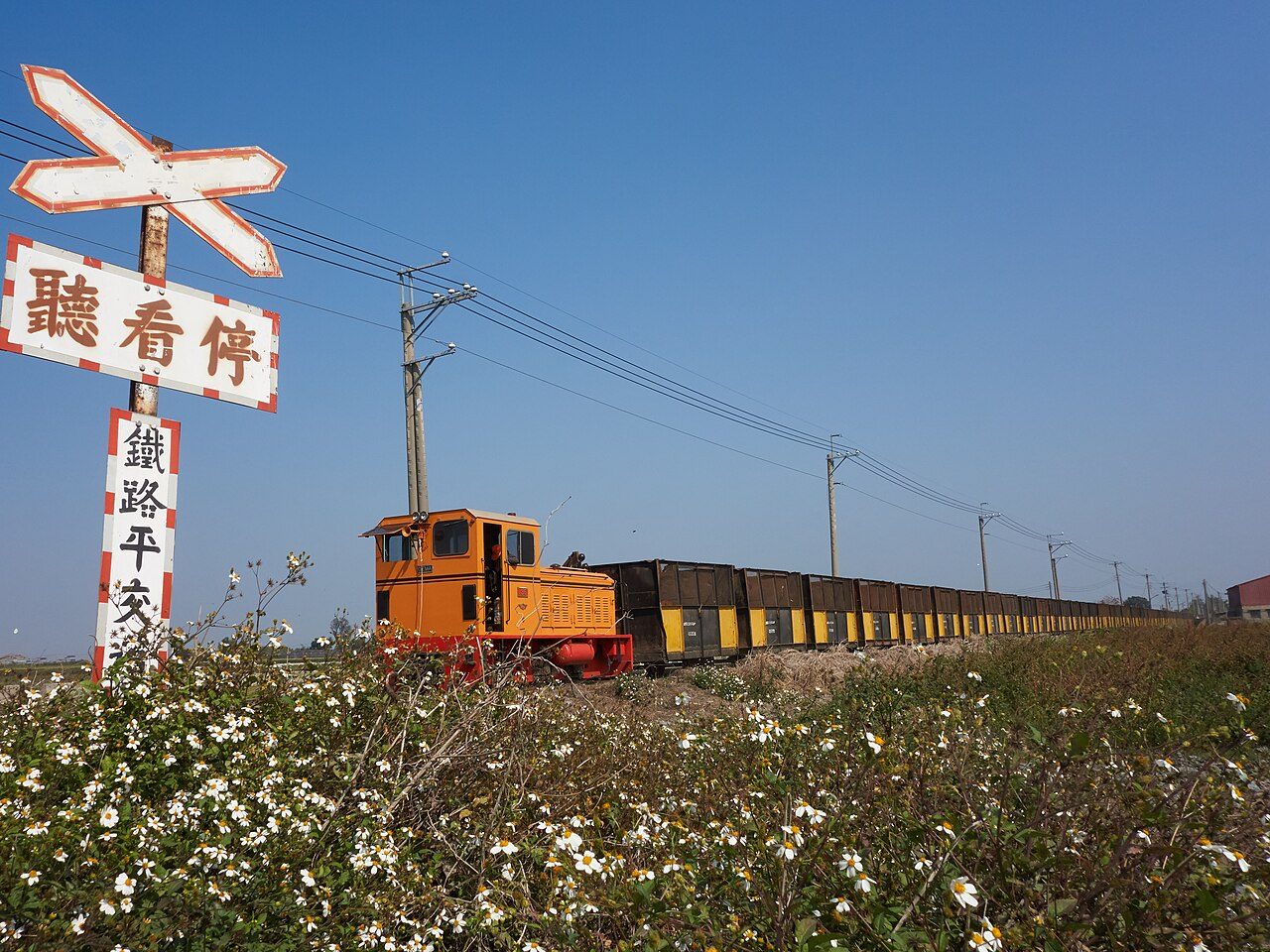
Today, only two refineries in all of Taiwan still make sugar: Huwei in Yunlin and Shanhua in Tainan. The Huwei factory, founded in 1907, is one of the two century-old refineries still operating and the only place in Taiwan where cane is still hauled by the five-part cars. In the 2024–25 season, Huwei expected to harvest 216,300 tonnes of cane and produce 19,500 tonnes of domestic raw sugar. An industry that once made 1.41 million tonnes a year now makes less than 20,000.[6]
EpilogueThe Aftertaste of Cane
What remained after the refineries closed? First, the land. The Taiwan Sugar Corporation inherited the four companies' vast holdings and became the largest landowner on Taiwan's plains; after sugar faded, it survived on that land — building housing, leasing factory sites, running petrol stations, growing orchids, raising pigs. A company founded on sugar ended up living off real estate — an irony, and the most honest footnote to Taiwan's post-war economic transformation.
Second, memory. Ciaotou, Suantou, Xihu, Sinying, Wushulin — refinery after refinery became a cultural park, and the five-part cars became sightseeing trains. Visitors ride the little trains through the fields, take photographs, buy ice pops, and listen to guides tell stories of the old days. The rails are still there; only what runs on them has changed. It is no longer cane. It is nostalgia.
But what is most worth remembering may not be nostalgia. It is what one industry taught Taiwan: an island can rise on a single crop, and it can be bound by that same crop. Cane gave Taiwan its first modern factory, its first industrial railway, its first factory towns — and it also gave it the confinement of the collection zones, dependence on factory-set cane prices, and the risk of a single market. When the world changed, the protection vanished, and costs could no longer keep up with rivals, the tightest rope snapped fastest.
On December 10, 1900, a meeting in Tokyo decided fifty years of an island's fate. Today, when Huwei's little train carries its cane through fields of shepherd's needle flowers and white smoke rises from the chimney, that train carries more than cane — it carries the story of how an island learned modernisation, and how it learned to let go. The sweetness fades, the cane withers, but the towns the rails drew are still there, the fields are still there, the people are still there. That is everything one stalk of cane left Taiwan — and the beginning of everything.