PrologueA Scale, and the Weight of an Island
In February 1926, a short story appeared in the Taiwan Minpao: a vegetable peddler named Qin Decan had his scale confiscated by a policeman on the grounds that it did not meet the regulations. The scale was his only means of making a living. Broken and desperate, he finally rose up in resistance. The story was called "A Steelyard," and its author was Lai He, a doctor from Changhua.[5]
How heavy can a scale be? In the story, it is a poor man's tool for earning a meal. In history, it is a yardstick for an entire island. Whether a scale is accurate was never a technical question, but a question of who had the power to decide. If the policeman said your scale was wrong, then your scale was wrong. With one broken scale, Lai He wrote down the most ordinary, and most cruel, truth of a colony: injustice does not arrive as a grand event from the sky. It hides in the morning market, in a policeman's palm, and in a confiscated livelihood.
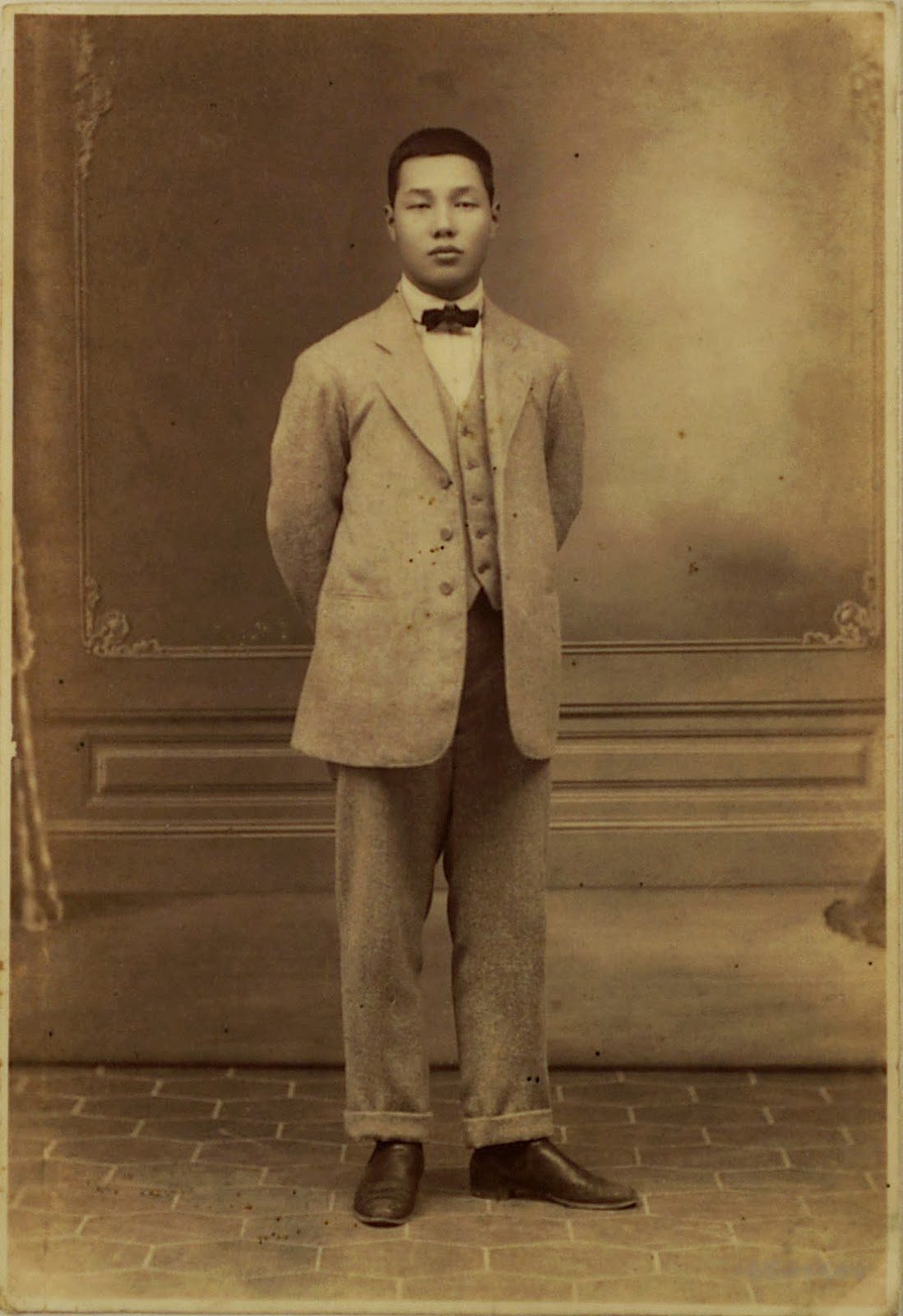
Lai He lived 48 years, born in 1894 and dead in 1943, a life that almost exactly overlapped the 50 years of Japanese rule over Taiwan.[5] He was a doctor and a writer; the man the people of Changhua called "He-a-sian," and the man later generations would call the father of Taiwan's new literature.[4] His whole life circled a single question: how can an island tell its own story, in its own words?
Chapter OneA Changhua Boy Between Two Worlds
Lai He, born Lai He with the character for "river," was born in Changhua on May 28, 1894.[5] In the year of his birth, Taiwan was still a territory of the Qing dynasty. The following year, after defeat in the First Sino-Japanese War, Taiwan was ceded to Japan. Before the infant could even learn the name of his hometown, his hometown had changed masters. From the day he was born, he lived on an island where the question "who are we?" had to be asked again and again.
His childhood straddled two worlds. Around the age of 10, he studied classical Chinese under the private tutor Huang Zhuoqi, while also attending a Japanese-run public school.[5] Classical Chinese taught him what benevolence and integrity meant; Japanese taught him what modernity and science meant. Neither education was wrong, but together they taught him something early: language is never merely a tool for communication. Behind every language stands power.
In 1909, at 15, Lai He entered the Taiwan Governor-General's Medical School in Taipei, in the same class as Du Congming and Weng Junming; Chiang Wei-shui was one year his junior.[5] The medical school was the highest institution a Taiwanese could reach, and a road the colonial system had designed: train the brightest Taiwanese children as doctors, and turn them into useful, obedient professionals. Lai He walked that road, but he did not arrive at the destination the system had planned for him. At school he learned anatomy and diagnosis, and how to look at the human body with scientific eyes. After school, he began to look at the whole of society with the same eyes.
He graduated in 1914 and practiced medicine in Taipei and then Chiayi.[5] At Chiayi Hospital he tasted the discrimination built into the colonial system: for the same work, Taiwanese doctors were paid less than Japanese doctors and ranked lower. The experience did not teach him patience; it taught him to see a structure. Colonial rule was not an abstract term in a history book. It lived in the pay slip, the dormitory allocation, and every look of contempt.
Chapter TwoThe Doctor's Hands, the Writer's Eyes
In 1917, Lai He returned to Changhua and opened his own clinic, where he practiced for the rest of his life.[4] In 1918 he briefly worked at the Hope Hospital on Gulangyu Island in Xiamen, where he witnessed the currents of thought swirling around China's May Fourth era; he returned to Changhua in 1919 and never left again.[5] His clinic stood in Shizaiwei, and most of his patients were poor. He never pressed them for payment, and at the Lunar New Year he would burn the account books. That is why they called him the "Mazu of Changhua," "Hua Tuo reborn," and "He-a-sian."[3]
The burning of the account books deserves a second thought. A doctor who burns his ledgers burns his own income, and leaves his patients their dignity. In a colony, the poor were used to bowing their heads and being counted like goods. What Lai He burned was not paper, but a system for sorting people into the worthy and the worthless. His clinic was therefore more than a place to see a doctor; it was a place where people could feel human again.
Being a doctor gave Lai He a pair of eyes that others did not have. Day after day, he saw not the great events of the newspapers but the most concrete kinds of suffering: farmers squeezed by the sugar companies, workers afraid to take a day off after an injury, women who labored a lifetime without a name of their own. Such suffering cannot speak for itself; someone has to write it down. So beside the stethoscope there appeared a pen. By day, he used medicine to heal the body; by night, he used literature to dissect the many faces of a colonized Taiwan.[3]
These were not two professions, but two sides of one conviction: a doctor believes illness has causes and can be treated; a writer believes the ills of society also have causes, and can be written down and seen. Lai He once said, "Literature is a miniature of society."[3] A miniature does not decorate reality. It concentrates it and sets it before the reader, so that no one can pretend any longer not to have seen it.
Chapter ThreeA Steelyard: Fairness, Broken
On October 23, 1925, sugarcane farmers in Erlin, Changhua, rose up against the exploitation of the sugar company. It was Taiwan's first farmers' movement, known as the Erlin Incident.[4] Lai He wrote his first new-style poem for the occasion, "A Sacrifice Made in Awakening: To My Comrades in Erlin," and threw himself into the creation of new literature. In the same year he published "Untitled," the first vernacular prose essay in the history of Taiwanese literature. On January 1, 1926, his vernacular short story "Joining the Festivities" appeared; in February of the same year, "A Steelyard" was published in the Taiwan Minpao, and he began editing the paper's literature column.[5]
Qin Decan had no land to farm, so he sold vegetables at the market to feed himself. The police confiscated his scale, claiming it violated weights-and-measures regulations. For a man to lose his scale was to lose the right to eat. Driven to a dead end, Qin rose up in resistance. The Taiwan Minpao of the time mocked the police as "emperors of the countryside," and Lai He turned that mockery into a living, breathing man.[5]
What makes the story powerful is that it shouts no slogan. Lai He writes not of grand national causes, but of a peddler's hands, the snap of a scale, and a man's slow passage from endurance to explosion. The reader finishes with a feeling, not a lesson: injustice can be this concrete. That is the power of literature. It does not persuade you; it makes you see, and once you have seen, you cannot go back.
It also matters that Lai He wrote this story in the vernacular. In 1926 Taiwan, classical Chinese was still the language of the literati, and vernacular writing was dismissed as crude. But Lai He insisted on writing in words ordinary people could understand, because he was writing about ordinary people's lives. A peddler's story, told in a classical language only scholars could read, would itself have been another kind of injustice. The choice of language was a choice of allegiance.
Chapter FourWriting in Taiwanese: Language Is Home
On October 17, 1921, the Taiwanese Cultural Association was founded in Taipei under the banner of "advancing Taiwanese culture," using the Taiwan Minpao as its organ and holding lecture tours and reading circles across the island.[7] Lai He joined the association, became a director for Taichung Prefecture, and threw himself into public lectures and editing the Taiwan Minpao.[4] Enlightenment soon collided with reality: on December 16, 1923, because of his part in the petition movement for a Taiwanese assembly, he was jailed for 24 days in the Public Order Police Incident.[5] On the day of his release, crowds lined the road to welcome him home, and he wrote the classical poem "Returning Home After Release from Prison": "Vast is the world, and all I see is wrong; this life I stake against the age." Prison did not tame him. It confirmed the road he had chosen.
In 1924, Zhang Wojun's essays in the Taiwan Minpao, attacking the old literature for blocking reform, touched off the debate between old and new literature. Lai He stood with the new, arguing for the vernacular and for writing about Taiwan's reality.[5] Before that debate had settled, a sharper question arrived: whose vernacular? China's, or Taiwan's?
In 1930, Huang Shihui published "Why Not Promote Native Literature" in the Wuren Bao: "Use Taiwanese to write prose, to write poetry, to write fiction, to write songs, and to describe the things of Taiwan." The following year, Guo Qiusheng answered with a long essay of more than 20,000 characters, "A Proposal for Constructing Taiwanese Vernacular Writing," arguing that Taiwanese should be given a written form.[6] The debate lasted nearly four years and only quieted down in 1934. Its best-known supporters were Lai He, Zhuang Suixing, and Li Xianzhang; its opponents dismissed Taiwanese as vulgar and jumbled, unfit to be a literary language.[6]
Looked at today, the debate was never only about literary form. It was about an island's sense of itself. If a people cannot write its own language into its literature, its stories must forever be told through someone else's tongue. Lai He supported Taiwanese vernacular writing not out of a linguist's preference, but out of a simple conviction: the words Taiwanese people speak deserve to be written down, and the lives they live deserve to be treated as literature. What colonizers fear most is never a few essays of protest; it is a ruled people beginning to imagine itself in its own language.
Lai He never wrote a single literary work in Japanese in his entire life; only his medical textbooks carried Japanese notes.[3] This was not because he could not write Japanese. It was a choice. In an age when speaking Japanese was the way to get ahead, he insisted on writing in Chinese, in the vernacular, in words Taiwanese people could understand. Here, language was not a tool. It was a form of loyalty.
Chapter FivePrison, Poetry, and a Refusal to Bow
The 1930s were Lai He's most productive decade, and also Taiwan's hardest. In January 1930, he published the novella "Mr. Snake," serialized in the Taiwan Minpao; in April 1931, under the pen name An Dusheng, he published the long poem "Elegy of the South" in the Taiwan Xin Minpao, mourning the Indigenous uprising of the Musha Incident.[5] The Musha Incident had erupted in October 1930, when Seediq people rose against colonial oppression and were brutally suppressed. Lai He's poem placed Han Taiwanese and Indigenous peoples in the same position: under colonial rule, the victims knew no ethnic boundary; the whole island was one.
At the same time, as editor of the Taiwan Minpao literature column, he mentored a new generation of writers: Yang Kui, Yang Shouyu, Yeh Shih-tao, Wu Zhuoliu, and Lu Heruo.[4] He was not writing alone; he was raising an entire generation. That is how a tradition grows: someone writes first, others follow, and the island's stories grow more complete. When Yeh Shih-tao later wrote the history of Taiwanese literature, he placed Lai He at its origin, not because Lai He wrote the most, but because he made those who came after believe that Taiwan was worth writing about.
On December 8, 1941, the day of the attack on Pearl Harbor, Lai He was arrested again and held for about 50 days, never told the reason.[5] In prison he wrote his "Prison Diary" on coarse paper made from straw. The imprisonment broke his health. Less than two years after his release, on January 31, 1943, he died of heart disease at 48, leaving behind debts of more than 10,000 yuan.[5]
A man who spent his life treating the poor and writing for the poor died penniless. This is not irony; it is the result of his choices. He could have lived comfortably on his medical skill, or won the system's favor by writing in Japanese. Instead, he traded every comfort for a refusal to bow. On the wall of the Lai He Memorial Hall are the words of his poem: "The brave shall fight for justice."[3] It was not a slogan. It was the footnote he wrote with his life.
EpilogueWhat He Left Behind Was Not Books, but a Mirror
More than 80 years after Lai He's death, the scales, the policemen, and the sugarcane farmers he wrote about have become terms in history textbooks. But the question he asked is still with us, and every era must answer it again: how can an island tell its own story, in its own words?
People in Taiwan today no longer go to prison for writing in their own language. What Lai He fought for has become ordinary life. But precisely because it has become ordinary, it is easier to forget what it cost. Freedom of language did not fall from the sky; it was bought, generation after generation, with prison terms, poverty, and lives. Lai He's value lies not in having foreseen the future, but in having believed, in the darkest of times, that Taiwanese people deserved a voice of their own.
The best way to read Lai He is not to place him on an altar, but to return to where his writing began: go to the morning market, stand a while outside a clinic door, and listen to how people who never write essays talk about their own days. Literature never begins in the study; it begins in life. What Lai He left Taiwan was not a theory of literature, but a mirror: an island watching itself move from being defined by others to defining itself.
A scale was broken nearly 100 years ago. The scale is still here. The island is still here. And the people who write its stories are still here. That is probably the ending Lai He most wanted to see: the story is not finished, because the people writing it were never only him.