PrologueA Flag, 150 Days
On October 21, 1895, Japanese troops marched into Tainan. There was no street fighting, no ceremony; the city gates simply opened. A blue flag bearing a yellow tiger was taken down, folded, and carried away. Counted from the day it was raised, May 25, it had flown for only 150 days.
In those 150 days, the people of the island tried something no one had tried before: when their own country was given away, they declared a country of their own. This country had a president, a reign title, a flag, and an army — yet no nation on earth recognised it. Its first president served for 10 days; its second fled in disguise. What it left behind was very little: a flag, a few battles, and a question — when the people of a place refuse to accept being sold, how far can they go?
This book tells the story of those 150 days.
Chapter OneNews of the Cession
On April 17, 1895, at Shimonoseki, Li Hongzhang signed the Treaty of Shimonoseki. The Qing dynasty ceded Taiwan, the Pescadores, and the Liaodong Peninsula to Japan, and agreed to pay an indemnity of 200 million taels of silver. The First Sino-Japanese War had gone badly from the start: Qing forces retreated all along the line, and the Beiyang Fleet was destroyed. By the time the negotiators sat down, there was nothing left to bargain with. When news of the treaty reached Taiwan, disbelief came first, then anger.
Tang Jingsong, the governor of Taiwan, memorialised the throne against the cession, and the island's gentry signed petitions of their own. Their argument was simple: the people of Taiwan had not been defeated, and Taiwan's armies were still standing — by what right were they handed over, land and people, to Japan? Beijing's answer was equally simple: the treaty was already signed. To the court, Taiwan was a frontier; to the people on the island, Taiwan was home.
Some argued for fighting to the death, some for appealing to the foreign powers, and some for simply founding a country of their own. That last idea came first from a group of gentry: if the Qing no longer wanted Taiwan, Taiwan would govern itself. The name they chose — Republic — was not chosen because everyone had suddenly become a republican. It was chosen because the whole world understood the word: if a republic were swallowed by a foreign power, the great powers would have reason to intervene. It was a diplomatic war fought with a country's name.
Chapter TwoMay 25
On May 23, 1895, the gentry and officials of Taipei resolved to found a state. Tang Jingsong issued the Declaration of Independence of the Republic of Formosa the same day. Two days later, on May 25, he was inaugurated in Taipei as Grand President, with Qiu Fengjia, a scholar-official, as vice president; Liu Yongfu, the veteran Black Flag Army commander, as commander-in-chief; and Li Bingrui as minister of military affairs.
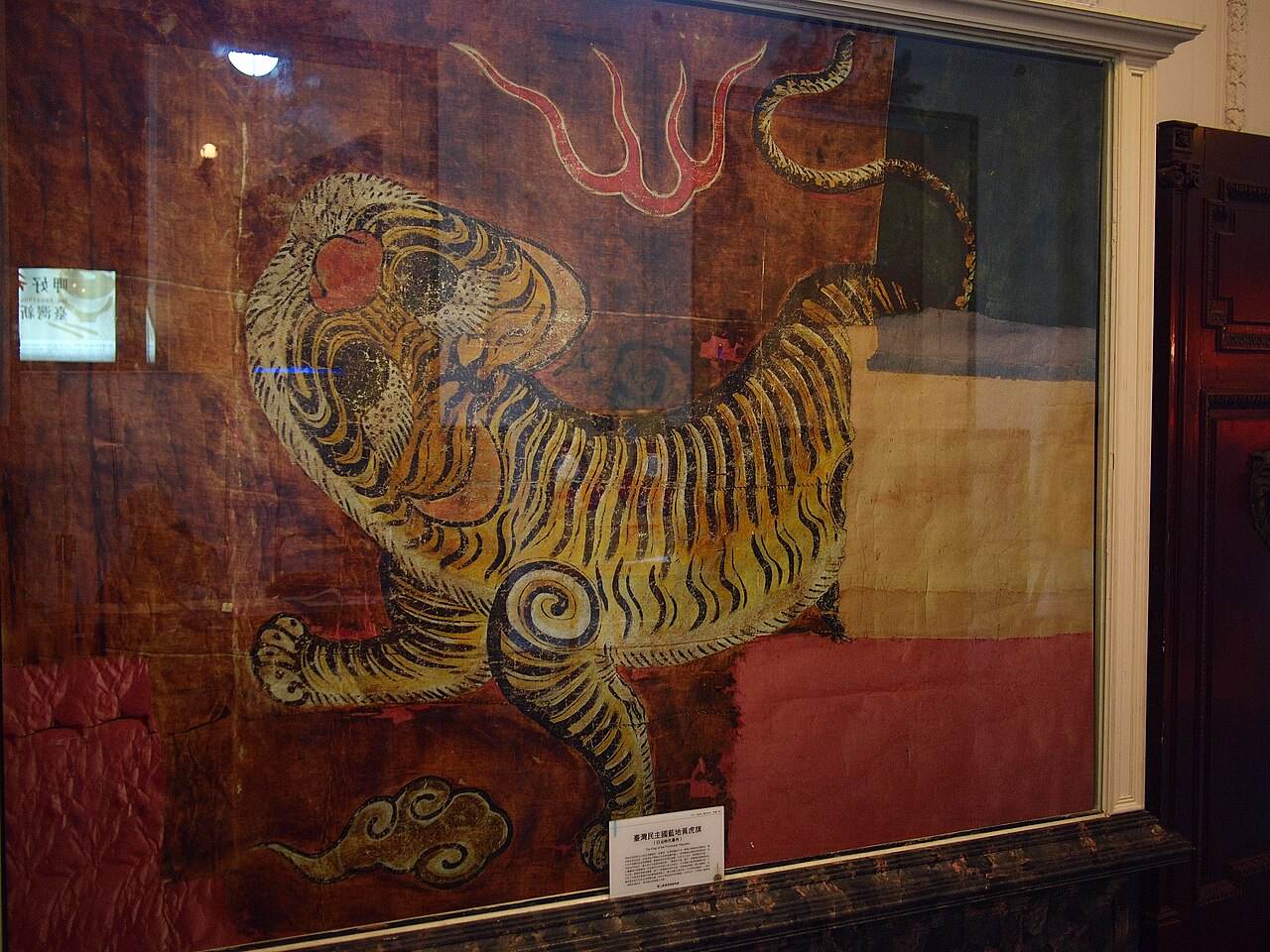
The new state's reign title was Yongqing — "forever loyal to the Qing". Its flag was a yellow tiger on a blue field, answering the Qing flag's blue dragon on yellow. The choice of flag said everything about what this country really was: it was not seeking independence from China, but holding up a banner that read "we are still Qing subjects" to block the Japanese takeover. The declaration stated it plainly: once the Japanese were driven out, Taiwan would return to Qing rule. A country that declared independence in order to go back — that is the strangest, and the most honest, thing about the Republic of Formosa.
But from its first day, the republic was in an impossible position. The Qing court did not support it; instead it ordered Tang Jingsong to leave Taiwan and return to Beijing. No foreign power recognised it. Its armies — Qing remnants, local militias, Hakka volunteers — answered to no single command. It was more a protest than a government.
Even so, on May 25 the yellow tiger flag went up over the streets of Taipei. For many Taiwanese, what it meant was simple: we do not agree.
More than one tiger flag was made. Research suggests the republic made at least three: one carried in the founding parade on May 25, one flown over the Keelung forts, and one sent to the customs house at Tamsui. H. B. Morse, the customs commissioner at Tamsui, reported that on May 26, while the Qing dragon flag still flew over the customs house, the tiger flag was already flying over the forts. Within a day, a new country's flag was flying over its gun batteries.
Chapter ThreeA Ten-Day President
On May 29, 1895, Japanese troops landed at Audi, on the north-east coast. Within a week, on June 3, Keelung fell. The Japanese were a regular army, with modern weapons and supply lines; the defenders were mostly hastily assembled militias and volunteers, short of guns and counting every bullet.
On the night of June 4, Tang Jingsong disguised himself as an old woman, boarded a German merchant ship, and fled to Xiamen. A president who had served 10 days simply walked away. The next day, Qiu Fengjia fled with his family to Jiaying in Guangdong. Before leaving, he left behind a poem: "Ministers in power can cede land; a lone minister cannot turn back heaven. I sail away in a small boat like Fan Li of old; looking back at the rivers and mountains, my heart sinks." On June 7, Japanese troops entered Taipei, and the first republic collapsed with the departure of its two leaders.
Later generations often call this "running away". The charge is not wrong, but it is only half the story. Tang Jingsong was a governor sent by the Qing court, not a leader chosen by the people of Taiwan; he became president because the gentry pushed him into it. That a man pushed into office should choose self-preservation when the army arrived is hardly surprising. What deserves a closer look is the people who stayed on the island after he left.
Chapter FourBaguashan
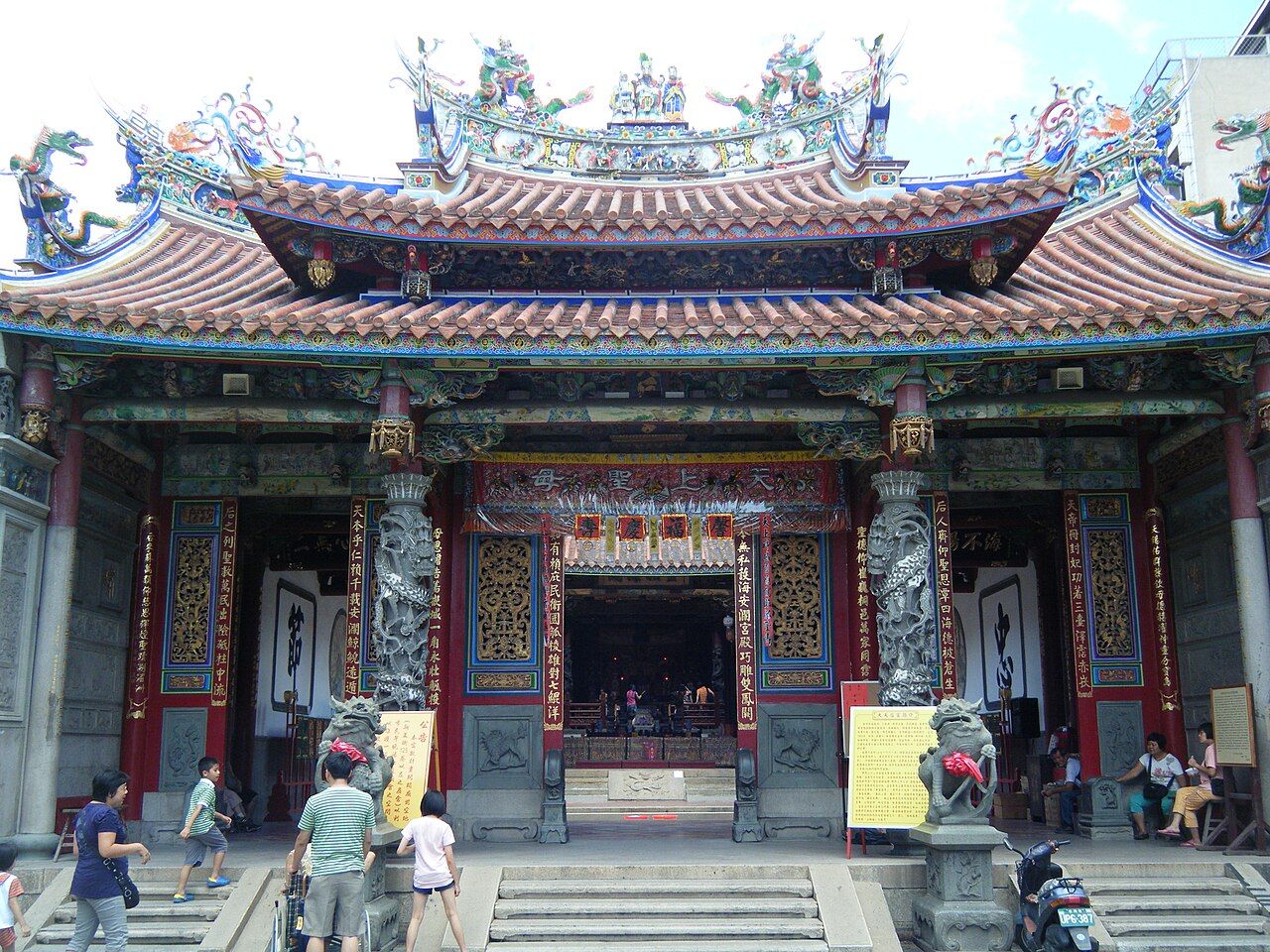
After Tang left, the war did not stop. The real fighting was done by the Hakka militias of central and southern Taiwan and Liu Yongfu's Black Flag Army. On June 26, Liu was proclaimed the second Grand President at Tainan, with the Grand Matsu Temple as the presidential office; the second republic was founded in the south.
The resistance was carried by a group later remembered as the Three Hakka Heroes: Wu Tangxing, Chiang Shaozu, and Hsu Hsiang. All three were local scholar-gentry who spent their own fortunes raising volunteer militias to defend their homes. On June 9, Wu issued a call to arms in Hsinchu and gathered volunteers to march south; Chiang, only 19 years old, was surrounded at Zhentoushan near Hsinchu on July 10, captured after his ammunition ran out, and took opium in prison the next day. On August 8, at the Battle of Jianbishan, the militia general Yang Zaiyun was killed, and Hsu and Wu fell back to Houlong.
On August 27, the largest pitched battle of the Yiwei War was fought at Baguashan, near Changhua. The Japanese committed about 15,000 men; the Formosan forces numbered only about 3,600. Holding the battery on the hill, the defenders beat back the first assaults; but the Japanese outflanked them, attacked through the night, and by dawn Baguashan had fallen. The Hakka militia leader Wu Tangxing and the Black Flag general Wu Pengnian were killed. The Japanese brigade commander Yamane Nobushige also died in the battle, and Prince Kitashirakawa Yoshihisa, commander of the Imperial Guards Division, was wounded by shellfire.
After Baguashan, the resistance never again fielded a large army. But the war did not end at once: the militias broke into small bands and turned to guerrilla attacks, harassing Japanese supply lines without pause. In early September, malaria broke out around Changhua, and more than 2,000 Japanese soldiers fell ill. Over the whole Yiwei War, the Japanese lost 333 men killed in action — and 6,903 dead of disease. Taiwan's forests and fevers killed far more soldiers than its bullets did.
Behind those numbers lies another count: about 14,000 people on the Taiwanese side lost their lives, including many civilians. It was the largest war ever fought on Taiwanese soil.
Chapter FiveThe Last Fifty Days
After Baguashan, the Japanese pushed south. By October, Liu Yongfu was holding Tainan, and food and ammunition in the city were nearly gone. On the night of October 19, he slipped away in disguise aboard a British merchant ship bound for Xiamen. Two days later, on October 21, Japanese troops entered Tainan, and the Republic of Formosa came to an end.
Hsu Hsiang was the last of the three to fall. After Baguashan he went south to see Liu Yongfu in Tainan, then raised more than 700 volunteers and returned to the front in Yunlin. On October 20, leading a charge near Madou on the south bank of the Zengwen River, he was shot and killed, aged 38 — the day after Liu Yongfu fled.
From May 25 to October 21: 150 days. A country's lifetime, barely longer than a summer.
But the meaning of those 150 days is not measured in how long they lasted. The Republic of Formosa was never a functioning state — it won no recognition, built no stable government, and both its presidents fled. Yet it did something no one in Taiwan's history had done before: when an empire handed a piece of land away as war reparations, the people who lived on that land said no, in their own name, for the first time.
EpilogueThe Flag Remains
That yellow tiger flag is now kept in the National Taiwan Museum. The surviving flag is a replica painted in 1909 by the Japanese artist Takahashi Untei, working from the original; it measures 315 centimetres by 263 centimetres, and in 2016 it was designated a National Treasure.
The flag has never really been put away in Taiwanese memory. Lai He, the father of modern Taiwanese literature under Japanese rule, wrote a poem about the yellow tiger flag; a century later, it is still the first image Taiwanese people think of when they talk about 1895.
The flag is painted on both sides. On the front, the tiger's pupils are wide open — the night tiger; on the back, they are half-closed like crescent moons — the day tiger. The two faces, it is said, stand for guarding the country by day and by night. A country that lasted 150 days left behind a flag that has been kept as a national treasure for more than 100 years.
The flag was preserved not because that country succeeded, but because the question it raised has not gone away: do the people of a place have the right to decide their own fate? In 1895, the people of Taiwan answered that question once, in 150 days. The answer was not written in any treaty. It was written on that flag.
One hundred and fifty days is short — too short to build a government, to win a war, or to make the world remember a country's name. But it is long enough: long enough for the people of an island to stand up in their own name for the first time, long enough for a flag to be kept as a national treasure more than a century later, long enough that every time people talk about what it means to be Taiwanese, the story can begin in 1895.