PrologueThe Palanquin in the Night
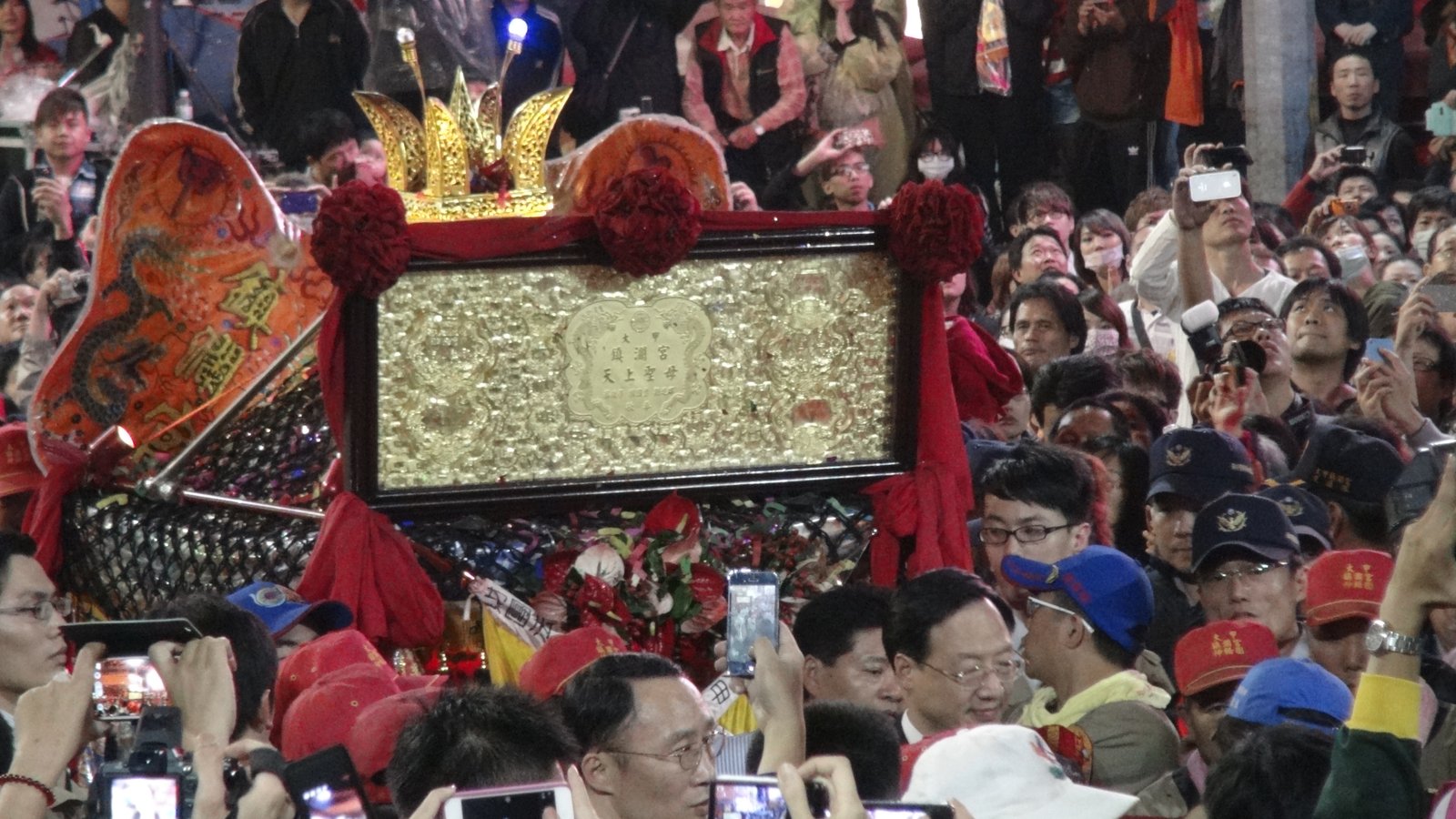
At 11 at night, the courtyard of Jenn Lann Temple in Dajia is packed shoulder to shoulder. Firecrackers shake the roof tiles. Some in the crowd hold up phones; some close their eyes and press their palms together; some lift children onto their shoulders just to catch a glimpse of the golden palanquin. The moment the palanquin moves, the whole street moves with it — hundreds of thousands of people escorting a wooden statue not a metre tall out of the city gate and into the dark.
That statue, less than a metre high, draws an entire island to walk 340 kilometres for her every year. She is no primordial god, no founder of a scripture. She began as a girl from a small fishing village in Fujian. How does one person become the faith of an island? That is what this book is about.
Chapter 1A Fisherman's Daughter
The legend goes like this. In 960, the first year of the Jianlong era under Emperor Taizu of Song, a daughter was born to the Lin family on Meizhou Island, off Putian in Fujian. They named her Lin Mo — "Mo" meaning silent — because, the story says, she did not cry for a month after birth, and a red light filled the room when she was born. She grew up knowing the water and the weather, able to read a coming storm in the surface of the sea; as a young woman she healed the sick and pulled drowning fishermen from the water. In 987, at twenty-seven, in the fourth year of the Yongxi era under Emperor Taizong, she ascended to heaven from a hilltop on Meizhou Island, and the villagers built a small shrine where she rose. They called it the Shrine of the Goddess.
This is legend, and it must be labelled as such. What the historical record can confirm is only an outline: in the tenth century, a woman named Lin Mo lived on the Fujian coast, and after her death the local people worshipped her as a sea goddess. UNESCO's own inscription text is careful to say only that she is "believed to have lived in the tenth century," that she devoted herself to helping her fellow townspeople, and that she died attempting to rescue the survivors of a shipwreck. Whether she was born on a particular day, how old she was when she died, or whether music sounded as she ascended — those are layers of gold leaf added by later generations.
But legend is itself a kind of evidence. What a society chooses to remember, and what it forgets, reveals more than any chronology. The fishermen of Meizhou did not remember a princess or a warrior. They remembered a neighbour's daughter who could swim, read the weather, and save people. The origins of a goddess decide how believers speak to her: not kneeling before heavenly majesty, but asking a reliable neighbour for help.
Chapter 2Titles from the Throne
The shrine was built in the year she died — 987. A few wooden beams, incense from fishermen on the same island. If the story had stopped there, Mazu would have remained one of thousands of local gods along the Chinese coast. What carried her outward was the imperial court.
Across the Song, Yuan, Ming, and Qing dynasties, emperors kept promoting her. From Lady to Celestial Consort, from Consort to Empress of Heaven, the titles grew longer and the temples grander. This was not sudden piety; it was a transaction. The empire's ships had to cross the sea, its grain fleets had to survive the storms, and the emperor needed a sea goddess to bless the voyages. Fishermen and merchants, in turn, needed the court to recognise the god they prayed to, so their faith would stand on solid ground. Each title was a contract signed by both sides.
The transaction reached its peak under the Qing. In 1684, after the Kangxi Emperor brought Taiwan under Qing rule, the court formally conferred on Mazu the title "Tianhou" — Empress of Heaven. From then on she was no longer merely the fishermen's goddess; she was an empress of the empire, her name carrying the court's seal. In the same era, the Meizhou ancestral temple grew from a small shrine into a five-compound complex known as the "Dragon Palace on the Sea." A god's rank, in the end, is a map of politics.
But the titles had a side effect the emperors probably did not foresee: the higher she was raised, the further she moved from the palace and the closer she came to ordinary people. Any village could build a Tianhou temple; anyone could invite the Empress of Heaven home. The court thought it was absorbing a sea goddess. In truth, it was handing her out to the whole world.
Chapter 3The Goddess Travels with the Ships
Mazu came to Taiwan not with missionaries but in migrants' luggage. In the Ming and Qing dynasties, people crossing from coastal Fujian and Guangdong to Taiwan first invited a statue of Mazu aboard, then built her a temple on the far shore. The practice is called fenling — dividing the incense: a new temple takes a portion of sacred flame from the ancestral temple, and the goddess in the new temple is the same goddess. The flame can be divided without end, and the goddess does not grow smaller for it. This is the most important institutional design in the Mazu faith.
Fenling is expansion without a centre. No headquarters sends out missionaries; no conversion plan is drawn up. Every new temple is a new node, and every node can divide again. The Penghu Tianhou Temple is the earliest Mazu temple in Taiwan documented in written records, with reliable references appearing in 1604. The Grand Matsu Temple in Tainan is the only Mazu temple in Taiwan built by the government and entered into the official register of state sacrifices; it was once the residence of Prince Ningjing of the Zheng regime. In 1694, the monk Shubi carried a Mazu statue from Chaotian Pavilion on Meizhou and founded Beigang Chaotian Temple at Bengang; the temples later divided from it number more than 300, and it is known as the head temple of Mazu in Taiwan.
Dajia's story is the same. According to tradition, in 1730 the Meizhou native Lin Yongxing brought his whole family to Taiwan and invited a Mazu statue from the ancestral temple to worship at home; in 1732 local gentry raised funds to build a small shrine, which was rebuilt as a Tianhou Temple in 1770 and renamed Jenn Lann Temple after a further rebuilding in 1787. A household god became, within two generations, the guardian of a whole town.
Today Taiwan has more than 500 Mazu temples. The number matters less than the pattern: from fishing harbours to mountain towns, from temple squares to night markets, Mazu temples are the nodal map of a migrant society. Wherever people came ashore, there she is.
Chapter 4Nine Days and Eight Nights
Every year in the third lunar month, the Dajia Mazu Pilgrimage sets out. The procession leaves Jenn Lann Temple in Dajia, walks to Fengtian Temple in Xingang, Chiayi, to "divide the fire," and walks back — about 340 kilometres over nine days and eight nights, passing through Taichung, Changhua, Yunlin, and Chiayi and more than a hundred temples along the way. In 2010 the pilgrimage was designated a National Important Folk Custom.
The numbers easily mislead people into thinking this is a carnival. Participation is routinely counted in the millions — a 2012 report estimated more than a million participants over the whole journey, and the temple's count for 2021 reached about 4 million. But the real content of the pilgrimage is not the headcount; it is the walking itself. Nine days and eight nights, blisters on the soles, shoulders rubbed raw, sleeping on temple floors at midnight. Nobody comes to watch a show. Everyone is part of the procession.
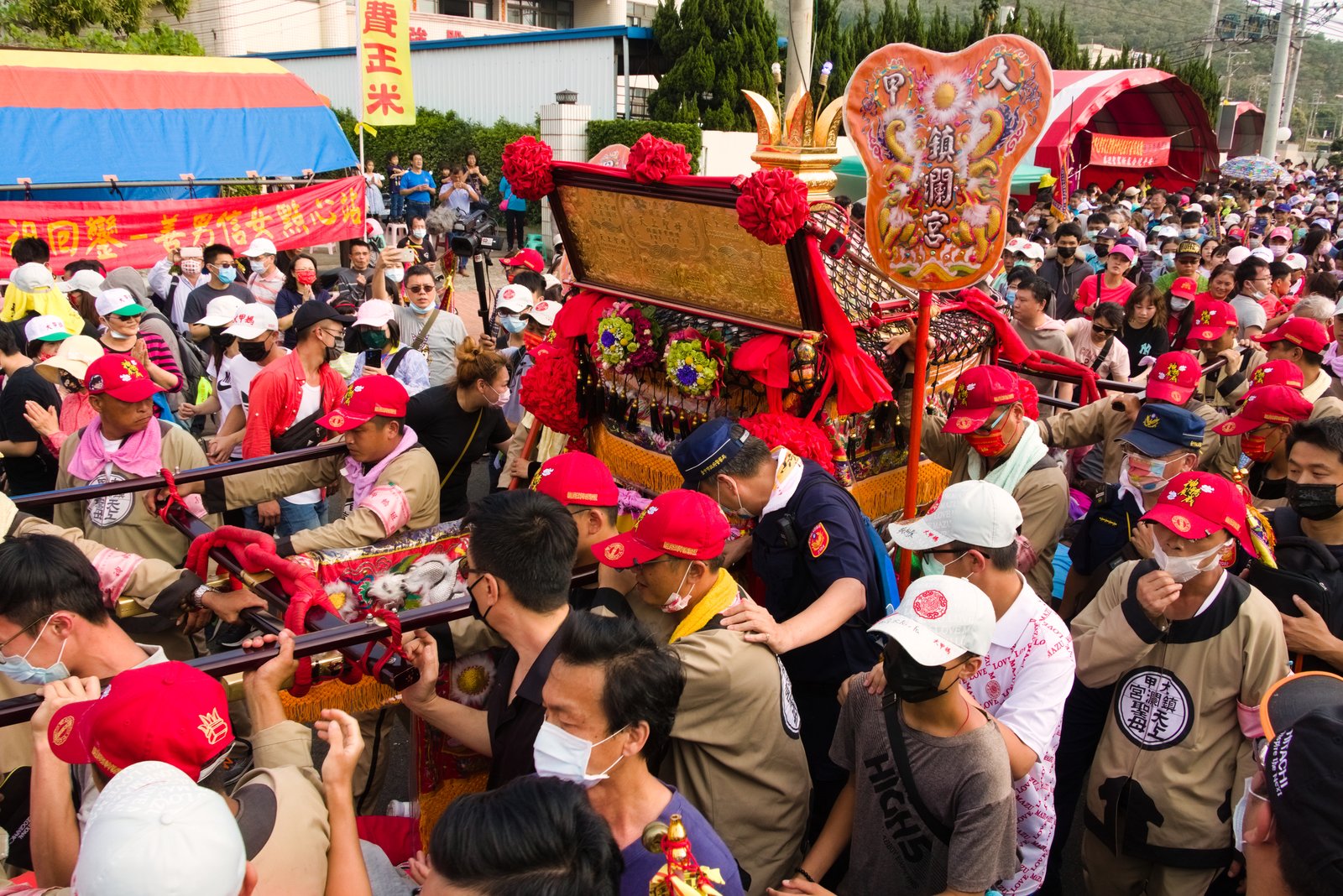
Along the route there is a sight unique to Taiwan: the "refreshment stations." Roadside stalls hand out food, water, and pain-relief patches for free, asking nothing in return except the goddess's blessing. The queue to crawl beneath the palanquin — zuan jiao jiao — can stretch for hours, all for a moment of passing under the goddess. These acts may look superstitious; in fact they are a precise social technology. How do strangers build trust quickly? First give together, then walk together.
The pilgrimage is a temple without walls. A temple stands in one place and waits for people to come. A pilgrimage carries the god out of the temple to visit the people. Every road a statue walks becomes a route along which a network of human relationships is rewoven. Walk it once a year, and the relationships are renewed once a year.
Chapter 5A Mother on Another Sea
Mazu is not the only mother sailors carried aboard. From 1405 to 1433, Zheng He led the Ming treasure fleets on seven voyages across the Indian Ocean. Before each departure the fleets sacrificed to Tianfei; before the seventh voyage, Zheng He held grand rites at the Tianfei temples of Changle and Meizhou Island to pray for the journey. The largest official ocean expedition in Chinese history rested its spirit on a goddess from a fishing village.
In almost the same era, Europe's sailors carried a mother of their own aboard. The Portuguese called her Our Lady of Navigators, praying for her to protect seamen in storms and bring them safely home. Between 1531 and 1536, the Spanish painter Alejo Fernández painted The Virgin of the Navigators: the Virgin spreads her mantle over the fleets below, sheltering kings and explorers — the earliest known painting whose subject is the discovery of the Americas.
Two mothers, two maritime civilisations. The Virgin spread with church and empire: where the fleets went, churches were built, and faith followed sovereignty. Mazu spread with divided incense and migration: where the flame went, temples were built, and faith followed people. One was conquest from above; the other was migration from below. Zheng He's fleets stopped sailing, but Mazu's incense never stopped — because she never needed a fleet. She needed one boat, one migrant, one stick of incense.
Chapter 6Why Her
Most Chinese gods are male, and most are stern: Guan Yu speaks of loyalty, the Dark Heavenly Emperor subdues demons, the City God governs the dead. Mazu is different. She is a mother figure — gentle, approachable, unconditional. Before fishermen put to sea they ask her to po-pi — a Taiwanese phrase that means, roughly, "look after us," spoken the way you would speak to family.
The human logic is plain. What a person fears most at sea is not death but loneliness. In a storm nobody can help you; you can only speak to a power you cannot see. A stern male god inspires awe; a mother is someone you can actually talk to. Mazu's power does not come from fear. It comes from the feeling of being looked after.
The institutional logic is equally plain. Fenling lets the faith reproduce without limit and without losing value; temples give it a physical foothold; the annual pilgrimage renews it. And Mazu temples were never only religious sites — they were the meeting hall, the mutual-aid society, and the news exchange of a migrant community. Beside the incense burner, people talked about the fishing season, about business, about whose daughter was getting married. Faith here is not a doctrine. It is a way of life.
The crowd psychology hides in the pilgrimage itself. One person walking 340 kilometres is an ordeal; a million people walking together is a festival. The individual disappears into the procession, and anxiety disappears with it. You do not need to believe in any grand doctrine. You only need to keep walking — walk to Xingang, divide a flame, and carry it home. What collective action gives people is more solid than any teaching: the certainty that "I am not alone."
EpilogueThe Sea Is Still There
In 2009, Mazu belief and customs were inscribed on UNESCO's Representative List of the Intangible Cultural Heritage of Humanity. More than a thousand years on, she has grown from a small shrine on Meizhou Island into a faith spanning 49 countries and regions, with some 300 million adherents. But behind the numbers, the thing worth noticing is this: her story was never written into any scripture, and her teachings were never systematised. She survived not through books, but through people.
In Taiwan today, the fishing boats are fewer and fewer people go to sea, yet Mazu has not ebbed with the tide. Every third lunar month, the palanquin still leaves Dajia, and the procession holds grandparents and teenagers in sneakers alike. Some walk for health, some for family, some just to walk. The sea is still there, the road is still there, the people are still there — and that is how she became the faith of an island: not by conquest, but by companionship.
An island's faith, it turns out, can begin with a girl. Not because she did anything earth-shattering, but because she gave every frightened person someone to ask for help. A thousand years have passed, and that need has never gone away.