PrologueThe Author Without a Face
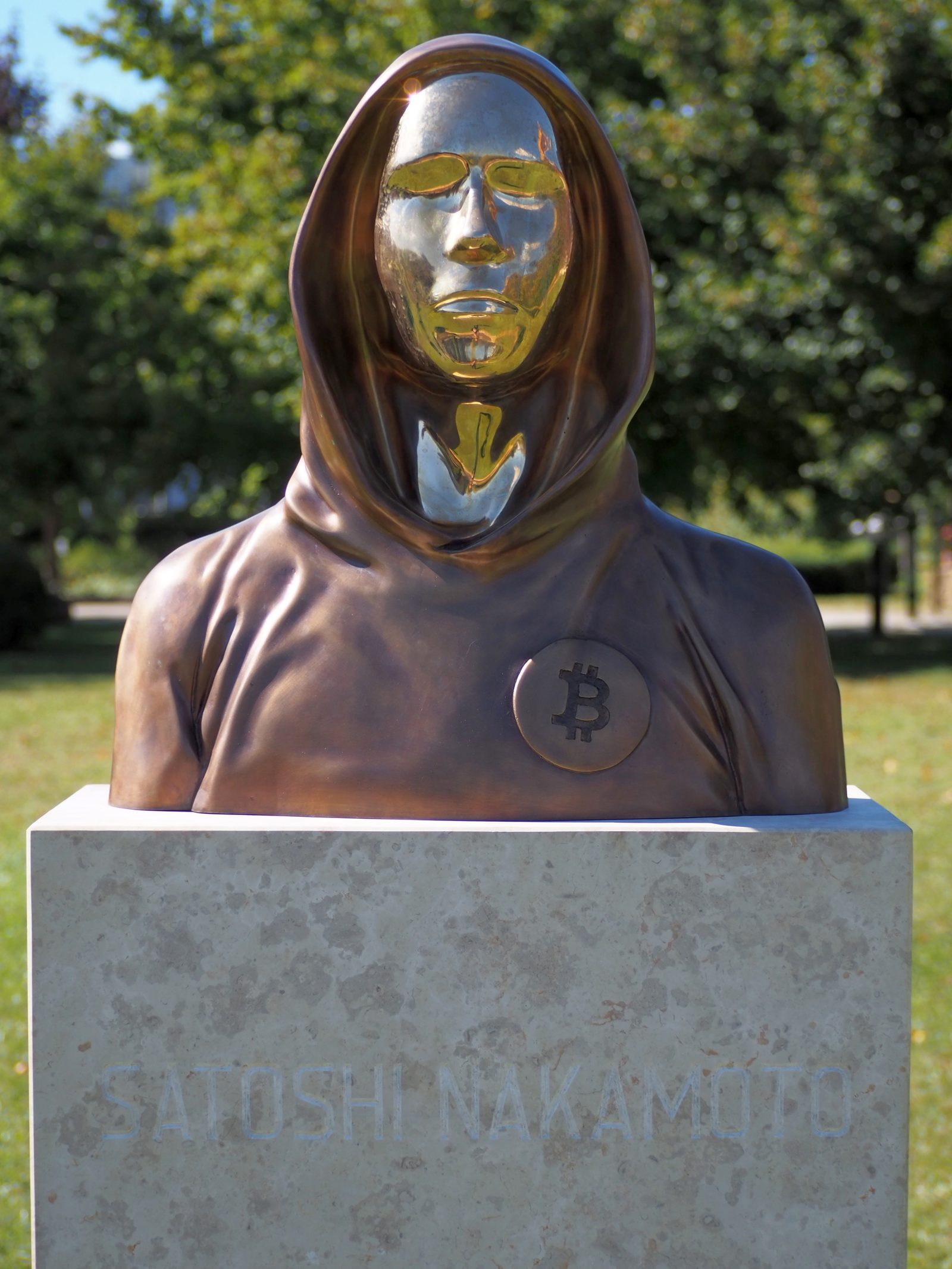
On October 31, 2008, a message arrived on a cryptography mailing list. No photograph, no company, no launch event. The sender called himself Satoshi Nakamoto. In the 18 years since, no one has seen him, no one has heard his voice, and no one can prove who he is. And what he left behind is still running.
This is a story about absence. Inventors in history usually stand beside their inventions, collecting applause, patents, and lawsuits. Satoshi Nakamoto did the opposite: he built the thing, handed it to a crowd of strangers, and walked away. He left cleanly, without even a silhouette behind him. Bitcoin has no founder's office, no founder interviews, no founder's account to calm the markets during a crash. There is only a nine-page document, a string of code, and a name that no one has ever claimed.
This is worth a book not because of how much bitcoin later rose in price, but because it forces us to rethink one of the oldest questions there is: where does trust come from? We are used to trusting institutions with seals, people in suits, promises written into constitutions. Satoshi's experiment ran in reverse: if you take the person out of trust, what is left? The answer is written in the ledger of the last 18 years.
Chapter OneA Nine-Page Letter
On October 31, 2008, the world was busy with other things. Six weeks earlier, on September 15, Lehman Brothers had filed for bankruptcy, and the global financial system froze within weeks; earlier that same year, the Beijing Olympics had closed in August, and the world was talking about a rising China. No one was waiting for a letter about electronic cash.[1][7]
The letter was short, its opening only two sentences long: "I've been working on a new electronic cash system that's fully peer-to-peer, with no trusted third party." Attached was a nine-page paper titled "Bitcoin: A Peer-to-Peer Electronic Cash System." It ran to twelve sections and eight references, citing b-money from 1998 and Hashcash from 2002 — old ideas that had circulated for years among the cypherpunks. Satoshi invented none of the parts; he assembled the parts into a machine that ran.[1]
The paper set out to solve a single problem, and one so old it is almost funny: how do you stop the same coin from being spent twice? In the physical world, a banknote handed over no longer belongs to you; but in the digital world, a file can be copied without limit. Every earlier attempt at digital cash had ended up asking a central institution to act as referee, confirming who paid first and who paid second. The white paper's answer was to let a crowd of computers that did not know one another decide the order through proof of work, and to make rewriting that order too expensive to be worth it. Trust would no longer rest on a person or an institution, but on mathematics and incentives.
Chapter TwoThe Newspaper Headline in the Genesis Block
A little over two months later, on January 3, 2009, the first block of Bitcoin was mined — the genesis block. It contained a single transaction: a mining reward of 50 bitcoins, paid to an address controlled by Satoshi himself. Because of a quirk in the software, those 50 coins can never be spent; they remain where they are to this day.[2]
What deserves attention is not the 50 coins but the line of text hidden inside the block: "The Times 03/Jan/2009 Chancellor on brink of second bailout for banks" — the front-page headline of The Times of London that day, on Chancellor Alistair Darling's deliberations over a second round of bank bailouts. The line does two things at once. Technically, it is a timestamp, proving the block could not have been mined before that day; historically, it is a statement of position, written on the ruins of the financial crisis.[2]
What is striking is that the white paper never mentions the financial crisis at all. In the paper, Satoshi is a cool-headed engineer, talking only about double-spending and proof of work; in the genesis block, he shows his attitude for the first time. On the birth certificate of a new system, what is written is not celebration but a challenge to the old order.
There is also a small riddle: after the genesis block was mined, the next block did not appear for six days, until January 9, 2009. No one can explain the six-day gap. Some guess Satoshi was testing; some guess he was waiting; some guess he was simply enjoying a quiet weekend. At the beginning of a system, even its creator did not seem in a hurry.[2]
Chapter ThreeA Test of 10 Bitcoins
On January 8, 2009, Satoshi announced the release of Bitcoin version 0.1 on the same mailing list. Four days later, on January 12, block 170 recorded the first transfer in Bitcoin's history: Satoshi sent 10 bitcoins to the cryptographer Hal Finney, as a test.[3]
Finney was the first person to download and run the Bitcoin software — other than Satoshi himself. On January 11, 2009, he wrote two famous words: "Running bitcoin." The next day, 10 coins arrived in his wallet. Bitcoin had no price then; 10 coins were worth nothing, and the whole thing resembled two engineers in a laboratory confirming that the circuit was connected.[3]
Finney spent the rest of his life carrying one question: was he Satoshi? He denied it again and again, producing his 2009 email correspondence with Satoshi as evidence that the two were separate people in conversation. On August 28, 2014, he died of amyotrophic lateral sclerosis, aged 58. All that remains of the other end of the first transaction is a public record of emails.[3]
This detail matters: the first time bitcoin moved between two people, it did so not through an exchange, a price, or speculation, but through a test. Whether a system survives often depends on the reason it was first used.
Chapter FourTwo Pizzas
On May 18, 2010, the programmer Laszlo Hanyecz posted on the forum: "I'll pay 10,000 bitcoins for a couple of pizzas." Four days later, on May 22, the deal was done: two large Papa John's pizzas were delivered to his home in Florida, at a price of 10,000 bitcoins. At the time the two pizzas cost about 25 dollars, and a bitcoin was worth roughly 0.004 dollars.[4]
The event later became known as Pizza Day, and every May 22 someone retells the joke: those were the most expensive pizzas in history. But behind the joke is a serious turning point: this was the first time bitcoin was used to buy something in the real world. Once a thing can be exchanged for pizza, it is no longer just a toy for programmers; it has a price, a market, and the question of what it is worth.[4]
Hanyecz later said in interviews that he spent close to 100,000 bitcoins on pizza in and around 2010. He has said he does not regret it, at least in public. The monetary character of a system is often not born in a white paper, but on an evening when someone is hungry.
Chapter FiveThe Hornets' Nest
In December 2010, after WikiLeaks published the United States diplomatic cables, it faced a financial blockade as payment processors cut off its funding. Someone suggested WikiLeaks accept bitcoin donations. On December 5, Satoshi objected in public on the forum: "No, don't 'bring it on.' The project needs to grow gradually so the software can be strengthened along the way. I make this appeal to WikiLeaks not to try to use bitcoin." Six days later, on December 11, he wrote again: "WikiLeaks has kicked the hornet's nest, and the swarm is headed towards us."[6][8]
This was one of the rare moments when Satoshi showed emotion. His worry was not moral but a matter of timing: Bitcoin was still a small beta community in its infancy, unable to bear the gaze of a superpower. WikiLeaks listened and held off, only publishing a bitcoin donation address on June 14, 2011 — by which time Satoshi was already gone.[8]
On December 12, Satoshi published his last public post, titled "Added some DoS limits, removed safe mode," a technical update for version 0.3.19 of the software. There was no farewell, no explanation. He logged into the forum once more the next day, and never posted in public again. Months later, on April 23, 2011, he wrote a private email to the developer Mike Hearn, saying he had "moved on to other things" and that bitcoin was "in good hands." That is the last message from him known to exist.[6]
Chapter SixOne Million Coins That Never Moved
How much bitcoin does Satoshi hold? No one knows the exact figure, and he never said so himself. The most cited estimate comes from the Argentine researcher Sergio Demian Lerner. In 2013, he found from a fingerprint in the earliest blocks that a single machine had mined about 40 percent of the first 50,000 blocks; in a 2019 update, he estimated that this miner, nicknamed Patoshi, had mined about 22,000 blocks and accumulated close to 1.1 million bitcoins.[5]
But Lerner himself has stressed again and again that the evidence is circumstantial: there is no mathematical proof and no direct witness. In September 2026, another blockchain analytics firm rechecked the numbers and, depending on how strictly the pattern is applied, put the total between roughly 900,000 and 1.17 million coins. In other words, "one million" is a well-grounded guess, not a fact. The one thing that is certain is that these coins have almost never moved: the Patoshi pattern vanishes abruptly around May 2010, near block 54,000, and never reappears.[5]
These coins are moving not because of what they are worth, but because they were never spent. A person holding a fortune large enough to top the richest-people lists has not moved a single coin in more than a decade — that, in itself, is the longest sentence in Bitcoin's history.
EpilogueDisappearance as Part of the Design
For 18 years people have asked: who is Satoshi? The list of candidates is long: Hal Finney, Nick Szabo, Adam Back, Dorian Nakamoto. Each has been denied or disproved. In 2014, a message signed Satoshi appeared on the P2P Foundation forum with a single sentence: "I am not Dorian Nakamoto." It was the only apparent appearance after the disappearance, and even the authenticity of that message cannot be confirmed. On March 14, 2024, the High Court in London ruled that Craig Wright, who had long claimed to be Satoshi, is not Satoshi. The one thing that could prove an identity — a signature made with a private key from the early blocks — has never appeared.[6]
Perhaps we have been asking the wrong question. Satoshi's disappearance may not have been an accident, but a precondition for the system to exist at all. A founder with a face can be arrested, bought, killed, forced to change the code, or held responsible for the price. A founder without a face can do nothing, and needs to do nothing. Bitcoin has no chief executive to subpoena, no headquarters to raid, no founder to threaten. This is not a flaw; it is the design.
The history of trust has two patterns. One is to trust people: to trust that a king will not print too much money, that a bank will not fail, that a founder will not run away. The other is to trust rules: to trust that mathematics does not lie, that incentives do not betray, that a ledger no one person can rewrite alone can be relied upon. Satoshi bet on the second. He bet that after the founder vanished, the system would not die, but would live longer precisely because it had no owner.
Eighteen years on, the bet has not yet lost. The white paper is still on bitcoin.org, nine pages, not a word changed. The newspaper headline in the genesis block is still in place, and the 50 coins have not moved. The pizzas were eaten long ago, Finney is gone, and WikiLeaks has gone its own way. And the person who wrote the first line of code has never come back to collect the applause — nor the million coins. The best ending for a founder may be to become someone whose name does not need to be remembered.