PrologueThe Enemy Without a Name
In October 1918, the streets of Philadelphia were piled with coffins. There were not enough gravediggers, not enough coffins, not even enough priests to pray over the dead. In four months the city lost more than 12,000 people — while, at the same time, the First World War was staggering to its end in the trenches of Europe.[7]
The war had lasted more than four years and killed 15 to 22 million soldiers and civilians.[14] The pandemic needed less than two years to take 50 to 100 million lives, infecting some 500 million people — a third of everyone alive on earth.[1][3] An enemy with no name and no face killed more people than the most brutal war in human history.
And yet, when the war ended, people raised monuments to the fallen, fixed days of remembrance, and wrote epics. The pandemic left almost nothing behind. This essay does not ask how the virus killed. It asks how a society made a catastrophe invisible — and then forgot it.
We are used to measuring disaster in the language of war: so many battles, so many fronts, so many generals. A plague speaks no such language. It has no front line, no surrender, no victor — only one ordinary person after another falling down. When death has no enemy, the story loses its shape. And a disaster without a shape is the easiest to forget.
Chapter OneHow It Got Its Name
The earliest recorded cases appeared in March 1918, in Haskell County, Kansas.[13] The virus crossed the Atlantic aboard troop ships and burrowed into crowded barracks and trenches. But the newspapers of the warring nations said nothing at all: Germany, France, Britain, and the United States all ran wartime censorship, and anything that might shake morale or expose weakness was forbidden in print. The enemy must not learn that our soldiers were falling ill — and our own people must not learn it either.
Only Spain was exempt. Neutral in the war, its press answered to no military censor. In May 1918, the Madrid papers began covering the epidemic at length, and even the illness of King Alfonso XIII made the front page. In June 1918, the London Times was among the first to use the term "Spanish flu," and the name stuck.[13]
It was a miscarriage of naming. Spain was neither where the epidemic began nor among the hardest hit in Europe; it was simply the one place willing to tell the truth. The French press at first called it the "American flu," then changed its mind so as not to offend an ally. The name of a disease is never decided by science. It is decided by politics: whoever controls the words decides whom the disaster belongs to.
Ironically, the Spanish themselves did not call it the Spanish flu. In Madrid it went by the "Naples Soldier," after a catchy tune from a popular operetta, and sometimes as the "French flu." Every country was in a hurry to blame the plague on someone else: it was Spanish, French, American — anything but ours. A name is a mirror. It shows not where the virus came from, but how frightened people point at one another.[13]
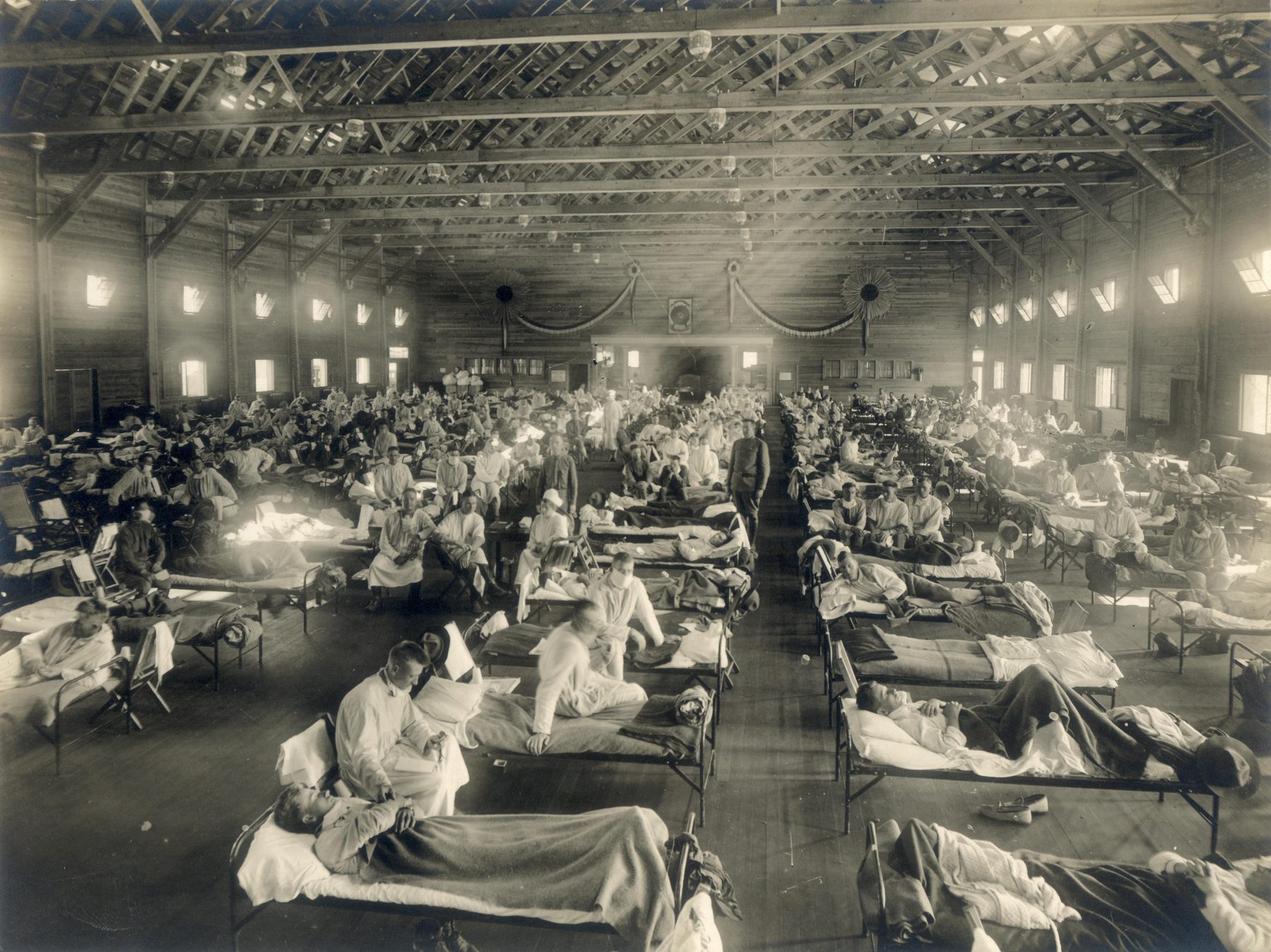
To this day, the geographic origin of the pandemic remains undetermined. The epidemiological record of 1918 is too fragmentary, and wartime silence buried the earliest clues deeper still. We know only one thing: when the virus appeared, humanity was busy killing one another, and no one had time to name it.
Chapter TwoThree Waves
The plague came three times. The first wave arrived in the spring of 1918, comparatively mild; many took it for ordinary seasonal flu. The second wave returned in the autumn, far more lethal; a third followed in the winter of 1918–1919, and in some places the epidemic lingered into 1920. Three waves circled the globe in less than a year.[2][3]
What made it strange was whom it killed. The mortality curve of influenza had always been U-shaped: the very young and the very old were most vulnerable, young adults safest. In 1918 the curve grew a third peak and became W-shaped: healthy young adults between 20 and 40 fell in droves. Death rates among people aged 15 to 34 ran more than 20 times higher than in previous years; nearly half of all deaths were young adults aged 20 to 40; and people under 65 accounted for more than 99% of excess deaths. It has never happened before or since.[2]
Why the young? Scholars suspect an over-violent immune response may have played a part, but there is still no settled answer. One theory holds that older people carried partial immunity from a similar virus they had met in their youth, leaving the young exposed. The truth remains buried in the lung tissue samples of 1918.
The numbers speak for themselves: the case-fatality rate exceeded 2.5%, against less than 0.1% for ordinary seasonal flu.[1] This was not a worse cold. It was a killer of an entirely different order.
The first wave was so mild it could almost be ignored; later scholars called it a "herald wave." Precisely because it did not kill, cities and armies let their guard down, and no one imagined the slaughter that would follow a few months later. In some places the epidemic did not even end in 1919; it returned again in 1920. A plague is never a single battle. It is a long war.[2][3]
Chapter ThreePhiladelphia and St. Louis
On September 17, 1918, Philadelphia recorded its first case. The city campaigned against coughing, spitting, and sneezing in public — and went ahead with the Liberty Loan parade planned for September 28. That day 200,000 people crowded the streets, and within days the hospitals were overflowing. Only on October 3 did schools, churches, theaters, and public gathering places close — a full two weeks too late.[10]
St. Louis told a different story. Two days after the first civilian cases appeared, the city shut schools, churches, and gathering places and quarantined the sick at home. The result: St. Louis's peak mortality rate was one-eighth of Philadelphia's. Over the first six months, 358 people per 100,000 died in St. Louis, against 748 in Philadelphia. The two cities used the same measures. The difference was timing.[7][10]
In 2007, two studies in the Proceedings of the National Academy of Sciences re-examined the public-health responses of American cities in 1918 with mathematical models. The conclusion was blunt: the earlier a city imposed multiple controls, and the more comprehensive they were, the lower its peak death rate. The fastest-acting cities cut transmission by 30% to 50%. In the early days of an epidemic, a delay of two weeks is enough for infections to multiply three to five times over.[7][8]
Philadelphia's parade was not stupidity. It was a choice: war bonds were more concrete than an invisible virus, and a patriotic parade fit a city's image of itself better than empty streets. Only when the coffins piled up did the price of that choice become visible. Epidemic control was never merely a technical problem. It was a collective negotiation over what is worth fearing.
Chapter FourTaiwan: Two Waves in a Colony
In 1918, Taiwan was under Japanese colonial rule. According to reports by Japanese medical officers of the time, the earliest cases probably entered through the port of Keelung in June 1918 and spread to all 12 administrative districts of the island in less than a month. The epidemic arrived fast and without warning, and the island had no line of defense.[6]
By December 15, 1918, 779,522 people in Taiwan had been infected — 20.8% of the population — and 25,394 had died, a case-fatality rate of 3.26%. The epidemic eased in early 1919, but a second wave swept the island again from December 1919 to March 1920. Together the two waves caused 51,048 excess deaths, about 1.38% of the population at the time.[4]
As elsewhere in the world, the young died out of proportion. In 1918, mortality among people aged 20 to 30 rose 5.2-fold, the steepest increase of any age group. Later studies, recalculating from influenza and pneumonia deaths, put the toll of the two waves above 60,000 — far higher than the 25,000 in the older literature.[5]
The second wave struck a different face. By 1920, the steepest rise in mortality was no longer among young adults but among children aged 5 to 10, whose death rate rose 7.7-fold. The virus had not changed; the map of immunity had. Those who survived the earlier wave carried protection, and children born after it became the new gap. Every wave rewrote its own list of victims.[5]
Deaths in a colony are always undercounted. Incomplete statistics, mistaken diagnoses, remote districts with no registration at all: the numbers are forever only a lower bound. Taiwan's 50,000-odd dead are a single small line in the global ledger, while in India an estimated 12 to 13 million people died — the heaviest, and least remembered, page of the whole pandemic.[11]
Chapter FiveMasks, Fines, and Gunfire
In 1918 there was no vaccine, no antiviral drug, no ventilator. All humanity had left were the oldest tools: masks, closed schools, banned gatherings, isolation of the sick. What looks obvious today was, at the time, a social experiment.
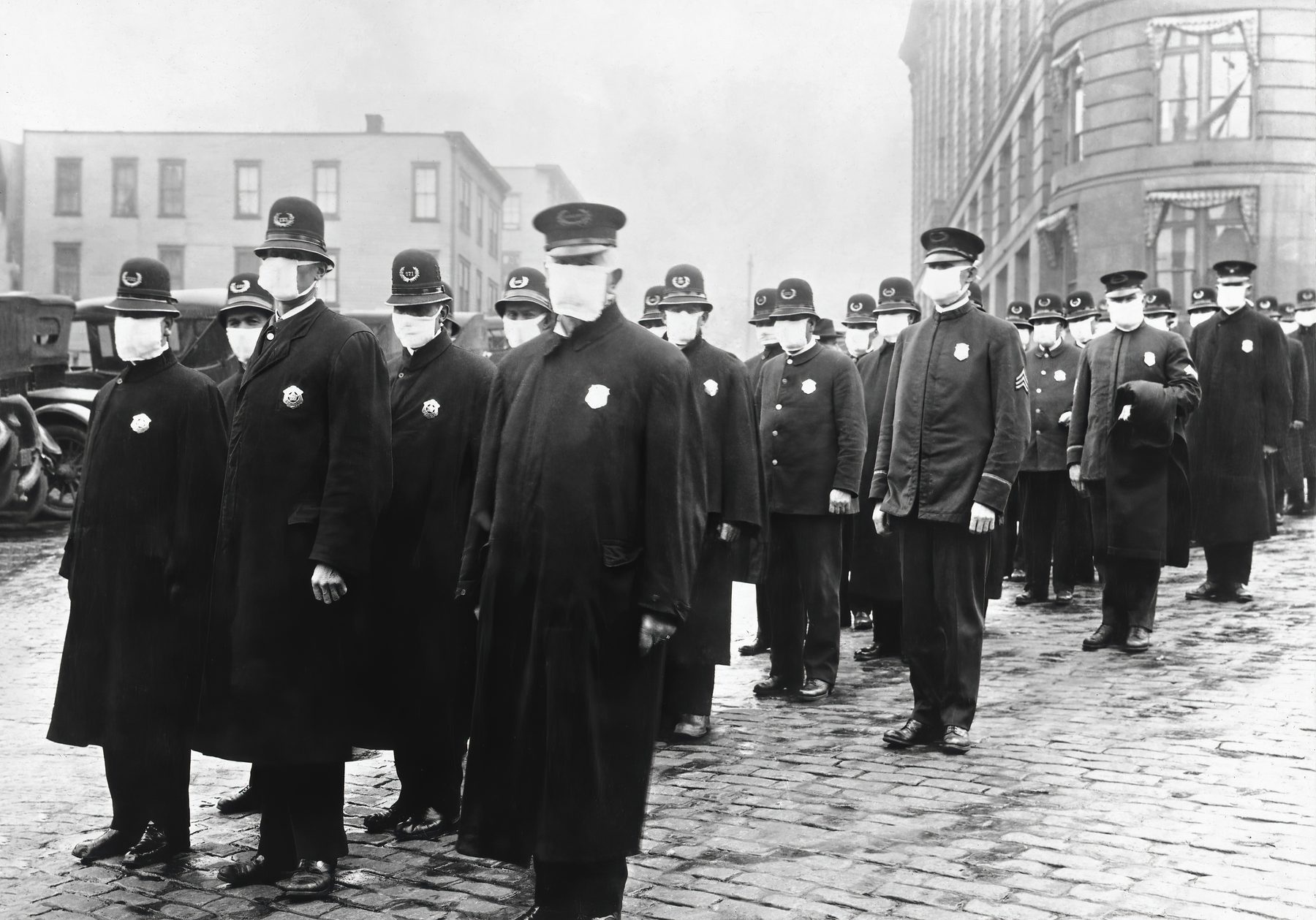
Seattle's rules were the strictest: no mask, no streetcar. The Red Cross put 120 workers to the task, and in three days they produced 260,000 masks. Police on the beat, streetcar conductors, hospital nurses — all wore white gauze masks. The mask became the most common sight on the streets in the winter of 1918, and the most contested symbol.[9]
Not everyone complied. In San Francisco a health officer shot three people when one refused to wear a mandatory mask; in Arizona, police handed out $10 fines to the unmasked; and on the streets of San Francisco, demonstrators tore off their own masks in protest. A mask was never just a piece of cloth. It was an order — and orders always meet disobedience.[10]
The masked and the unmasked denounced each other, and the newspapers coined the word "slacker" for those who refused to cooperate. Fear split society in two: one half believed collective action could save lives, the other believed freedom mattered more than safety. More than a century later, the same argument returned, almost word for word.
Behind the quarrel over masks lay a deeper crack: when the danger cannot be seen, who has the right to ask others to pay a price? Those who wore masks believed they were protecting their neighbours; those who refused believed they were defending freedom. Both sides thought they were right, and the virus cared only about who stood close to whom. Public-health measures were never merely medical advice. They were a test of the social contract, measuring how much trust a frightened society had left.
EpilogueThe Forgotten Pandemic
When the war ended, Europe raised monuments to its dead without number, and November 11 became Armistice Day. The influenza of 1918 left almost no memorial at all. Life expectancy in the United States fell by 12 years in 1918; hundreds of thousands of families lost parents, children, and spouses — and society chose silence.[12][14]
Why? War has enemies, victory, and a story that can be told. A pandemic has none of these. Its deaths were too ordinary, too scattered, too meaningless to be woven into a national narrative. Survivors refused to speak of those months, and historians needed decades before they began counting the dead again. Forgetting was not an accident. It was self-protection.
But the numbers do not disappear. Fifty to 100 million dead, some 500 million infected, 675,000 dead in the United States, more than 50,000 in Taiwan, 12 to 13 million in India. These figures were pieced together from the archives, graveyards, and census records of many countries, recovered bit by bit. Behind every revised number stands a group of people who were once forgotten.[1][3]
Perhaps the most important lesson of 1918 is not medical but political: what decides how many people a pandemic kills is often not the virus itself, but whether a society is willing to admit, at the first moment, that it exists. Censorship can make a plague invisible; forgetting can make its lessons void. And when the next pandemic comes, we will face the same question — how much visible cost are we willing to pay for a danger we cannot see?
A century later, when another pandemic arrived, people dug out the old newspapers, photographs, and statistics of 1918 and were startled to find everything familiar: panic buying, rumours, masks, lockdowns, distrust of experts. History did not repeat itself. Humanity simply never learned to remember. Memory is the only monument a plague can leave behind.