PrologueThe Prison with Seven Inmates
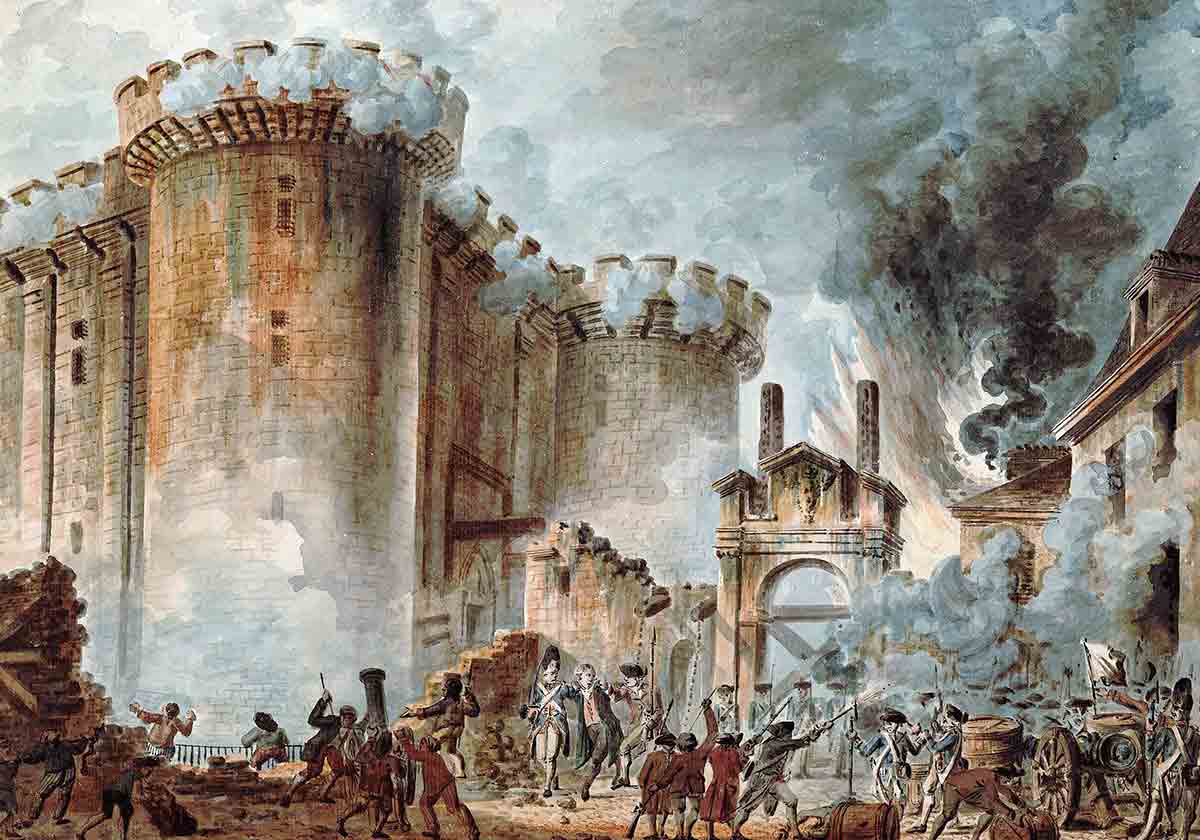
On the afternoon of July 14, 1789, a Paris crowd stormed the Bastille. Around 98 attackers fell beneath its walls; the governor, de Launay, was dragged out, beheaded, and his head paraded on a pike.[1] Inside the prison, there were just seven people: four forgers, two men of unsound mind, and a count locked up at his family’s request.[1]
The crowd had not come to free anyone. They had come for gunpowder — earlier that day they had taken thousands of muskets from the Invalides, but had almost nothing to fire them with. The Bastille’s real value was not who was locked inside it, but what it was: a medieval fortress of eight towers, the stone symbol of a king who could lock people up.
That is the first lesson of the French Revolution: revolutions never begin with facts. They begin with symbols. The facts added up to seven prisoners; the symbol was enough to burn down a kingdom.
No one gave the order that day. There was no leader standing above the crowd, no plan that read “take the prison first, then behead the governor.” The crowd organized itself out of fear: fear that the king’s troops were gathering, fear that the bread would run out, fear that tomorrow would be worse than today. Fear is the most effective mobilizing order — it needs to persuade no one; it only has to make everyone feel that if they do not act now, it will be too late. When the Bastille fell, what Parisians learned was not how to seize power. It was how to stop being afraid.
Chapter OneA Bankrupt Kingdom
What went bankrupt first was not the treasury. It was trust.
In 1789, France had about 28 million people, the largest population in Europe,[2] but the royal finances were exhausted: years of war, the cost of the court, and taxes the nobility and clergy refused to pay. Louis XVI had no choice but to summon the Estates-General — something that had not happened since 1614, 175 years earlier.[2]
On May 5, 1789, 1,139 deputies gathered at Versailles, 611 of them from the Third Estate.[2] The Third Estate spoke for about 98 percent of the population,[2] yet held one vote out of three, because the three estates voted separately. The fight was never really about taxes. It was about who counted as the people.
The deadlock lasted six weeks. On June 17, the Third Estate declared itself the National Assembly;[3] on June 20, locked out of their meeting hall, the deputies crowded into a nearby indoor tennis court, where 576 of them swore never to disband until they had written a constitution for France.[3] That was the Tennis Court Oath: a group locked out of its own hall, using a single vow to turn itself into the nation.
On July 11, the king dismissed Jacques Necker, the finance minister the people loved, and Paris rose in revolt. Three days later, the Bastille fell.
The old order was not overthrown in a single night. It was first declared void — by its own creditors, its own assembly, its own people — again and again, until on July 14 a crowd looking for gunpowder finally held its funeral.
The fatal flaw of this system was that it could not reform itself. The people who could decide on reform were the very ones who profited most from the status quo: tax-exempt nobles, a church collecting the tithe, grandees grown rich selling offices. At every fiscal crisis, the king’s answer was to squeeze a little more from those with the least, because taxing the rich meant cutting into the very foundation of his own rule. A system that can only take from the weak and never ask anything of the strong is already dead — all that remains is to wait for a date to turn its death into a ceremony.
Chapter TwoRights Written on Paper
Less than a month after the Bastille fell, the National Assembly spent the night of August 4, 1789, abolishing the entire feudal system in one sitting: seigneurial privileges, the tithe, the sale of offices — centuries of layered privilege, declared void in a single night.[4]
Twenty-two days later, on August 26, 1789, the Assembly adopted the Declaration of the Rights of Man and of the Citizen, 17 articles in all.[5] The first article is a single sentence: “Men are born and remain free and equal in rights.” The second adds that the aim of all political association is to preserve man’s natural and imprescriptible rights: liberty, property, security, and resistance to oppression.[5]
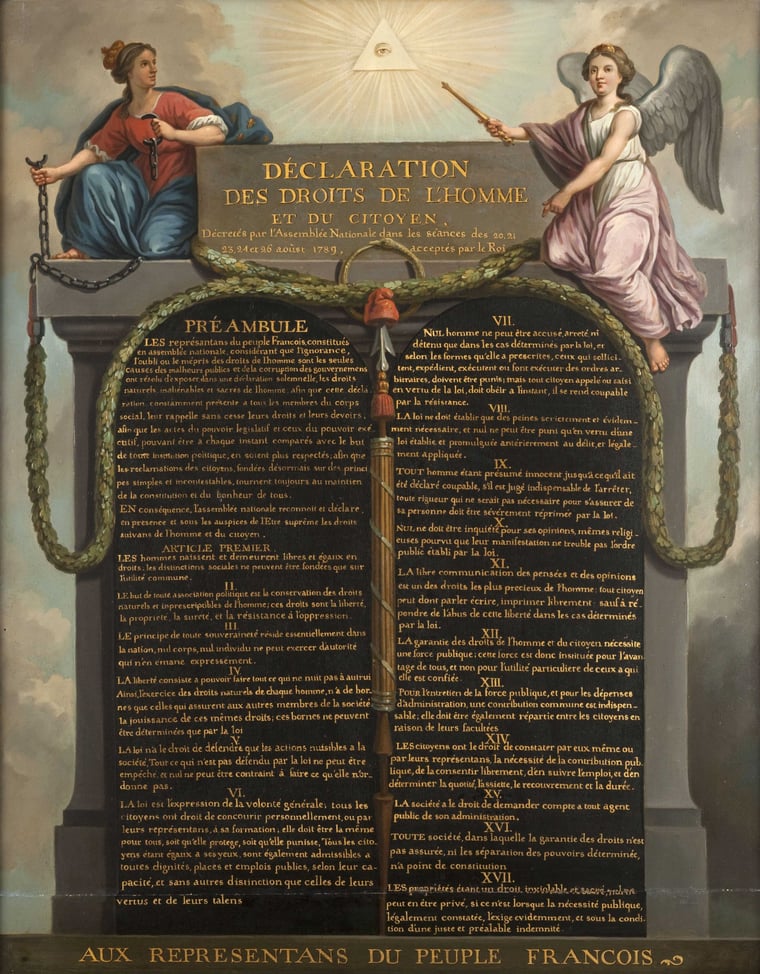
The more universal the Declaration sounded, the sharper the gap it exposed. It said “man,” but women had no vote; it said liberty, but enslaved people in the colonies were outside it. On October 5, 1789, some 7,000 Parisian women marched on Versailles for bread and dragged the royal family back to Paris;[6] what they wanted was not a declaration but a loaf that could feed their children — something no declaration could give them.
But that is precisely what made the Declaration so dangerous: it handed a universal sentence to everyone. From that day on, anyone left outside it could use the Declaration’s own words to put the Declaration on trial. The logic of revolution hides right there — once a promise is spoken, it can never be taken back. It can only be kept, again and again, or paid for in blood.
Hidden inside the Declaration’s 17 articles are a few time bombs. Article 11 says that the free communication of thoughts and opinions is one of the most precious of the rights of man; Article 16 says that a society in which rights are not guaranteed and powers are not separated has no constitution at all.[5] These sentences were written to limit the king’s power, but their force did not stop with the king — from then on, anyone in power would be measured against the same standard. The authors thought they were writing a founding document. In fact, they had written a cheque that could never be fully honored.
Chapter ThreeThe King Walks to the Scaffold
The second lesson of the revolution is this: once the words are spoken, someone has to answer for them.
In 1792, France declared war on Austria; the war went badly, and on September 21, 1792, the monarchy was abolished and the Republic proclaimed. Louis XVI was put on trial for treason, and the National Convention condemned him to death by a single vote. On the morning of January 21, 1793, he was taken to the guillotine in the Place de la Révolution in Paris.[7]
The guillotine had become France’s official method of execution in the spring of 1792,[8] and the reason for its design carried the revolution’s own stamp: no distinctions of rank, the same death for everyone — a king and a thief dying under the same blade. Marie Antoinette followed him on October 16 of the same year.
Killing the king was not revenge. It was a ritual. Monarchy rested on the divine right of kings — the king’s power came from God, not from the people. To end that kind of power, a constitution was not enough; there had to be a body to prove it: a king who could be tried and executed like any mortal man. The moment Louis XVI’s head fell, France truly had no way back.
But rituals have a price. A republic that has killed its king must now answer a question of its own making: if even a king can be put to death, who cannot?
The trial itself was a ritual for turning a god into a man. Louis XVI was stripped of his royal title and tried as “Citizen Louis Capet” — Capet, the surname his ancestor had used eight centuries earlier. A dynasty that had ruled for hundreds of years by blood and divine will was reduced, in the end, to a surname, a citizen, a mortal man standing in a courtroom. The king’s head had not yet fallen, but his divinity had already been taken from him by the trial.
Chapter FourThe Logic of Terror
The answer came quickly: anyone.
From September 5, 1793, to July 27, 1794 — less than a year — France lived under the Reign of Terror.[9] In the name of defending the revolution, the Committee of Public Safety arrested at least 300,000 suspects; about 17,000 people were officially executed, and about 10,000 more died in prison without trial.[9] The Law of 22 Prairial, passed on June 10, 1794, stripped defendants of counsel and public trial, leaving juries only two choices: acquittal or death. In the 47 days that followed, 1,376 people were guillotined in Paris alone.[9]
The cruelest figure is who the victims were: about 85 percent of those executed belonged to the Third Estate — ordinary people — while the nobility accounted for less than one in ten.[10] The blade fell, for the most part, not on the enemies it claimed to destroy, but on bakers, peasants, and servant girls — the very people the revolution said it had come to free.
Terror was not a loss of control. Terror was a system. Its logic was simple, and seductive: blame every problem on “the enemy,” keep the power to define the enemy in your own hands, and any violence becomes justified. Robespierre sincerely believed that virtue without terror was empty talk. The question is: when virtue has to be maintained with 30 heads a day, is it still virtue?
On July 27, 1794, the National Convention arrested Robespierre; the next day, July 28, he was sent to the guillotine himself, together with 21 associates, without trial.[11] The architect of the Terror died on the machine he had built. “The revolution devours its children” — from then on, the phrase had a shape.
Once the machine of terror starts, it cannot stop, because it must constantly be fed new enemies. When the enemies run out, it turns to its own: even Danton — one of the early drivers of the Terror — ended up on the same scaffold.[11] Every execution carried the same message: no one is safe, including the people who signed yesterday’s death warrants. Fear is the cheapest instrument of rule, because it needs to buy no one; it is also the most expensive, because sooner or later it comes for the rulers themselves.
Chapter FiveExhaustion and the General
When the Terror ended, France did not get liberty. It got exhaustion.
The Directory was corrupt and incompetent, prices soared, and what the people wanted was no longer ideals but order, bread, a government that could let them live their lives. Ten years of revolution had burned everyone out — and exhausted people are the quickest to put their hope in a man in uniform.
On November 9, 1799 — 18 Brumaire in the revolutionary calendar — Napoleon Bonaparte seized power in a coup, overthrew the Directory, and became First Consul.[12] The coup was almost bloodless, because no one wanted to bleed for the Directory anymore.
Napoleon understood what the revolution had really left behind, and it was not slogans. It was institutions. On March 21, 1804, the Napoleonic Code came into force: equality before the law, property rights, private ownership — the revolution’s promises, written into a code that everyone had to obey.[14] On December 2 of the same year, he crowned himself emperor at Notre-Dame in Paris,[13] taking the crown from the Pope’s hands and placing it on his own head.
The revolution had spent ten years going in a great circle, back to rule by one man. But this man ruled not by bloodline — by military glory, by a legal code, by a people’s hunger for order. The old order could never return, because the sentence “men are born free and equal” could no longer be taken back by anyone.
Napoleon was the revolution’s strangest product: he ended it, and he preserved it. He wrapped the oldest core of the old order — rule by one man — in the revolution’s own language: citizens, a legal code, merit. The only difference was that an emperor’s legitimacy no longer came from God and bloodline, but from the people’s longing and victories on the battlefield. The revolution destroyed kingship, but it taught the French how to worship a strongman — a lesson Europe would spend the next hundred years paying for.
EpilogueThe Revolution Never Ended
The French Revolution left behind two things: a body, and a sentence.
The body belonged to Louis XVI, to Robespierre, to 17,000 people sent to the scaffold. It is a reminder that once an ideal starts proving itself with violence, it is hard to stop — because every killing creates new enemies, and new enemies demand new killings.
The sentence is “men are born and remain free and equal in rights.” Almost 160 years later, in 1948, the United Nations adopted the Universal Declaration of Human Rights, whose first article reads: “All human beings are born free and equal in dignity and rights.” It is almost an echo of the first article of 1789.
The revolution left behind a third thing, harder to see than the body or the sentence: a new protagonist, called “the people.” Before 1789, the people were the object of rule; after 1789, the people became the source of power — at least in name. From then on, every regime would have to claim to represent the people, and every protest would have to claim to be the people. Once the word was invented, no one could monopolize it ever again — and everyone would have to fight over it.
The Bastille was demolished long ago; its stones were sold off as souvenirs. But the question raised on that afternoon of July 14 has not expired: by what right is power yours? If your answer is “because I was born to it,” then one day, someone will come to your door carrying that same sentence.
The revolution never ended. It only changed address, and carried on.