PrologueTwelve Ships
In early October 1347, twelve Genoese merchant galleys sailed into the harbour of Messina, Sicily. By the time they docked, most of the sailors were already dead; the rest were covered in swellings and could barely speak. The harbour authorities ordered the ships out — but it was too late. Rats came ashore along the mooring ropes, fleas slipped into warehouses and houses, and death had found its footing in Europe.[3]
Those twelve ships carried no spices or silk. They carried a bacterium, one whose name humanity would not speak for another 500 years: Yersinia pestis. Over the next 6 years it would travel the trade routes and river roads across Europe, killing an estimated 25 million to 50 million people — about 30% to 60% of the continent's population.[4]
But this is not an article about how a bacterium kills. It is about how a plague rewrote a civilisation. When a third of the population disappears, the land is still there, the castles are still there, the laws are still there — yet every assumption that made them work has changed.
Chapter OneFrom Lake Issyk-Kul to the Black Sea
The Black Death began 9 years before Messina, and 5,000 kilometres away. In 2022, an international team reported in Nature that it had found ancient Yersinia pestis DNA in skeletons from two cemeteries near Lake Issyk-Kul in Kyrgyzstan. The tombstones gave the years of death as 1338 and 1339, and the cause as "pestilence". The strain was identified as the ancestor of the great diversification that fuelled the pandemic — the Black Death finally had a birthplace and a birth year.[1]
From Central Asia to the Black Sea, plague travelled the roads of trade. The Mongol Empire had stitched Eurasia together; its relay stations and caravans carried silk, spices and grain westward — and rats and fleas with them. In 1346, the armies of the Golden Horde besieged Caffa, a Genoese port on the Black Sea, and plague broke out in their camp. Later chroniclers told a horrifying story: the besiegers hurled plague-ridden corpses over the walls. The tale may not be true — modern historians note that plague more likely slipped west aboard the grain fleets when trade resumed — but it points to the essential fact: Caffa was not the plague's origin; it was the first port it boarded.[4]
In 1347 the plague reached Constantinople, then crossed the Mediterranean by merchant ship and docked at Messina in October.[3] From there it no longer needed ships: it followed roads and rivers north and west, one city after another. Florence in the spring of 1348; Paris that summer; London in the autumn of 1348; Moscow by 1352.[4] Europe spent 6 years learning a single lesson: no wall can keep out a flea.
It took until 2011 for humanity to name the killer with certainty. That year, scientists extracted and sequenced Yersinia pestis DNA from plague victims buried in London's East Smithfield cemetery between 1348 and 1350, ending decades of argument: the Black Death was plague — not a virus, not anything else.[2] Medieval people knew nothing about their enemy; it took us 660 years to identify it.
Chapter TwoFlorence, Spring 1348
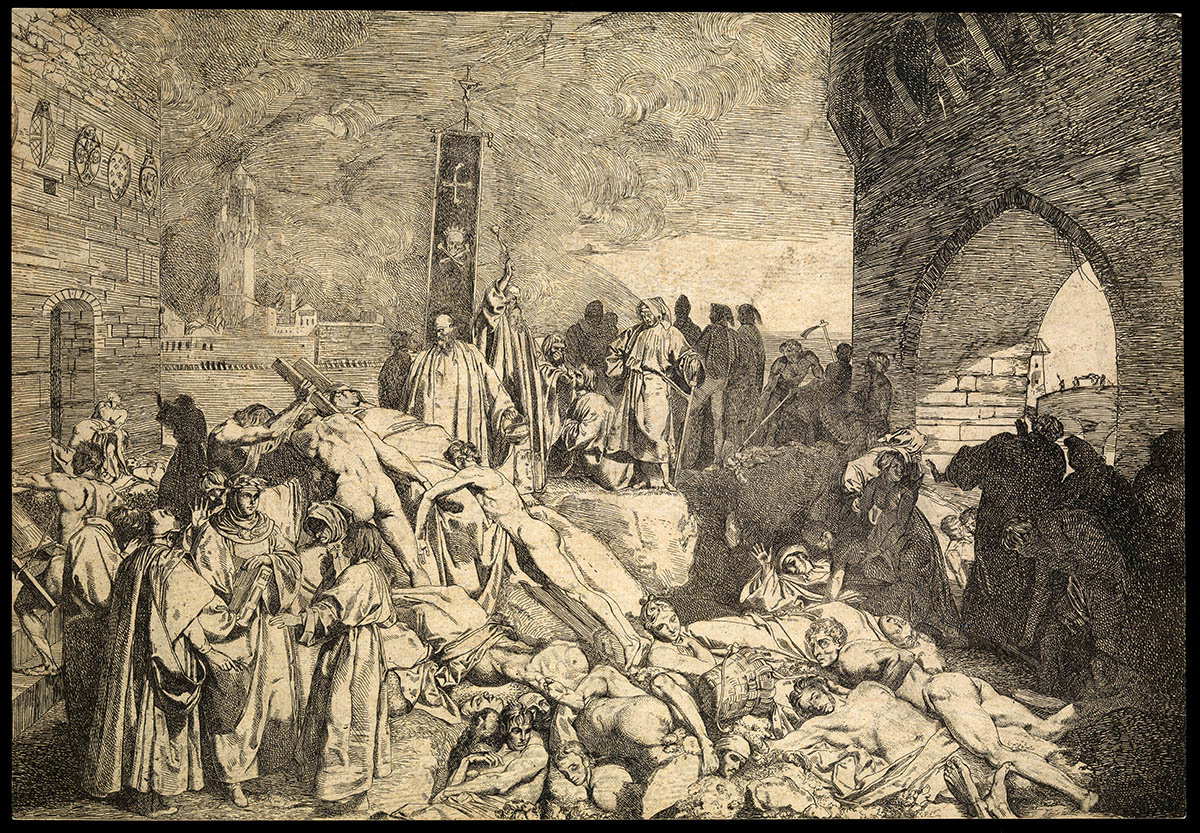
No one wrote closer to the event than Boccaccio. His Decameron, written between 1349 and 1353, opens with Florence in the spring of 1348: the plague did not begin, as it had in the East, with bleeding from the nose, but with swellings in the groin or the armpit, some as large as a common apple, others like an egg — the common folk called them gavoccioli. After the swellings came black or livid blotches across the body, and most victims died within 3 days of the first signs.[5]
Boccaccio wrote that between March and July of 1348, 100,000 people died within the walls of Florence. The number is almost certainly exaggerated — the city may not have held that many people — but the exaggeration is itself testimony: a man watching his whole city emptied out loses all sense of number; all that remains is "too many to count".[5]
The structure of the Decameron is itself an answer: 10 young people — 7 women and 3 men — meet in the church of Santa Maria Novella, decide to flee Florence, and retreat to a country villa to tell 100 stories over 10 days. Faced with death, Boccaccio did not write a penitential tract or a theological debate; he wrote about people who keep talking, keep laughing, keep desiring amid the ruins. Plague can close a city, but it cannot close a story.
Those who stayed in the city split in two directions. Some locked themselves indoors, drank nothing, and would not see even their own kin; others did exactly the opposite — convinced they were going to die anyway, they drank, feasted and took what they wanted while no one was left to stop them. Boccaccio records it all coldly: the same catastrophe, answered by abstinence on one side and indulgence on the other, and behind both answers the same discovery — that the rules which had governed people were never carved in stone; they only held because everyone pretended they did.
Chapter ThreeLooking for a Scapegoat
When death has no reason, people invent one for it. Between 1348 and 1349, a rumour spread out of the German lands: the Jews had poisoned the wells; they had brought the plague. Wherever the rumour arrived, massacre followed. Jewish communities were wiped out town by town, their property divided up, their debts cancelled — hatred, here, had a very practical motive.
Pope Clement VI was one of the few in power to say what was true. On 6 July and 26 September 1348, he issued two bulls condemning the violence against Jews, arguing that the plague had killed Jews too, and had struck peoples who had never lived alongside them — so blaming the Jews could not stand. He ordered the clergy to protect them, and offered them refuge in his own territory of Avignon.[9][6]
The bulls did not work. The pope's voice did not reach every town, and where it did, it was no match for fear. Before the plague, the papal court at Avignon was as helpless as the town council of Florence — and a helpless authority finds it easiest to hand the blame to someone weaker than itself.
The flagellants offered another answer. Bands of men stripped to the waist and whipped themselves from town to town, convinced that bodily pain could appease God's anger. The Church first tolerated them, then condemned them — but the condemnation itself reveals something: when official prayer and medicine both fail, people invent their own rituals. The most terrible product of catastrophe is not death; it is the vacuum of meaning, and a vacuum is always filled by the loudest voice.
Chapter FourPeople Became Expensive
After the plague, Europe faced a new arithmetic: the same amount of land, a third fewer people. Crops rotted in the fields because no one was left to harvest them; sheep wandered the commons because no one was left to herd them. Those who survived suddenly discovered that they were worth something.
English account books recorded the change. In 1348, farm labourers on the Earl of Stafford's estates earned 1 penny a day; by 1350, the same work cost 2 pennies, and neighbouring landowners were paying 3. Studies of the period find that increases in labour costs of more than 60% were not uncommon in England.[7][8]
The landowners' first response was legislation. The Ordinance of Labourers of 1349, and the Statute of Labourers passed by Parliament in 1351, capped wages at their 1346 levels and threatened imprisonment for anyone who refused work.[8] The law was reissued 13 times over the next century — and every reissue was an admission of failure. Wages were not set by Parliament; they were set by the number of the dead.
Serfs discovered they had a choice. Lords desperate to keep their workforce began allowing money payments in place of labour services; serfs who won no concessions simply fled, hiring themselves to the highest bidder in another manor or town. The manor system loosened piece by piece: land was no longer worked by hereditary serfs but by tenants on lease. The Jacquerie rose in France in 1358; the Peasants' Revolt rose in England in 1381. Both revolts failed — but the unravelling of serfdom did not stop. By 1500, serfdom had virtually disappeared in Italy, most of France, and England.[10]
This is the Black Death's deepest irony: it killed a third of the people, yet it gave the survivors bargaining power for the first time. The feudal order rested on a single premise — people were cheap and land was dear. The plague inverted it: land was everywhere, and people had become scarce. And once the premise a system stands on is inverted, the system itself is only a matter of time.
Chapter FiveWhen the Church Had No Answer
Before the plague, the Church's powerlessness was plainer than any theological argument. Priests who prayed at deathbeds caught the disease and died first; in many parishes the clergy were wiped out, and there was no one left to bury the dead. Clement VI was forced to grant a remission of sins to all who died of the plague — because there were simply not enough priests left to hear final confessions.[9]
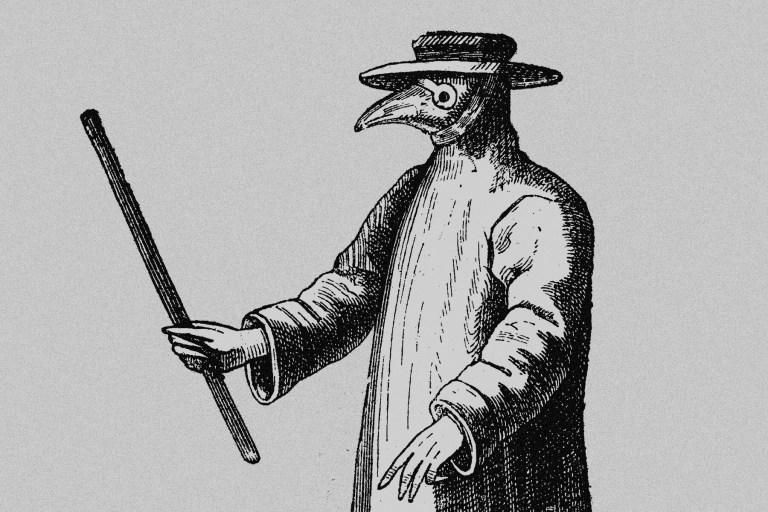
Medicine's explanations were no better. Astrologers summoned by the pope blamed the conjunction of Saturn, Jupiter and Mars in 1341 for corrupting the air; physicians prescribed incense, bloodletting and flight — none of it worked. Clement VI followed his doctors' advice and sat surrounded by burning torches, believing fire would purify the air. He survived — but that was luck, not medicine.[9]
Yet the plague also forced humanity's first public-health institutions into being. In the 14th century, Venice became the first European city to write quarantine into law: incoming ships and their crews had to wait in isolation before landing, a practice that later hardened into a 40-day detention — quarantine, from the Italian for "40 days". For the first time, human beings fought an epidemic with institutions instead of prayers.[11]
But the deeper crack opened in people's minds. A Church that claimed to hold the keys to salvation proved as helpless as any mortal before the plague. That did not overthrow the Church overnight — but it planted a question that would bear fruit generations later: if prayer could not stop death, what else could the Church not stop?
EpilogueSix Years Later
By 1353, the first wave had receded. The pope's agents counted the dead of Christian Europe at 23,840,000 — against a pre-plague population of about 75 million, a mortality of about 31%.[4] But the plague never truly left: it returned in 1361, 1369 and 1374. Europe's population did not recover to its early 14th-century level until the 16th century.[4]
The Black Death brought no utopia. The survivors were still poor; the wars went on — the Hundred Years' War would not end until 1453.[12] But some things never went back: wages never went back, serfdom never went back, and the awe in which people had held Church and lord never went back. A plague overthrew no dynasty — yet it loosened the ground every dynasty stood on.
When we talk about the Black Death today, we are not really talking about 1347. We are talking about a more general question: a society looks unshakeable, often only because the conditions it runs on have never been broken. Population, labour, trust, authority — these things feel as given as air, until a third of them vanishes, and people discover that the whole order was built on air.
In the ruins, Boccaccio chose to tell stories. Ten young people told 100 stories, full of love, wit and desire — the plague took everything, except people's ability to tell their own story. Perhaps that is the Black Death's most important lesson: catastrophe can rewrite institutions, but only people can decide how the rewritten story gets told.