PrologueA Novel Without an Author's Name
A stone, judged unfit to mend the sky, is cast down into the human world. It watches a family rise in splendour, watches it fall, and returns to its mountain to write the story on itself. That is how Dream of the Red Chamber begins — and the book itself, like that stone, still has no complete biography of its own.
Originally titled The Story of the Stone, the novel was composed in the Qianlong era and is attributed to Cao Xueqin — yet it was published without an author's name. That name appears only once, in a single sentence in Chapter 1: "Cao Xueqin, in the Mourning-the-Red Studio, read it through for ten years and revised it five times, drew up its table of contents, divided it into chapters, and entitled it The Twelve Beauties of Jinling."[1] One sentence. Ten years. The whole life of the book is hidden inside it.
Stranger still, the 120 chapters we read today are not the version Cao finished. He left only the first 80; the last 40 were supplied by other hands, and whether they got it right has been argued for more than two centuries. The crowning work of Chinese fiction is unfinished, without a settled text, its author's life disputed. That is precisely why it deserves a book of its own: its incompleteness is not a flaw. It is the subject.
Chapter OneFrom Confiscation to the Mourning-the-Red Studio
Cao Xueqin's grandfather, Cao Yin, served as textile commissioner of Jiangning, and the Cao family enjoyed three generations of eminence in the south. Then, in the fifth year of the Yongzheng reign (1727), it all ended.
Cao Fu was convicted of embezzlement and the family property confiscated. Cao Xueqin was about 13, and followed his family north to the outskirts of Beijing. The rest of his life ran downhill: in old age he lived in the western suburbs, selling paintings and living on friends' charity. A friend, Dun Cheng, wrote him a poem containing the line: "The whole family lives on gruel, and wine is bought on credit."[2] A man who had once stood at the centre of the empire could not, in the end, pay for his own wine.
It was in such days that he wrote Dream of the Red Chamber. The preface to the Jiaxu manuscript leaves us one line: "Every word seems written in blood; ten years of toil, out of the ordinary."[2] Ten years, five revisions. A commentator's note in the Jiaxu manuscript records that on New Year's Eve of the Renwu year, "the book unfinished, Cao wept his last tears and died"[10] — the last night of 1762, or 12 February 1763 by the Western calendar. His birth and death dates are still disputed; the common account has him born around 1715 and dead around 1763, not yet 50.[2]
Why does this life matter? Not because it "solves" the novel — reading the book as the Cao family history is the longest wrong turn in Redology. It matters for something else: the man who wrote this book had seen prosperity with his own eyes, and had seen, with his own eyes, how prosperity vanishes. He was not writing from imagination. He was writing from memory. The more golden the Rongguo household shines in the book, the more it resembles a man mourning what he has lost.
Chapter TwoHow the Garden Was Built
The Grand View Garden was built for Yuanchun's home visit. Yuanchun, Jia Baoyu's elder sister, had entered the palace and become an imperial consort; her family built a garden for the single day she would come home. Inside that one sentence sits the whole economics of the book.
A home visit is a performance, and a performance costs money. Rockwork, streams, pavilions, towers — every corner of the garden had to be paid for in silver. The silver came from the Jia family's rents, the Xue family's trade, the Wang family's power — the entire credit of the clan was staked on a single garden. The more beautiful the garden, the brighter the family's face, and the deeper the hole in the ledger.
Once finished, Baoyu and his sisters moved in. From then on the book runs on two kinds of time: outside the walls, time is officialdom, debt, marriage and death; inside, it is poetry clubs, crab-apple and peach blossom, drinking games. Young people live inside the walls, cut off from the world outside, as if it would stay out so long as they never went out.
Daiyu wrote a poem for the garden, with the line: "Borrowed the mountains' grace, and added scenes anew."[7] Borrowed. The garden's beauty was borrowed from the first day — borrowed mountains, borrowed silver, borrowed time. Zhou Ruchang notes that the commentator Zhi Yanzhai put it plainly: Cao wrote the Grand View Garden "only for a mound where flowers are buried."[7] The garden was built so that people could bury flowers inside it.
That is the garden's double identity: the most beautiful place in the book, and the most expensive. It takes everyone in, and it traps everyone. Those who live inside believe they live in a paradise beyond the world. In truth, they live on the ledger.
Chapter ThreeTwo Worlds
In 1979, the historian Yu Ying-shih proposed an idea of lasting influence: there are two worlds in Dream of the Red Chamber. One is the real world of the Rongguo household — dirty, scheming, ruled by convention. The other is the ideal world of the Grand View Garden — clean, free, ruled by feeling. The garden is the projection on earth of the Land of Illusion in Chapter 5.[7]
It explains the book's most unsettling structure: the most beautiful things are precisely the least real. The garden is clean not because nothing dirty lives inside it, but because the walls keep the dirt out — and walls do not hold for long. From Chapter 71 on, the author is already arranging the garden's ruin; by Chapter 73, an embroidered love-pouch turns up inside the garden, the sign that the Grand View Garden has begun to fall.[3]
The people in the garden are not ignorant of the outside world's rules. They have agreed, together, to pretend otherwise. The poetry club, the drinking games, the burial of flowers — these rituals let a group of people believe, for a while, that the world could be another way. When reality is too hard to bear, people first build a small world to hide in, and then slowly believe that the small world is everything.
Daiyu is the clearest-eyed person in the garden, and so she sees the ending first. In Chapter 1, above the gate of the Land of Illusion, hangs the couplet: "When the false is taken for true, the true becomes false; where nothing is made into something, something becomes nothing."[1] The Grand View Garden is that couplet built in stone and timber.
The contrast of the two worlds is the book's hard core: an ideal world exists only so long as someone keeps paying for it. Once the money runs out, it shatters — and the people inside discover they never lived in heaven at all. They lived in the human world all along.
Chapter FourWho Decides a Person's Fate
Baoyu, Daiyu and Baochai — readers have argued over this triangle for two hundred years. But the answer to the question was never in the hands of the three of them.
Daiyu has talent and a true heart, but no family to stand behind her. Behind Baochai stands the Xue family, and Baochai herself behaves exactly as convention requires — the "correct" daughter-in-law in the family's eyes. Baoyu's marriage is a family decision, not a choice of love: who marries in depends on who can keep the Jia family alive.
The way the Jia household decides is the way it decays. The dowager, the ladies, the stewards, the hangers-on — each defends their own position, and no one answers for the whole. Every decision looks reasonable in the moment: borrow a little to get through, flatter someone powerful, put the wedding off a while. But reasonable little decisions, added together, make a road to the cliff's edge. That is the fate of a system: it needs no villains, only people who follow the rules.
Wang Xifeng is the most capable person in the book, and she dies the ugliest death. In such a system, competence is not a shield but an accelerator: the more capable you are, the more the system depends on you, and the faster it uses you up. Her shrewdness bought the family a few more years — and made her everyone's target. A system never thanks the capable. It uses them and discards them.
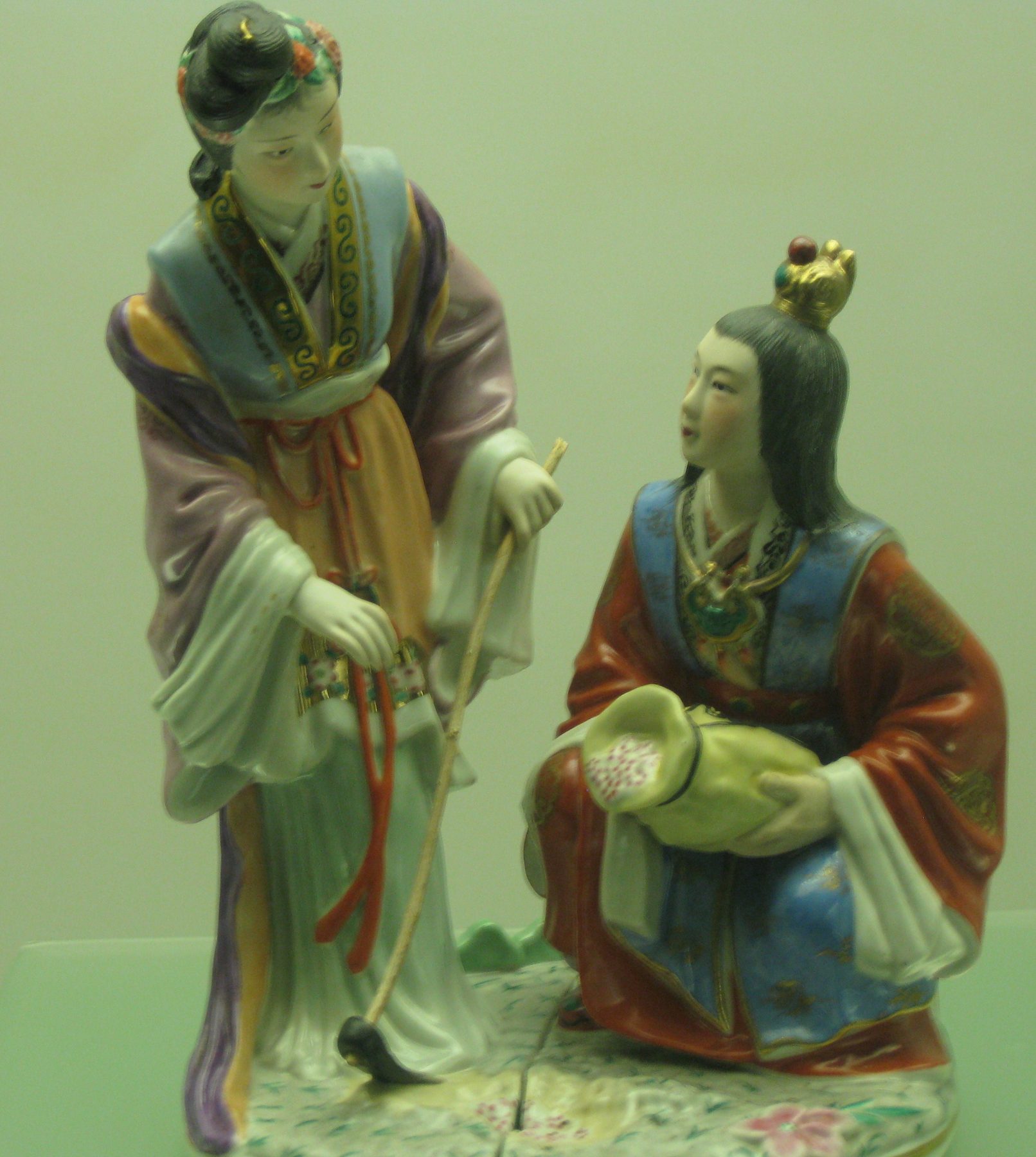
So the rise and fall in Dream of the Red Chamber is not a story of good people losing to bad people. It is a story of how a system leads a group of clever people, together, to ruin. Once you see that, the book stops being only a love story and becomes a book about organisations, about power, and about the weaknesses of human nature.
Chapter FiveA Book That Was Never Finished
After Cao Xueqin's death, The Story of the Stone circulated in manuscript. The earliest surviving copies: the Jiaxu manuscript of 1754, with 16 chapters; the Jimao manuscript of 1759, with 41 chapters and two half-chapters; the Gengchen manuscript of 1760, with 78 chapters, lacking Chapters 64 and 67.[9] A book passed hand to hand for decades, never once complete.
In 1791, Cheng Weiyuan and Gao E joined the first 80 chapters to 40 later chapters they had collected and patched, and printed the 120-chapter Dream of the Red Chamber. It was the book's first printing, and the first time the title "Dream of the Red Chamber" replaced "The Story of the Stone" as the name everyone used. In 1792 they issued the revised Chengyi edition.[3]
The argument began the day it was printed. In 1921, Hu Shi published his Studies on Dream of the Red Chamber, concluding that the last 40 chapters were not Cao's work, probably continued by Gao E; Zhou Ruchang argued the original should have been 108 chapters; the commentaries hint at fewer than 114. In 2008, the People's Literature Publishing House changed the attribution to "first 80 chapters by Cao Xueqin, last 40 continued by an anonymous hand, edited by Cheng Weiyuan and Gao E." More than two centuries on, who finished this book still has no settled answer.[4]
A book that was never finished gave life to a whole discipline: Redology. Since Hu Shi founded the evidential school in 1921, it has grown schools of hidden-meaning reading, textual research and cultural thought, studying everything from history and institutions to dress, food and gardens.[5] At its heart, Redology is readers refusing to accept that a great book has no ending — and setting out to find one themselves.
1791 is a year worth remembering. The Qianlong Emperor was still on the throne, in the 56th year of his reign, the empire at its grandest and its most exhausted: in August, Gurkha forces invaded Tibet again, and Qianlong sent Fukang'an with an army to drive them out.[6] On 5 December, Mozart died in Vienna, aged 35, leaving his Requiem unfinished.[8] At the two ends of the world, two unfinished works were taken by fate in the same year. At the tail of a golden age, a book about decay was printed for the first time — a coincidence that reads more like criticism than any critic could.
EpilogueWhy We Still Read It
Because every one of us has lived in a Grand View Garden.
A sheltered stretch of days, a good season we believed would last forever, a group of people who agreed to pretend not to know. There is no villain in the book, only a structure: when glory must keep spending money to prove itself, decline has already begun; when everyone in an organisation does the most reasonable thing in the moment, disaster is already on its way.
We do not read Dream of the Red Chamber to learn the ending. The ending is given in Chapter 1: "Pages full of wild words, a handful of bitter tears! All call the author a fool — who understands what is inside?"[1] We read it to see clearly which side of the garden wall we are standing on — inside the wall or outside it; burying flowers, or counting the accounts.
In the end the stone returned to Green Peak. Those who finish the book should return to their own days, carrying a little clarity. The garden will be torn down in the end, but those who have seen it know what beauty is, what it costs, and what can never come back. That is enough.