PrologueOn the Night the City Split
On the morning of Sunday, 13 August 1961, Berliners woke to find their city cut in half overnight. Streets had been torn up, barbed wire strung down the middle of the roads, soldiers posted at the intersections, trams halted mid-route. A city that had been freely passable the night before was, by morning, two worlds. The Wall would stand for 28 years.
The men who did it that night were not an invading army. They were East Germany’s own soldiers and police, working under the code name “Rose”. Berliners stared at the wire in disbelief: one had been to a dentist on the western side the day before; another had left a child with its grandmother for the weekend; another’s fiancée lived on the other side. They assumed it was a temporary measure, gone in a few days. Nobody knew the separation would last a generation.
Why is a wall worth a whole book? Because it was never just concrete. It was the shape a system takes when it grows visible: a regime that cannot keep its own people decides to lock them in; a city cut in two, whose two halves each learn to live, adapt, and forget — until one evening, because of a misspoken word, the wall falls. This book is not about concrete. It is about people.
Chapter 1The People Were Leaving
Before the Wall went up, East Germany was already bleeding. Between 1949 and 1961, some 3.5 million East Germans left their country — about a fifth of the population. Most of them went through Berlin: walk from East Berlin into West Berlin, then fly on to West Germany. Berlin was the last place where light got through the Iron Curtain.
In the summer of 1961, the trickle became a flood. In July alone, 30,000 people crossed to the West. Most of them were young — skilled workers, doctors, engineers. A state can endure criticism, can endure poverty, but it cannot endure watching its own future leave every day on the metro.
Two months before the Wall went up, East German leader Walter Ulbricht told a press conference, in person: “No one has any intention of erecting a wall.” It was 15 June 1961. The reporter had asked about the border; Ulbricht volunteered the word “wall” himself — until then, nobody had thought of Berlin in those terms. Fifty-nine days later, the barbed wire went up.
The sentence became the most famous political lie of the twentieth century. But what matters about it is not the lie; it is what the lie gives away — that even the men building the wall knew the thing could not stand the light. A regime that believes in the superiority of its own system does not need a wall to keep its people in. The Wall was an architecture of admitted failure, a confession written in concrete.
East Germany’s official name for it was the “Anti-Fascist Protection Rampart”, as if the wall existed to keep an enemy out. But the guns on the Wall never pointed outward. The wall was not built to keep people out; it was built to keep people in — and every Berliner knew it.
Chapter 2More Than a Wall
Most people imagine the Berlin Wall as a single wall. In fact it was an entire system. The fortifications ran about 155 kilometres in total, of which 43.1 kilometres cut straight through the city of Berlin; the rest encircled West Berlin completely. In its final form the concrete wall stood 3.6 metres high, lined with 302 watchtowers.
There were really two walls. The outer wall faced west, the inner wall faced east, and between them lay the “death strip”: levelled sand, searchlights, patrol roads, guard dogs, tripwire mines and automatic firing devices. Every footprint in the sand could be seen; every shadow at night had a gun on it. This was not a border. It was a machine designed to kill.
And the wall kept growing. It began as barbed wire and concrete blocks, then became prefabricated slabs topped with a rounded pipe to defeat climbers; windows were bricked up, a church was left standing in no-man’s-land, a cemetery was cut in two, and residents of flats whose doors faced east and whose windows faced west found that even opening a window counted as crossing a border. The wall did not only cut the city. It cut houses, streets, graveyards and families.
What matters more is the order behind the wall. Border guards were instructed to shoot anyone who tried to cross. The shoot-to-kill order was not withdrawn until April 1989. Which is to say that for almost the whole of the Wall’s existence, an eighteen-year-old soldier stood in a tower whose job was to fire on someone quite possibly his own age. That is the most terrible thing about a system: it turns killing into a shift of work.
So the wall became a mirror. People in the West looked at it and felt they lived in the free world; people in the East looked at it and learned to keep their heads down. The wall did not need to kill every day. It only needed everyone to know that it could.
Chapter 3The People Who Ran
On 15 August 1961, two days after construction began, nineteen-year-old East German border guard Conrad Schumann leapt over the still-low barbed wire and ran west. A photographer caught him in mid-air: his body still above the wire, his feet already out of East Germany. The picture became one of the most famous images of the Cold War. A man whose job was to guard the wall voted with his body — for the other side.
Over the 28 years the Wall stood, more than 100,000 people tried to escape, and more than 5,000 succeeded in getting over it. They dug tunnels, hid in compartments built into cars, swam, climbed, forged papers. In October 1964, a passage known as Tunnel 57 carried 57 people to the West in a single night. In 1979, two families flew across the border in a homemade hot-air balloon. The methods grew more inventive every year, because desperation is the best engineer.
But most did not make it. After checking each case one by one, the Berlin Wall Foundation and the Centre for Contemporary History in Potsdam confirmed at least 140 people who died at the Wall; counting the border zones around Berlin, the estimate rises above 200. Of the 140, 101 were shot, died by accident, or took their own lives while trying to flee.
On 17 August 1962, eighteen-year-old Peter Fechter was shot as he climbed the wall and fell into the death strip, where he bled for nearly an hour while soldiers on both sides watched and did nothing. The whole world saw him die on television. The last person shot dead at the Wall was twenty-year-old Chris Gueffroy, killed on 5 February 1989 — nine months before the Wall fell.
What these people risked death for was, when you say it plainly, almost embarrassingly ordinary: not wealth, not fame, only the freedom to choose where to live, what to say, what to read. The Wall turned the most ordinary freedoms into things worth dying for. A system that makes an ordinary life a luxury has already lost — it just does not know it yet.
Chapter 4Life on Either Side
Once the Wall was firmly in place, the most terrible thing happened: people got used to it. Children grew up beside it and assumed the city had always looked like that; on the metro map there was a line, and on the other side of the line was another world you would never visit in your life. Berliners born after 1961 never knew a Berlin without the Wall.
West Berlin became an island. Supplies came by airlift and subsidy, rents were cheap, and students and artists poured in — there was no military service here, and the cost of living was low. West Berliners looked at the Wall and felt they were the shop window of the free world; they also knew the window was paid for by someone else. The island’s freedom was real, and it was subsidised.
Life in the East had a different texture: rationing, queues, surveillance, denunciation. The secret police kept files full of neighbours’ reports, colleagues’ conversations, letters you wrote to relatives. East Germans learned a particular art of survival: one language in public, another in the kitchen. The wall did not only imprison bodies; it trained a divided tongue.
On 26 June 1963, the American president John F. Kennedy stood in the Rudolph Wilde Platz in West Berlin and told hundreds of thousands of people: “Ich bin ein Berliner.” The words made West Berliners weep. But they were no comfort to the people on the eastern side, who could only listen in secret on the radio. In that moment, two groups of people in the same city heard the same sentence and lived in two different realities.
Germans later invented a phrase for what remained: the “wall in the head” — Mauer im Kopf. It was still there after the concrete came down: people in the East felt like second-class citizens, people in the West felt the Easterners complained too much. Concrete can be demolished; prejudice takes much longer. That is the hardest homework the Wall left for a reunified Germany.
Chapter 5The Night It Fell
By the autumn of 1989, East Germany was coming apart. Hungary had opened its border with Austria, and tens of thousands of East Germans escaped to the West through Hungary; in Leipzig, more and more people took to the streets every Monday, chanting “We are the people.” For the first time, the regime discovered that when the guns are pointed at a crowd, the hands holding them shake.
On the evening of 9 November, Günter Schabowski, a member of East Germany’s Politburo, read out new travel regulations at a routine press conference — a text finished only a few hours earlier. A reporter asked: when do they take effect? Schabowski shuffled his papers and answered: “As far as I know — effective immediately, without delay.” In the original, two words: sofort, unverzüglich. The rules had been meant to take effect the next day. He had said it wrong.
West German television immediately reported that the Wall was open. Tens of thousands of East Berliners poured towards the crossings and demanded to be let through. The border guards telephoned their superiors for orders, and nobody dared give one. At 23:30, Harald Jäger, the officer in charge at the Bornholmer Straße crossing, decided on his own authority to open the gates and let the crowd through without checking papers. That night, nobody ordered the Wall open. The crowd pushed it open.
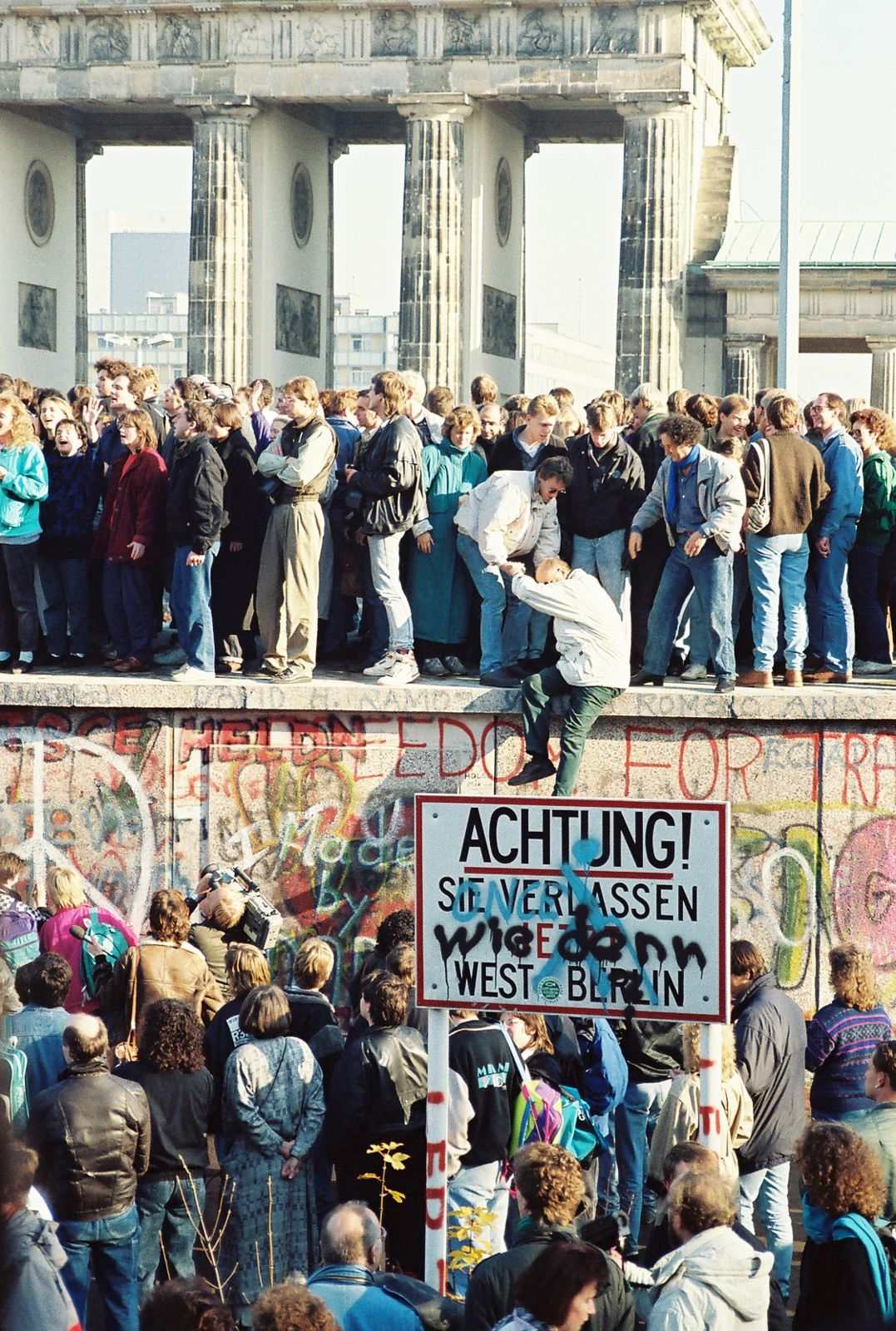
People climbed onto the Wall, sat on top of it drinking champagne, chipping at the concrete, embracing strangers. For the first time in 28 years, East and West Berliners shook hands in front of the Brandenburg Gate. Bringing down a wall takes no explosives — only one evening in which nobody is willing to shoot any more. A misspoken word, a superior afraid to give an order, a man who refused to wait: that is how history is sometimes rewritten, not by plan, but by a chain of accidents.
EpilogueThe Wall Is Gone. Is It?
Eleven months after the Wall opened, Germany was formally reunified on 3 October 1990. East Germany ceased to exist; five states joined the Federal Republic, and East and West Berlin became one city again. Most of the 155 kilometres of wall was demolished within two years, its pieces ground down for roadbeds or sold to tourists as souvenirs.
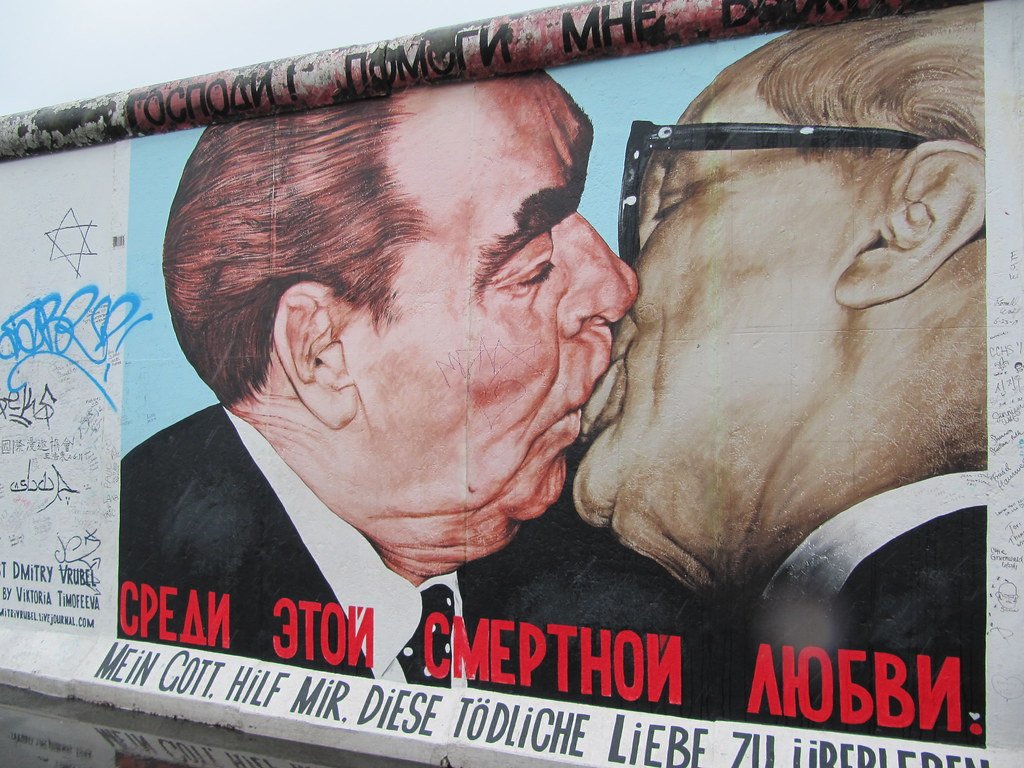
The longest stretch that remains is the East Side Gallery, along the River Spree: 1.3 kilometres of wall, painted in early 1990 by 118 artists from 21 countries and formally opened on 28 September 1990. Its most famous image shows Brezhnev and Honecker in an embrace, captioned: “My God, help me to survive this deadly love.” A wall once built to separate people had become the world’s largest open-air gallery. The hostility was painted over, but the wall itself stayed — people could not bear to tear it all down, because forgetting is easier than remembering.
More than 30 years after the Wall fell, Germans are still paying for it. The pay gap between east and west persists, voting patterns still differ, and the “wall in the head” has not entirely come down. That is the lesson of the Berlin Wall most worth remembering: a wall is never built to keep an enemy out; it is built to lock its own people in. And once a wall has moved into people’s heads, removing the concrete is only the first step.
What the Berlin Wall really teaches us is simple: do not judge a system by what it says; judge it by whether it needs a wall to keep its people. When people vote with their feet, they need no speeches and no slogans — only a direction. On that night in August 1961, the wall went up because the people were leaving; on that night in November 1989, the wall came down because the people were no longer afraid. On both ends of the wall stood the same people.