PrologueA Photograph, a Code
On 25 April 1953, the British journal Nature published a paper barely more than a page long. Its authors were two young men at the Cavendish Laboratory in Cambridge, James Watson and Francis Crick. Near the end of the paper sat a sentence that would become the most famous understatement in the history of science: the pairing they proposed, they wrote, immediately suggested a possible copying mechanism for the genetic material.[1] In the same issue, two further papers followed quietly, one of them carrying an X-ray photograph. On that day, humanity saw its own code for the first time — and began arguing over it.
This is not a story about a spiral. It is a story about a discovery. Discovery is never only about seeing; it is also about who saw first, who was allowed to see, and whose name gets written beside the finding. The story of DNA holds flashes of genius and the slow grind of laboratory politics, a search stretching across 84 years, and a woman scientist left waiting a long time outside the spotlight.
Chapter OneWhen Genetics Had No Shape
In 1869, the Swiss physician Friedrich Miescher isolated a strange substance from pus-soaked bandages and called it nuclein. For the next half-century, science paid it little attention: DNA looked too simple, with only four bases, to carry the whole complexity of life. Most researchers preferred to bet on proteins, with their 20 amino acids and endless variety — they looked like a book thick enough to hold the story.
The evidence turned, piece by piece. In 1944, Avery and his colleagues showed that the "transforming principle" that changed the character of pneumonia bacteria was DNA itself; in 1952, Hershey and Chase used a blender and radioactive labels to prove that a virus injects only DNA, not protein, into a bacterium. By 1953, the question had shifted from what the genetic material was to what it looked like. Any answer had to explain two things at once: how hereditary information is stored, and how it is copied, faithfully, to the next generation.
The chemist Erwin Chargaff had already measured a clue: in the DNA of any species, the amount of adenine always equals the amount of thymine, and guanine always equals cytosine. Numbers do not speak, but they wait for someone to ask them why.
Genetics had, in fact, been waiting for this day for nearly a century. In 1866, Mendel wrote down the laws of segregation and independent assortment from pea plants in a monastery garden, and his paper went unnoticed; in 1900, three botanists independently rediscovered his work, and genetics was born. From peas to the double helix, science needed 87 years to turn an abstract hereditary factor into a molecular building that could be seen and touched.
Chapter TwoTwo Laboratories, Two Temperaments
In early 1953, the race to solve the structure of DNA had only two teams. At the Cavendish Laboratory in Cambridge, Watson and Crick — a 24-year-old American postdoctoral fellow and a 36-year-old physicist turned biologist who had worked on magnetic mines during the war — had no DNA data of their own. They worked with models, arguments, and other people's numbers.
The other side was King's College London, where, in John Randall's laboratory, Maurice Wilkins and Rosalind Franklin photographed DNA fibres with X-ray diffraction. Franklin was a master of X-ray crystallography. She was the first to distinguish the two forms of DNA: the dry A form and the hydrated B form, the latter being the shape DNA takes inside a living cell.[3] The relationship between the two camps was neither collaboration nor open hostility — more like a long race run with mutual suspicion.
Franklin herself was no accidental visitor to the field. Born in London in 1920, a graduate of Newnham College, Cambridge, she had studied the structure of coal during the Second World War and refined her crystallography in Paris, returning to Britain as one of the sharpest eyes in the discipline. Her standards were exacting: without enough evidence, she would not publish a conclusion. That rigour made her slower than her rivals, but it also meant that every photograph she produced could stand on its own.
The race also had a third heavyweight: Linus Pauling, the chemical giant who had just solved the alpha helix of proteins. In February 1953, Pauling and Corey proposed that DNA was a triple helix with the phosphate backbone on the inside. As soon as the model appeared, Cambridge and London both saw the flaw — the negatively charged phosphate groups, crowded inside, would repel one another; chemically, it could not stand. But Pauling's move was also a warning: wait any longer, and someone else would take the answer.
Chapter ThreePhotograph 51
On 2 May 1952, Franklin and her doctoral student Raymond Gosling aimed X-rays at a DNA fibre thinner than a human hair, exposed it for 62 hours, and developed the film on 6 May.[3] It was the 51st photograph in their numbered series, and it became known as Photo 51. At the centre of the image sat a clean, dark X, ringed by layers of spots.
To anyone who understood X-ray crystallography, that X was a sentence in itself: a helix. The distances between the spots hid more precise numbers — 10 base pairs per turn of the helix, bases stacked 3.4 ångströms apart, a helix about 20 ångströms across.[4] From the density of the pattern, Franklin had also deduced that the phosphate backbone lay on the outside and the bases on the inside. She was in no hurry to build a model; she wanted the evidence to speak for itself.
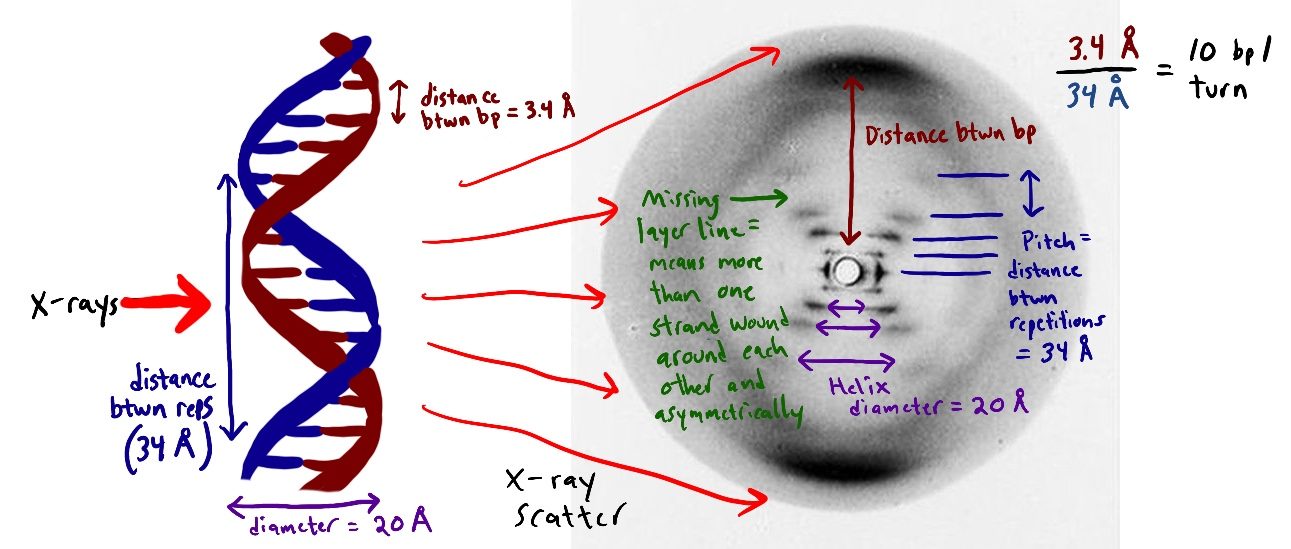
But the photograph did not stay in London. At the end of January 1953, Wilkins showed Photo 51 to a visiting Watson, without Franklin's knowledge.[4] Around the same time, a report Franklin had written for the Medical Research Council reached Cambridge through Max Perutz, a member of the committee, carrying her key measurements of B-form DNA. Watson later recalled that the moment he saw the X, his heart sank — he knew the helix was right, and he knew time was running out.
Chapter FourA One-Page Revolution
Cambridge, now holding the decisive clues, moved at full speed. Crick's crystallographic skill translated the geometry of the X into structural parameters; the chemist Jerry Donohue corrected the chemical forms of the bases; Chargaff's numbers fixed the pairing: adenine only with thymine, guanine only with cytosine. In March 1953, the model rose in the Cavendish workshop: two antiparallel chains, sugar and phosphate forming the backbone on the outside, bases paired like rungs on the inside.
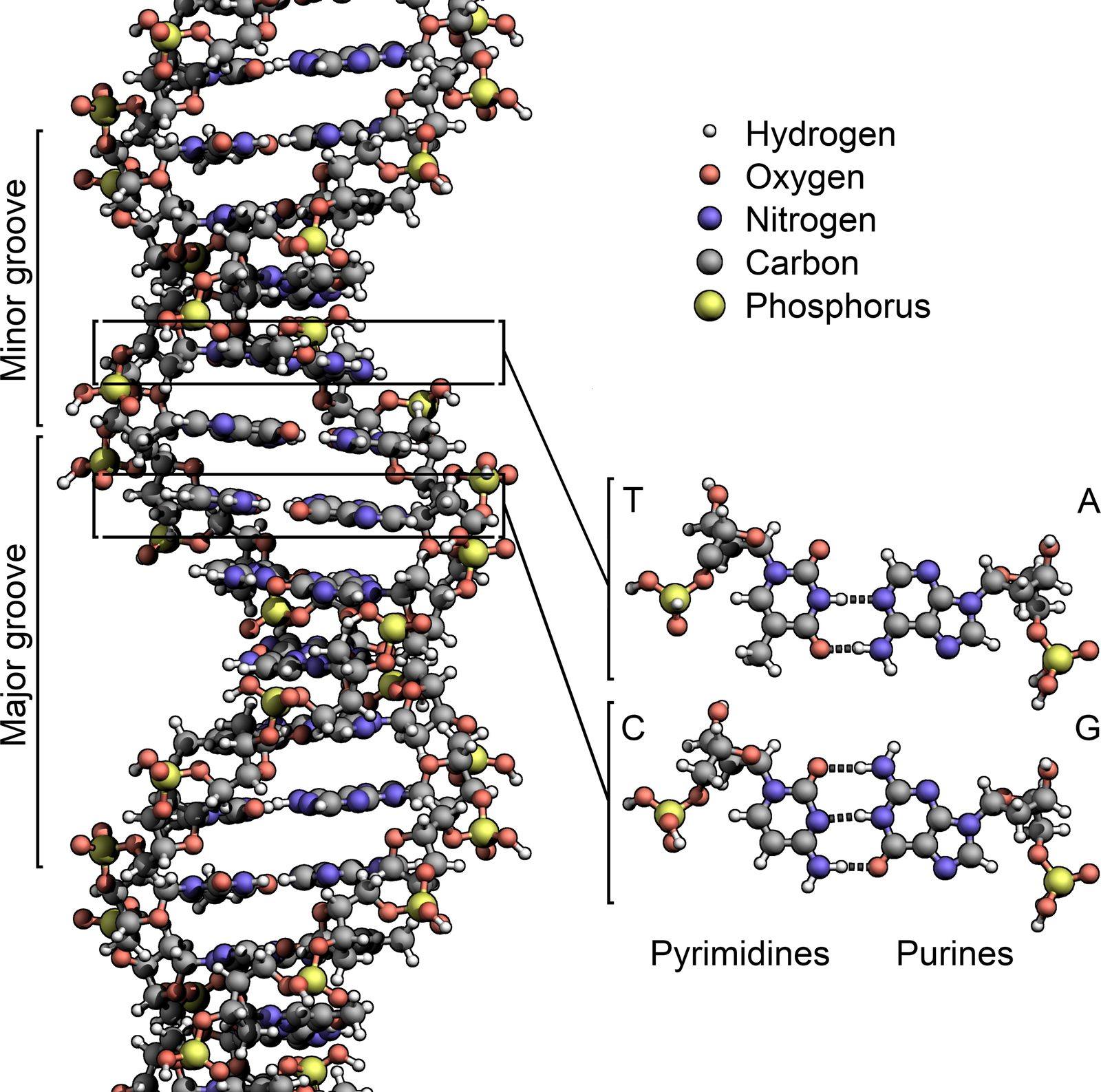
The beauty of the double helix lies in how few parts it needs to answer so many questions. Why can hereditary information be stored so stably? Because the bases hide inside the helix, protected by the backbone. Why is copying almost error-free? Because A recognises only T, and G only C, so either strand carries a complete backup of the other. This was not an engineer's design; it was a logic the molecule had grown for itself.
The paper was sent on 2 April and published on 25 April. At under 1,000 words, it stated the logic of life in a single stroke: a double helix about 2 nanometres across, 10 base pairs per turn, bases spaced 3.4 ångströms apart; adenine joined to thymine by two hydrogen bonds, guanine to cytosine by three.[1] The mechanism of copying was written into the structure itself — the two strands separate, each serves as a template, and a new double helix is born.
The same issue of Nature carried two more papers, one by Wilkins and his colleagues and one by Franklin and Gosling, placed second and third.[2] Franklin's paper printed Photo 51, but its position and framing presented the image as supporting evidence for the Cambridge model, not as the key that had made the model possible. The order of authorship wrote the first draft of history.
Chapter FiveThe Late Prize and the Missing Name
Verification came quickly. In 1958, Meselson and Stahl used bacteria grown on heavy nitrogen to prove that DNA replication is indeed semi-conservative: every new helix keeps one old strand. The double helix passed from an elegant hypothesis into experimental fact.
The distribution of honours took much longer. In 1962, the Nobel Prize in Physiology or Medicine went to Watson, Crick, and Wilkins for discovering the molecular structure of nucleic acids.[5] Franklin's name was not on it — she had died of ovarian cancer on 16 April 1958, aged only 37. Nobel Prizes are not awarded posthumously, and no more than three people may share one. Even had she lived, the committee could not simply have added her as a fourth.
The belated recognition has not stopped since. In 1968, Watson published his memoir The Double Helix, and his portrayal of Franklin set off decades of argument; since then, historians of science have returned again and again to the laboratory notebooks of 1952 and 1953 to weigh her contribution anew. Almost every textbook today says the same thing: without Franklin's data, there would have been no double helix. But the sentence came too late for her to hear it.
The argument over credit is worth retelling not because the seating plan needs rearranging, but because it exposes science as it really is: discoveries rarely belong to one person, and rarely to a single moment. They belong to those who developed the film, those who measured the numbers, those who built the model — and to whom the institutions choose to remember. Gender, temperament, and the power of institutions all left their fingerprints on the order of the names.
EpilogueAfter the Code Was Read
Fifty years after the double helix was published, the Human Genome Project read the whole book of life — some 3 billion base pairs; 20 years later, gene editing made it possible to rewrite that book. From one X-ray photograph to rewriting genes, the road took only 70 years. On the timescale of life science, that is the blink of an eye.
But the true legacy of the double helix may lie not in technology, but in the way of seeing it demonstrated: complicated things do not always need complicated answers, and a single elegant structure can answer two questions — storage and copying — at once. And every time we admire the elegance of an answer, we should remember to ask: who took the photograph? Who measured the numbers? And who decided the names?
In the spring of 1953, the world was busy with other things — Stalin died on 5 March, and on 27 July the Korean War ended in an armistice signed at Panmunjom.[7] Nobody noticed that a metal model standing in a Cambridge laboratory was about to rewrite the life story of everyone who came after. Some changes arrive quietly — so quietly that even their own authors dared only to mention them in passing.