PrologueJuly 15, 1799 — Rosetta
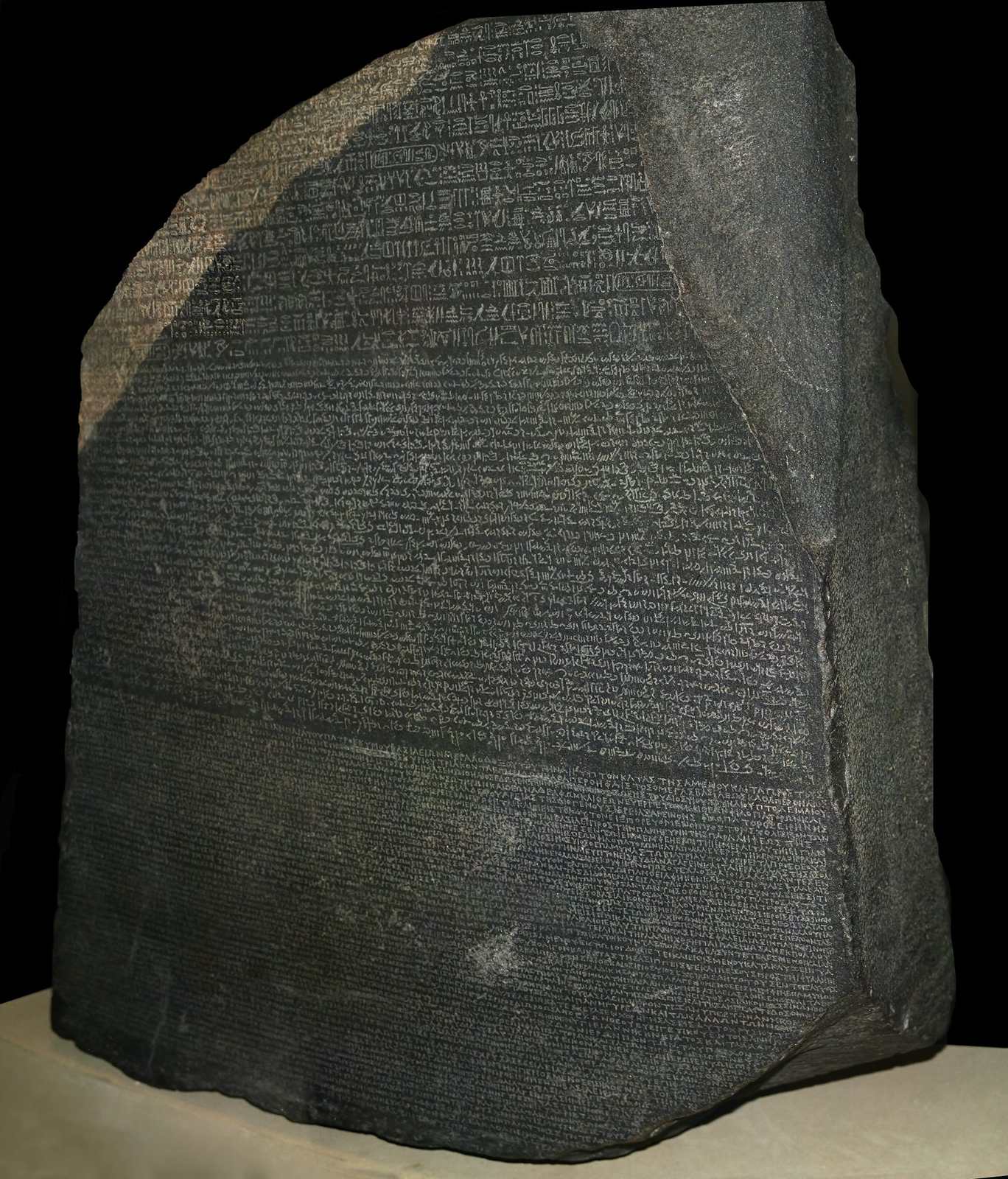
On July 15, 1799, outside the port of Rosetta in Egypt's Nile Delta, a detachment of French soldiers was strengthening an old fortress. Lieutenant Pierre-François Bouchard, the engineer officer in charge, watched as his men dug a slab out of a demolished wall — a slab covered in writing. Three kinds of writing. Bouchard could make out that the lowest band was Greek, and he reported the find to his superiors at once. The stone was sent to Cairo. No one there knew it yet, but this slab, reused as building material, was about to give a voice back to a language dead for 1,400 years — and to bring an entire civilization out of silence.
This is the story of that stone. It took 23 years to turn from a slab no one could read into a key.
Chapter OneOne Decree, Three Scripts
What is carved on the stone is not a great poem, nor a king's boasts. It is an administrative order.
In 196 BC, the priests of Egypt gathered in the ancient capital of Memphis and passed a decree honoring the young king Ptolemy V, who was only 13 years old. Converted to our calendar, the decree is dated March 27, 196 BC, in the ninth year of the king's reign, around the anniversary of his coronation. The decree lists the king's good deeds — remission of taxes, release of prisoners, repair of temples — and orders that his image be set up and his cult celebrated in the temples throughout Egypt. It ends with an instruction: carve this order on hard stone, in three scripts, and set it up beside the king's image in temples of every rank.
So the same decree was carved three times: at the top, hieroglyphs, the formal script of temples and monuments; in the middle, Demotic, the cursive hand Egyptians used for everyday writing; at the bottom, Greek, the administrative language of the Macedonian dynasty that ruled Egypt. Two languages, three scripts, saying the same thing — but not as a word-for-word translation.
The stone is not complete. It was once a taller stele, estimated to have stood about 149 centimeters high; what survives is 112.3 centimeters high, 75.7 wide, and 28.4 thick, weighing about 760 kilograms. Of the hieroglyphic band only 14 lines survive, every one of them broken; the Demotic is the best preserved, with 32 lines; the Greek runs to 54 lines, its lower right corner lost. The rock is granodiorite, dark grey veined with pink, quarried near Aswan in the far south. It was probably first erected in a temple at Sais, and at some unknown point it was taken down and ended up as building material in a fortress.
The decree itself was nothing special. The priests of the Ptolemaic dynasty did this sort of thing often, and several similar decrees survive. What was special was that this stone put three scripts side by side — and that, by accident, made it a key. No one yet knew where the door was.
Chapter TwoThe Lost Language
Hieroglyphs were once among the longest-lived writing systems in the world. They appeared around 3200 BC, and the last dated hieroglyphic inscription was carved on the wall of the Temple of Isis on the island of Philae in 394 CE. After that, no one wrote the script anymore — and no one could read it.
Why it died is no mystery. In the late 4th century, the Roman Empire banned pagan worship, and Egypt's old temples closed one after another. The priesthood vanished, the schools stopped teaching the script, and the last people who could read it died one by one. Knowledge simply snapped. For the next 1,400 years, the temple walls, obelisks, and tomb chambers along the Nile were covered in signs no one could read. Greek and Roman writers left guesses, most of them wrong: some said each sign was a profound philosophical idea, others that the priests had designed the script as a secret code.
Medieval Arab scholars tried too. In the 10th century, Ibn Wahshiyya wrote a book, Ancient Alphabets, attempting to read hieroglyphs, and guessed the sounds of a few signs correctly. Renaissance scholars in Europe kept guessing for three hundred years, and not one of them ever truly read a single sentence.
When a language dies, more than words die with it. Three thousand years of Egyptian history — the lists of kings, the wars, the taxes, the faith, one person's imagining of the afterlife — were all locked inside those signs. Europeans looking at the pyramids could only imagine.
Chapter ThreeThe Stone's Second Fate
The discovery of the Rosetta Stone was a by-product of war. In 1798, Napoleon invaded Egypt, bringing with him the Commission des Sciences et des Arts — 167 scholars, artists, and engineers — to measure and draw this ancient land for France. By the time Bouchard found the stone, the French had been in Egypt for a year, and the sharp edge of the expedition had worn away.
The stone was sent to Cairo, and the French scholars saw its value at once: the Greek band could be read, and if all three bands said the same thing, the hieroglyphs might be unlocked. They made ink impressions of it, and copies were sent to Paris. On September 15, 1799, the Courier de l'Égypte wrote that this stone might "provide the key" to cracking the hieroglyphic code.
But the stone itself did not stay in French hands. On September 2, 1801, the French surrendered at Alexandria, and Article 16 of the capitulation declared that the "Arabian manuscripts, the statues, and the other collections" the French had gathered in Egypt would pass to the disposal of the allied generals. General Menou, the French commander, insisted the stone was his "private property," as exempt from requisition as "the linen of his wardrobe or his embroidered saddles." The British did not give way. On September 12, the stone was handed over to British troops in the streets of Alexandria.
In February 1802 it reached Portsmouth aboard the captured French frigate L'Égyptienne, was exhibited to the Society of Antiquaries in London on March 11, and went on public display at the British Museum that June. There has been only one break since: during the First World War, from 1917 to 1919, it was briefly taken off display. To this day it remains the most-visited object in the museum.
Painted on the sides of the stone, the words from that time are still there: "Captured in Egypt by the British Army, 1801," and "Presented by King George III." Those two lines are a second history in themselves.
Chapter FourThe Oval Around a Name
The key to the code turned out to be a shape.
Egyptian kings' names were written inside an oval frame called a cartouche. The Greek band mentioned Ptolemy, and scholars guessed that one cartouche repeated in the hieroglyphs must also read "Ptolemy." In 1814, the English polymath Thomas Young identified that cartouche and worked out the sound values of several of its signs. In 1819 he published a long article on "Egypt" in the Encyclopaedia Britannica, setting out a partial table of sound values and showing that Demotic was a cursive form of hieroglyphs.
In France, Silvestre de Sacy and the Swedish diplomat Johan Åkerblad each worked out sound values in royal names too. But everyone stopped at the same wall: they assumed hieroglyphs were purely ideographic — each picture standing for an idea or a word — and that only foreign kings' names were spelled out phonetically. That assumption kept the code locked for eight more years.
Young was a genius — physicist, physician, linguist, everything at once. But he lacked one thing: he did not know Coptic.
Chapter FiveA Young Man Who Spoke Coptic
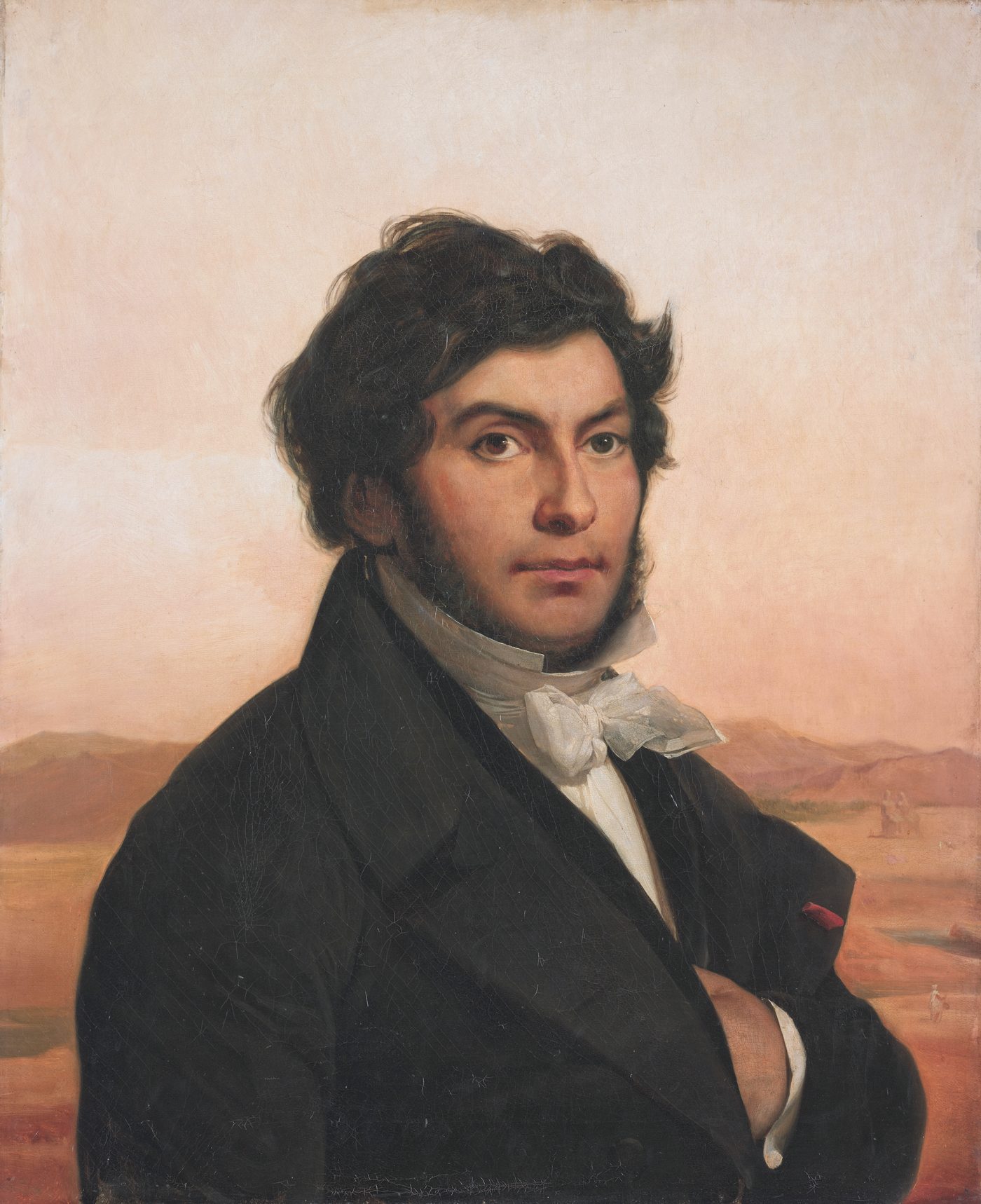
Jean-François Champollion was born in 1790 in Figeac, a small town in southern France. He was 8 years old when the stone was found. As a young man he learned Coptic — the liturgical language of Egypt's Christians, the last stage of the ancient Egyptian language — until he could read and write it fluently. He believed the language of the Egyptians had not died outright; it had changed its clothes and survived in the liturgy of the church. If hieroglyphs recorded Egyptian, then Coptic was the living road back to it.
In December 1821, an obelisk shipped from Philae arrived in England. The Greek inscription on its base named Ptolemy and Cleopatra, and the hieroglyphs on the obelisk itself contained two cartouches. One was Ptolemy; the other, the Greek suggested, must be Cleopatra. The two names shared letters: P, T, L. Comparing the two cartouches, Champollion worked out a set of sound values that held in both names. More importantly, he found that the same sound could be written with different signs — hieroglyphs were not one picture for one meaning. They had sound.
But that was not enough. Ptolemy and Cleopatra were Greek names; spelling them phonetically proved nothing surprising. The real test was whether the same sound values could read the names of Egyptians themselves.
Chapter SixSeptember 14, 1822
On September 14, 1822, Champollion received copies of inscriptions from the temples of Abu Simbel. Among them were two cartouches. The first began with a sun disc — in Coptic, the sun is "re" — and ended with two signs he already knew, S and S. In the middle was a sign he had seen on the Rosetta Stone, standing beside the Greek word for "birthday"; in Coptic, "to give birth" is "mise." Ra-mes-s: Ramesses. The second cartouche began with an ibis, the bird of Thoth, whose name in Coptic is "Djehuti." Thut-mose: Thutmose.
These were not Greek kings. They were native Egyptian kings. And the signs that spelled their names were the same sound system that spelled Ptolemy and Cleopatra. Hieroglyphs were not only ideographic; they could spell sounds. And they were not only phonetic; a single line could be picture, sound, and meaning all at once.
Legend has it that Champollion ran into his brother's office crying, "I have it!" — and collapsed on the floor. Thirteen days later, on September 27, 1822, he read his Lettre à M. Dacier before the Académie des Inscriptions et Belles-Lettres in Paris, listing 25 confirmed phonetic signs. Two years later, his Précis du système hiéroglyphique of 1824 set out the whole system: hieroglyphs were "at once figurative, symbolic and phonetic." Egyptology was born that day.
Champollion did not live long. In 1828 he finally reached Egypt and stood in the tombs of the Valley of the Kings, seeing with his own eyes the words he had only ever read on paper. On March 4, 1832, he died in Paris, aged 41.
EpilogueThe Stone Is Still Speaking
What the Rosetta Stone unlocked was more than a script. It unlocked the archive of an entire civilization: three thousand years of king lists, myths, medicine, mathematics, and one person's journey after death. Without it, even after Tutankhamun's tomb was opened, the words on its walls would have stayed silent; with it, Egypt changed from a vast riddle into a history that could be read.
Whether the stone should go back to Egypt is an argument that has never stopped. In 2022, the British Parliament received a petition demanding that Article 16 of the 1801 capitulation be declared null and void; it was rejected on December 21 of the same year. The stone still stands in London. The argument over its return is itself part of the stone — a reminder that the ownership of a stone was never only a museum's question.
And perhaps the stone's real lesson is not on the stone at all. A language lost for 1,400 years needed only three scripts side by side, one living language, and one young man willing to believe that a dead language was still alive. Civilizations are not buried by time; they are buried by forgetting. And forgetting can be undone — as long as someone is still willing to read.