PrologueThe Stone That Learned to Speak
When the goddess Nüwa mended the sky, she used 36,500 stones — and one was left over, abandoned beneath Green Ridge Peak on the cliff of the Great Wilderness Mountain.[1] The leftover stone gained a soul, and wept day and night, begging a monk and a Taoist to take it down to the mortal world so it could taste wealth and glory for once. They agreed. The stone shrank itself into a luminous piece of jade, was placed in the mouth of a newborn baby, and entered the world. The baby was Jia Baoyu.
That is how Dream of the Red Chamber begins. It opens with a myth and ends with a confiscation. In between — 120 chapters, 768 characters — it tells how one family travels from "boiling oil and fresh flowers" to a "vast white earth, truly clean."[1] This essay is about how the book came to be: how a boy whose family had been ruined spent 10 years turning his family's rise and fall into the summit of Chinese fiction.
Chapter OneThe Boy Whose Family Was Confiscated
Cao Xueqin was born in Nanjing around 1715. His grandfather Cao Yin was the Imperial Textile Commissioner of Jiangning; the Kangxi Emperor made six southern tours, and Cao Yin was in charge of receiving him on four of them. Three generations of the Cao family — four men in all — held the Jiangning commission for 58 years.[2] Those were the family's most splendid years, and the Nanjing of Cao Xueqin's childhood memory: silk clothes, easy wealth, a life of pleasure.
The splendour stopped in 1728. In the sixth year of the Yongzheng reign, the Cao family was stripped of everything for embezzlement and moved back to Beijing, living on a few old houses outside the Chongwen Gate.[2] Cao Xueqin was still a boy in his early teens; overnight he went from being the young master of the commissioner's mansion to an ordinary boy in the capital. As an adult he worked as a clerk in a school for imperial clansmen; in his later years he moved to the western suburbs of Beijing, selling calligraphy and paintings and living on the charity of friends — "the whole family eating gruel, wine always on credit."
In 1762 his young son died; on New Year's Eve of 1763, Cao died himself, poor and ill, aged 47, the book unfinished.[2] The most important sentence of self-testimony in the whole novel sits in its first chapter: "Cao Xueqin, in the Mourning the Red Chamber studio, read it over for ten years, and revised it five times, compiled its table of contents, and divided it into chapters."[3] Ten years, five revisions, 80 chapters — and then he was gone.
But Dream of the Red Chamber is not Cao Xueqin's autobiography. The Jia family is not the Cao family, and Baoyu is not Cao Xueqin. Reading the novel as family history is one of the great controversies of Redology; what Cao wrote was the splendid old dream he had seen and heard with his own eyes — but he also wrote a law that no family and no age escapes: what rises to the extreme must decline.
Chapter TwoThe Grand View Garden: A Borrowed Paradise
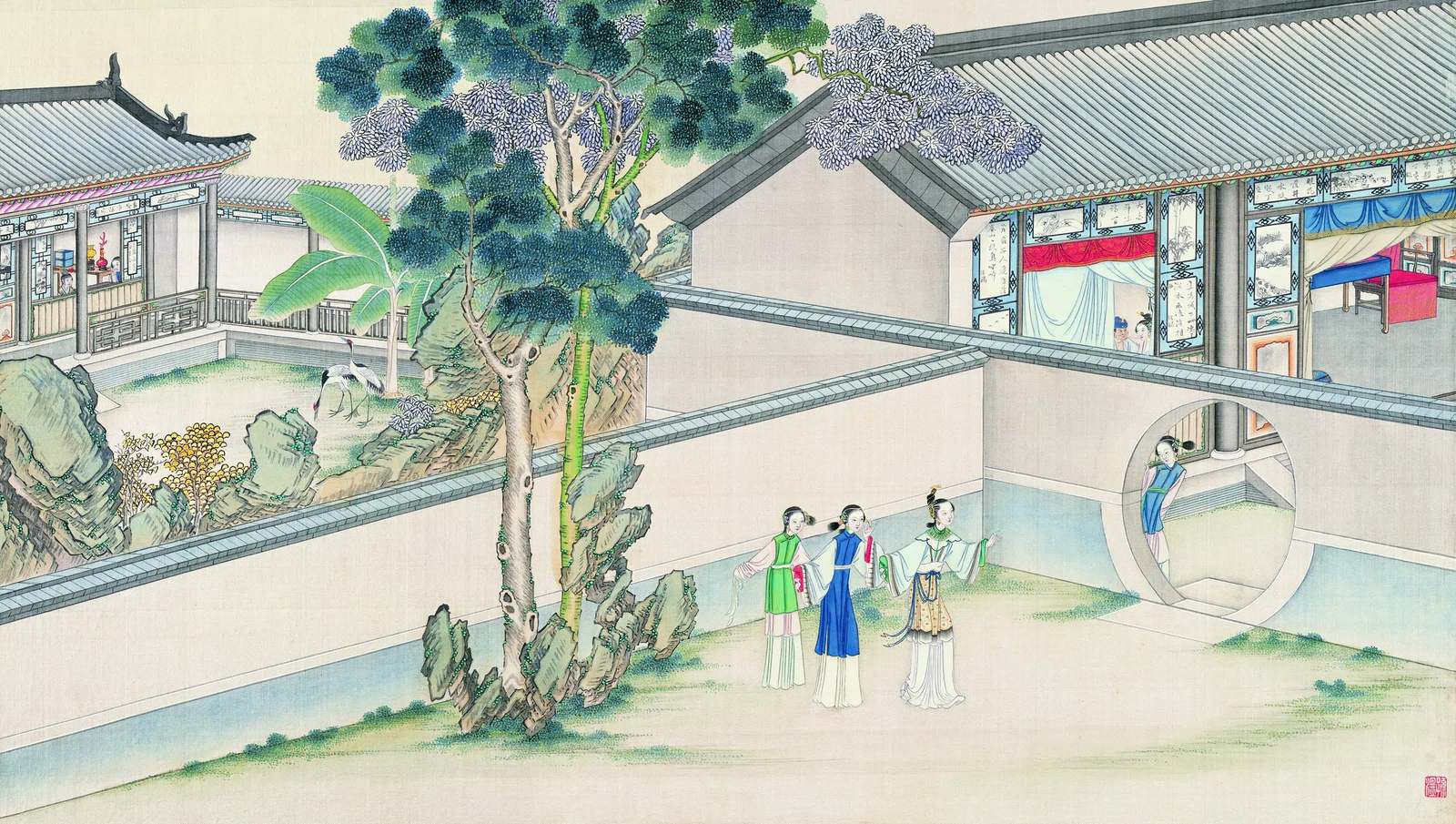
The most enchanting place in the book is a garden. Jia Yuanchun, Baoyu's elder sister, was chosen for the palace and made an imperial consort; the emperor allowed her a home visit, and the Jia family spent a fortune building a Grand View Garden between the two mansions to receive her.[1]
The visit lasted a single day, but the garden stayed. Baoyu and a company of young women moved in: the Bamboo Lodge, the Sweetgrass Court, the Happy Red Court, the Autumn Studio. Life inside the garden is classical Chinese civilisation at its most refined: Tanchun invites everyone to form the Crab-Flower Poetry Club, and they compose poems on the crab-flower; in autumn they eat crabs and play drinking games; on snowy nights they admire the snow, write poems, and eat venison; Daiyu buries fallen blossoms beneath the flowers and writes, "Flowers fade, flowers fly, flowers fill the sky; red fades, fragrance ends — who will pity them?"
But the garden is a borrowed paradise. Its rent is the glory of imperial favour, and the silver the Jias poured into it was propped up by deficits and loans. The more beautiful the garden, the faster the bill arrives. In chapter 5, Baoyu dreams his way into the Land of Illusion and sees a register in which the fates of the Twelve Beauties of Jinling are already written down; in chapter 73, an embroidered sachet is found in the garden, and Lady Wang orders the Grand View Garden searched — from that moment the garden's purity is broken. Cao Xueqin makes the garden as beautiful as it can possibly be, and then makes the reader watch it collapse, piece by piece.
A family staking its entire dignity on a single home visit: that is the system in miniature. Glory is not earned; it is borrowed. And borrowed things must be returned.
Chapter ThreeThe Twelve Beauties of Jinling: Two Fates in Contrast
Baoyu has a famous line: "A girl is made of water; a man is made of mud." Of the novel's 768 characters, the author gives his most moving brushwork to the girls.[1]
In the Land of Illusion in chapter 5, the Principal Register of the Twelve Beauties of Jinling lists 12 women: Daiyu, Baochai, Yuanchun, Tanchun, Xiangyun, Miaoyu, Yingchun, Xichun, Xifeng, Qiaojie, Li Wan, and Qin Keqing. Each woman's verdict and song already writes her ending. The reader has not even reached the halfway mark before knowing how everyone ends — the novel's cruellest design.
Daiyu and Baochai are the book's most important pairing. Daiyu is the "Wood and Stone Alliance": in a former life she was the Crimson Pearl Flower, repaying the Divine Attendant's gift of water by coming down to earth to return him a lifetime of tears. She is sensitive, outspoken, brilliantly gifted — burying flowers, writing poems, playing the qin — living in the Bamboo Lodge, known in the poetry club as the "Xiao Xiang Consort." Baochai is the "Gold and Jade Match": poised, restrained, knowing how to survive inside the system, living in the Sweetgrass Court, known as the "Sweetgrass Lady." The song in the Land of Illusion says it plainly: "All say it is a match of gold and jade; I only remember the alliance of wood and stone."[1]
This is not a love triangle. It is a choice an age makes between two women: true feeling, or the system? Baoyu chooses Daiyu's heart; fate puts Baochai in the bride's place beside him. On the night Daiyu burns her poems and dies coughing blood, Baoyu is next door, bowing in his wedding ceremony.
Wang Xifeng is another kind of contrast. She is the most capable person in the book, managing the food, clothing, and daily life of several hundred people in the Jia household, running Qin Keqing's funeral with splendour and order — sharp, decisive, daring. But her cleverness serves a sinking system: withholding servants' wages, lending money at high interest — all of it becomes evidence at the confiscation. Her song, "The Burden of Cleverness," says of her: "She schemed with all her cleverness — and her cleverness ruined her life." Her cleverness was not the problem. The problem was that the world she was clever in could no longer stand.
Chapter FourThe Book That Was Never Finished
When Cao Xueqin died, the book was not finished. The earliest surviving manuscripts contain only the first 80 chapters, under the title The Story of the Stone, with the Commentary of Rouge Inkstone, also called The Story of the Stone, The Record of the Monk of Feeling, and The Precious Mirror of the Wind and the Moon.[1]
The manuscripts are crowded with red-ink commentary from a person called Rouge Inkstone. The comments reveal that the second half was meant to tell of Daiyu's death, Baoyu's departure from the world, and the confiscation of the Jia family. One comment is heartbreaking to read: "On New Year's Eve of the renwu year, the book unfinished, Cao wept until his tears ran dry and died."[3] New Year's Eve, 1763: the book unfinished, the author dead in tears.
Who Rouge Inkstone was remains unsettled to this day. Some say he was Cao Xueqin himself; some say Shi Xiangyun; some say Cao's uncle. In 1784, the Dream Awakening Master's preface edition first titled the book Dream of the Red Chamber; from then on, the manuscript circulated among friends for 30 years. Everyone who read it knew it was an extraordinary book — and no one could read its ending.[1]
A book without an ending became the summit of Chinese fiction. That fact alone is worth pausing over: what Cao Xueqin left unfinished is precisely the most honest part of the book. No one could have written the ending of splendour, because it had not happened yet; by the time it happened, the writer was gone.
Chapter Five1791: The Book Finally Goes to Press
It was 28 years after Cao Xueqin's death before the book was printed for the first time. In 1791, Cheng Weiyuan and Gao E published a 120-chapter edition in movable wood type — the Chengjia edition; in 1792 they issued a revised Chengyi edition.[5]
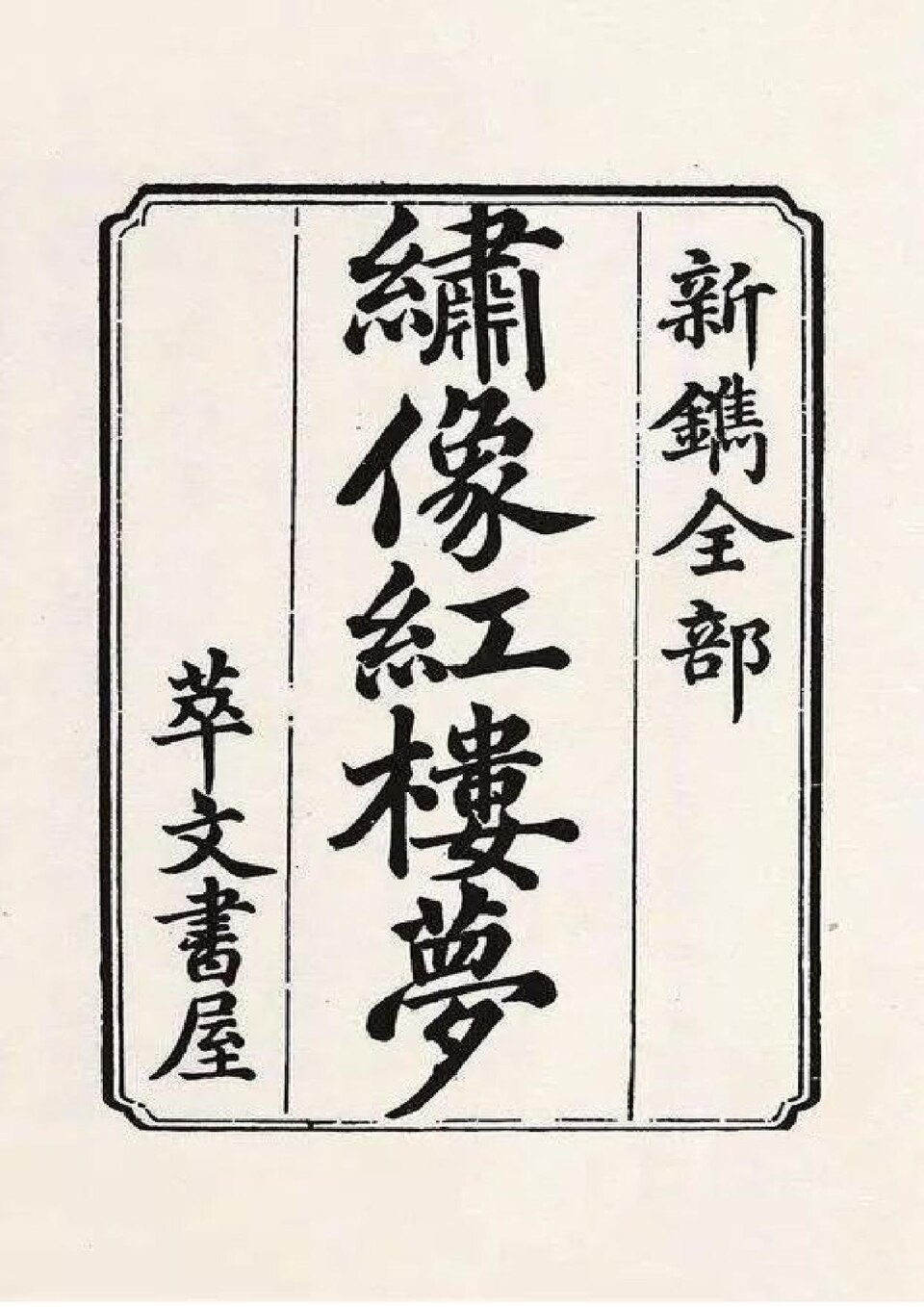
Cheng Weiyuan wrote in his preface that the last 40 chapters were fragments he had collected over many years, patched together with Gao E by "cutting the long and mending the short." From then on, Dream of the Red Chamber replaced The Story of the Stone as the book's common title, and the 120-chapter edition circulated for more than 100 years, becoming the Dream of the Red Chamber on the desks of generations of Chinese readers.[1]
But who wrote the last 40 chapters is still disputed today. Some say Gao E continued them; some say an anonymous hand; some say Cao Xueqin's own drafts survive inside them. The People's Literature Publishing House's revised 2008 edition changed the byline to "Chapters 1–80 by Cao Xueqin; chapters 81–120 continued by an anonymous author, edited by Cheng Weiyuan and Gao E."[3] Even statistics joined the battle: in 1981, Chen Bingzao used statistical methods to conclude that all 120 chapters were Cao Xueqin's, while Zhao Gang, using the same methods, reached the opposite conclusion.[3]
The dispute itself is proof of the book's standing. That the last 40 chapters of a novel can keep generations of scholars arguing for 200 years says everything about what the first 80 chapters achieved — they are worth 200 years of questions.
Chapter Six1921: Hu Shi Brings the Author Back
In 1904, the 27-year-old Wang Guowei serialised his "Commentary on Dream of the Red Chamber" in the magazine Educational World, reading the novel through Schopenhauer's philosophy as a "tragedy of tragedies."[8] It was the founding work of modern Chinese literary criticism: for the first time, someone read Dream of the Red Chamber not as a romance, but as a philosophical book about human suffering.
In 1921, Hu Shi published his "Textual Research on Dream of the Red Chamber," using Qing-dynasty archives and the poems of Cao Xueqin's contemporaries to establish that the author was Cao Xueqin, and putting forward the "autobiographical" reading — the founding of the evidential school of "New Redology."[4] Before him, who wrote Dream of the Red Chamber was a fog; after him, studying it became a discipline — Redology.
There is something moving about Hu Shi's method: he did not look for the answer inside the book, but in the Cao family's history. The archives of three generations of Jiangning textile commissioners, the poems of Cao Xueqin's friends Dun Cheng and Dun Min — line by line, they matched the Jia family in the novel. For the first time, a novel's life story was investigated as history.
From 1973 to 1986, the British sinologist David Hawkes and his son-in-law John Minford published their five-volume The Story of the Stone with Penguin — Hawkes translating the first 80 chapters, Minford the last 40.[6] Dream of the Red Chamber gained readers around the world: one Englishman spent 13 years translating a book the Chinese had spent 200 years learning to read.
EpilogueEveryone Has a Grand View Garden
Why read Dream of the Red Chamber? It is not about the Jia family. The Jia family is only the pretext. It is about how a civilisation builds its most refined, most exquisite, most moving things — and then destroys them with its own hands.
Everyone has a Grand View Garden. In youth we move in, believing it will never fall; growing up, we learn the gate will close sooner or later. Cao Xueqin's honesty is that he left the garden no back door: Daiyu dies, Baoyu leaves the world, Xifeng dies ill, Tanchun marries far away, the garden stands empty, the family is confiscated. A vast white earth, truly clean — clean enough to hurt, but that is the truth.
Sun Wen and his son spent 36 years painting 230 scenes for this book, more than 3,000 figures.[7] A painter spends a lifetime painting one book because the book is worth it. More than 200 years on, Dream of the Red Chamber remains one of the most valued works of literature in China in the 20th century.[1]
The stone returns to Green Ridge Peak. The story is left to the reader.