PrologueOctober 24, 1908 — Taichung Park
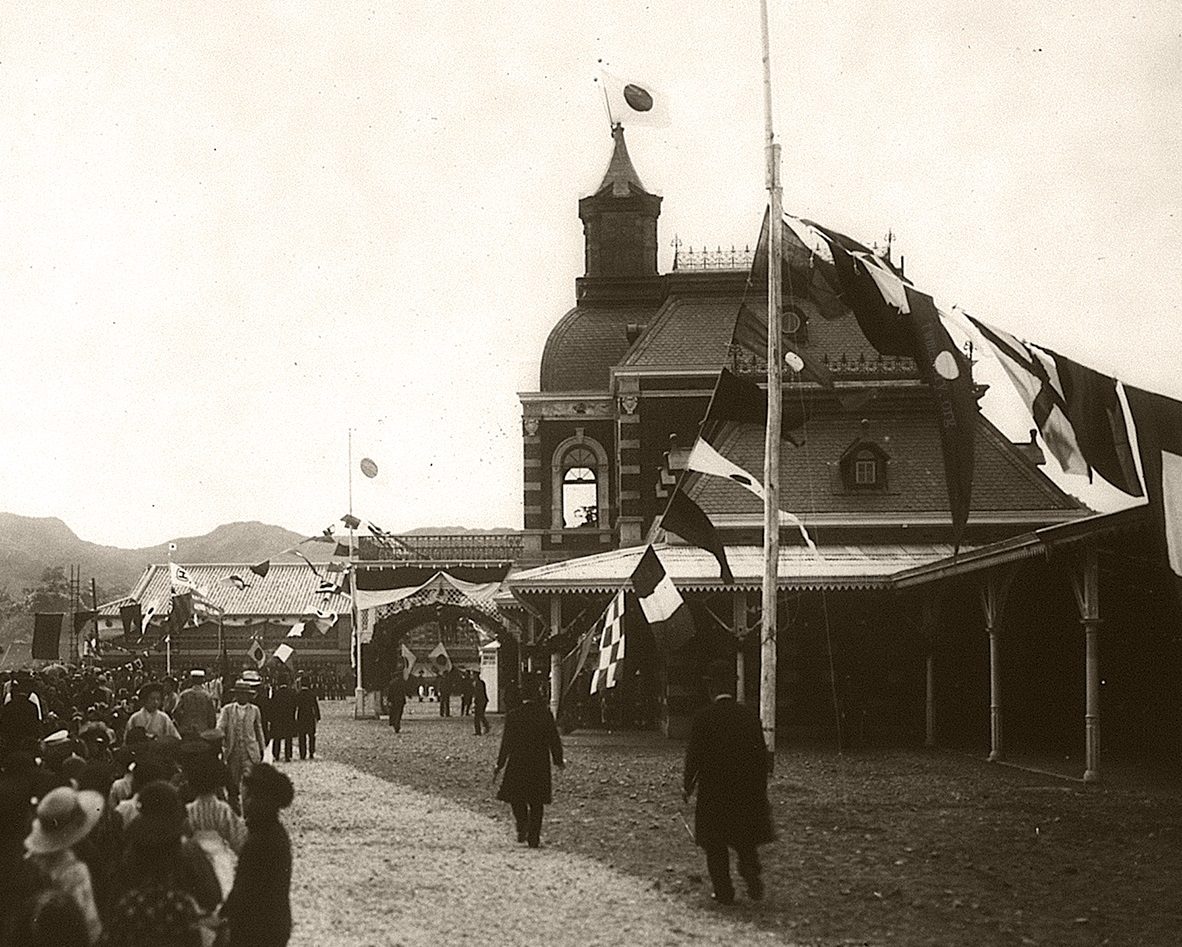
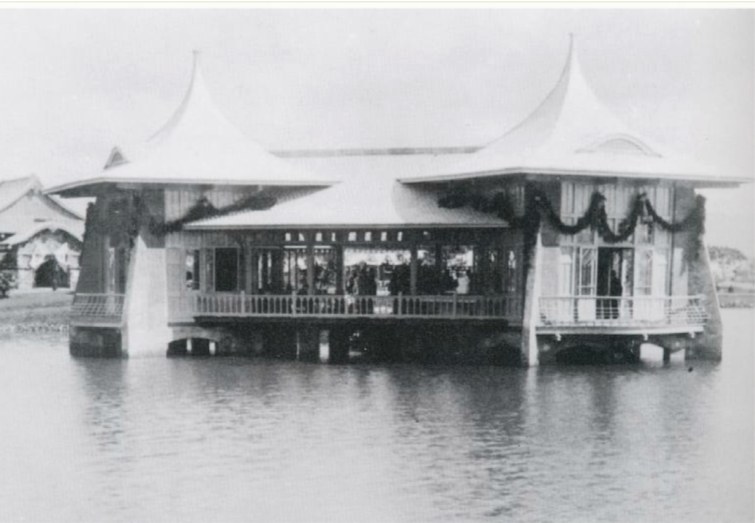
At 7 a.m. on October 24, 1908, a special train left Taipei carrying Prince Kan'in Kotohito of the Japanese imperial family southward. Its destination was Taichung Park. A new pavilion had been built on the park's pond, where the prince would rest and watch the performances; around the pond, flags flew and speeches were given. The Government-General of Taiwan had prepared for this day for a long time, because on this day a railway finally ran all the way from Keelung to Takao.[5][6]
Fifteen-year-old Jiang Lianding was there too. A pupil of the Sijhangli Public School, he had walked about seven kilometres from Beitun to Taichung Park with his teachers and classmates. Many years later, in an essay titled "A Feeling of Another World," he recalled that day: a boy walks into a park and watches the north and south of an island joined together for the first time. For him it was not a ceremony. It was a scene a person meets only once in a lifetime.[6]
This is the story of that railway. It took 21 years, from the Qing dynasty into Japanese rule, from a governor's memorial to the throne to a ceremony hosted by royalty. What it changed was not only transport. It changed how the people of Taiwan felt distance, how they felt time, and how they felt about the place called Taiwan itself.
Chapter OneAn Island Without a Railway
Before the railway, Taiwan was an island that moved on foot. From Taipei to Tainan took days on foot or by oxcart, and freight moved slower still: rice, sugar, camphor and tea went by oxcart, then by boat, then by oxcart again. One island, full of people who rarely met one another; what happened in the north took a long time to reach the south.
In 1887, Liu Mingchuan, the first governor of Taiwan, petitioned to build a railway from Keelung all the way to Tainan. The Qing court allowed him to raise the funds himself, and he went to Southeast Asia to find investors. A railway in those days was more than transport. It was a certificate: an island forced open by foreign powers wanted to prove, with iron rails, that it could become modern too.[4]
But modernity could not be bought with a few locomotives. It needed money, skill, surveying, tunnelling, and the knowledge of how to make a train climb a hill. What Liu had was a group of inexperienced craftsmen and a mountainous island. The railway's first lesson was never about engineering. It was about patience.
In 1887, the railway was among the most advanced technologies in the world. Whether an island had one decided its place on the map: with a railway, goods and troops could move fast, cities could grow, and news could travel in a day; without one, however rich the island, it could only wait where it was. What Liu Mingchuan wanted to build was never just a railway. It was a ticket into the modern world.
Chapter TwoA Tunnel and a Dismissal
The first examination came at Shiqiu Ridge in Keelung. In the spring of 1888, workers began to dig a tunnel 235 metres long. Without modern machinery, it was done by hand and by time — thirty months, until August 1890. It was Taiwan's first railway tunnel, and it is the only Qing-dynasty railway tunnel still standing today. One mountain took two and a half years to pierce. The fate of the whole railway was much the same.[3][4]
In 1888, the section from Dadaocheng in Taipei to Xikou (today's Songshan) opened for trial runs. In October 1891, Keelung to Taipei opened, 28.6 kilometres. But before the opening, Liu Mingchuan had already left office. His successor, Shao Youlian, halted the work at Hsinchu on the grounds of financial difficulty; in 1893, Taipei to Hsinchu opened. That was where the Qing railway ended: 106.7 kilometres in total, sixteen stations. The road that was meant to reach Tainan stopped with its embankment at Qiding.[3]
The Qing railway left a cruel lesson: a railway is the extension of a will, and when the person leaves, the road stops. Whether a project can be finished depends not only on engineering, but on whether a will can outlast one man's term in office. In 1895, defeated in the First Sino-Japanese War, the Qing ceded Taiwan to Japan. The new rulers inherited a railway that reached only as far as Hsinchu, and an island dug only halfway through.
Chapter ThreeNine Years, Digging from Both Ends
In 1899, the Railway Department of the Government-General began work from both ends at once, north and south. Its head was Goto Shinpei, the civil administrator, and its planning was done by chief engineer Hasegawa Kinsuke. Their first decision was to throw out almost all of Liu Mingchuan's old line: it curved too much and climbed too steeply, so more than ninety percent of it was redrawn. Rather than patching, they drew a new map.[1]
That Goto Shinpei headed the Railway Department himself says everything about how much the railway weighed in the Government-General's mind. It was not a project for an engineering office. It was the skeleton of colonial rule: wherever the railway reached, rule reached; whenever the trains ran, the towns woke. On Hasegawa Kinsuke's plans, what was drawn was not only track. It was a new map of rule.[1]
Why start from both ends? Because the middle was the hardest part: the wide riverbed of the Zhuoshui River, tunnels through the hills. Digging from both ends meant saving the hardest part for last — and leaving no way back. For nine years the rails crept toward the middle, and the towns along the way were drawn, one by one, into the same net.
In 1906, unfinished sections were temporarily joined by light railways, and for the first time there was a rail link from Keelung to Takao. On April 20, 1908, the whole line was completed and opened; on the same day, Taichung Station held an "Automobile Exhibition" — "automobile" in those days meaning a steam locomotive. Six months later, on October 24, came the opening ceremony in Taichung Park. A commemorative postcard read: "From Keelung to Takao, 247 miles." Two hundred and forty-seven miles, about 406 kilometres. One railway, 21 years, two regimes.[1][5]
Chapter FourTaipei to Takao in a Single Day
At first there was only one through train a day between north and south. It left Taipei at 6 a.m., reached Tainan at 5:13 p.m., and arrived in Takao at 7:55 p.m. — about fourteen hours. A journey that used to take days on foot could now be done within a single day. For the first time, the people of Taiwan had the feeling of "there and back in a day": leave Taipei in the morning, and eat dinner in Takao that evening.[2]
The railway carried more than people. Rice, sugar, camphor and tea flowed along the rails to the ports; fertiliser, cloth and machinery flowed back to the villages. Stations became markets, and markets grew into towns. Wherever the railway passed, a new timetable took hold: market days, school terms, work, weddings — everything began to run on the train's schedule.
Taichung is the clearest example. On May 15, 1905, Taichung Station opened as a small wooden building. The railway came, and people came with it; by 1916, 559,867 passengers a year were passing through the station, and the little wooden building could no longer hold them. On March 31, 1917, the main body of a grand second-generation brick station was completed, and on November 6 its opening ceremony was held. An inland town became the centre of central Taiwan because the railway passed through it. Taipei Station was the same: in 1901 it was rebuilt in red brick, in Renaissance style. A station was no longer just a place to wait for a train. It was the face of a city, and whether a city had a proper station became a mark of status.[7][8]
Chapter FiveMountain and Sea — Two Roads
Once the railway opened, a new problem arrived at once: the mountain line was not enough. Between Zhunan and Changhua, the line climbed over the hills, steep and winding, and freight soon jammed it. In 1917, a serious freight congestion gripped the whole island, and the Government-General decided to build another road — this one along the coast.[9]
On December 25, 1920, the first section of the coastal line opened, from Wangtian to Qingshui. On October 11, 1922, the whole coastal line opened, with a ceremony at Tongxiao. It cost more than 11 million yen, and ran about 90 kilometres from Zhunan to Changhua. Once the coastal line opened, long-distance trains took the coast, and the mountain line stepped back; Changhua, sitting at the junction of both lines, became the transport centre of the north-south route again, and was made a city in 1933.[9][10]
In 1922, Changhua gained one more thing: a roundhouse. Locomotives were parked like the ribs of a fan inside a semicircular shed for maintenance. That roundhouse still stands today — the only surviving roundhouse in Taiwan. The contest between mountain and sea never stopped. On September 24, 1998, the new mountain line was completed with double tracks throughout, and the mountain line became the main route again; on July 1, 1979, the whole trunk line had been electrified. Two roads, one by the sea and one through the mountains, taking turns as the main line. What they were fighting over was never just a route. It was the fate of the towns along the way.[1][9]
EpilogueThe Pavilion Is Still There
The pavilion built for the ceremony in 1908 is still standing in the pond of Taichung Park. In 1999, it was designated a historic site of the city. The pavilion has not changed. What changed is the world around the pond — the boys who came to watch the ceremony that year are long gone; the water is still there, and the pavilion is still there.[7]
Taichung Station is still there too, only now it holds three generations under one roof: the wooden station of 1905, the brick station of 1917, and the elevated station of 2016, three eras stacked in the same place. On October 16, 2016, the brick station sent off its last train and retired from service, remaining as a city's memory.[8]
The railway is still running. In 2007, the high-speed rail opened, and Taipei to Zuoying now takes about an hour and a half at its fastest — a journey that took fourteen hours in 1908 now takes less than a ninth of the time. On January 1, 2024, Taiwan Railway was corporatised, and the Railway Administration passed into history as a state-owned company. The trunk line is still the core of Taiwan's western main line.[1][12]
After the high-speed rail opened, Taiwan Railway changed its own role too: the western trunk line shifted its centre of gravity from long-distance transport to commuting, under a plan called the "metro-isation of the Taiwan Railway" — turning a railway from 1908 into a line people ride to work every day. The railway's job has changed, but its place has not. It is still the first sound the island wakes to each morning.[14]
But one thing has not changed: the way the people of Taiwan feel distance was taught by the railway. Before 1908, Taiwan was an island whose north and south could only look at each other from afar; after 1908, it was an island that could be crossed in a single day. The railway did not change the shape of Taiwan. It changed its size. And the size of an island was never decided by a map. It was decided by time.