Prologue9 June 1815: A Single Document
On 9 June 1815, in Vienna, the representatives of Europe's powers signed a document that put back together a continent shattered by the Napoleonic Wars: who got Poland, how Saxony would be cut, how many states Germany would be left with, whether Switzerland would be neutral — all settled at once. It was called the Final Act of the Congress of Vienna.
Nine days later, Napoleon was defeated at Waterloo. In other words, when the Congress signed, the war was not yet over.
It was the strangest peace conference in history. It lasted nine months and held countless balls, yet almost never held a single plenary session. It was made up of monarchs and diplomats, yet it decided the fate of Europe for the next forty years. It has been condemned as reactionary, backward, and hostile to nationalism — and yet it kept the great powers of Europe from fighting another general war for nearly forty years.
This is the story of what happened in those nine months — and why a conference famous for dancing deserves to be taken seriously.
Chapter 1A Conference That Never Met
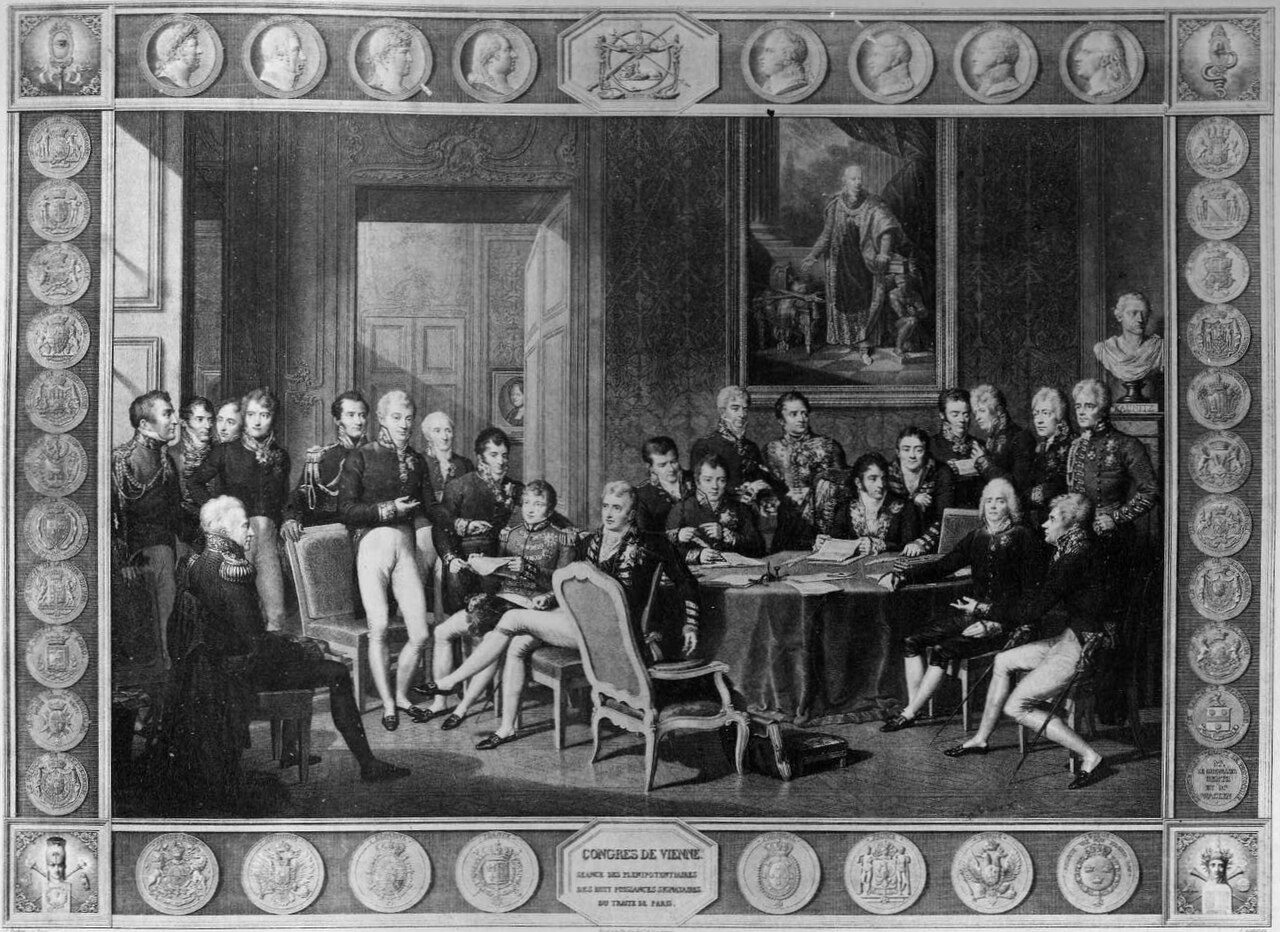
In September 1814, Europe's monarchs and diplomats began arriving in Vienna. Emperor Francis I of Austria played host; Tsar Alexander I of Russia came in person; the King of Prussia, Britain's Foreign Secretary Castlereagh, and France's Talleyrand were all there. In name, this was a "congress". In fact, it held only one plenary session from start to finish — on the final day, when everyone came to sign.
The real negotiations happened in small rooms. The four victorious powers — Austria, Britain, Russia, and Prussia — formed an inner circle, and Talleyrand of France elbowed his way in to make it five. The representatives of the smaller states could only wait in the corridors and pick up rumours at the balls.
The balls were not decoration; they were part of the work. What could not be said across a negotiating table could be said on the dance floor; terms that could not be agreed by day were traded over cards at night. The waltz was still new then — even a little improper, a man and a woman holding each other close and spinning — yet in Vienna it became fashionable overnight. In those nine months, the line between diplomacy and entertainment almost disappeared.
Prince Charles Joseph de Ligne was the oldest rake at the Congress, nearly eighty, and still at every ball. In French he left behind the line that became the Congress's label: "Le congrès danse beaucoup, mais il ne marche pas." The Congress dances a lot, but it does not advance.
The line was only half right. The Congress did dance for nine months, and for the first three it truly achieved nothing. But when it finally began to move, it moved fast — so fast that nine days after Waterloo's guns sounded, Europe's new map was already drawn.
Chapter 2Three Principles, One Near-War
The man chairing the Congress, Austria's Foreign Minister Metternich, worked from three principles. The first was legitimacy: dynasties overthrown by revolution must be restored — the Bourbons back in France, in Spain, in Naples. The second was compensation: every great power must be paid off in the loser's territory, and none must lose out. The third was the balance of power: no single state could be allowed to grow strong enough to dominate Europe.
The principles sounded elegant; in practice they were all quarrel. The greatest dispute was over Poland and Saxony. Tsar Alexander I wanted all of Poland — most of the Duchy of Warsaw, reborn as a Kingdom of Poland with himself as its king. Prussia wanted the whole Kingdom of Saxony as compensation, having given up its old Polish lands to Russia.
Britain and Austria flatly refused. A Russia holding Poland would reach into the heart of central Europe; a Prussia swallowing Saxony would dominate Germany. In the winter of 1814, the talks deadlocked, and Russia and Prussia began to posture as if war were possible.
On 3 January 1815, Britain, France, and Austria signed a secret defensive alliance: if Russia and Prussia resorted to arms, the three would stand together against them. One of its signatories was Talleyrand of France — a month earlier, France had been a defeated power that could barely get a seat at the table; a month later, it was an indispensable part of the balance. Talleyrand had used the principle of legitimacy to win France a chair, and then used the chair to win France a voice.
The crisis ended in compromise: Russia took most of the Duchy of Warsaw and created the Kingdom of Poland; Prussia received three-fifths of Saxony, and the King of Saxony kept the rest. Nobody was fully satisfied, and nobody went to war. That is the essence of the balance of power: not that anyone wins, but that no one wins enough.
Chapter 3How the Map Was Redrawn
The Final Act signed on 9 June 1815 was a map of Europe redrawn. Its logic was a single one: France must be ringed with buffer states strong enough that it could never strike out again.
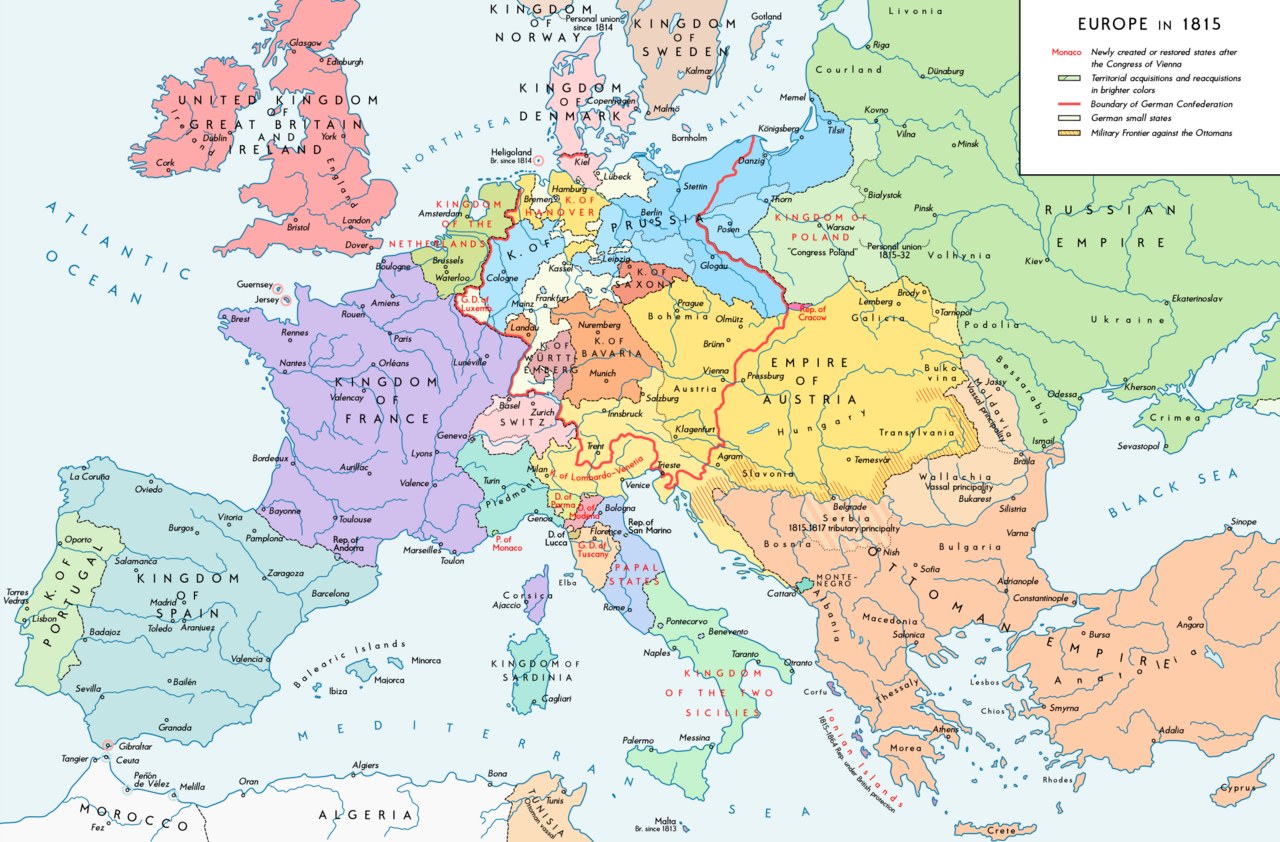
To the north, Holland and Belgium were merged into the United Kingdom of the Netherlands, blocking France's northern gate. To the east, Prussia pushed west to the Rhine, while Austria took Lombardy and Venetia in northern Italy. To the south, the Kingdom of Sardinia recovered Savoy and Nice and absorbed Genoa. Switzerland gained new cantons, including Geneva, and its permanent neutrality was guaranteed by the great powers.
Germany's hundreds of petty states were consolidated into a German Confederation of 39 states, replacing the Holy Roman Empire, dissolved in 1806. The Confederation was famously loose — no common army, no unified customs — but it left Germany neither united nor divided, wedged exactly between France and Russia.
The Polish settlement best captures the character of the Congress: the Kingdom of Poland was created, but its king was the Russian Tsar. It had a constitution and a parliament, and was independent in name — in practice, a Russian dependency. Poles waited more than a hundred years, until 1918, for real independence. The Congress gave Poland a name; it did not give it a country.
The Congress also did one thing that looked progressive and was in fact hollow: it issued a declaration condemning the slave trade as contrary to the principles of humanity. But the declaration set no timetable for abolition and created no machinery to enforce it. Britain wanted abolition; Spain and Portugal wanted to keep making money. The declaration was beautifully written, and the slave ships kept sailing. This was the other face of Vienna: it was good at writing principles, and bad at enforcing them.
Chapter 4The War Came Back Before the Dancing Stopped
On 1 March 1815, Napoleon escaped from his exile on Elba and landed in the south of France. When the news reached Vienna, the story goes, the delegates were at a ball. For the men at the negotiating table, it was, paradoxically, a rescue: with a common enemy back, there was no more time to quarrel over the spoils.
The Polish and Saxon disputes stopped at once. On 25 March, the four powers renewed their alliance against Napoleon; the delegates hurried to finish the Final Act even as they prepared for war. It was signed on 9 June; Waterloo followed on 18 June. By the time the Congress dispersed, Napoleon was on his way to St Helena.
That same year, another disaster was unfolding on the other side of the world, and no one in Vienna knew. On 10 April 1815, Mount Tambora on the Indonesian island of Sumbawa erupted — the largest volcanic eruption in recorded history, killing some 71,000 people. Ash rose into the stratosphere and dimmed the sun; the next year, the Northern Hemisphere endured the "Year Without a Summer": it snowed in New England in June 1816, and famine spread across Europe.
While the delegates danced in Vienna, volcanic ash was drifting around the globe; while they drew a new map of Europe, the climate was rewriting the harvests. That is history's irony: men believed they were in charge of events, while half of events were being decided by a volcano.
Chapter 5The Price of Peace
Three months after the Congress ended, the monarchs of Russia, Austria, and Prussia signed the Holy Alliance in Paris, pledging in the name of Christian brotherhood to stand together against revolution. Britain and France did not join, but the five powers soon formed the Quadruple Alliance, then the Quintuple Alliance, meeting regularly to coordinate policy. The system came to be called the Concert of Europe.
Its record is startling: from 1815 until the Crimean War broke out in 1853, the great powers of Europe fought no general war against one another. Nearly forty years of peace is rare in European history. The peace the Congress of Vienna bought was real.
But peace had a price. The logic of the Congress was to preserve the status quo, and the status quo was monarchical absolutism. Nationalism and liberalism were treated as diseases to be suppressed: Italians who wanted unity were blocked by Austria; Germans who wanted unity were held back by the Confederation; Poles who wanted independence waited a century. In 1848, the fire broke out everywhere at once — in Paris, Vienna, Berlin, and Milan. It was a fire that had been smothered for 33 years.
Critics call the Congress of Vienna a reactionary settlement that turned the clock back to before 1789. Defenders call it a pragmatic one that understood that revolutionary ideals could not save Europe — only the balance of power could. Both are right. That is what makes Vienna so hard to judge: it suppressed liberty and prevented war, and both were done by the same system.
EpilogueWhat Vienna Teaches Us
A century later, another war ended, and another group of diplomats met in Paris. The logic of the Versailles conference was the opposite of Vienna's: defeated Germany was shut out of the negotiating room, and reparations and guilt were piled on it alone. Twenty years later, Europe was at war again.
The contrast between Vienna and Versailles is the most important lesson the Congress left behind. Vienna brought the defeated power back to the table, gave it a seat, dignity, and a voice — not out of kindness, but out of calculation: a humiliated France would sooner or later strike back; a France inside the system might behave. Versailles forgot that. Vienna did not.
The balance of power is not justice. It does not ask who is right and who is wrong; it only asks who is too strong. It disappointed the Poles, the Italians, and the Germans — and it kept Europe alive. That is not a satisfying answer, but it may have been the only workable one in 1815.
On 9 June 1815, the delegates signed and went home. The balls ended, the orchestra packed up. Europe's map had been redrawn, volcanic ash was still drifting in the sky, and Napoleon was on a ship to exile. No one knew how long this peace would last. It lasted nearly forty years. For a conference famous for dancing, that was already a great deal.