PrologueHe Crowned Himself
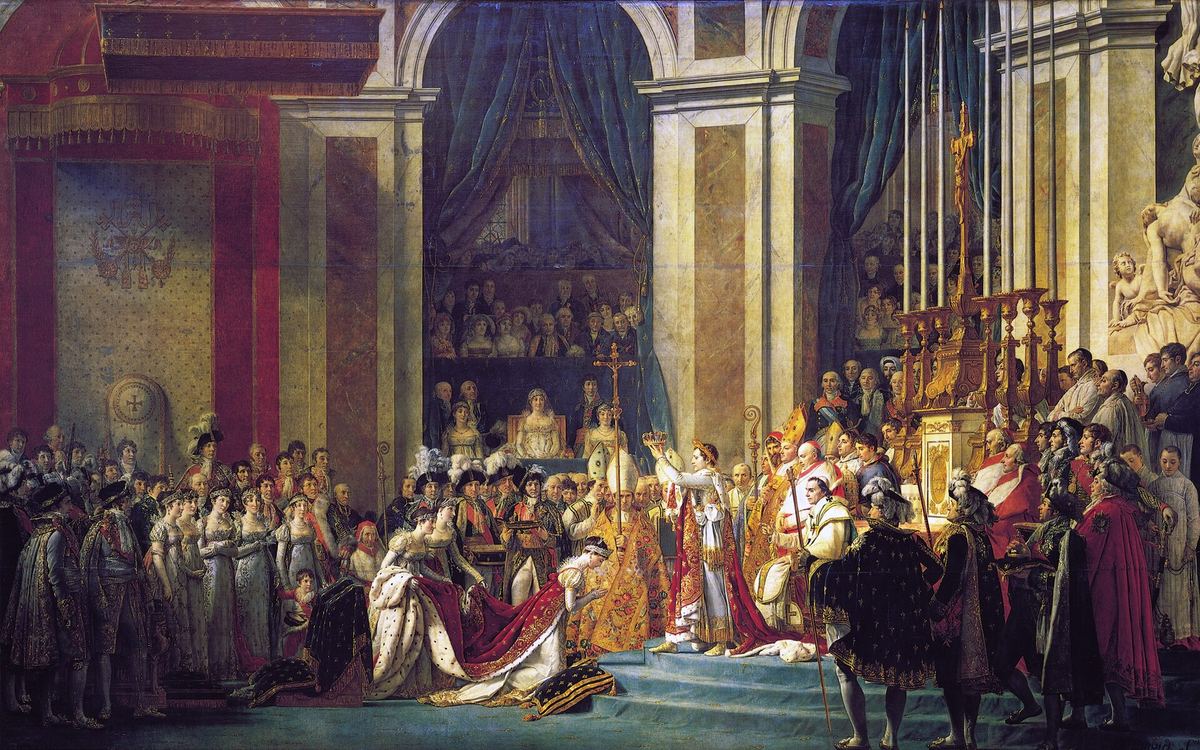
On 2 December 1804, in Notre-Dame Cathedral in Paris, Pope Pius VII had travelled from Rome to crown the new Emperor of the French. Napoleon stepped forward, took the crown from the Pope's hands, turned to face his court, and placed it on his own head. Then he took a smaller crown and placed it on the head of his wife, Joséphine.[1]
Everyone present understood what the gesture meant. Kings before him had received their crowns from the Church, from God, from bloodline. Napoleon's crown came from himself. The source of power had been rewritten: no longer divine right, no longer birth, but merit, the army, and his own will.
He was 35 years old. Fifteen years earlier he had been an obscure artillery lieutenant from Corsica, speaking French with an accent, shut out of the officers' mess in Paris. Fifteen years later, all of Europe watched his face. This book tells what happened in those fifteen years — and how, in the eleven that followed, he smashed it all with his own hands.
Chapter 1The Outsider from Corsica
Napoleon was born on 15 August 1769 in Ajaccio, Corsica, to a family of minor Italian nobility.[1] The year before his birth, Corsica had been ceded to France by Genoa. He was born, in other words, a newcomer on new territory — a provincial in French eyes, a Frenchman in Corsican eyes.
At nine he was sent to a military school in mainland France. His classmates mocked his accent, his poverty, his surname. He answered by reading: mathematics, history, geography, and above all artillery. He graduated at sixteen, one of the youngest artillery lieutenants of his year. The school taught him more than gunnery; it taught him that in a world obsessed with birth, expertise was the one passport that needed no pedigree.
The outsider's status stayed with him all his life, and it shaped him all his life. The Parisian aristocracy looked down on him, the politicians of the Revolution distrusted him, the royal houses of Europe feared him. Because no circle ever truly took him in, he was willing to overturn them all. The greatest advantage of an outsider is that he feels no loyalty to the old order.
In 1789 the French Revolution erupted, and the old regime came down like a rotten house. For most Frenchmen the Revolution was a disaster; for Napoleon it was a door. Behind the door there was no bloodline and no family name, only a new rule: the able rise. He spent ten years proving the rule was real.
Chapter 2The Guns of Toulon
In 1793 the port of Toulon was held by royalists and the British. Napoleon, aged 24, was put in charge of the besieging force's artillery.[2] His plan was simple: take the heights above the harbour, train the guns on the anchorage, and force the allies out.
The siege commander thought little of the young man. Napoleon went over his head, writing directly to the Committee of Public Safety in Paris for men, guns and powder. On the night of 16–17 December the French stormed the heights, the British sailed away in the dark, and Toulon was retaken.[2] Napoleon became famous overnight and was promoted to brigadier general at 24.
Toulon already contained his whole way of war: find the decisive ground and the decisive moment, concentrate everything on a single point, and tear the gap open with speed and firepower. It worked on the battlefield, and it worked in politics. He was never the most patient of men, but he was the best at judging where the key point lay.
Two years later, on 5 October 1795, royalists rose in Paris, and Napoleon put the rising down with cannon.[2] In 1796 he led an army into Italy and won battle after battle, until his name was in every newspaper in Europe. In 1798 he sailed for Egypt, hoping to cut Britain's road to India. Egypt could not be held, but his fame sailed home ahead of him like a rising tide. In 1799 he slipped away from the expedition and returned to France — the moment had come, and Paris was waiting for a man who could clear up the mess.
Chapter 3Brumaire: The Temptation of Order
On 9 November 1799, the 18th of Brumaire, Napoleon seized power, overthrew the Directory, and became First Consul.[9] Few shots were fired, and the government changed hands. The people of Paris did not take to the streets in protest. They breathed a sigh of relief.
That is the most thought-provoking thing about the coup. Ten years of revolution had exhausted France: the Terror had killed without mercy, the Directory was corrupt and incompetent, prices soared, and coups came round like the seasons. What the people wanted was no longer liberty. It was order — a government that could open the bakeries, keep the streets safe, and keep its word. Napoleon understood this, and so he presented himself as order made flesh.
His first task was to put the Revolution's gains inside institutions: a centralised administration, tax reform, reconciliation with the Church, a national bank. The slogans of the Revolution — equality before the law — he wrote into a code; the dictatorship the Revolution feared, he dressed in republican clothes. France accepted the bargain because it was tired.
The same logic explains why he sold Louisiana. In 1803 Napoleon sold the United States 828,000 square miles of North American territory for $15 million; the treaty was signed on 30 April 1803.[12] He had dreamed of rebuilding a French empire across the Atlantic, but the war in the Caribbean was lost, Haiti was about to become independent, and the American dream was broken. Better to turn land he could not hold into cash for the wars in Europe.[7][12] The United States doubled its territory overnight, and almost no one in France mourned the sale — because to Paris, America was far away, and Europe was the battlefield.
Chapter 4The Code Outlives the Sword
On 21 March 1804 the Napoleonic Code came into force: 2,281 articles.[3] Four jurists had been commissioned to draft it, and Napoleon himself chaired many of the sessions that debated it.[3] Nine months later he put on the crown. The code came first, the crown second — and the order was no accident.
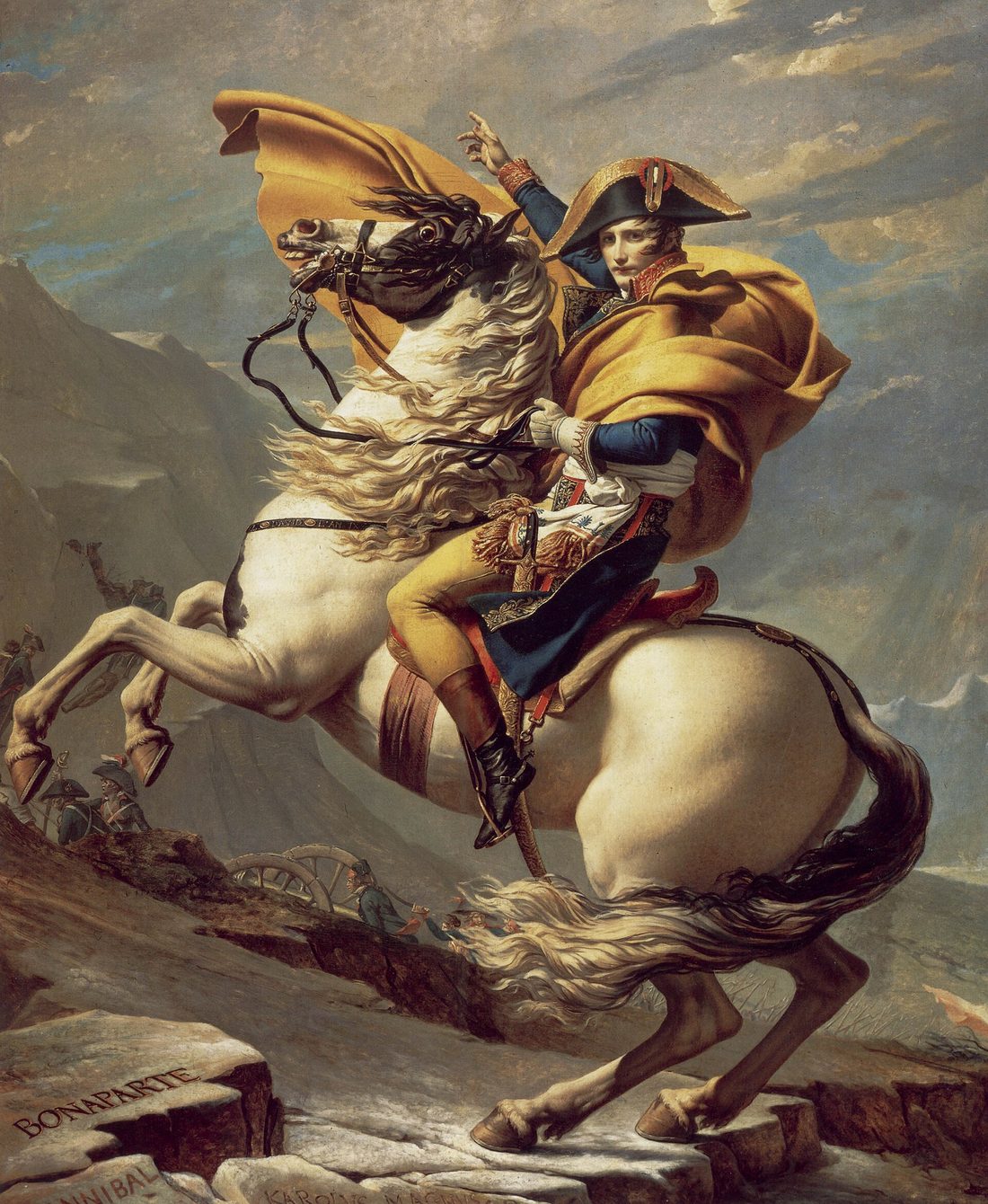
What did the Code say? That all male citizens are equal before the law; that feudal privilege and primogeniture are abolished; that private property is inviolable; that contracts are free; that marriage and civil registration are taken out of the Church's hands.[4] In today's language, it was a bourgeois code: it protected buying and selling, inheritance and private property, not the bloodline of the aristocracy.
Napoleon was no jurist, and he was not even the Code's main author.[3] But he did something no jurist could do: he used the will of the ruler to push the Code through every obstacle until it became the single law of all France. Before him, the south lived under Roman law and the north under a patchwork of local customs; each region went its own way. After the Code, a Frenchman faced the same law wherever he stood.
The Code travelled with the French armies across Europe and became the model for the civil codes of continental Europe and Latin America in the nineteenth century;[4] it remains in force in France today, heavily amended.[3] It is the strangest achievement of Napoleon's life: he conquered Europe by war, but he stayed by a book of law. Swords rust, treaties lapse, but the Code moved into every marriage contract, every will, every deed of sale, and became part of daily life.
Chapter 5Austerlitz and Moscow
In the first year after the coronation, Napoleon tasted heaven and hell together. On 21 October 1805, at Trafalgar, the British Admiral Nelson destroyed the combined French and Spanish fleets, dying in the battle himself;[11] Britain held command of the sea from then on, and Napoleon's dream of invading England was finished.
On land, however, no one could stop him. On 2 December 1805 — the anniversary of his coronation — at Austerlitz, 68,000 French troops met a combined Austro-Russian army of about 90,000[12] and destroyed it in a single day; the allies lost about 16,000 men killed or wounded, and 11,000 more were taken prisoner.[6] It was the peak of his military career, the "Battle of the Three Emperors", named for the three emperors whose armies were on the field.
After Austerlitz, Napoleon was the undisputed master of the Continent. He made and unmade kings like chess pieces: his brother Joseph became King of Spain, his brother Louis King of Holland, his brother-in-law Murat King of Naples.[2] He redrew the map of Europe with a pencil, again and again. The trouble was that maps can be redrawn, but hearts cannot. Conquered nations remembered the humiliation, puppet kings commanded no respect, and the whole Continent waited for its chance.
The chance came in 1812 — and Napoleon delivered it himself. On 24 June 1812, more than 600,000 French and allied troops crossed the Niemen and invaded Russia.[6] On 7 September came the bloodbath of Borodino;[5] on 14 September the French marched into Moscow and found an empty city in flames.[5] The Tsar would not negotiate, winter came, supplies failed, and Napoleon ordered the retreat. The retreat became a rout, and cold, hunger and Cossack horsemen devoured the largest army Europe had ever seen.
The Russian campaign was the true turning point of Napoleon's life. Before it, he had lost small battles but never the larger game; after it, all of Europe understood one thing: the Emperor was not a god. He could make mistakes, and one mistake could be fatal. The most dangerous moment for ambition is not when it is thwarted, but when it has succeeded so long that it stops listening to advice.
Chapter 6Waterloo and St Helena
On 11 April 1814 Napoleon signed his abdication at Fontainebleau and was exiled to the Mediterranean island of Elba.[10] He spent ten months there as "Emperor" of a small island with a few hundred soldiers, reportedly building roads and opening mines, like a shopkeeper tending his shop with great care.
But he was not a man content to tend a shop. On 1 March 1815 he landed in the south of France with about 1,000 soldiers;[10] the troops sent to stop him went over to him one after another, and on 20 March he was back in Paris, Louis XVIII having fled in the night.[10] From landing to throne took twenty days, almost without a shot fired. Those 110 days are known as the Hundred Days.[10]
The powers of Europe at once formed a Seventh Coalition. On 18 June 1815, at Waterloo, on a muddy field in Belgium, the Anglo-allied army under Wellington and the Prussians under Blücher caught Napoleon between them and destroyed him.[5] Four days later, on 22 June, he abdicated a second time.[10] This time there was no Elba: the British sent him to St Helena, a volcanic island in the South Atlantic, far from any mainland.
On 5 May 1821 Napoleon died at Longwood on St Helena, aged 51.[1] He began on one island and ended on another. Corsica sent him out into the world; St Helena shut the world out.
EpilogueThe Code Remains; the Crown Does Not
After Napoleon's death, the powers of Europe met at Vienna to put the map back together in the shape of the old order.[10] The Bourbons were restored, the Holy Alliance was formed, and the Revolution seemed to have been put back in its bottle.
But some things could not be put back. Napoleon's armies had carried the Code, a centralised administration and the idea of equality before the law into every country they occupied. When the French marched home, the Code stayed, and the idea stayed. Young men in Germany and Italy began to ask why they could not be a single nation like the French. Nationalism, the beast Napoleon himself had let loose, would in the end devour the very imperial order he had built.
Napoleon's life is a complete experiment in ambition: ambition can lift a Corsican lieutenant onto an emperor's throne, and it can push him off a cliff. Ambition itself is not a crime; it is fuel. The question is always who holds the helm, and when to stop. Napoleon's tragedy was not that he failed, but that he succeeded too completely and too young ever to learn how to stop.
On 2 December 1804 he crowned himself. In that moment he announced to the world: I need no one's permission. History's answer was that permission was never one man's to give. A man can climb to the summit on his own will, but he cannot stay there on his own will alone. A crown can be put on, and it can be taken off. Only the Code remained — because the Code never belonged to one man.