PrologueThe Day of the High
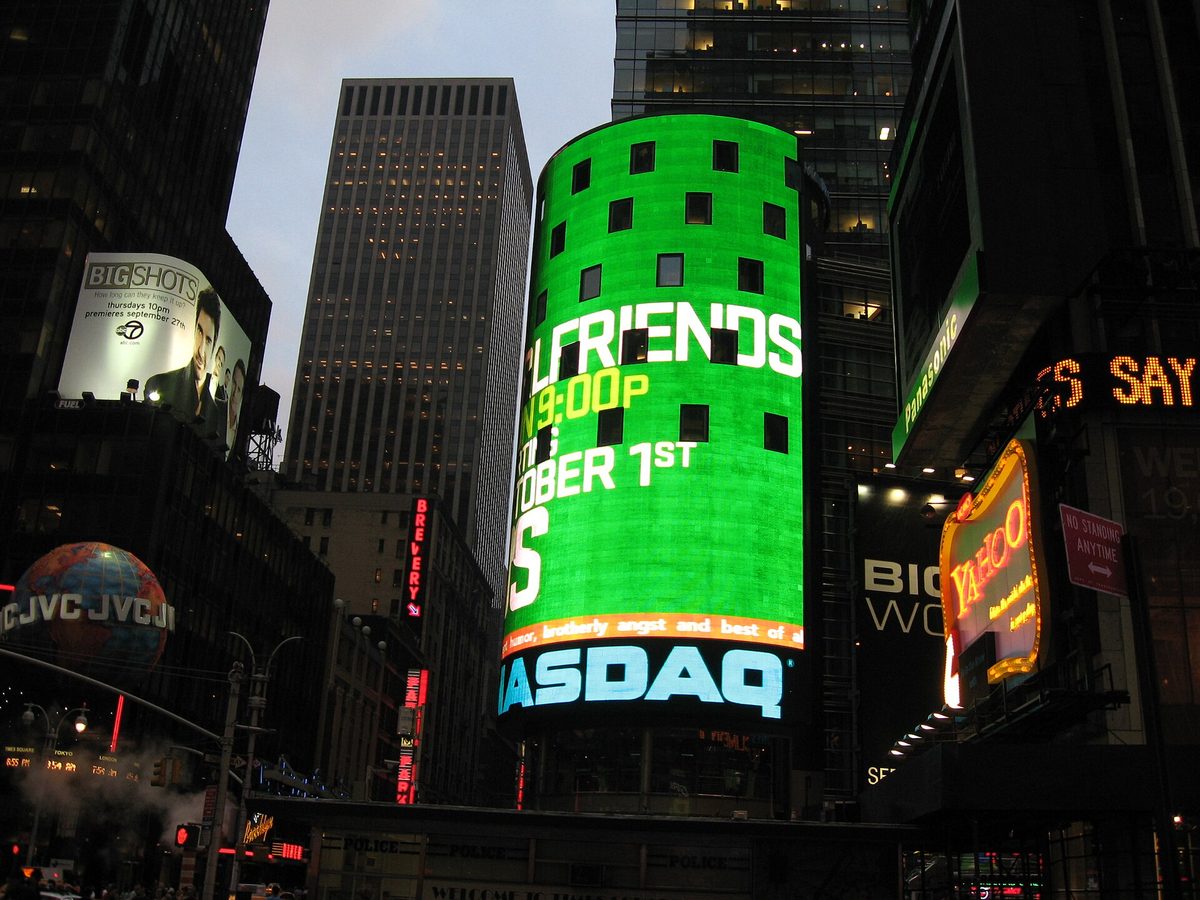
Friday, March 10, 2000. The Nasdaq Composite closed at 5,048.62, its highest close in history.[1]
Less than five years earlier, the index had been hovering around 1,000. It first closed above 1,000 in July 1995; in under five years it had risen fivefold, including an 85.6% jump in 1999 alone.[1] As the closing bell rang that day, nobody on the trading floor felt they were standing on a cliff edge. Everyone felt they were standing inside the future.
The cliff was right under their feet. Two and a half years later, on October 9, 2002, the Nasdaq closed at 1,114.11 — down 77.9% from the peak, nearly four-fifths of its value gone.[1] It would not close above the March 2000 high again until April 23, 2015 — a full 15 years later.[1]
This book is about how those 15 years began. Not the story of an index curve, but of how a group of clever people came to believe, together, in something that had not happened yet — and how that belief turned on them.
Chapter OneAugust 9, 1995: A Browser Goes Public
It all started with a company that sold a web browser. On August 9, 1995, Netscape Communications went public. The offer price had been set at $14, then doubled to $28 at the last minute; the stock opened at $71 and closed at $58.25, giving the company a market value of $2.9 billion.[2] It was sixteen months old, had never made a profit, and gave its browser away essentially for free.
Navigator’s power lay not in how many copies it sold, but in turning the internet from an engineers’ tool into something ordinary people opened every day. Before it, going online required technical skill; after it, anyone who could click a mouse could do it. That is why Wall Street was willing to pay a fortune for it: Navigator was not selling software, it was selling the doorway — and whoever controlled the doorway controlled every business not yet born.[2]
The lesson Wall Street took from that day was not “the browser will change the world.” It was “as long as the story is new enough, profits can wait.” From then on, going public no longer required a record of making money — only a future people could believe in. Venture capital flooded in, toward any company with “.com” after its name.
The logic was not entirely crazy at first. The internet was real, computers were getting cheaper, and more people were going online every month. The crazy part came later: once everyone agreed the future belonged to the internet, the question was no longer “will it come,” but “how much is it worth paying today.” The market spent five years giving that question an absurd answer.
Chapter TwoIrrational Exuberance
On December 5, 1996, Federal Reserve Chairman Alan Greenspan posed a question in a speech: “But how do we know when irrational exuberance has unduly escalated asset values?”[3] The next day, the Tokyo market fell 3%, and markets around the world wobbled. But the wobble lasted only a few days. The party went on.
He had asked the right question — just too early. After the speech, the index kept climbing for more than three more years before it peaked.[1] The warning failed not because nobody heard it, but because halfway through a party, nobody wants to be the first to leave. The first one out looks like a fool; everyone who stays is making money — on paper, at least.
By 1999, the very method of valuation had been rewritten. Price-to-earnings ratios were old-fashioned. The new metrics were click-through rates, eyeballs, membership growth, market share. Sometimes a company that lost more money was admired more, because its losses were read as “grabbing territory.” The more ornate the analysts’ language, the less anyone needed to read a financial statement.[8]
The most fashionable phrase of the time was the “new economy”: the internet had made the business cycle obsolete, and the old methods of valuation obsolete with it. Since the future was bound to belong to the internet, any price paid today was reasonable — because you were not buying today’s profits, but the whole of the future. The most dangerous thing about this argument was that half of it was true. The internet really did change everything. Only the “any price is reasonable” half was wrong.[8]
The cost of money helped too. Between June 1999 and May 2000, the Federal Reserve raised rates six times, lifting the federal funds rate from 4.75% to 6.5%.[9] But the hikes did nothing to cool the fever: from the first hike in June 1999 to the end of that year, the Nasdaq rose more than 50%.[9] When everyone believes prices can only go up, interest rates are just background music.
That is the most stubborn feature of a bubble: it does not need everyone to be mad. It only needs everyone to believe that someone else will be madder.
Chapter ThreeThe Art of Burning Money
On March 20, 2000 — ten days after the Nasdaq’s record high — Barron’s ran a cover story called “Burning Up.” Its reporters examined 207 internet companies and calculated their burn rates. The conclusion: nearly half of them had only enough cash to survive one more year.[5] The question was never whether these companies would make money. It was how much longer they could stay alive.
No company embodied the era better than Pets.com. Founded in August 1998, it sold cat and dog food and pet supplies — the most ordinary business in the world.[4] Amazon held a majority stake, venture capitalists lined up to fund it, and its sock-puppet mascot starred in a Super Bowl ad, famous enough to appear in the Macy’s Thanksgiving Day Parade.[4]
Pets.com went public in February 2000 at $11 a share.[4] But the books never added up: from February to September 1999, revenue was just $619,000, while advertising alone cost $11.8 million.[4] Delivering a bag of dog food often cost more in shipping than the food itself. Every new customer made the company lose a little more. The bigger it grew, the faster it bled.
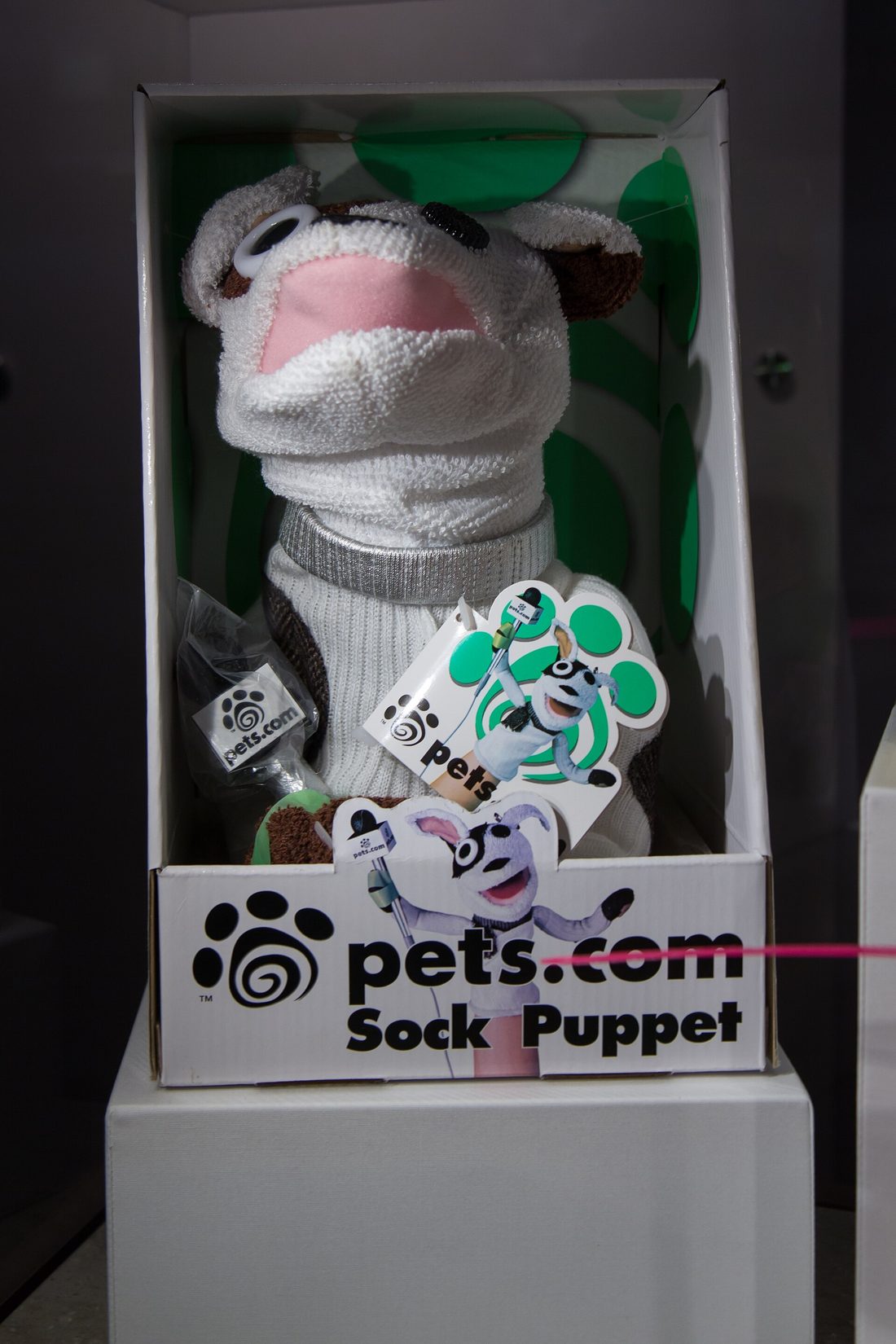
On November 6, 2000, Pets.com announced it was closing. The stock stood at $0.19 that day. From IPO to liquidation took just 268 days; some $300 million of investment vanished, and hundreds of employees lost their jobs overnight.[4] The sock puppet was later bought by another company and went on making ads. The puppet was fine. The shareholders were not.
Pets.com was not an isolated case — only the most famous one. Most of the 207 companies in the Barron’s survey were answering the same question: when the next round of funding stops coming, who runs out of air first? The answers came one by one over the next two years.[5]
Chapter FourHalved, Then Halved Again
After the peak, the index did not crash all at once. It leaked, a little lower each month. By the end of 2000, the Nasdaq closed at 2,470.52 — more than half its value gone within a year.[1] Many thought it was a correction, a chance to buy cheap. They did not know the real bottom was still two years away.
Behind the numbers on the screen were real lives. People put off retirement as their savings shrank; engineers holding stock options found themselves back where they started overnight; young founders watched the lights go out in their offices one by one. The cruelest thing about a bubble is not that it makes people lose money. It is that it first convinces them losing money is impossible.
Once the money stopped, the fall found its own momentum: investors who had bought on margin were forced to sell, selling pushed prices down, and falling prices forced more selling. This loop needs no villain to run. It only needs everyone to discover, at the same time, that the exit is narrower than they thought.[8]
In March 2001, the American economy officially entered a recession that lasted until November.[10] The recession itself lasted only eight months, but winter for technology stocks lasted far longer. On October 9, 2002, the Nasdaq closed at 1,114.11, down 77.9% from its peak.[1]
The bubble was not America’s alone. In the same period, Taiwan’s TAIEX fell from 10,202 to 3,446 points, a drop of 66.2% that took 17.3 years to recover.[11] Different markets, the same play: believe first, chase prices later, and pay the tuition together.
Chapter FiveThe One That Almost Died
Not everyone died. Amazon nearly died in the same crash — and then survived. The way it survived deserves a closer look than its stock price.
The market’s judgment looked reasonable: the company had never made a profit, its peers were collapsing one after another, and even Pets.com, a company it had invested in, had shut its doors. The one difference was that Amazon had raised $672 million in convertible bonds in early 2000, before the funding window slammed shut.[6] That money became its lifeline.
Its stock fell harder than its peers’. Amazon’s shares peaked at $113 in the fourth quarter of 1999 and bottomed at $5.97 in the third quarter of 2001; from the December 1999 high to the September 2001 low, the fall was about 94%.[7] In 2000 alone, the stock fell 79.6%.[7] Jeff Bezos opened his 2000 shareholder letter with a single word: “Ouch.” By the time he wrote it, he said, the shares were down more than 80% from a year earlier.[6]
But while the stock lost 94%, the business did not disappear. Books were still selling, customers were still coming, and the warehouses and logistics kept running. In the fourth quarter of 2001, Amazon reported its first quarterly profit: $5 million on $1.1 billion in revenue.[7] Five million dollars is tiny, almost negligible. But it proved one thing: the model could make money — it just needed time.
The difference between Amazon and Pets.com was not whose story was more moving. It was whose books could hold out until the day cash flow turned positive. A bubble never tests a vision. It tests how long the runway is.
Chapter SixWhat Grew Out of the Ruins
After the bubble burst, the internet did not disappear. Quite the opposite: what the bubble left behind turned out to be more durable than the bubble itself. The infrastructure built in the mania, the software written, the people trained — all of it stayed. Prices collapsed. The construction remained.[8]
What survived was not only hardware, but a tested way of doing business: get the product into customers’ hands first, and learn to make money slowly; keep the users first, and figure out how to charge later. E-commerce, search advertising, online payment — the models that look obvious today were all given their shape in that fire.
In 2000, a small company was quietly doing one unglamorous thing: ranking search results better than anyone else. Google had been founded in 1998, and by 2000 its index already covered more than one billion web pages, making it the world’s largest search engine, handling 18 million searches a day.[12] It bought no Super Bowl ads, kept no puppet, and had no first-day pop. It just kept doing the same thing better.
That is the bubble’s strangest legacy: the loudest companies died fastest, and the quietest lived longest. In 2000, the market paid a fortune for the claim that “the internet will change the world.” The claim itself was true. What was wrong was the price tag — and the timetable. The future really did arrive. It just did not arrive on that day’s price list.
EpilogueThe Bubble Was Not Wasted
Twenty-six years on, the dot-com bubble looks like a mirror. It reflects not one year or one market, but a fixed loop in human nature: first a genuinely new thing appears, then a genuinely good story, then the story grows faster than the thing, and finally the price grows faster than the story. By the time someone asks “what is this actually worth,” the party is already over.
Institutions pushed it along. Venture capital needed exits, investment banks needed underwriting, analysts needed stories, the media needed headlines, and ordinary investors needed a fortune. Nobody in the chain had to believe in the bubble. They only had to believe the next person would take it off their hands. The faster the chain spun, the fewer people stopped to ask: how does this company make money? How long will its cash last? If nobody is willing to fund it tomorrow, what is it worth?
Those questions sounded tedious in 2000, and they still sound tedious today. But they are the only way to tell a party from construction. A party asks “how much higher will it go.” Construction asks “will it still be here when nobody is watching.” The Pets.com puppet is still making ads. Amazon’s warehouses are still shipping. Google’s search box is still waiting for the next question. In the end, time never keeps the one that rose fastest. It keeps the one that lasted longest.
Every generation gets its own 2000. The names change, the technology changes, even the boards on the exchange change — but the loop does not: a new thing appears, a good story appears, the story runs faster than the thing, and the price runs faster than the story. Understanding 2000 is not about laughing at the people who were there. It is about asking, the next time someone says “this time is different”: different how — and worth how much?
The bubble was not wasted. It taught the market, at the cost of a 77.9% collapse, one thing: the future will come — just not on your price list.[1]