PrologueThe City That Lived 1,123 Years
On the morning of Tuesday, 29 May 1453, Constantinople fell. Counting from its founding as an imperial capital in 330, the city had lived 1,123 years. It was the eastern capital of the Roman Empire, the heart of the Byzantine Empire, the largest city in Christendom. It had turned back Arabs, Bulgars, and Rus' siege after siege, and held for a thousand years — then fell in 53 days.
After that day, the Byzantine Empire was gone. The oldest empire of the Middle Ages went out on a Tuesday morning, and the sultan who took it was only 21. This book is not only about a siege. It is about why a city could live 1,123 years, and why it could not live past 1453; about how gunpowder rewrote the rules of war; and about a group of scholars who fled with their manuscripts and carried an empire's legacy into the next age.
Chapter OneThe Thousand-Year City
Constantinople did not begin in 330. It began earlier, as Byzantium. Around 658 BC, colonists from the Greek city of Megara built a town on the Bosporus, on a site almost unfairly well chosen: Europe on one side, Asia on the other; the Black Sea one way, the Mediterranean the other; water on three sides, land on only one. In 324, the Roman emperor Constantine the Great chose the site for a new capital, and on 11 May 330 it was formally dedicated as Constantinople — the City of Constantine, a "New Rome."
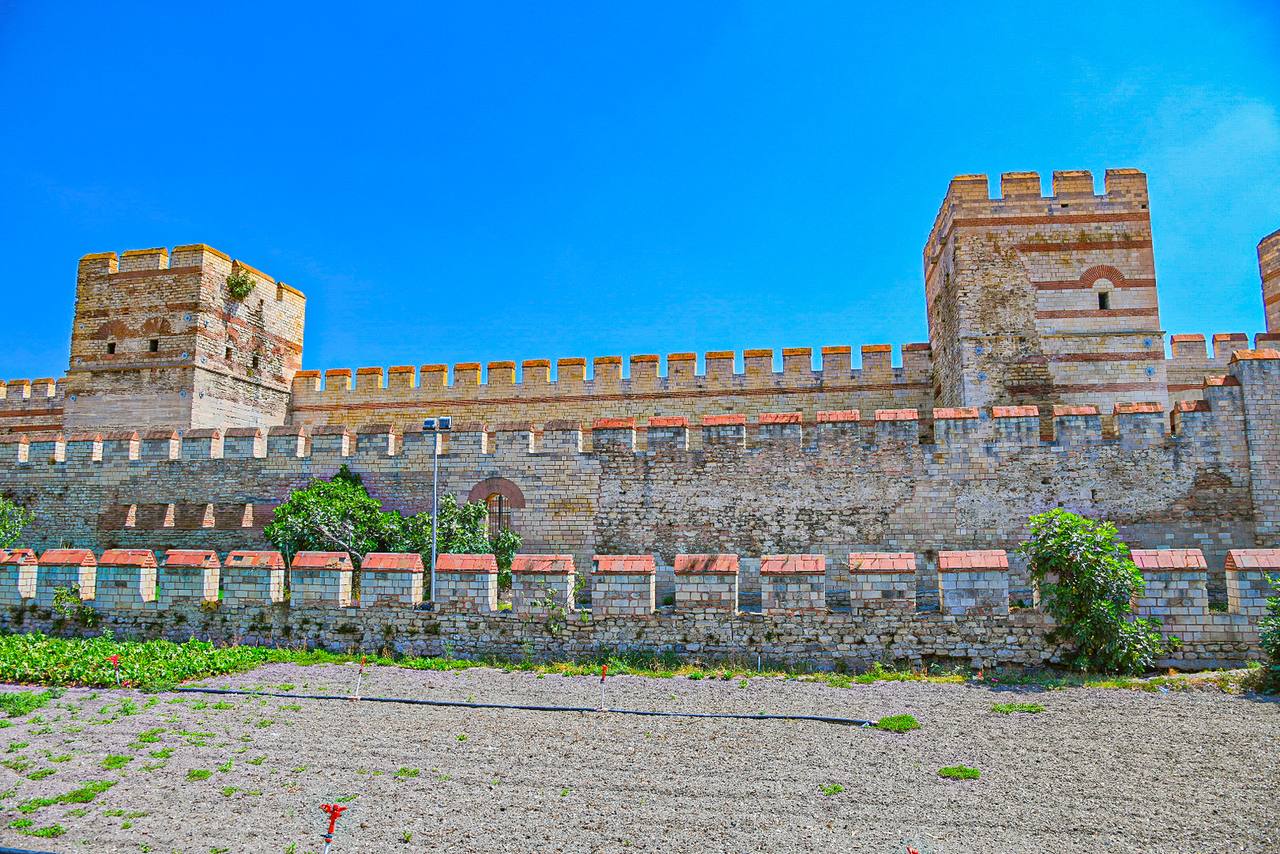
What kept the city alive was a wall. Under Theodosius II, the empire began work around 404 and finished in 413 on a double land wall: an outer wall, an inner wall, and a moat between them and the open ground. The inner wall ran 5.65 kilometres, stood 96 towers, and rose to about 12 metres at its highest. From the 5th century to the 15th, it guarded Constantinople for nearly a thousand years. Two great Arab sieges, Bulgars, Rus', Seljuks — all of them broke against it.
Inside the walls stood the most splendid city in Christendom. Justinian I built the Hagia Sophia between 532 and 537; it was consecrated on 27 December 537, its dome 31 metres across, the largest interior space in the world at the time. At the empire's height, about 400,000 people lived in the city, and its markets held Chinese silk, Indian spices, and northern furs.
But 1204 changed everything. The Fourth Crusade never reached the infidel; instead it sacked Constantinople, carrying off gold, relics, and manuscripts, and stripping the city of much of its wealth. Byzantium retook the capital in 1261, but it never recovered. By the middle of the 15th century, the population had fallen to between 40,000 and 50,000, and the empire's territory was down to Constantinople itself, the Morea in the Peloponnese, and a few Aegean islands. An empire a thousand years old had shrunk to a single city.
Chapter TwoThe Twenty-One-Year-Old Sultan
In 1451, Sultan Murad II of the Ottoman Empire died, and his 19-year-old son Mehmed II took the throne. The young man had a single ambition from childhood: to take Constantinople. His grandfather and his father had both besieged the city and failed. He understood that the problem was not the army. It was the walls.
Mehmed was born on 30 March 1432 in Edirne, the old Ottoman capital. He spoke several languages and had read the lives of Alexander and Caesar. In his second year on the throne, in 1452, he built a fortress, Rumeli Hisarı, on the European shore of the Bosporus at its narrowest point, choking off the city's Black Sea supply line. Everyone in the city understood: this was not a threat. It was the last step before war.
The city had a new emperor, too. Constantine XI was crowned in January 1449 at Mystras in the Peloponnese — not in the Hagia Sophia, because many in the city opposed his support for reuniting the Eastern and Western churches. He was the empire's last emperor, inheriting an empire that was now only its capital. He begged Western Europe for help. The pope promised ships; Venice and Genoa stalled. In the end, the only man who truly came was the Genoese commander Giovanni Giustiniani: on 29 January 1453 he arrived with 700 soldiers he had raised himself, and the emperor gave him command of the land walls.
Chapter ThreeCannon Against Walls
Mehmed's answer was a cannon. The Hungarian founder Urban had first offered his great gun to Constantine XI, who could not pay for it, so he went over to the sultan. At Edirne he cast a bronze monster 8.2 metres long, called the Basilica: a single stone ball weighed 270 kilograms and could be thrown more than 1.6 kilometres. According to the historian Gibbon, moving the gun from Edirne to the walls took 60 oxen and hundreds of men. The Encyclopaedia Britannica counts 69 guns in the Ottoman siege lines.
On 6 April 1453 the guns opened fire, and the siege began. Modern historians put the Ottoman army at about 60,000 to 80,000 men. Inside the city, the emperor's secretary Sphrantzes counted the men able to bear arms: 4,773 Greeks and about 200 foreigners, plus Giustiniani's Genoese, the Venetians, and volunteers — roughly 7,000 to 8,000 defenders in all. The land walls alone ran 6.5 kilometres, which meant each defender was responsible for nearly a metre of wall, before any rotation for rest, and before the sea walls along the Golden Horn.
The guns fired every day, and the walls broke every day. By night, defenders patched the breaches with timber, earth, and rubble. Giustiniani organized the whole population into night repair crews — women, monks, craftsmen, all up on the walls. For 53 days the walls fell and rose, rose and fell. Gunpowder made a wall that had stood for a thousand years breakable for the first time — not in a day, but inch by inch, over 53 days.
Chapter FourShips Over Land
Beyond the land walls there was another line of defence: a great iron chain across the mouth of the Golden Horn, guarded behind it by 26 Byzantine and Italian ships. The Ottoman fleet could not get in. On 20 April, four Christian ships — three Genoese vessels and one Byzantine grain transport — fought their way through the blockade and into the harbour in full view of both armies, and the Ottoman admiral lost his command for it.
Mehmed's reply became the most famous episode of the siege. Before 22 April, he laid a track of greased logs over the hills behind Galata and hauled some 70 ships, set on rollers and carts, overland from the Bosporus down into the Golden Horn. The chroniclers differ slightly — 67 to 72 ships — but the result was the same. In a single night the chain was made useless: the enemy's ships were already inside the harbour, and the defenders had to pull men off the land walls to guard the sea walls along the Horn. The 6.5 kilometres of defences grew thinner still.
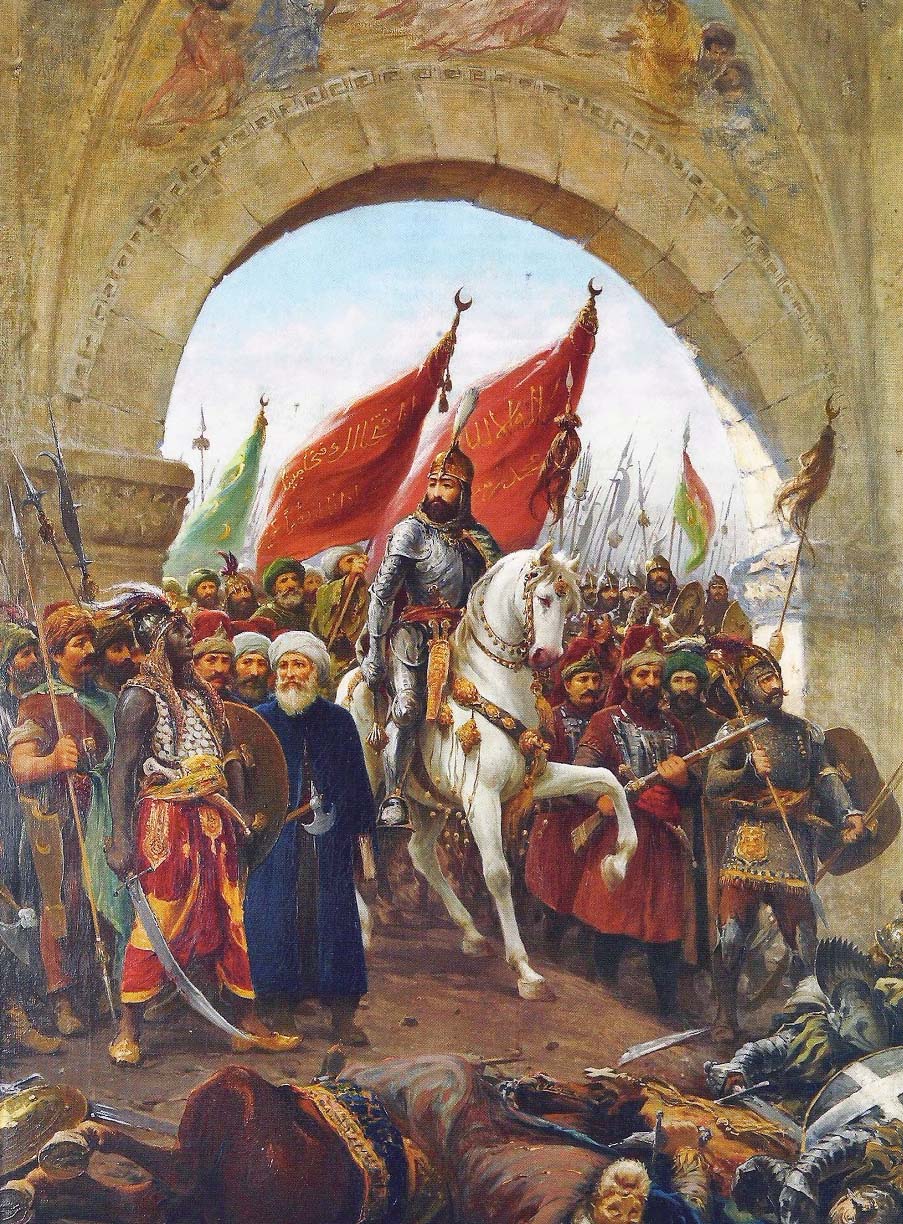
On the night of 28 May, the Hagia Sophia held its last service. The church was packed — the emperor, soldiers, monks, and ordinary people praying together. Hours later, at 1:30 in the morning of 29 May, the final assault began. The Ottomans attacked in three waves: first the irregulars, then the regular troops of Anatolia, and finally the elite Janissaries. As the Janissaries fought up onto the breach, Giustiniani was wounded and carried from the walls, the Genoese wavered, and the gap could no longer be closed.
Constantine XI did not run. By the accounts we have, he cast aside his imperial robes, took up his sword, and charged into the melee, and was never seen again; his body was never certainly identified. Before morning, Constantinople had fallen. Mehmed allowed his army three days of pillage, and by the accounts, between 30,000 and 50,000 residents were carried off and sold into slavery. An empire of 1,123 years ended on a Tuesday morning.
Chapter FiveThe Manuscripts Flee West
The city fell, but not everything in it was destroyed. Before, during, and after the siege, Greek scholars fled to Italy, one group after another, carrying manuscripts. What they carried was not gold or silver. It was Plato, Aristotle, Homer, Ptolemy — Greek texts in the original that Western Europe had not read for centuries.
This westward movement did not begin in 1453. As early as the winter of 1397, the Byzantine scholar Manuel Chrysoloras had come to Florence at the city's invitation to teach Greek, and his pupils included Leonardo Bruni and Guarino da Verona, later among the great humanists. Bruni recalled afterwards that no one in Italy had studied Greek for 700 years. The fall of 1453 took a river that had been flowing for half a century and turned it into a flood.
The most famous figure in that flood was Bessarion. Born in 1403 in Trebizond, on the Black Sea, he travelled to Italy with the emperor in 1437 and stayed, eventually becoming a cardinal. He spent his life collecting Greek manuscripts, and in 1468 he gave 752 of them — 482 in Greek, 264 in Latin — to the Republic of Venice, where they became the core of the Library of St Mark. One empire's library went on living inside another country's library.
The timing is the strangest part. In the same decade that Constantinople fell, Johannes Gutenberg in Mainz printed the first Bible from movable type: finished on 23 February 1455, in an edition of 180 copies, of which 49 survive today and only 20 are complete. Fleeing manuscripts met the printing press, and Greek literature could be copied in bulk and spread quickly for the first time. The end of an empire and the beginning of a revolution in knowledge fell in the same decade.
EpilogueThe City Still Stands
On 29 May 1453, the same day the city fell, Mehmed II entered the Hagia Sophia and ordered it converted into a mosque; on 1 June the first Friday prayers were held there. Constantinople became the new capital of the Ottoman Empire, which moved there from Edirne and stayed for 469 years, until the empire dissolved in 1922. In 1930 the city was formally renamed Istanbul, the name it still bears.
Later historians often call 1453 the end of the Middle Ages. The label is, of course, a convenience invented afterwards — the Middle Ages did not end in a day. But 1453 really was the close of an age: the last continuation of the Roman Empire went out, gunpowder rewrote war, Greek learning returned to Western Europe, and the printing press was changing what knowledge could be.
Go to Istanbul today, and the Theodosian Walls still stand where they stood, and the Hagia Sophia still stands where it stood. A city has changed its name, its rulers, and its faith, but its geography has never moved: the Bosporus is still the same strait, and Europe and Asia still face each other across it. The empire of 1,123 years is dead. The city it built, the books it wrote, and the learning it left behind are still here.