PrologueThe Day of the 0–4
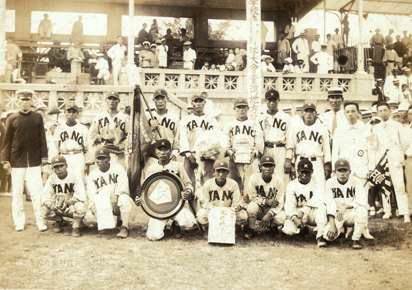
21 August 1931, Koshien Stadium, Hyogo, Japan. The final out is recorded, and the scoreboard stops at 0–4. On the losing side stands a group of Taiwanese high school boys — KANO stitched across their chests, Han Chinese, indigenous Taiwanese and Japanese players on the same team, their ace pitcher with the skin worn off his fingers after four straight games, unable to throw with his usual speed any more.
They lost the final and won the applause of all Japan. The next day, the celebrated writer Kikuchi Kan praised the team from the colony in the Osaka Asahi Shimbun. A team that had never won anything made an entire empire look at Taiwan differently, in a single summer.
Chapter OneA Team That Had Never Won
The Kagi Agriculture and Forestry School was founded in 1919 by the Japanese colonial government in Taiwan; it is the predecessor of today's National Chiayi University. Its baseball team was formed in 1928, and for its first few years it hardly won a game.[1]
The turning point was one man. Kondō Hyōtarō, born in Matsuyama, Shikoku, in 1888, had joined the fledgling baseball team at Matsuyama Commercial School as a student and later coached the school, taking it to Koshien six times. In 1931, he took over Kano. His training was famously severe — running, fielding, pitching, practised until dark. But the more important thing he did was to make a group of boys who distrusted each other believe they could be one team.
In the summer of 1931, Kano travelled to Taipei for the island-wide tournament for the first time, reached the final, and beat the perennial champions Taipei Commercial — a team made up of Japanese players — to take the Taiwan championship. It broke a 12-year northern monopoly on the title. Taiwanese baseball had a saying, "the championship banner never crosses the Zhuoshui River", meaning the title never went to the central or southern part of the island. Kano broke it.[1]
Incidentally, the name "KANO" comes from the first two letters of the Japanese words for Kagi (Chiayi) and Norin (agriculture and forestry). A school abbreviation later became shorthand for an entire island.[6]
Chapter TwoThree Peoples, One Uniform
What made Kano special was not skill but composition. Of the starting nine in 1931, two were Han Chinese, four were indigenous Taiwanese, and three were Japanese.[4] In colonial Taiwan, these three groups lived in different worlds: the Japanese ruled, the Han Chinese formed the ruled majority, and the indigenous peoples lived in the mountains, called "savages". On the field, they wore the same uniform and carried wins and losses together.
The timing is worth pausing over. Less than a year earlier, in October 1930, the Musha Incident had erupted: Seediq indigenous people rose against Japanese rule, and the Japanese military and police crushed the uprising, killing nearly a thousand people. It was a bloody ethnic conflict. Less than a year later, four indigenous boys in Kano uniforms stood at Koshien with their Japanese teammates, and all of Taiwan — regardless of ethnicity — cheered for them.
Baseball came to Taiwan with the Japanese, and by the 1930s it had taken root across the island. The colonisers introduced it to civilise and assimilate — to teach the colonised Japanese discipline and spirit. But Kano's story shows something else: what the colonised learn is not always used the way the coloniser intended. One uniform can become the place where an island proves itself.
Chapter ThreeThe Summer at Koshien
Koshien — the National Secondary School Baseball Championship — is the highest stage of Japanese high school baseball, held since 1915. Before the war, champions from Taiwan, Korea and Manchuria could also enter. The 1931 summer tournament was the 17th, with 23 teams.[6]
Kano sailed from Keelung to Japan and stepped onto Koshien's soil for the first time. They beat Kanagawa Shoko 3–0 in the opener, then kept winning against Sapporo Commercial and Kokura Technical, all the way to the final. At first the Japanese press treated them as a curiosity — a team from the colony, barely fluent in Japanese, somehow keeps winning. By the end, the Koshien crowds were cheering for them.
The ace pitcher Wu Ming-chieh was the team's backbone. From the Taiwan tournament through Koshien, he pitched four straight games; his fingers were worn raw, his nails peeling off. On the day of the final he took the mound injured, his pitches no longer carrying their usual power. His teammates shouted to him: "Throw it straight — we'll handle the defence!" He gritted his teeth and finished the game. The final score was 0–4 against Chukyo Commercial of Aichi — a team that went on to win three straight titles from 1931 to 1933, the only such record in Koshien history.[1]
They lost the final but gained something larger than a trophy. Kikuchi Kan wrote in the next day's Osaka Asahi Shimbun that the team's fighting spirit was a lesson for all Japan. Japanese baseball gave them a title: "Tenka Kanō" — under heaven, Kano is the strongest.
Reports at the time put the crowd at some 55,000. In the Koshien stands, many were watching a Taiwanese team play for the first time; when the game ended, the applause went to the runners-up as well as the champions.[5]
Chapter FourThe Final They Lost, the Things They Won
If Kano's story had ended with the 1931 runners-up finish, it would be just a pleasant sports anecdote. It did not end there. Kano reached Koshien four more times, five appearances in total before the war (once in spring, four times in summer), and became a recognised powerhouse in Japanese baseball.[2] Its players went on to professional careers in Japan: Wu Bo (Go Shōsei) became a star in Japanese professional baseball and was inducted into the Japanese Baseball Hall of Fame; he played in three summer Koshien tournaments and one spring tournament, all under Coach Kondō.[3]
The deeper impact was inside Taiwan. After 1931, baseball in Taiwan was no longer just the Japanese people's sport — it became the Taiwanese people's sport. Kano proved something: within the colonial system, Taiwanese could stand as equals with Japanese on a level field — a field with no privilege, only rules — and even beat them. For a colonised island, that experience carried more force than any political speech.
But history has another side. When the players returned to Taiwan, the whole island cheered them — yet the world they lived in had not changed: Taiwanese could not enter Japanese-dominated institutions, and education and employment had ceilings everywhere. Equality on the field did not become equality off it. That is precisely why Kano's story moves people: it is true, and it is limited. One ball game can be won, but a system does not fall because of one ball game.
In 1933, Kano won the Taiwan championship again, and the streets of Chiayi were decorated with flags as the whole city turned out to celebrate the team's departure. Photographs of the scene show a high school baseball team's send-off become a city festival.[1]
Chapter FiveFrom Kano to Kano
After the war, the Kano baseball team's name faded. The school was reorganised, the team disbanded, and the summer of 1931 became a legend told by older fans. It was not until 2014, when the film Kano — produced by Wei Te-sheng and directed by Umin Boya — brought the story to the big screen, that Kano returned to the eyes of all Taiwan.[5]
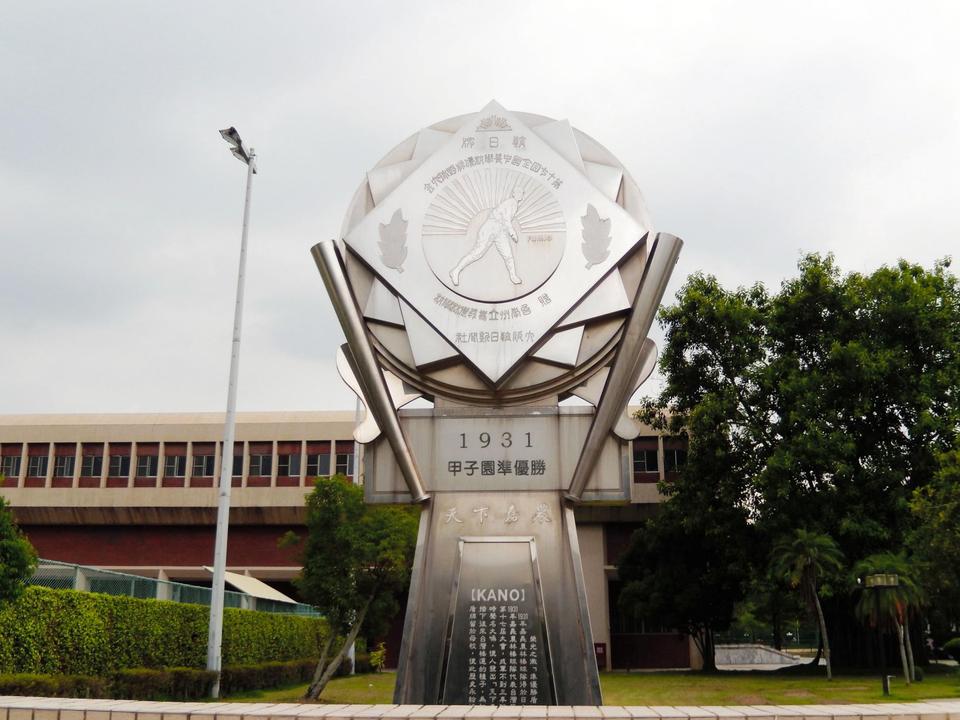
Walk into the National Chiayi University campus today and you will find a stainless-steel monument: two crossed bats framing a baseball, engraved with "1931 Koshien Runners-up", "Tenka Kanō" and "KANO". The monument was raised by later generations; the players of 1931 never imagined being commemorated. They only wanted to win the next game.
In the year the film came out, Taiwanese baseball had already travelled more than a century: the Red Leaf Little League's win over a visiting Japanese team in 1968, the Golden Dragon's world title in 1969, professional baseball in the 1990s, and the Premier 12 championship in 2024. Kano stands at the head of that long river — the first proof that Taiwanese baseball could play in front of the world.
The runners-up shield from 1931 was lost in the chaos of war. A replica was later made, and in 1996 the former player Su Cheng-sheng personally returned it to the school for safekeeping. A shield took 65 years to come home — Kano's story came home the same way.[2]
EpilogueWhy We Still Tell This Story
Kano never won a championship. That is the most honest — and most powerful — part of this story. Had they won the final, it would be a perfect fairy tale; they lost, and the story became real: about a group of boys who, in an unfair world, used one fair game to win a breath of dignity for an island.
Sports history is full of champions, most of them forgotten. People remember Kano not because they won, but because they lost beautifully — and after they lost, the whole island felt it had won something. That year, for the first time on a national stage, Taiwan was not displayed as a colony but respected as a competitor.
More than 90 years have passed since the summer of 1931. Koshien's dirt has been replaced countless times, but Kano's story is still being told. Every generation of Taiwanese retells it, each in its own way: some tell it as ethnic harmony, some as colonial resistance, some as pure baseball. But the core has never changed — a team that had never won, daring to believe it could. The answer is: believe first, and only then is it possible. And belief itself was the most important lesson an island learned in the summer of 1931.