PrologueAn Opening Line That Fooled Readers for Nearly 300 Years
"The empire, long divided, must unite; long united, must divide." Almost every Chinese reader can recite this sentence, and almost all of them believe it is the first line of Romance of the Three Kingdoms, written by Luo Guanzhong. It is not. The line was added by a father and son in the early Qing dynasty, nearly 300 years after Luo.[4] The book's opening was not written by its author, and even its title, Romance of the Three Kingdoms, was not its original name — the whole book is a 500-year collective creation. That is exactly why it deserves a book of its own: how does a novel grow from one person's manuscript into the shared memory of a people?
Its original title was Sanguozhi Tongsu Yanyi — The Popular Elaboration of the Records of the Three Kingdoms. The word yanyi, "elaboration," says everything about its method: it takes the records in Chen Shou's official history and "elaborates" them in plain language — into plot, into human motive, into a hundred years of war made up of particular people. This article is not a history of the Three Kingdoms. It is the history of a book: how it was written, rewritten, translated, and finally turned into a language every Chinese person shares.
Chapter OneThe Story Is 1,000 Years Older Than the Novel
The stories of the Three Kingdoms had already circulated among ordinary people for 1,000 years before Luo Guanzhong picked up his brush. Chen Shou composed the Records of the Three Kingdoms in the early Western Jin, a biographical history that records events briefly, in outline only; in the early 5th century, Pei Songzhi was ordered to annotate it, drawing on many other accounts, and his commentary ran to three times the length of the original text.[1] Beyond the histories, the storytellers took over. Meng Yuanlao's Dongjing Meng Hua Lu records that in the entertainment quarters of Kaifeng, performers specialised in "telling the Three Kingdoms"; under the Jin and Yuan dynasties, more than 30 plays were staged on Three Kingdoms themes.[5]
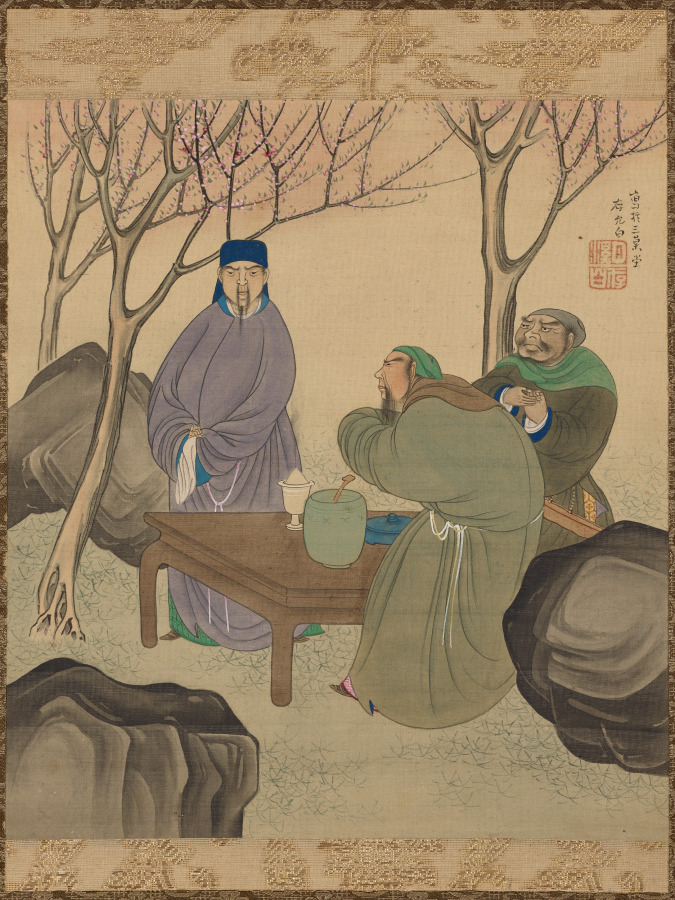
In the Zhizhi era of the Yuan dynasty (1321–1323), the Yu family of Jian'an printed the Complete Illustrated Plain Tale of the Three Kingdoms, the earliest surviving plain tale on the subject: about 80,000 characters in three volumes, now held in the Cabinet Library of Japan.[2] The plain tale opens with a tale of karmic retribution: in the underworld, the judge Sima Zhongxiang decrees that Han Xin will be reborn as Cao Cao, Peng Yue as Liu Bei, and Ying Bu as Sun Quan — the grudges of the Three Kingdoms were written in a previous life. In the plain tale, Liu, Guan, and Zhang even become bandits on Mount Taihang for a time, an episode Luo later discarded. But the plain tale already had the skeleton of the Romance: it opens with the oath in the peach garden and closes with Zhuge Liang's death, with a century of war in between. Luo Guanzhong did not invent from nothing; he gathered, selected, and shaped 1,000 years of fragments into a single book.
This is often underestimated. A great novel rarely starts from zero; it is more like the lower reaches of a river. Upstream, the water has already flowed for 1,000 years — the storytellers' mouths, the gongs and drums of the stage, the illustrations in the plain tales were all testing the material. Luo stood downstream and gathered the water into a single channel. Without those 1,000 years, there would be no Romance of the Three Kingdoms; without the Romance, those 1,000 years would have remained scattered sand.
Chapter TwoThe Birth of a Book
Luo Guanzhong — given name Ben, courtesy name Guanzhong, sobriquet "the Recluse of Lakes and Seas" — was a native of Taiyuan in Shanxi, living roughly from 1330 to 1400.[5] Almost nothing about his life survives in the official histories; nearly all we know comes from his own books and later accounts. He composed his work in the Hongwu era, at the turn of the Ming — an old dynasty had just fallen and a new one had not yet found its footing. The man who wrote about chaos lived in chaos himself.
The earliest surviving printed edition is the Sanguozhi Tongsu Yanyi, printed in the first year of the Jiajing era (1522), inscribed "The history of Chen Shou, Marquis of Pingyang of Jin; edited and arranged by the later student Luo Guanzhong." In 24 volumes and 240 sections, it is the ancestor of every later edition — and the name "Luo Guanzhong" itself comes from this inscription.[3] The book runs from the Yellow Turban Rebellion of 184 to the Jin conquest of Wu in 280, nearly a century of history.[3] Later readers often describe it as "70 percent fact, 30 percent fiction," but scholars warn that the relation between fact and invention cannot be summed up in a single phrase.[5] The real balance lies in the details: the skeleton of great events mostly rests on the histories; the flesh is mostly the novelist's work.
The Jiajing edition's language is plain, its chapter titles single seven-character lines, and it still carries the storyteller's tone. It was not a book written for scholars' desks, but for marketplaces, teahouses, and people who could barely read yet loved a good story. That starting point decided its fate for the next 500 years: it was never a classic for the few; from birth, it belonged to the many.
Chapter ThreeThe Border Between True and Invented: Red Cliffs
Winter, 208, at Red Cliffs. Cao Cao wrote to Sun Quan claiming, "I now command 800,000 naval troops, and propose to go hunting with you in Wu" — 800,000 was intimidation, not a headcount. Zhou Yu's estimate was a little over 200,000, including the surrendered Jingzhou troops he had just absorbed; the Sun–Liu alliance fielded about 50,000 men, 30,000 of Sun's and 20,000 of Liu's.[7] The decisive move was Huang Gai's feigned surrender and the burning of the chained ships, with Zhou Yu in overall command; disease helped too, as Cao's northern troops fell sick in large numbers in the unfamiliar southern climate.[7]
The novel makes the battle more beautiful still: Zhuge Liang borrows arrows with straw boats, summons the east wind, and Guan Yu lets Cao Cao escape at Huarong Pass — all three are inventions. The east wind is the most exquisite of them: it turns a victory won by weather, disease, and fire into a legend of one man who could read heaven, earth, and human hearts. But the novel does not invent everything. "Thrice he visited me in my thatched cottage" comes from Zhuge Liang's own Memorial on Dispatching the Troops, so the three visits have a basis in the record;[1] and the great turning points — Guan Yu's death at Maicheng in 219, Liu Bei's enthronement in 221, his defeat at Yiling in 222, his death at Baidi City in April 223, Zhuge Liang's death at Wuzhangyuan in August 234 — agree broadly with the histories.[8]
That is what yanyi truly means. History gave it a skeleton; the novel gave history flesh. What readers remember is never the balance of forces, but the river fog on the night of the east wind, and Guan Yu's moment of mercy at Huarong Pass. Numbers are forgotten. Faces are not.
Chapter FourThe Mao Rewrite — A Book Written by Two Generations
The Romance as readers know it today is in fact the recension of Mao Lun and his son Mao Zonggang, in the early Qing. Mao Lun went blind in middle age and amused himself by writing commentaries on novels, with his son as his scribe.[6] In the 1660s, father and son reorganised the Ming text into 120 chapters, cut passages praising Cao Cao's officers and generals, replaced crude verse, and trimmed the text from about 900,000 characters to about 750,000. It was published in the 18th year of Kangxi (1679), with a preface by Li Yu, under the title The First Book of Genius: The Records of the Three Kingdoms.[4][6]
That opening line — "The empire, long divided, must unite; long united, must divide" — was added by the Maos.[6] Their stance was explicit: honour Liu, denigrate Cao, and treat Shu-Han as the legitimate line. That stance was not Luo Guanzhong's invention, yet from then on it fixed the moral coordinates of the Three Kingdoms for Chinese readers: Liu Bei the benevolent lord, Cao Cao the villain, Zhuge Liang the minister who gave his all until death. For nearly 300 years after the Mao edition appeared, it was virtually the only Romance Chinese readers knew. The fate of a book sometimes rests with its last editor.
This is worth pausing over. We think we are reading Luo Guanzhong, but we are actually reading the choices Mao Lun and his son made for him: which lines to keep, which men to diminish, which sentence deserved to open the whole book. A classic is never written by one person alone; it is revised, generation after generation, by editors, commentators, and storytellers. The Mao edition was not a betrayal of the original. It was how the book stayed alive.
Chapter FiveLeaving China
Romance of the Three Kingdoms was the first of China's four great classical novels to receive a complete English translation. Its translator, Charles Henry Brewitt-Taylor (1857–1938), was a British customs official who lived in China for 40 years (1880–1920).[9] His first completed draft was burned during the Boxer Uprising; he translated the book again. In 1925, Kelly & Walsh in Shanghai published his San Kuo, or Romance of the Three Kingdoms.[9] In 1991, Moss Roberts's complete translation appeared from the University of California Press, with notes translating Mao Zonggang's commentary.[11]
From the Jiajing edition of 1522 to the English translation of 1925, the book took 400 years to leave China. Once it had left, it was no longer only a Chinese novel; it became a name no account of world literature can avoid. A British customs officer spent much of his life turning a story Chinese people told over tea into a story that could be told over tea in another language — translation at that depth is no longer carrying words across; it is writing the book again in another tongue.
EpilogueWhy We Still Read the Three Kingdoms
The novel's readers long ago ceased to be only the bookish. Its plots moved into opera, storytelling, picture books, television, and games; its language moved into everyday speech: three visits to the thatched cottage, borrowing arrows with straw boats, the empty-city stratagem, forgetting Shu in delight, giving one's all until death — when Chinese people scold, advise, or argue a point, they speak in the language of the Three Kingdoms. A people remembered its history through a book, and then learned to think about the present in that book's language.
What Luo Guanzhong actually wrote was not the Three Kingdoms at all, but every posture a person can take in a time of chaos: Liu Bei's endurance, Cao Cao's ruthlessness, Sun Quan's patience, Zhuge Liang's calculation, Guan Yu's loyalty, Zhou Yu's jealousy — everyone can find in it a self, or a self they would rather not become. Five hundred years on, the empire is still dividing and uniting. The book is still being opened, because it was never only about the past.
More remarkable still, many who have never opened the book live inside its language anyway. A person who has never read the Romance will still speak of "three visits to the thatched cottage" to describe a sincere search for talent, still knows what "the empty-city stratagem" means, and still burns incense before a statue of Guan Yu. That is the highest state a book can reach: it no longer needs to be read, because it has become the air. The story set out from the storytellers' mouths, passed through printed editions, commentaries, and translations, and finally returned to everyone's mouth — a book that finished writing itself and became a language.