PrologueThe Last Day
On an ordinary day some 66 million years ago, a rock about 10 kilometres across fell out of the sky and slammed into the shallow sea off what is now Mexico's Yucatán Peninsula. By the end of that day, some three-quarters of all species on Earth were doomed — including the dinosaurs, who had ruled the land for 165 million years. Nobody saw it happen. Humanity would have to wait another 66 million years before reading its farewell note, written in a layer of clay only a few centimetres thick.
This is not a story about dinosaurs. It is a detective story. The detectives included geologists, a physicist, oil-company prospectors and a graduate student; the clues were scattered across a gorge in Italy, a cliff in Denmark, a rock layer in Haiti, and a kilometre beneath the floor of the Gulf of Mexico. Each clue on its own looked like nothing. Together, they pointed at the same stone.
Chapter OneA Dynasty That Ruled for 165 Million Years
Dinosaurs first appeared in the late Triassic, about 230 million years ago, when the continents were still joined in the supercontinent Pangaea. They began unremarkably, as small two-legged reptiles; then a mass extinction at the end of the Triassic, 201 million years ago, cleared away many of their rivals, and the dinosaurs took over the land. From then on they ruled for some 165 million years — more than 500 times as long as humans have existed so far.[9] The long-necked giants of the Jurassic and the Tyrannosaurus and Triceratops of the Cretaceous were faces of the same dynasty at different hours.
What matters is that they did not die out because they were failing. Late Cretaceous dinosaurs were still diverse, and the fossil record shows no long decline. The day the dynasty ended came without warning — like a play that had run for 165 million years, its curtain falling suddenly, with no farewell.
Chapter TwoA Layer of Clay That Should Not Be There
In 1977, the American geologist Walter Alvarez was studying limestone in a gorge outside the town of Gubbio, Italy. He wanted to measure the end of the Cretaceous with ancient magnetism, but between a layer of Cretaceous limestone and a layer of Paleogene limestone he found a band of clay only about a centimetre thick, holding almost no fossils at all. Stranger still, the clay was loaded with iridium.
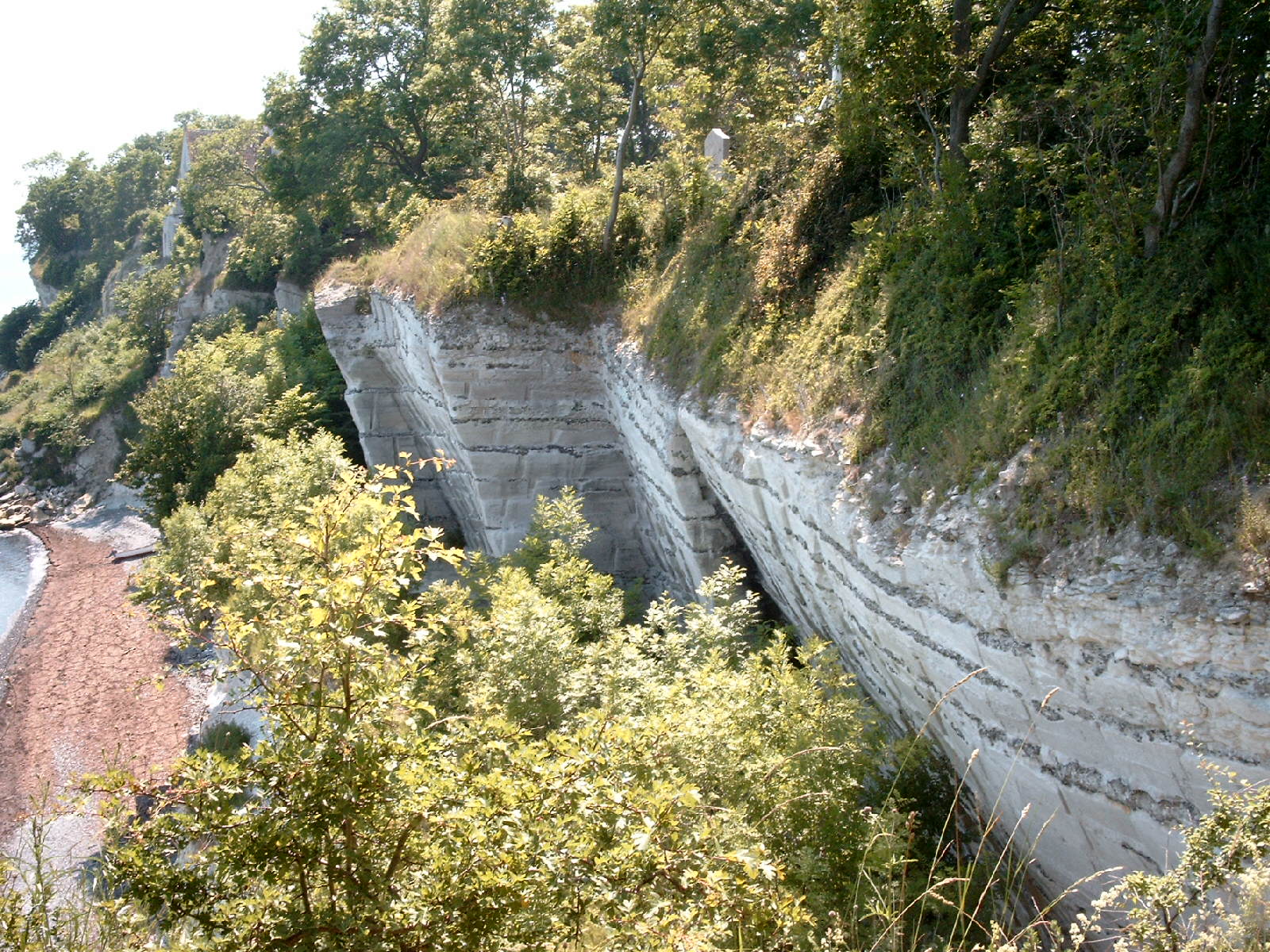
Iridium is vanishingly rare in the Earth's crust, but common in meteorites. Alvarez carried the samples back to Berkeley, where he worked on them with his father, the Nobel physicist Luis Alvarez, and the chemists Frank Asaro and Helen Michel. The results: the Gubbio clay held about 30 times the normal level of iridium; the same clay layer at Stevns Klint in Denmark held about 160 times; a site in New Zealand, about 20 times.[1] Three places half a world apart, the same clay, the same anomaly — this was no local coincidence. It was the fingerprint of a single global event.
On 6 June 1980, they published their case in Science, under the title "Extraterrestrial Cause for the Cretaceous-Tertiary Extinction". The argument was bold to the point of recklessness: an asteroid about 10 kilometres across had struck the Earth, throwing some 60 times its own mass of pulverised rock into the atmosphere, where dust lingered in the stratosphere for years, blocking the sunlight, shutting down photosynthesis, and collapsing the food chain from the bottom up.[1] The energy released, the paper estimated, was on the order of a hundred million megatons of TNT. Almost at the same time, the Dutch palaeontologist Jan Smit independently reached the same idea.
Chapter ThreeThe Objectors, and Another Volcano
When the paper appeared, palaeontologists rose almost as one against it. The extinction of the dinosaurs was their territory, and now physicists and geologists claimed to have solved it overnight. Worse, geology's orthodoxy was gradualism — the Earth changes slowly and continuously. A stone falling out of the sky sounded like mythology.
The objectors offered another suspect: the volcanoes of India's Deccan Traps. The Deccan basalts had erupted on a vast scale at the end of the Cretaceous, over hundreds of thousands of years, and could just as well have thrown dust and sulphur dioxide into the sky and thrown the climate into chaos. The iridium in the Gubbio clay, they argued, might have come from the mantle — volcanoes can carry the Earth's iridium up with them too.
The argument was not settled quickly. Through the 1980s, both sides hunted the rock record for evidence the other could not explain. The Alvarez camp's trump card was the traces only an impact can leave: shocked quartz — the fine parallel lines that only tens of thousands of atmospheres of pressure, delivered in an instant, can etch into a quartz crystal, something no volcano can do — and the tiny glass spherules found worldwide, droplets of impact-melted rock that cooled as they fell back to Earth.[4] But one thing was still missing, the most important of all: the crater itself. Without a crater, the asteroid was only an elegant guess.
Chapter FourThe Oil Company Knew First
The irony is that the crater had already been found — by people who had no idea what they had found.
In the 1940s, Mexico's state oil company was measuring gravity across the Yucatán Peninsula and found an enormous circular anomaly underground. In 1952, the company drilled straight into it, passing through about a kilometre of limestone before hitting hard crystalline rock, which it logged as volcanic and went on looking for oil. Nobody connected a circular gravity anomaly with dinosaurs.[8]
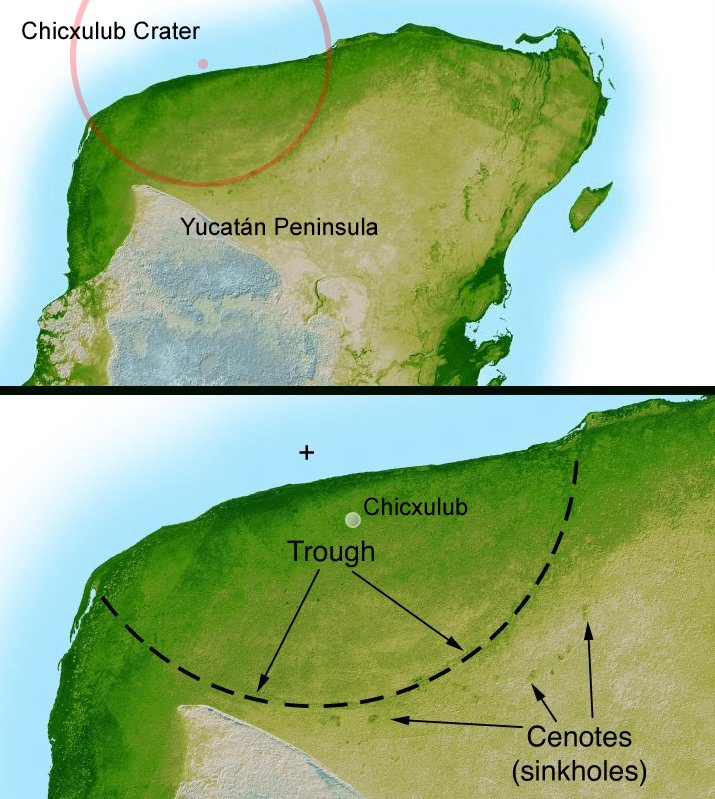
In 1978, the geophysicist Glen Penfield was reading magnetic survey data off the Yucatán coast for the oil company when he noticed a huge arc-shaped anomaly under the sea. Matching it against the 1940s gravity maps on land, he found the other half of the arc: together they made a complete circle, a bullseye some 180 kilometres across, centred near a small village on the peninsula's north coast called Chicxulub.[2][8] Penfield was convinced it was an impact crater, but the survey data belonged to the oil company as a commercial secret, and he could not publish. All he could do was present it at a 1981 geophysics meeting, without once using the words "impact crater", describing it vaguely as a "major igneous zone".
The break came in 1990. Alan Hildebrand, a Canadian graduate student, had found a layer of impact debris about half a metre thick in Haiti and guessed the crater lay somewhere around the Caribbean; someone told him about Penfield's discovery twelve years earlier. Together they tracked down drill cores from the old Pemex wells, stored in a closet at the University of New Orleans since 1965, and under the microscope they saw shocked quartz. In September 1991 they published in Geology: the structure buried about a kilometre beneath the Yucatán, some 180 kilometres across, was the crater.[2] That same year, scientists noticed something else: a ring of natural wells — the Yucatán's famous cenote sinkholes — lines up exactly along the crater's rim, the fractured limestone slowly collapsing over 66 million years.[8]
Chapter FiveThe World After the Impact
With the crater found, the case was still not closed. How exactly an impact kills dinosaurs is a story still being pieced together. In 2010, 41 scientists published a joint assessment in Science concluding that the Chicxulub impact was the main cause of the end-Cretaceous mass extinction — the Deccan volcanoes may have made things worse, but they were not the main cause.[4]
The day of the impact can only be rebuilt from models: a rock about 10 kilometres across, travelling at roughly 20 kilometres per second, vaporised on contact with the shallow sea, excavating a crater some 180 kilometres wide and about 30 kilometres deep — so deep that the crust rebounded like the surface of water, forming a central peak ring. The shock wave drove a tsunami hundreds of kilometres inland; molten rock rained back down like meteors and set wildfires burning around the world; and most deadly of all, dust, soot and sulphate aerosols shut out the sun. Photosynthesis stopped, plants died, the animals that ate plants starved, and the animals that ate them starved too. In the oceans, the plankton that also live by sunlight died, and the food chain collapsed from the surface to the sea floor.
The extinction erased about 75% of all species on Earth: every non-avian dinosaur, the pterosaurs, the ammonites, the mosasaurs and plesiosaurs and the other great marine reptiles — all gone. What survived was small, unfussy, and able to endure the dark: small mammals, crocodiles, turtles — and one branch of the dinosaurs themselves, the birds. Birds are not the dinosaurs' cousins; they are dinosaurs, and the more than 10,000 bird species alive today are all survivors of that impact.
In 2013, argon–argon dating fixed the impact at 66,038,000 years ago, give or take 11,000 years — in geological time, the impact and the extinction were the same instant.[3] In 2016, an international drilling expedition cored the crater's peak ring and found that within hours of the impact, seawater and debris had already flooded back into the hole;[8] and in 2024, ruthenium isotopes in the boundary clay confirmed that the impactor was a carbonaceous asteroid that had formed beyond the orbit of Jupiter.[5]
EpilogueWe Are the Survivors' Descendants
In 2008, the International Commission on Stratigraphy formally renamed the "Tertiary" the "Paleogene", and the Cretaceous–Tertiary boundary became the Cretaceous–Paleogene boundary. More than a name changed: it was an admission that the age had not ended in a natural changing of the eras, but in an accident.
The role of the Deccan volcanoes is still argued — in 2019, two papers in Science still disagreed over the timing of the eruptions.[6] But the impact itself is no longer in doubt: the crater has been found, the dates match, and the killer's chemical fingerprint matches too.
The most thought-provoking part of the dinosaurs' extinction is not that they died, but who lived. If that rock had missed by a little, arrived a little later, or been a little smaller, the dynasty that ruled the Earth for 165 million years might still be here, mammals might forever have remained thieves in the night, and there would be no primates and no us. Evolution has no script, and neither does history. We are not the inevitable product of anything. We are the survivors of an accident.
In 1980, the year the Alvarezes published their paper, shipyard workers in Gdańsk, Poland, signed the agreement that created Solidarity,[10] and American voters elected Ronald Reagan.[11] Nobody noticed that a paper about something 66 million years old was rewriting humanity's understanding of itself: every layer of rock beneath our feet may hide a letter from deep time.