PrologueRouen, May 30, 1431
On the morning of May 30, 1431, in the Old Market Square at Rouen, a nineteen-year-old girl was tied to a stake, a paper cap covered with her crimes on her head. In the crowd, some had come to watch a witch die; others had come to watch a saint die. The last word she cried out, witnesses said, was the name of Jesus.[1]
Two years earlier, she had been a farm girl nobody knew. In two years she lifted the siege of a city, put a crown on a king's head, was abandoned by that same king, and was burned by an enemy court. Her story is as short as a dream, and long enough for France to spend six hundred years retelling it. This book does not ask whether she really heard voices — no one can answer that for her. It asks something else: how did a nineteen-year-old girl with no rank, no family name, and no education get a whole kingdom to follow her? And how did a kingdom, having used her up, hand her over to the stake?
Chapter OneThe Girl from Domrémy
Joan was born around 1412 in Domrémy, a village of a few dozen households on the river Meuse in northeastern France. Her father, Jacques d'Arc, was a tenant farmer; the family lived by tilling the land and tending livestock. The village sat on the border between the duchy of Bar and Lorraine, caught in the seams of the Hundred Years' War — a war that had begun in 1337 and would not end until 22 years after her death.[1][2]
She was born in France's darkest hour. By the Treaty of Troyes in 1420, the succession to the throne had been handed to Henry V of England, and the dauphin Charles had been disinherited by his own father, reduced to a crown prince without a crown. English troops and their Burgundian allies held Paris and much of the north; Charles could only retreat south of the Loire, unable even to reach Reims, where kings were crowned. A nation can lose a war. France had lost something more fundamental: nobody believed it was still a nation.
Joan grew up in that France. She could not read. She had never traveled more than a few dozen miles from home. By any prediction of her time, her life should have been marriage, children, and growing old in the village. History does not always follow predictions.
More brutal still, this was not only a war against a foreign enemy. France was split in two: the Armagnacs, who backed the dauphin, and the Burgundians, allied with the English. Frenchmen had been fighting Frenchmen for years. Domrémy was one of the few villages that stayed loyal to Charles while the surrounding lands bowed to Burgundy. Joan grew up inside that split — the enemy was not only beyond the border but in the next village.[3]
Chapter TwoThe Voices
By her own later testimony at trial, in the summer of 1425, when she was about thirteen, she first heard a voice in her father's garden, accompanied by a blaze of light. She later identified the speakers as the archangel Saint Michael, and the saints Catherine of Alexandria and Margaret of Antioch.[1]
At first the voices only told her to be a good child and to attend church faithfully. Slowly the message grew specific: go to the dauphin, lift the siege of Orléans, and bring him to be crowned at Reims. She vowed to remain a virgin — the source of her title la Pucelle, the Maid.[1][2]
In 1428 she went to the nearby fortress town of Vaucouleurs and asked its captain, Robert de Baudricourt, to send her to the dauphin. He sent her away. She returned early in 1429, and this time she won an escort. On March 6, 1429, she reached Chinon; two days later the dauphin Charles received her. She was seventeen; he was twenty-six.[3]
Charles did not believe her at once. He sent her to Poitiers, where a panel of theologians questioned her for about three weeks. Their conclusion was cautious: nothing in her life or teaching was contrary to the faith, and she might be put to the test at Orléans. They did not vouch for her voices — they only said it was worth the gamble. So she was given a suit of armor, a banner bearing the names Jesus and Mary, and a sword said to have been dug up behind the altar of the church of Sainte-Catherine-de-Fierbois.[1][3]
It is worth pausing here. Why would a crown prince stake a nation's fate on a seventeen-year-old farm girl? The answer lies not in her but in him. Charles had tried everything: negotiation, marriage alliances, mercenaries, waiting. Nothing had worked. A desperate person, faced with someone certain, often mistakes the other's certainty for his own way out.
The record of the Poitiers examination has not survived — a hole history left behind. We know the conclusion but not what she said to win over a panel of theologians. Perhaps it is precisely because the record is missing that every age has been able to put its own Joan into the gap: the Catholic saint, the nationalist heroine, the feminist pioneer. Each era takes from that emptiness what it needs.[1]
Chapter ThreeOrléans
Orléans was the fortress on the Loire. The English had besieged it since October 1428; if the city fell, the road to southern France would open. On April 29, 1429, Joan entered the city with a relief army. The people inside received her like rain after months of drought.[1][2]
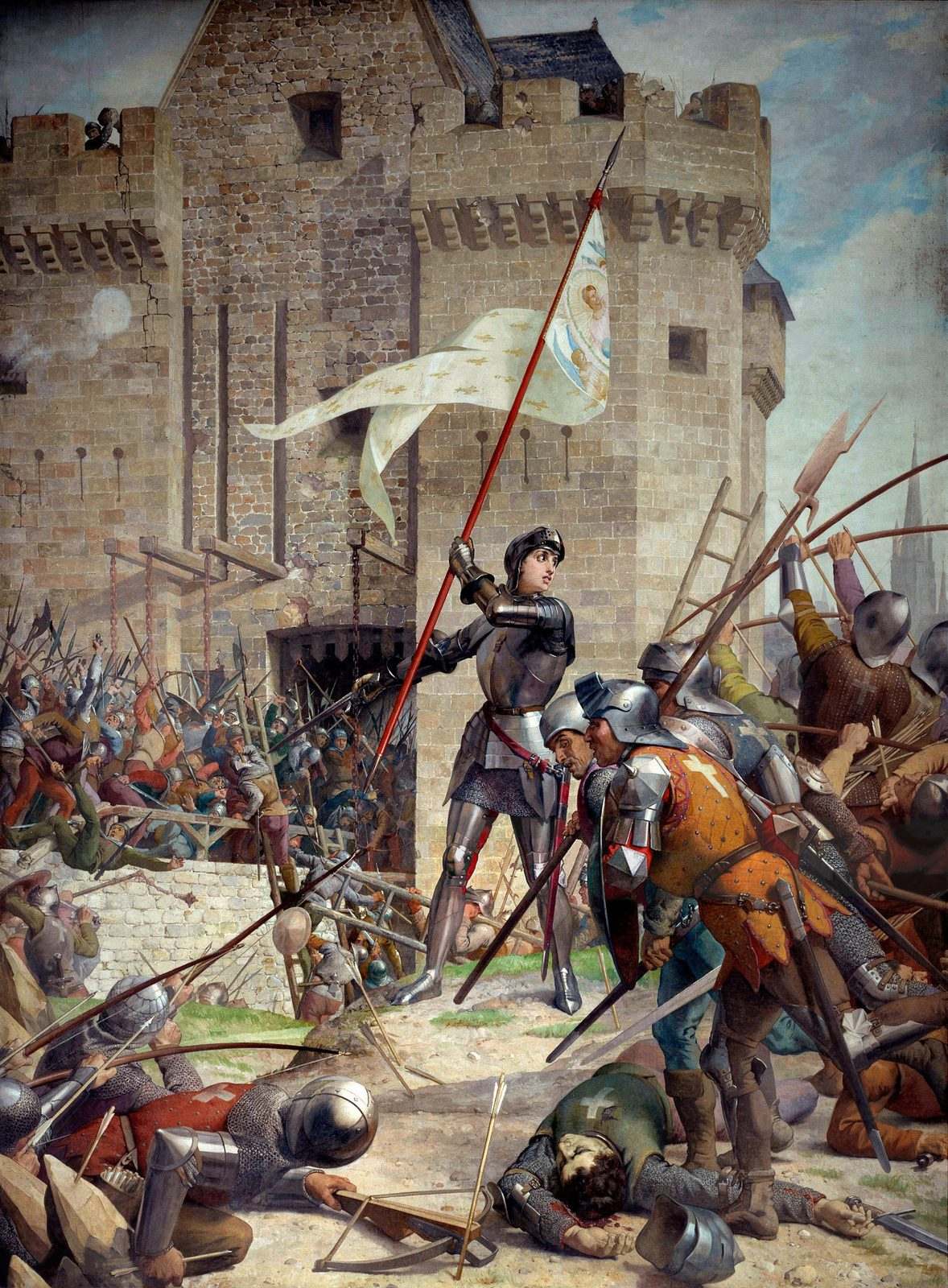
The days that followed were the climax of the whole story. On May 7, assaulting the fortified bridgehead of Les Tourelles outside the walls, she was struck by an arrow between the neck and the shoulder; she had it pulled out and returned to the fight. On May 8, the English abandoned the siege.[1] A city besieged for seven months was freed in nine days.
Military historians can argue over how much of the victory was her tactics and how much was morale. But morale is itself a tactic. After seven months under siege, the defenders believed not in their walls but in the words "we will win" — and those words need someone to believe them first, standing where everyone can see. That was what Joan did: she did not command; she appeared. She carried the banner and walked in front.
On June 18, the French routed the English at Patay. The road to Reims lay open.[2]
After Orléans, the name of the Maid spread across France. Chroniclers wrote about her, poets wrote about her, even English soldiers talked about her. Her arrival changed not only the war but the language of the war: from that day on, the French spoke not of "the dauphin's army" but of "the Maid's army." A name travels farther than an army.
Chapter FourReims
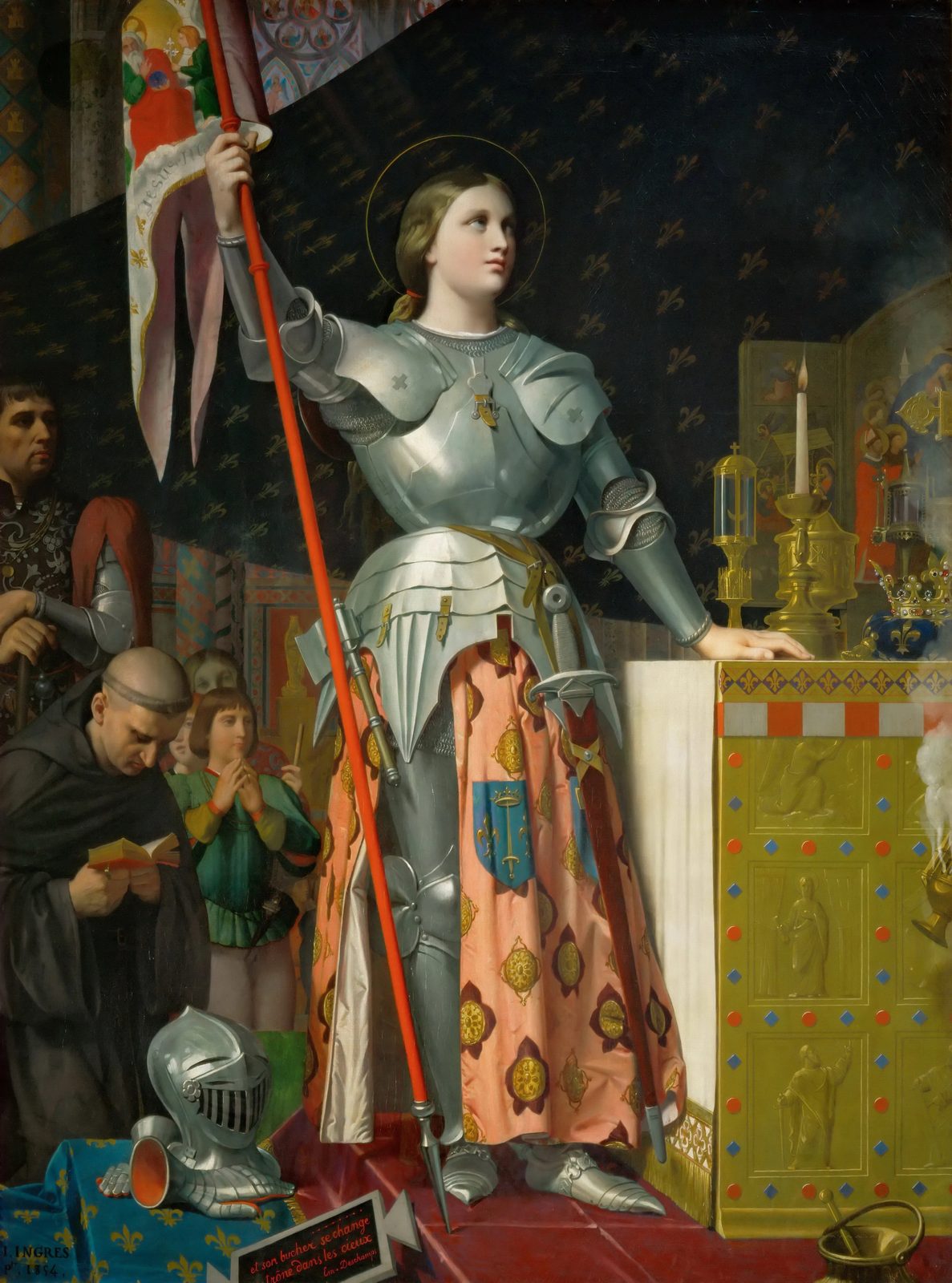
On July 17, 1429, Charles was crowned Charles VII in Reims Cathedral, with Joan standing by the altar holding her standard.[1] It was the highest day of her life, and the day her mission was complete. Everything she had promised the king had come true: Orléans was relieved, and the king was crowned.
After the coronation she wanted to press on: take Paris, drive the English out of France. On September 8, she led an assault on Paris. It failed, and she was wounded.[2] The mood at court began to change. A king with a crown no longer needed a saint who made trouble. Generals with victories no longer needed a farm girl standing in front of them. Her usefulness was being spent, a little at a time.
A nation's symbol is often born at the moment it is no longer needed. The coronation at Reims was the summit of Joan's life — and the beginning of her abandonment.
Chapter FiveCompiègne
In the spring of 1430, Joan led a company of volunteers to relieve Compiègne. On May 23, during a sortie against the Burgundian camp outside the town, she was captured. The Burgundians sold her to the English for 10,000 livres tournois.[2]
Charles VII paid no ransom, opened no negotiation, and sent no army to rescue her. Historians still argue whether he could not or would not. For Joan, the result was the same: she had put a crown on his head, and he shut the door on her. A person can stake her life on a nation, but a nation stakes nothing on any one person — a nation owes nobody anything.
In November 1430 she was handed over to the English and taken to Rouen. What waited for her was not a war but a trial.
The capture at Compiègne is often told as the moment her luck ran out. But luck was never her weapon. Her weapon was being believed — the soldiers believed her, the cities believed her, the king believed her. And belief, once it starts to drain away, cannot be recovered. After the failure at Paris, the court's trust began to loosen; after Compiègne, even the soldiers on the battlefield began to wonder whether the voices were still with her.
Chapter SixThe Trial at Rouen
The trial began on January 9, 1431, presided over by Pierre Cauchon, the pro-English Bishop of Beauvais.[1] The charges began as seventy articles, later reduced to twelve: wearing men's clothes, obeying demonic voices, refusing to submit to the Church.[4] Among the seventy, only one truly mattered — she said her orders came from God, not from the Church. In fifteenth-century France, that sentence was itself a crime.
The trial record survives, and it still shocks to read. A nineteen-year-old girl who could not read, facing a bench of theologians, answered weeks of questions about faith, theology, and the authority of the Church, with no lawyer and no witness to speak for her. Sometimes she answered wrongly; sometimes she fell silent. But she never handed her voices over.[4]
The trial was never designed to find the truth. Bishop Cauchon was an English partisan; the articles of accusation were sent to the University of Paris for endorsement before the verdict was ever reached. The whole procedure had a single purpose: to prove her a heretic, and thereby to prove that Charles VII's coronation at Reims had been won by witchcraft. To try Joan was to try the legitimacy of the coronation. Her opponent was never theology. It was politics, wearing a judge's robe.[4]
On May 24, under threat of immediate burning, she signed an abjuration, agreeing to give up men's clothing and her voices. The court sentenced her to life imprisonment. Days later she put men's clothes on again and withdrew the abjuration. The court declared her a relapsed heretic — under the Church law of the time, that crime carried only one penalty: burning.[1][4]
On May 30, she was burned in the Old Market Square at Rouen, aged about nineteen.[1] Afterward, the English threw her ashes into the Seine, fearing people would keep her bones as relics. They burned a girl. They could not burn the question she left behind.
EpilogueTwenty-Five Years Later, She Came Back
On July 7, 1456, a court authorized by Pope Callixtus III re-examined her case and declared the verdict of 1431 null and void: the trial had been tainted by fraud, irregular procedure, and errors of fact and law.[1][2] In twenty-five years, a verdict had changed from "heretic" to "miscarriage of justice." But the France that cleared her was not the France of her lifetime — it was the France after the war, the France that no longer needed to fear her.
On May 16, 1920, Pope Benedict XV canonized her; two years later she was declared one of the patron saints of France.[1] Her home village of Domrémy was renamed Domrémy-la-Pucelle — Domrémy of the Maid. On the second Sunday of May each year, France keeps a national holiday in her honor.[1]
Joan's story is, in the end, a story about belief. She believed the voices, the soldiers believed her, France believed the soldiers — layer upon layer of belief won a war that could not be won. Then the same belief turned and burned her: the court believed she was a heretic, the king believed she was no longer useful, the crowd believed a stake could burn a question away.
What she left behind is not an answer but a warning: how a society treats its most steadfast people decides what kind of society it is. Joan died at nineteen. France took nearly five hundred years to learn how to remember her — and learning to remember is often harder than learning to forget.
There is another layer to her story, often overlooked: she was the first ordinary person to be remembered in the name of France. Before her, history belonged to kings and nobles; after her, a farm girl could become the symbol of a nation. The idea of the nation was still vague in the fifteenth century, but Joan gave it a face — the face of a nineteen-year-old, a woman, a peasant. France later went through revolution, empire, and republic, and every age reclaimed her, because every age needed a face like that.