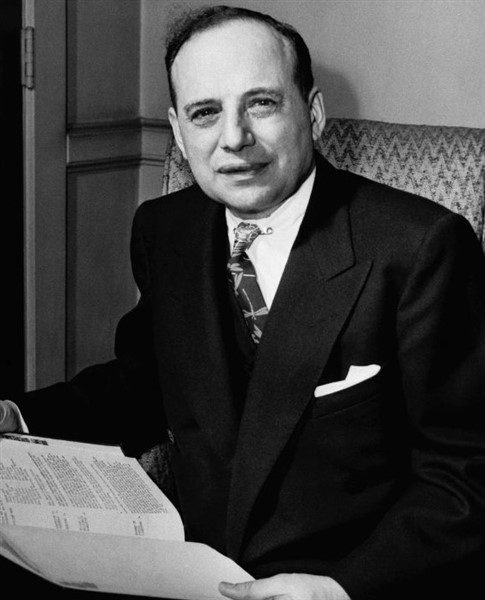
PrologueThe Teacher Nobody Wanted to Hear
In 1949, four years after the Second World War ended, the American stock market was about to begin a bull run that would last twenty years. Everyone was asking the same question: how do I get rich faster? That year, a 55-year-old Columbia professor published a book that taught people to slow down. It was called The Intelligent Investor.[4]
The book predicted nothing about next year's market. It recommended no stock and promised no return. It did only one thing: it turned investing from a race about who could run fastest back into a study of human nature. Its author, Benjamin Graham, spent his life answering a single question: why do clever people go mad in the market?
The answer is not in the numbers. Anyone can do arithmetic, including madmen. The answer is in his own life: a boy who lost his family's money at thirteen, a fund manager who nearly went broke in 1929, a teacher whose student became the richest investor alive. This book is the story of how one man turned his own wounds into a method that lets others bleed less.
Chapter One1907: A Boy Learns Loss First
Benjamin Graham was born Benjamin Grossbaum in London on May 9, 1894, and moved to New York with his family when he was one year old.[1] His father died young; the family lived off an import business, and in the Panic of 1907 the family savings were wiped out overnight.[1] A thirteen-year-old boy learned the first lesson of the money world: money can disappear, and it does not warn you first.
He won a scholarship to Columbia, graduated in 1914 second in his class, and before graduation was offered teaching posts in three departments: English, Greek and Latin philosophy, and mathematics.[2] He turned them all down. His family needed him to earn, so at twenty he walked into Wall Street and started at the bottom of Newburger, Henderson and Loeb. A young man who might have become a classical scholar was pushed by necessity into the market.
That beginning set the colour of everything that followed. Other people enter the market to get rich; he entered it after his family had already been poor once. For him the first question of investing was never "how much can I make?" but "how do I make sure I never lose it all again?" That order of questions became the starting point of his whole philosophy.
Chapter Two1929: How Clever People Go Broke
In 1926, Graham formed an investment partnership with Jerome Newman, and within three years he was a respected name on Wall Street. Then 1929 arrived.
From 1929 to 1932, his fund lost about 70 percent of its capital: down 20 percent in 1929, 50 percent in 1930, 16 percent in 1931, and 2 percent in 1932.[6] He survived only by selling personal assets and borrowing from friends, and it was not until 1935 that the account had fully recovered.[6] The Dow lost about 80 percent over the same stretch; he lost slightly less than the market, which was no comfort at all — he had nearly lost everything.
The problem was not that he could not value a business. Much of what he owned really was cheap. The problem was leverage. When the market falls, creditors do not wait for you to be proved right; at some price, a margin call decides for you. Clever people go mad in the market not usually because they misjudge a company, but because they stand in the wrong posture: borrowed money on the edge of a cliff leaves no room to be right later.
What makes the episode worth retelling is not the size of the loss but what it revealed about the market's machinery. In a rising market, leverage feels like intelligence: every borrowed dollar earns, and every success confirms the borrower's judgment. The bill only arrives when prices fall, and it arrives all at once, in the form of forced selling. Graham's fund was not destroyed by a bad idea. It was destroyed by a good idea bought with borrowed money at the worst possible moment.
He swore off leverage for the rest of his life. That vow mattered more than any theory: a man who had nearly been ruined finally understood that the first task of investing is not to prove you are clever, but to make sure you live long enough for being right to pay.
Chapter ThreeBuy a Business, Not a Ticker
In 1934, Graham and his Columbia colleague David Dodd published Security Analysis.[5] It was the first book to teach people to read financial statements and calculate value by a systematic method. Before it, Wall Street analysed stocks with tips, instinct, and connections; this book translated investing out of the language of the casino and into the language of accounting.
The book drew a line: an investment operation is one which, upon thorough analysis, promises safety of principal and an adequate return; anything that fails the test is speculation.[4] The line looks simple, and it offended the whole of Wall Street — because it said that most of what people did every day was not investing at all.
His method was stubbornly plain: buy a stock the way you would buy a business. A share price jumps every day; the business itself does not change price every day. In the 1920s, he studied Northern Pipeline and found the company held $95 a share in quick assets while the stock sold for $65; he kept buying until he held enough proxies to win a board seat, and fought to return the value to shareholders.[11] The point was never how much that trade made. The point was the method: never ask what others will pay; ask what the business itself is worth. Price is other people's opinion. Value is your own homework. Separating the two is where value investing begins.
Chapter FourMr. Market
The Intelligent Investor, published in 1949, wrote that method for ordinary people.[4] Its two most famous chapters are Chapter 8, Mr. Market, and Chapter 20, the margin of safety. Buffett would later say those two chapters are the most important in the book.
Graham asks you to imagine that you own a business with a partner called Mr. Market. Every day he knocks on your door with a price: sometimes euphoric, offering absurdly high prices; sometimes depressed, begging you to buy at a giveaway. His moods are your opportunity — on the condition that you do not catch them.
The metaphor has lasted because it exposes the truth about the market: a share price is not a measure of value; it is a thermometer for the crowd's emotions. Every day the market hands you not an answer but a question: will you go mad with everyone else today? Clever people go mad not usually in one foolish decision, but a little each day, by taking other people's feelings for their own judgment.
Notice what the metaphor quietly assumes: that you already know, roughly, what the business is worth. Mr. Market is only useful to someone who has done the homework; to someone who has not, his daily prices are not opportunities but orders. That is why Graham put the valuation work first and the temperament second in his teaching, even though temperament is what the book is remembered for. The method gives you the number; the metaphor gives you the nerve to act on it.
So Graham said the market is there to serve you, not to instruct you. When the price falls, you may buy; when it rises, you may sell; if you dislike both, you may do nothing and keep the door shut. An investor's greatest freedom is the right not to trade — and that is exactly the freedom most people forget they have.
Chapter FiveA Nineteen-Year-Old Reader
Early in 1950, a nineteen-year-old graduate of the University of Nebraska read The Intelligent Investor. He would later call it by far the best book about investing ever written.[8] The young man was Warren Buffett.
Buffett discovered the author taught at Columbia, applied to Columbia Business School, enrolled in 1950, and took his master's degree in economics in 1951.[7] In Graham's classroom he learned more than formulas; he learned a posture toward the market — to treat the share price as a servant, not a master.

One Saturday in 1951, Buffett walked into GEICO's Washington office, knocked, and met the executive Lorimer Davidson; the two talked for four hours.[10] What he learned that day later became one of the most important investments of his life. A teacher never teaches only the textbook; what a student truly learns is the teacher's way of seeing the world.
In 1954, Buffett joined Graham-Newman, and worked there until Graham retired and wound up the partnership in 1956.[1] The teacher retired at sixty-two; the student, twenty-six, set out on his own. Graham wrote two books that changed the history of investing and taught for twenty-seven years — but the most valuable thing he left the world may have been a single student.
Chapter SixGEICO: The One Time He Broke His Own Rule
Graham had set himself an iron rule: no single holding more than about 5 percent of the fund, diversify widely, never put all the eggs in one basket. In 1948, he broke it with his own hands.
That year, Graham-Newman paid $712,500 for a 50 percent stake in GEICO, about 25 percent of the partnership's capital.[9] The Government Employees Insurance Company looked unremarkable, but its cost structure was strikingly low: it sold policies directly to government employees and paid no agents' commissions. Graham understood the business, so he made the biggest bet of his life.
What followed, he himself said, was luck. By 1972, one hundred shares of GEICO — worth $11,413 in 1948 — were worth $1.66 million; and from 1936 to 1956, Graham-Newman earned about 20 percent a year, against about 12.2 percent for the market.[9][1] The profit from GEICO alone exceeded the sum of all the partnership's other investments over twenty years.[9]
Looking back in old age, he said something disarmingly honest: "In 1948, we made our GEICO investment and from then on, we seemed to be very brilliant people." That is the difference between discipline and luck: discipline keeps you alive; luck decides how far you go. He spent his life teaching the former, because the former can be learned and the latter cannot.
EpilogueThe Margin of Safety Is a Temperament
In Chapter 20 of The Intelligent Investor, Graham set out what he called the central concept of investment: the margin of safety.[4] The gap between the price you pay and the value you estimate is your room for error. Valuations will be wrong, the future will surprise you, and the margin of safety exists so that being wrong is not fatal.
But the margin of safety was never only arithmetic. It is a temperament: to admit you will be wrong, to admit the market will go mad, to admit even a good business can be bought too dear. Clever people go mad because they believe they cannot be wrong; the first lesson Graham's students learned was to assume they could be.
Graham died in Aix-en-Provence, France, on September 21, 1976, aged eighty-two.[1] He left behind no company and no fortune, but a book, a metaphor, and a simple line of defence. The market still knocks every day, and the crowd's moods still swing; the warning from 1949 has not expired: you do not need to be cleverer than the market, only calmer than it.
Investing never ends in beating the market. It ends in beating the voice inside you that wants to go mad with everyone else. The market has invented faster ways to go mad since 1949 — screens that refresh by the second, crowds that gather in hours, leverage available to anyone with a phone. The machinery is new. The madness is the same, and so is the defence. Graham spent a lifetime learning that, and he wrote it down for everyone willing to stop and think.