PrologueThe Well Dug 2,000 Years Later
On March 29, 1974, in the village of Xiyang in Lintong County, Shaanxi, a group of farmers was digging a well. A metre and a half down, a shovel struck something hard. They pulled it out: a human head, moulded in clay, eyes and brows intact.[6]
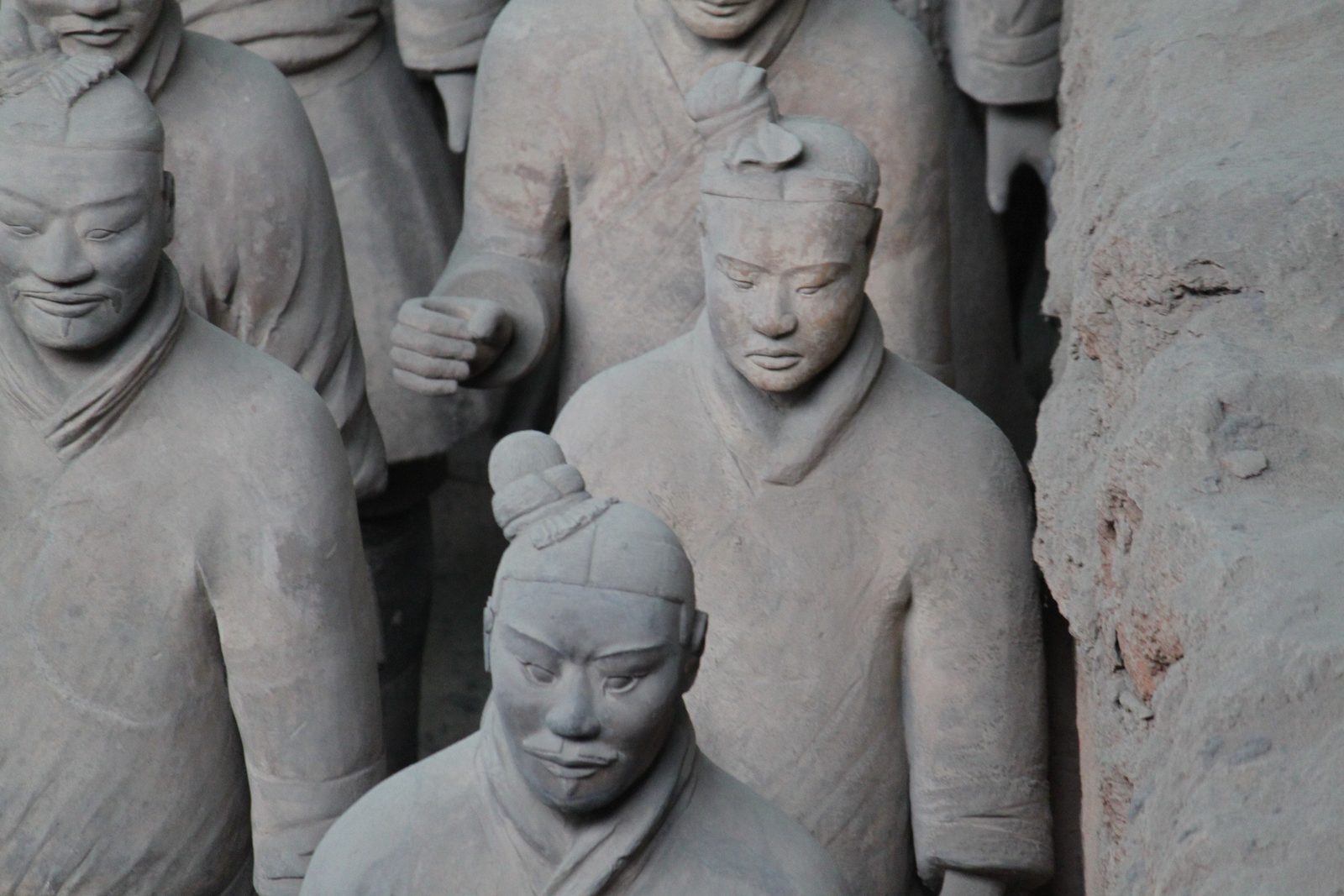
They did not know they had found an army. The excavations that followed opened up three enormous pits, holding some 8,000 terracotta soldiers, 130 chariots and hundreds of clay horses, drawn up in battle formation and facing east.[6] That army had stood underground for more than 2,000 years, guarding one man's grave. The man was Qin Shi Huang.
In 1987 the mausoleum was inscribed on UNESCO's World Heritage List.[7] But a better question than the listing is this: how can one man be both a tyrant and a founder? The same Qin Shi Huang who burned books, killed scholars, built the Great Wall and unified the script also left behind institutions that later dynasties used for 2,000 years. This book is about the two sides of that face — and why they are the same face.
Chapter OneThe Hostage's Son of Handan
Ying Zheng was born in 259 BC in Handan, the capital of the state of Zhao. His father was Prince Zichu of Qin, then living in Zhao as a hostage; his mother, Lady Zhao, was of obscure birth.[2] As for who his real father was, Sima Qian left behind a story that has haunted the record ever since: the merchant Lü Buwei, it is said, gave the already pregnant Lady Zhao to Zichu, making Ying Zheng Lü Buwei's son. Today the story is mostly read as slander — the Encyclopaedia Britannica calls it "probably a slanderous invention".[1][2] It survives because it fits the way people imagine the man: a child of doubtful birth, destined to seize everything by doubtful means.
Whoever his father was, Ying Zheng was 13 when his father died and he took the throne of Qin.[2] A boy sat on the throne while Lü Buwei, the merchant turned chancellor, ran the state. Beside him stood another figure, Lao Ai, who had bought his way to power through the queen dowager. In 238 BC, at the age of 22, Ying Zheng took power into his own hands, eliminating Lao Ai and then Lü Buwei, one after the other.[3]
From that year on, there was no second voice in Qin. What the young king set out to do next was something six generations of his ancestors had failed to finish: destroy the other six states and gather a world that had been divided for centuries into a single hand.
Chapter TwoPower at 22, Six States in 10 Years
The wars of unification began in 230 BC. Han fell first, its king surrendering; Zhao fell in 228 BC, Wei in 225, Chu in 223, Yan in 222, and finally, in 221 BC, the king of Qi surrendered without a fight, and China was one.[3] From 230 to 221 BC, it took only 10 years.
Those 10 years were not won by brute force alone. The strategy, designed by Li Si and Wei Liao, was to befriend the distant and strike the near, swallowing the states one at a time, with bribery, intrigue and assassination marching alongside the armies. In the campaign against Chu, the veteran general Wang Jian refused to move without 600,000 men, and Ying Zheng gave them to him.[1] Six hundred thousand men: nearly every man Qin could put in the field. Ying Zheng was willing to stake them all, because he knew that to lose was to lose everything.
The cruelty of the wars needs no embellishment. For more than 250 years the seven states had fought one another, and the dead were beyond counting. Ying Zheng ended war by pushing war to its extreme — a greater war to end all wars. It was the pattern of his whole life: he believed every problem had a final solution, and the final solution was usually to take the means to their maximum.
Chapter ThreeTurning Six States into One
Conquest was only the first step. Harder still was turning six states into one. In 221 BC Ying Zheng invented a new title for himself: Shi Huangdi, the First Emperor. The word "emperor" had not existed before; he fused the "huang" and "di" of the legendary sage rulers, meaning: I am the first, and there will be a second and a third, down to ten thousand generations.[2]
Then came the institutions. The feudal order was abolished. The empire was divided into 36 commanderies, each subdivided into counties, and officials were appointed by the centre and could be removed at will.[4] Hereditary aristocrats lost their lands, and in their place stood a bureaucratic machine: orders travelled from the capital at Xianyang along highways and canals, layer by layer, to the farthest commandery. The Han dynasty that followed took the commandery system over almost unchanged, and it remained in use for 2,000 years.[4]
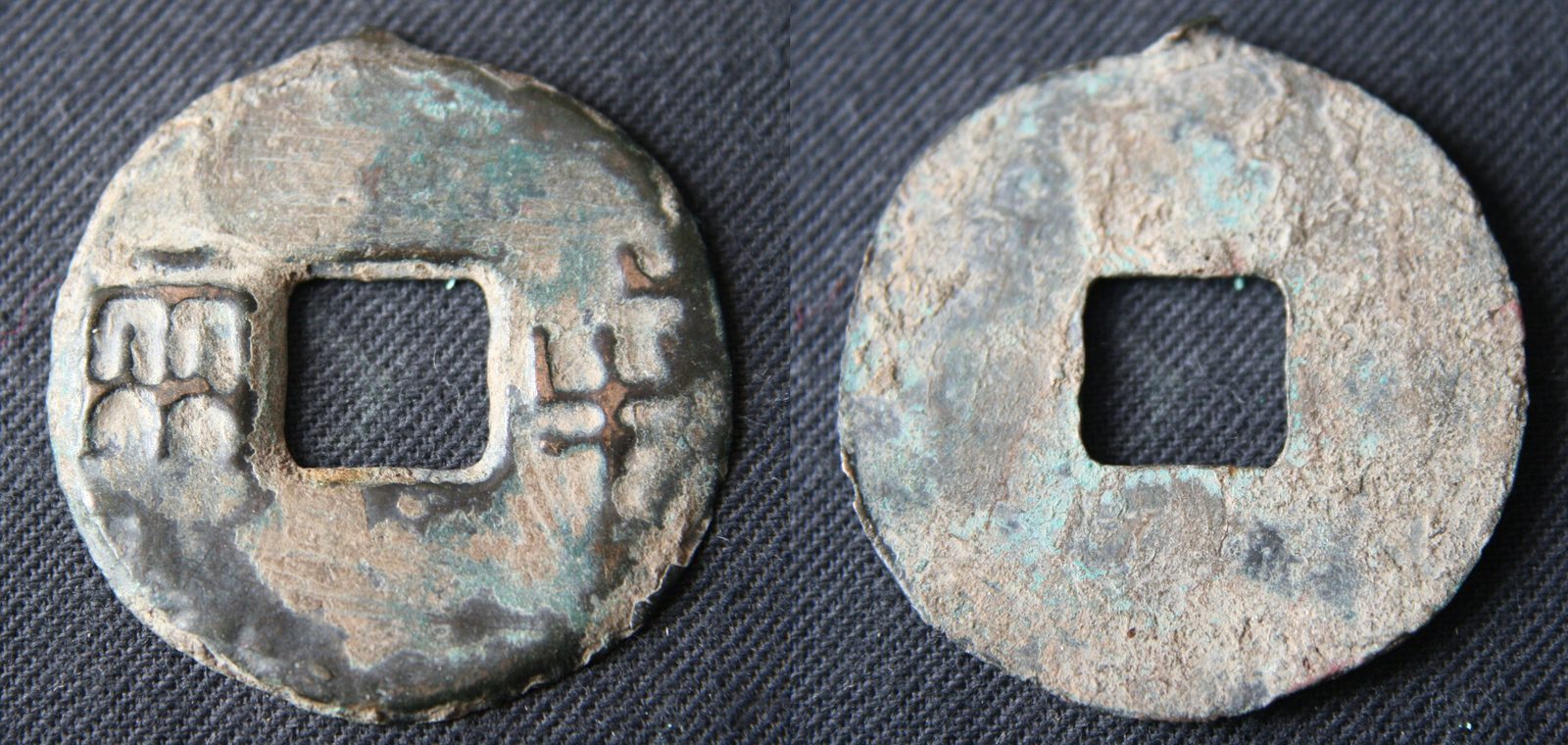
Then came the standards. The script was unified in the small seal form, the coinage was unified in the round Ban Liang coin with its square hole, weights and measures were unified, and even the width of cart axles was fixed.[2] A single Ban Liang coin looks unremarkable, but it meant that a merchant from Chu no longer had to change his money in a Qin market, and an edict from Xianyang could be read as far away as the far south. The price of unity was the destruction of difference; the dividend of unity was that difference stopped being an obstacle.
And then there were the great works: the old walls of the northern states were joined into a single Great Wall, and in 214 BC the Lingqu Canal was cut through, joining the Xiang and Li river systems so that grain could be shipped by water to the armies campaigning in the far south.[9] These works and standards shared one quality: none of them was built for one person or one place. They were built for "all under heaven" as a single whole. Ying Zheng was not thinking about how to rule six states; he was thinking about how to make six states disappear, leaving only one empire.
Chapter FourBurning Books, Burying Scholars
In 213 BC, the chancellor Li Si proposed that private copies of the Book of Songs, the Book of Documents and the writings of the Hundred Schools should all be handed in and burned; only books on medicine, divination and tree-planting were spared, and the court scholars could keep their copies. Ying Zheng approved.[5]
The following year, in 212 BC, the Records of the Grand Historian reports that more than 460 practitioners and scholars were put to death for criticising the emperor and failing to find him the elixir of life. Later tradition joined the two events under one name, fenshu kengru — "burning the books and burying the scholars" — and it became the shorthand for Qin Shi Huang's tyranny.[5]
But historians have reservations about the story. First, Sima Qian wrote more than a century after the events, at the court of the Han dynasty, which had every reason to paint its predecessor black. Second, he names not a single Confucian victim; modern scholars argue that the victims were more likely fangshi — occult practitioners and alchemists — than Confucians, and that the word keng in Sima Qian's text may simply mean "to kill", not necessarily to bury alive.[5] In other words, the burning of books very likely happened; the details of the burial of scholars were probably embroidered later.
Yet discounting the details does not change the core. Qin Shi Huang genuinely wanted the power of the state to unify thought. He would unify not only the script, the coinage and the measures, but also what people were allowed to think. An empire can tolerate different accents; it cannot tolerate different loyalties. That is the other side of the commandery system: when power can travel layer by layer to the farthest county, thought can be inspected layer by layer too.
Chapter FiveThe Man Who Wanted to Live Forever
Once China was unified, Ying Zheng feared only one thing: death. He made five imperial tours, travelling as far as the eastern coast; he sent practitioners overseas to seek the elixir of immortality, and Xu Fu sailed away with thousands of boys and girls, never to return; he swallowed elixirs compounded by court alchemists in the hope of living forever. As for the true cause of his death, the Records of the Grand Historian does not say, and every later theory remains only a theory.[1]
Running alongside the search for immortality was another kind of eternity: building. Work on his mausoleum at Mount Li had begun soon after he took the throne; Sima Qian records that 700,000 labourers were assigned to it, and that rivers of mercury were laid inside, with hidden crossbows and traps throughout. To this day the main burial chamber has never been opened.[1][7] In life he wanted the whole world to listen to a single voice; in death he wanted an army of clay to guard his empire.
The Epang Palace was the same: vast in scale, begun in his later years, and still unfinished when he died.[1] All these works shared one logic: the emperor's time was infinite, so no project needed a deadline; the emperor's will was absolute, so no cost needed counting. The trouble was that the emperor's time was in fact limited, while the costs had to be paid, one by one, by the living.
Chapter SixThe Forged Edict at Shaqiu
In 210 BC, on his fifth imperial tour, Ying Zheng fell ill at the travelling palace of Shaqiu and died, aged 49.[2] Only three people were with him: the chancellor Li Si, the palace official Zhao Gao, and his youngest son, Huhai. His eldest son, Fusu, was far away on the northern frontier, serving under the general Meng Tian.
According to Sima Qian, the dying emperor left an edict summoning Fusu back to Xianyang to oversee the funeral. But before the edict could be sent, the emperor died. Li Si and Zhao Gao suppressed it and forged another: Fusu and Meng Tian were ordered to kill themselves, and Huhai would take the throne. Fusu and Meng Tian obeyed the order and died; Huhai was enthroned as Qin Er Shi, the Second Emperor.[8]
But there is another side to the story. Bamboo slips excavated from the Han period suggest that Huhai's accession may not have been a simple conspiracy, but the outcome of political manoeuvring — and that the forged-edict account may be a later explanation invented for Fusu's death.[8] Which version is true can no longer be settled. What is certain is this: in an empire ruled by edicts, the first thing to be forged after the emperor's death was an edict itself.
Qin Er Shi reigned for less than 3 years. In 207 BC, Zhao Gao launched a coup and forced him to kill himself; in the same year the Qin dynasty fell.[8] From unification in 221 BC to collapse in 207 BC, the dynasty lasted only 14 years. An empire that one man had spent 10 years conquering was lost in 3.
EpilogueThe Same Face
After Qin Shi Huang's death, the Han dynasty inherited his empire — and his institutions. The commandery system stayed, the unified script stayed, the Ban Liang coin stayed, and even the books that had survived the burning were collected and edited again under the Han. The dynasty that denounced Qin most loudly was the one that inherited the most from Qin.
That is what makes Qin Shi Huang so hard to judge. His cruelty was real: the burned books, the executed scholars, the corvée labour, the uncounted bones beneath the Great Wall. His founding was real too: without him, China might have remained six states at war with one another, and the very idea of "China" would have arrived much later.
The tyrant and the founder were not two faces. They were two sides of the same face. Founding required centralisation; centralisation required silencing dissent; silencing dissent required violence; and once violence became a habit, it stopped distinguishing enemies from subjects. His greatest mistake was not wanting unity, but believing that unity could be held together by fear, and that any price could be settled afterwards, so long as the means were thorough enough.
The army dug up in 1974 still stands in its pits today, facing east. The terracotta soldiers have no expressions, yet no two faces are alike. Looked at from more than 2,000 years away, what Qin Shi Huang left behind is less an empire than a question: how far down the wrong road can a person travel for the sake of a right goal? And when the right goal and the wrong means have grown together, which half should later generations inherit — and which half should they bury?