PROLOGUEA Name in Three Languages
He had three names. The Chinese called him Zheng Chenggong. The people of Taiwan called him Guoxingye, the Lord of the Imperial Surname. The West called him Koxinga. Three names, three languages, one man: a boy born in Japan, the son of a sea merchant, a general who built a kingdom in Taiwan. His kingdom lasted only 21 years; he himself died 13 months after landing on the island. Yet more than 300 years later, over 100 temples in Taiwan still worship him, and Japanese theatres still perform his story. How does a man leave so long a shadow in so short a life?
His story begins with the sea. In the 17th-century East Asian seas there were no borders, only shipping lanes. Chinese silk and porcelain, Japanese silver, Southeast Asian spices — all of it moved by water. Whoever controlled the lanes controlled the wealth. Zheng Chenggong's father, Zheng Zhilong, grew up on that sea. And his son's life was almost a miniature of it: from Hirado to Anping, from Xiamen to Luermen, every step he took followed the rise and fall of the tide.
CHAPTER ONEThe Sea Merchant's Son
Zheng Zhilong was born in 1604 in Shijing, Nan'an, Fujian. As a young man he went to Hirado in Japan to learn trade — and foreign tongues — sailing under the great merchant Li Dan. When Li died in 1625, Zhilong took over the fleet. He began as a pirate, accepted a Ming amnesty in 1628, and became a coastal defence commander in Fujian. On 22 October 1633, he defeated a combined Dutch East India Company and pirate fleet under Liu Xiang at Liaoluo Bay off Kinmen, and from then on he monopolised the China–Japan trade route. At his peak he commanded more than 800 warships, sailing between Japan, Taiwan and Southeast Asia — the most powerful man on the East Asian seas.
Zheng Chenggong was born in Hirado on 27 August 1624, to a Japanese mother, Tagawa Matsu. His childhood name was Fuzong. At seven he was brought back to Anping in Fujian, renamed Sen, and sent to study at the Imperial Academy in Nanjing. A boy born in Japan, educated in China's highest school — that double origin would colour his whole life: he understood both the rites of China and the rules of the sea.
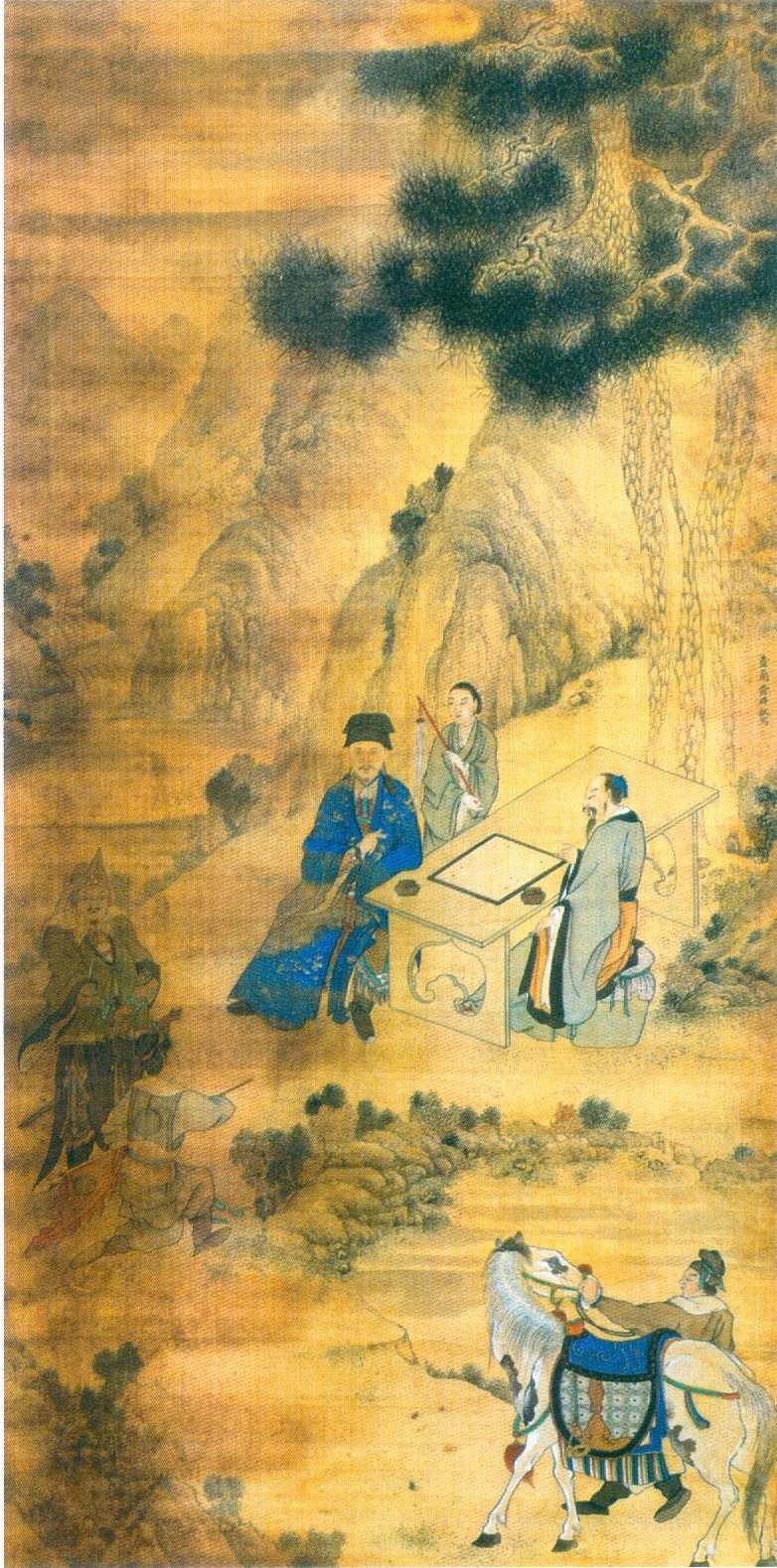
In 1644, the rebel Li Zicheng took Beijing and the Ming dynasty fell; the Manchu Qing armies entered China and the country descended into dynastic war. Zhilong helped enthrone the Prince of Tang in Fuzhou as the Longwu Emperor. In 1645, the young Zheng Sen impressed the emperor, who granted him the imperial surname Zhu and the name Chenggong, "Success", and made him Earl of Zhongxiao. From then on he called himself "Chenggong of the Imperial Surname", and people called him Guoxingye, the Lord of the Imperial Surname. Dutch traders wrote the Hokkien pronunciation down as Koxinga — a name that spread across Europe and became the only name by which the West knew him.
CHAPTER TWOThe Father Surrendered; the Son Did Not
In 1646, as Qing armies closed on Fujian, Zheng Zhilong chose to surrender. He believed submission would preserve the family's fortune; instead it began his house arrest in Beijing. Qing troops took Anping, and Chenggong's mother, Tagawa Matsu, took her own life. In the same year the Longwu Emperor died in the fighting and the Fuzhou court collapsed. At 22, Chenggong had lost his father to surrender, his mother to death and his emperor to war. All he had left was a remnant of his father's old force — and four words: "Overthrow the Qing, restore the Ming."
He chose to keep fighting. In 1655, the Yongli Emperor, in exile in the southwest, made him Prince of Yanping. Along the Fujian coast he built 72 military garrisons and six civil bureaus, turning Kinmen and Xiamen into a sea fortress. His fleets seized Qing grain ships and collected fees from passing merchantmen, funding a large army with trade. Between 1657 and 1659 he launched three northern expeditions; the last was the grandest. In June 1659, 83 camps, more than 100,000 men and over 3,000 warships sailed up the Yangtze, and on 12 July they laid siege to Nanjing. But Chenggong did not storm the city at once — he waited for the gates to open on their own, and for his army to rest. While he waited, Qing reinforcements arrived. On 24 July the Qing army sallied out and fought a decisive battle; Chenggong's army was routed and fell back to Kinmen and Xiamen. Nanjing was the closest he ever came to victory — and the furthest.
On 10 May 1660, a Qing fleet of more than 300 ships and 40,000 men attacked Xiamen. Chenggong struck back with the tide and destroyed the Qing fleet at Haimen harbour. He won — but it was a costly victory: he lost more than half his own ships. That same year the Qing court ordered the coastal evacuation, forcing seaboard residents inland and cutting Chenggong's ties with the mainland still further. On 5 February 1661, the Shunzhi Emperor died and the boy Kangxi took the throne. Two small islands, Kinmen and Xiamen, could no longer hold his army or his ambition. He Bin, a Chinese interpreter who had once worked for the Dutch in Taiwan, brought him a map of the island and urged him to seize Tayouan: fertile land, deerskins, sugar, and a port the Dutch had run for 38 years. The decision to cross to Taiwan was the product of military pressure, the need for grain and commercial calculation together; the evacuation order merely gave it a push.
CHAPTER THREELuermen
On 23 March 1661, Chenggong held a sacrificial ceremony at Liaoluo Bay in Kinmen and set sail; on 30 March he departed from Penghu a second time. His fleet — nearly 900 warships and 25,000 officers and men — crossed the Taiwan Strait. At dawn on 30 April, riding the flood tide, it forced its way through the Luermen channel into the Taijiang lagoon — a shallow passage the Dutch had never imagined anyone could enter.
On 4 May, Fort Provintia at Chikan surrendered. Chenggong then laid siege to Fort Zeelandia at Tayouan. Its garrison numbered only 1,100 men, against an army more than 20 times its size, but the fort was built of stone and its cannon could not be breached; the siege lasted 9 months. In September 1661, a relief fleet sent from Batavia was defeated in the lagoon; on 12 January 1662, Chenggong's guns concentrated on the Utrecht redoubt, and the defenders' morale finally broke. On 1 February 1662, Governor Frederick Coyett signed the surrender, and the two sides signed a treaty: the Dutch handed over the fort and their weapons, and Chenggong allowed them to leave with their personal belongings. On 17 February, the Dutch sailed away from Taiwan. Thirty-eight years of Dutch East India Company rule on the island came to an end.
The victory shocked Europe. The historian Tonio Andrade has called it "China's first great victory over the West": a Chinese general had expelled a European colonial army by siege. The Dutch East India Company lost more than a fort — it lost one of its most profitable entrepôts in East Asia.
CHAPTER FOURDongdu, the Eastern Capital
Less than two months after landing, on 14 June 1661, Chenggong proclaimed his government: six ministries — personnel, revenue, rites, war, justice and works — Chikan renamed "Dongdu Mingjing", the Eastern Capital, the Chengtian Prefecture established with Tianxing and Wannian counties, and Anping Town as the capital district. Tianxing was seated at Jialixing, Wannian at Erzanhang. A pirate family's fleet had grown the skeleton of a kingdom. Soldiers were settled on the land by garrison — military farming — with reclamation stretching north to Kavalan and south to Langqiao. Chen Yonghua, his most trusted adviser, had managed trade and farming for him in Xiamen; in Taiwan he took charge of the state.
But the founding king ruled for only 13 months. On 23 June 1662, Chenggong died of illness in Chengtian Prefecture. In the same year, the Yongli Emperor was executed in Kunming by Wu Sangui, and the Southern Ming came to an end. Chenggong had kept the Yongli reign name to his death; his kingdom, however, only truly began after it. His son Zheng Jing won the succession struggle and, in 1664, renamed "Dongdu" to "Dongning" — Dongdu was a travelling capital, a temporary seat; Dongning meant a peaceful East, a place to stay. In 1665, on Chen Yonghua's advice, Taiwan's first Confucian temple was built in Tainan; military farming, salt-making, the civil examinations and the baojia system followed one by one. Dongning was no longer just an army's camp. It was beginning to look like a state.
CHAPTER FIVEDongning: A Kingdom of Sons
Zheng Jing's 19 years (1662–1681) were Dongning's most state-like. In 1672 he signed a trade treaty with the English East India Company, exporting sugar and deerskins, importing muskets and cannon, and even asking the English to train his gunners. When the Revolt of the Three Feudatories broke out in 1673, he crossed the sea to join the war, taking Zhangzhou, Quanzhou, Chaozhou and Huizhou, his armies at one point reaching deep into China's southeast coast. But after his ally Geng Jingzhong surrendered to the Qing, Zheng's forces were beaten back again and again, and in 1680 he withdrew entirely to Taiwan. On 17 March 1681, Zheng Jing died from injuries after a fall from his horse while hunting, aged 40. The heir he had named, Zheng Kezang, was murdered in a coup; the young Zheng Keshuang was put on the throne in his place.
The end came quickly. In June 1683, the Kangxi Emperor ordered Shi Lang to conquer Taiwan; on 10 July, Shi Lang destroyed Liu Guoxuan's fleet in the waters of Penghu, and on 16 July he took the islands. In September, Zheng Keshuang submitted his surrender; Zhu Shugui, the Prince of Ningjing, took his own life in Ming dress. In October, Shi Lang entered Taiwan to accept the surrender. Counted from the taking of Fort Zeelandia in February 1662, Dongning had lasted 21 years. In 1684, the Qing established Taiwan Prefecture under Fujian. The Zheng royal house and its officials were moved to the mainland; even the tombs of Chenggong and Zheng Jing were relocated. A kingdom named for Taiwan ended without leaving even its graves on the island.
EPILOGUEAfter His Death, He Became Three Men
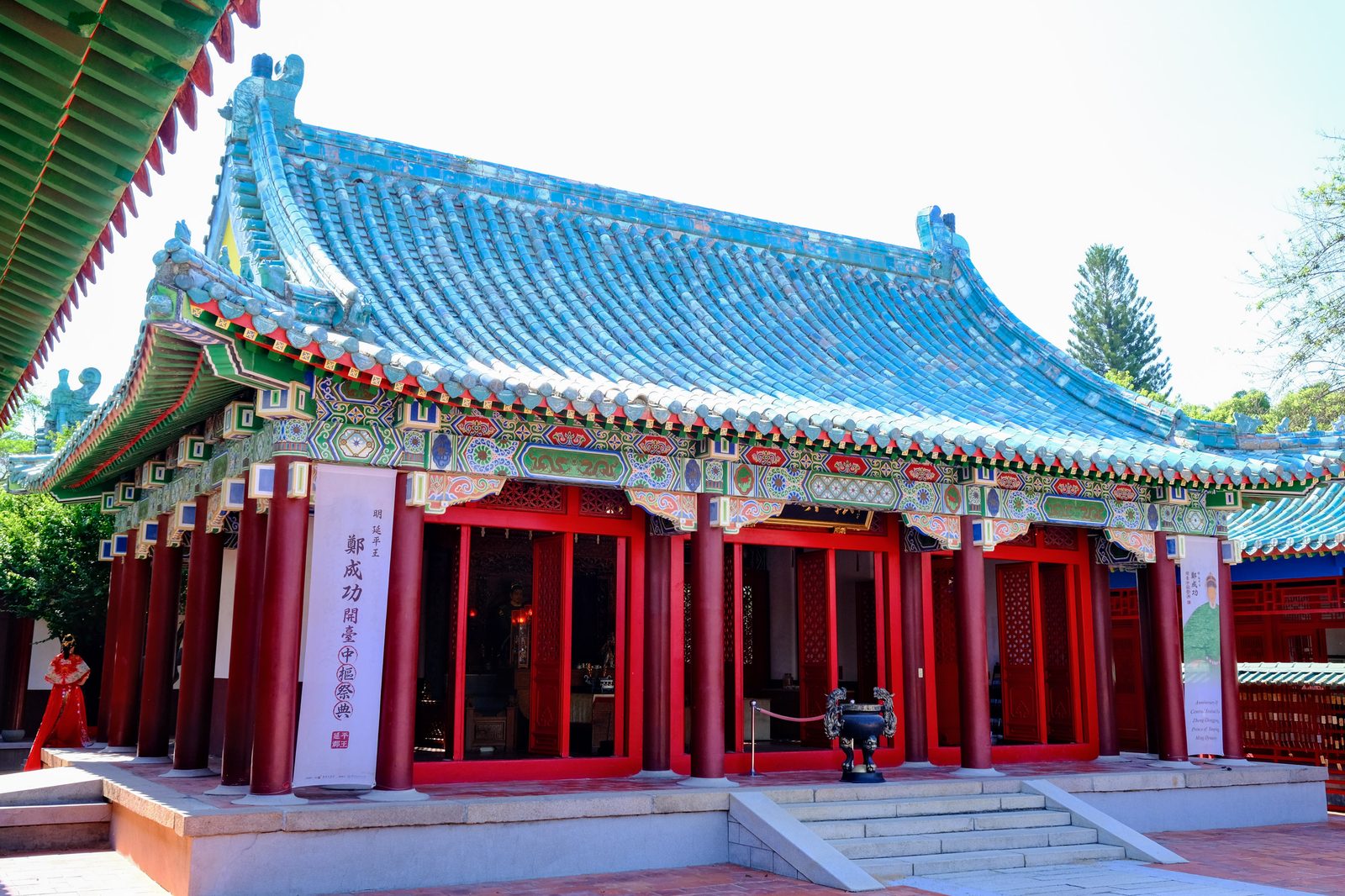
The people of Taiwan did not forget him. After Dongning fell, they built the Kaishan Wang Temple in Tainan to worship him — under Qing rule the word "king" was dangerous, so the "shan", mountain, in the name quietly meant Taiwan: the sage-king who opened Taiwan. After the Mudan incident of 1874, Shen Baozhen came to Taiwan to organise its defences and petitioned for a dedicated shrine; on 15 February 1875, the court approved, posthumously granted Chenggong the name Zhongjie, "Loyal and Steadfast", and raised the temple to the Yanping Junwang Shrine, entered in the state's spring and autumn rites. Under Japanese rule it became the Kaishan Shrine; in 1963 it was rebuilt in the form seen today. Of the more than 100 temples in Taiwan dedicated to Chenggong, it is the only one built by the state.
In Japan he became a hero of the stage. In 1715, Chikamatsu Monzaemon's "The Battles of Coxinga" premiered at the Takemoto Theatre in Osaka and ran for 17 months, a sensation. Its hero, Watōnai, was modelled on Chenggong — but with a happier ending than history allowed: on stage he fights his way back to China, rescues his mother and restores the Ming. The Japanese turned a foreign general into one of their own heroes.
In the West he became a name. Koxinga — a name transliterated from the Hokkien for "Lord of the Imperial Surname" — was the first Chinese name by which Europe came to know Taiwan. In that same era, in 1660 Charles II returned to London and the English monarchy was restored; in 1661 China's Shunzhi Emperor died and Kangxi came to the throne; in 1662 the last emperor of the Southern Ming was executed in Kunming. Old dynasties were ending at both ends of Eurasia at once, and new orders were beginning. Chenggong's 21-year kingdom, caught between those two endings, burned briefly and brightly: it did not restore the Ming, but it gave Taiwan its first name centred on itself — Dongning.
What does a man leave behind? Chenggong left no territory. He left a question: how does an island become itself in the narrow space between empires? More than 300 years later, that question has not gone out of date.