PROLOGUETwo Scents
Before 1860, Taiwan was an island on the edge of the Qing Empire — mountainous, small-ported, barely a name on the world map. What changed it was not a war, nor a king, but two scents: the aroma of a cup of tea and the smell of a lump of camphor. One came down from the hills of the north, the other out of the deep mountains of the centre. Both boarded foreign merchant ships for New York, London and Yokohama, and for the first time an island put its name on the map of world trade with goods of its own.
This essay is about the 30-odd years after the ports opened in 1860: how tea and camphor became global commodities, how the tea merchants of Dadaocheng and the camphor workers in the mountains were pulled into the same web of world trade, and how a war fought over camphor rewrote an island's fate.
CHAPTER ONEThe Opening of the Ports
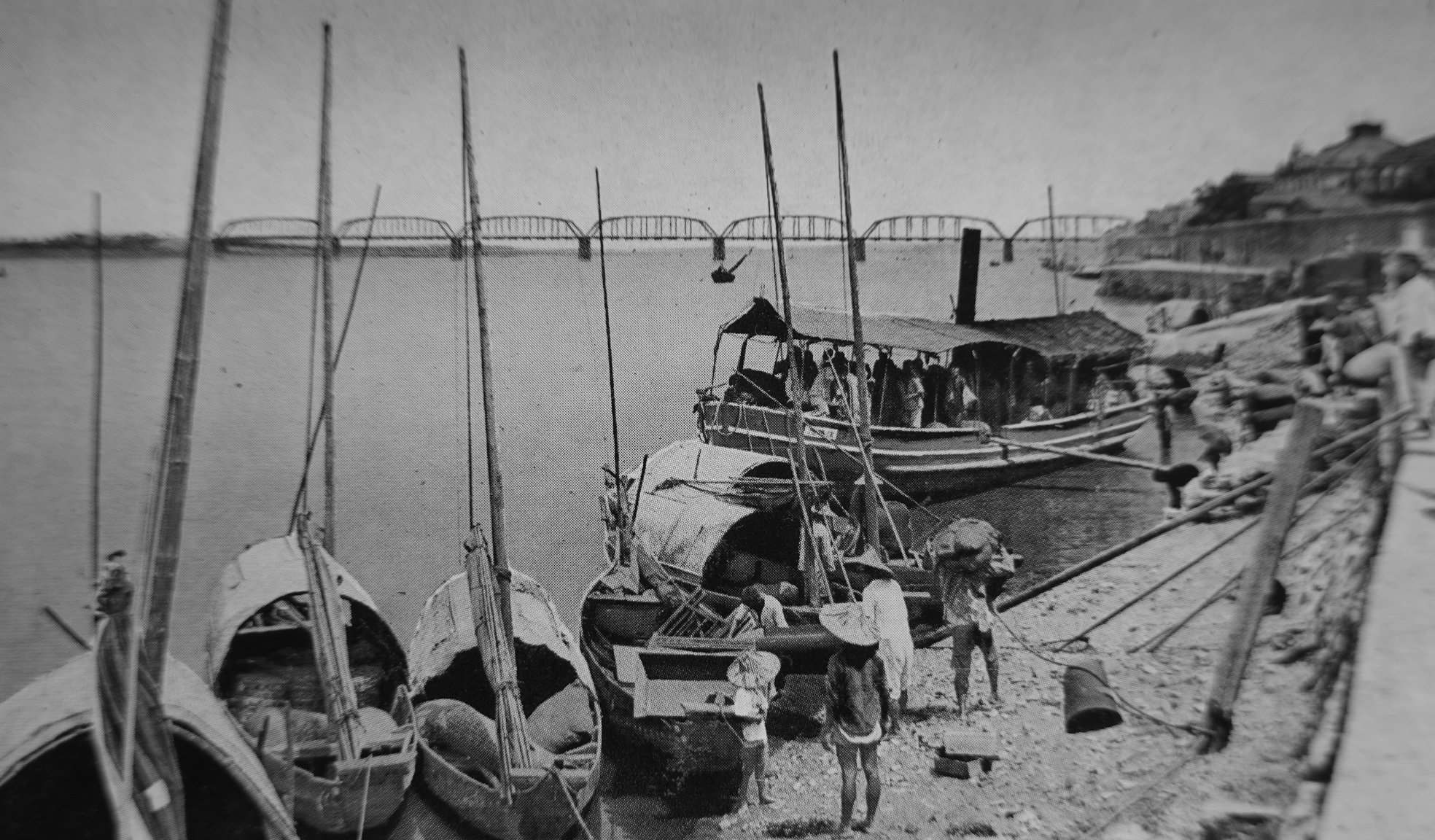
The story begins with a treaty. After the Second Opium War (1856–1860), the Qing court signed the Treaty of Tianjin in June 1858 and the Convention of Peking in 1860, and the Taiwanese ports of Tamsui and Anping were forced open to foreign merchants. In 1861, Robert Swinhoe, Britain's first consul in Taiwan, set up his consulate in Anping and moved it to Tamsui the following year; Takao (today's Kaohsiung) opened in 1864, and Keelung followed. Within a few years, foreign trading houses, consulates and customs offices had moved in, and missionaries came ashore with them.
Before the ports opened, Taiwan's foreign trade had to pass through Xiamen and Fuzhou on the mainland; the island could not see the world, and the world could not see what the island had. After the opening, ships could sail straight up the Tamsui River and load ocean-going vessels directly. The trading houses brought in opium and foreign goods, and took away sugar, tea, camphor and coal. For the first time, Taiwan became a direct supplier to the world market, not a small line on someone else's transshipment manifest.
The timing is worth noting: in the same years that Taiwan's ports opened, the old order of trade was retiring. The British East India Company lost its rule over India in 1858 and was formally dissolved in 1874. The company-state that had dominated Asian trade for more than 200 years walked off the stage, replaced by free-trading merchants, the consuls of nation-states and customs houses. Taiwan was not taken over by a company; it was taken over by a whole new set of rules — rules called free trade, whose price was paid by the people on the island.
CHAPTER TWOWhite Gold
Camphor's first secret hides inside a tree. The camphor laurel (Cinnamomum camphora) is a large evergreen native to East Asia; chip its wood, distil it, condense the vapour, and you get white crystals. The Chinese had used them for a thousand years: as medicine, as insect repellent, in ritual. Once it reached Europe, it remained a costly medicine in the apothecary's shop.
In the 19th century, camphor's uses changed suddenly. In 1870, the American brothers John and Isaiah Hyatt mixed nitrocellulose with camphor to make celluloid — the first man-made plastic, turned into combs, buttons and spectacle frames, and later the raw material of motion-picture film. In 1884, the Frenchman Paul Vieille invented smokeless powder, with camphor as a key ingredient, letting rifles be built with smaller bores and higher rates of fire; modern warfare changed from that moment. A single white crystal walked into the cinema and onto the battlefield at the same time.
And nearly all the world's camphor grew in Taiwan and Japan. By the early 19th century, China's own camphor trees had been cut to exhaustion; only Taiwan and Japan still held great camphor forests, and Taiwan's output far exceeded Japan's. From the late 19th century to the middle of the 20th, more than 70% of the world's camphor was exported from Taiwan; from 1910 to 1916, Taiwan produced about 56% of the world's camphor every year, most of it for military use. Camphor was not merely a Taiwanese speciality; it was the first world-class strategic material the island ever held in its hands.
The question was who had the right to sell it. The Qing court had made camphor a monopoly long before: only the craftsmen who built official warships could legally go into the mountains to cut timber and make camphor, and the income kept the navy afloat. In 1863, the naval timber warehouses were formally converted into camphor works, contracted out to Han merchants who paid a share of the profit to the government. To foreign merchants, that was a monopoly: to buy camphor you had to go through the government, and neither the price nor the quantity was yours to decide.
CHAPTER THREESeven Cannon Shots
The British merchants protested first. In 1867, Rutherford Alcock, the British minister in Beijing, lodged a formal complaint about Taiwan's camphor monopoly with Prince Gong. The next year, William Pickering, the Taiwan representative of Elles & Co. — a contractor of the British firm Dent & Co. — was ordered to buy camphor. He bought about $6,000 worth of crude camphor at a small port north of the prefectural capital, and the circuit intendant Liang Yuan-kui had it seized. The two sides were stuck.
When talks broke down, the acting consul John Gibson chose force. On the morning of 21 November 1868, the British gunboats HMS Bustard and HMS Algerine sailed into Anping harbour with their guns trained on the whole town; at 4pm on 25 November, the Algerine fired 7 cannon shots at Anping. British troops then occupied Anping for 2 months, until the Qing court gave way.
The camphor regulations signed afterwards ended the Qing camphor monopoly, opened the trade to all, and made the Qing pay restitution to British merchants for earlier losses. About 20 years later, the governor Liu Ming-chuan tried to restore the monopoly — but that is another story. For the people of Taiwan, this war of 7 cannon shots cost more than humiliation: camphor was freed from the government's hands, only to flow from Taiwanese hands into foreign trading houses. The door of free trade had opened; a different set of people stood at the door collecting the money.
The Camphor War also carried a cost that is often overlooked. The camphor trees grew in the traditional territories of the indigenous peoples, and Han camphor workers pushing into the mountains met constant conflict; output fell, violence spread, and in the 1870s Taiwan's camphor exports to Hong Kong dried up. The white crystals the world wanted were paid for with forests and lives. Behind every lump of camphor there was a road into the mountains — and a road back that some never took.
CHAPTER FOURA Scotsman and a Comprador from Xiamen
John Dodd had come for camphor in the first place. The Scots merchant reached Hong Kong in 1859 and first visited Taiwan in 1860; he landed again in 1864 and did not leave for 30 years, serving from the following year as the resident representative of Dent & Co. in Tamsui. He went into the northern mountains looking for camphor, and soon found something with a brighter future: tea, growing on the hills of northern Taiwan.
Taiwan then had no large-scale tea industry. In 1865, introduced by Elles & Co., the Xiamen merchant Li Chun-sheng became Dodd's comprador — the middleman between a foreign trading house and local suppliers, who knew the language, the prices and the people. Li had left his hometown after the Taiping Rebellion wrecked its economy and crossed the strait to rebuild his life in Taiwan; Dodd wanted to grow tea there. Two outsiders ended up on the same boat.
In 1866, Dodd brought oolong seedlings from Anxi in Fujian, lent them to farmers on credit, taught them to plant and process tea, and hired tea masters from Fujian to refine it in Dadaocheng. Three years later, in 1869 — the same year the Suez Canal opened — two large sailing ships carried 2,131 dan, about 129,000 kilograms, of oolong from Tamsui straight to New York, the chests stamped "Formosa Oolong Tea". The tea sold out on arrival, and within a year the price per dan had doubled, from $15 to $30.
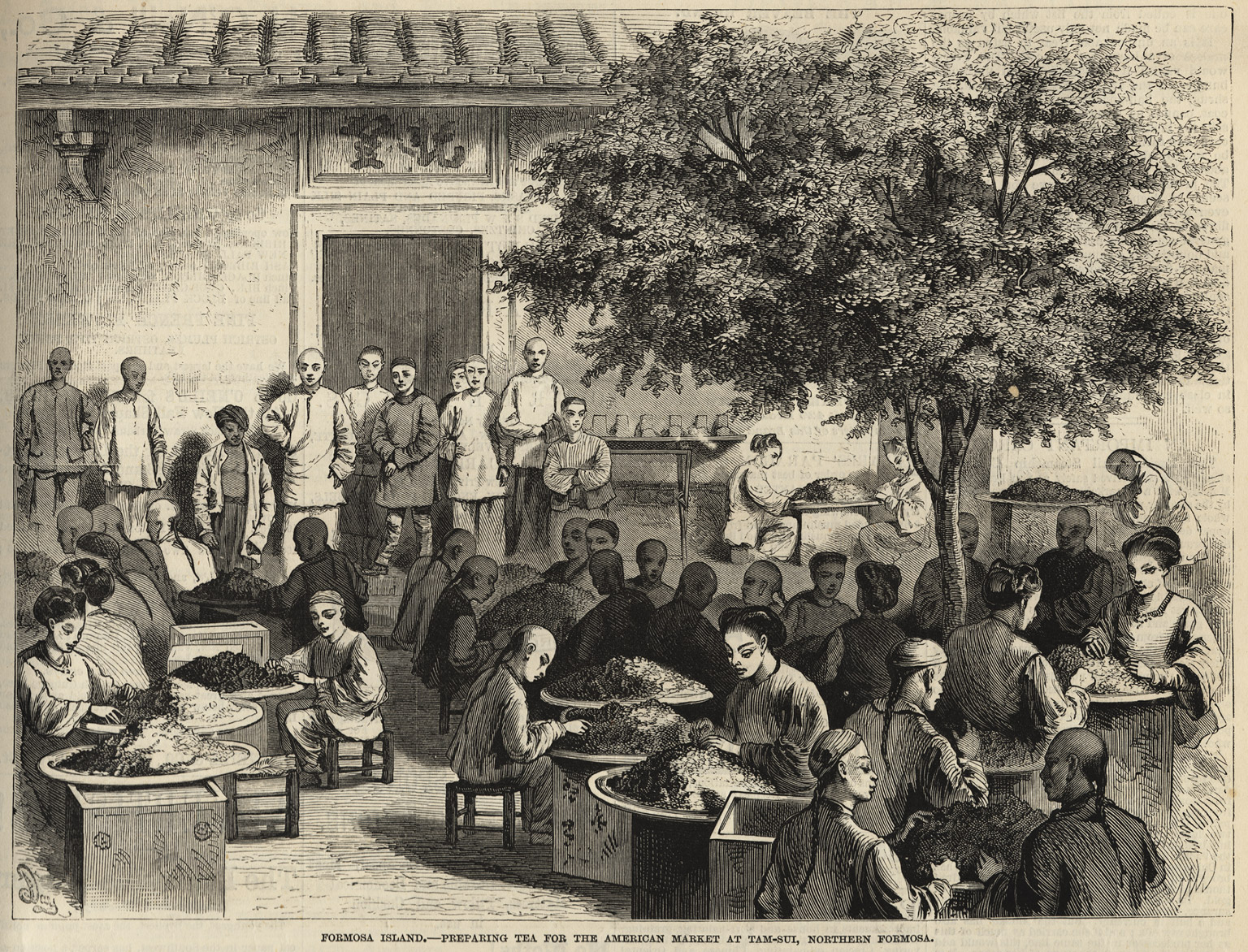
The shipment mattered not for its price but for its route. Until then, Taiwanese tea could only be shipped to Xiamen for refining and re-export, with the profit and the pricing power in Xiamen merchants' hands. Dodd and Li kept the refining in Dadaocheng and sailed the ships directly to New York, rewriting the rule. From 1870, 5 large trading houses opened branches in Tamsui and Dadaocheng in turn, rushing into the new business. Dadaocheng, once a small Tong'an settlement on the Tamsui River, became the richest place in Taiwan.
CHAPTER FIVEDadaocheng
Tea changed everything. Its share of Taiwan's total exports rose from 7% in 1868 to more than 50% within 10 years; according to Tamsui customs records, the volume of tea exported from Taiwan grew a hundredfold between 1866 and 1892. At its height, more than 250 tea firms and trading houses lined Chongqing North Road, Yanping North Road, Dihua Street and Guide Street in Dadaocheng — picking, sorting, packing and clearing customs, the whole street working as one factory.
Tea changed the hills too. Tea bushes spread across the hills around Dadaocheng — today's Nangang and Shenkeng, the banks of the Xindian River — everywhere, until they stopped at the edge of indigenous territory. Tea gardens needed workers, workers needed houses, houses needed streets, and a port settlement grew into a city. Wang Tea, founded in 1890, still sells tea on Dihua Street; the Xinfangchun tea house, built in 1934, is a listed historic building in Taipei today.
Li Chun-sheng himself was the change in miniature. He rose from comprador to one of the richest tea merchants in Taiwan, and in 1915 he single-handedly funded the building of the Dadaocheng Church, which is still in use. A merchant from Xiamen made his money on an island, and gave the money back to the island's streets. Tea was never just a commodity; it was how a generation of people made a living.
EPILOGUEAfter the Scents Faded
In 1895, Taiwan was ceded to Japan, and the fates of tea and camphor parted. The Japanese Government-General set up the Nanmen Factory in 1899 and took camphor into a state monopoly, imposing a complete monopoly in 1919; camphor went from a free-traded commodity back to a state-controlled strategic material. Tea stayed, and kept sailing out of the Tamsui River to the world.
Camphor's golden age lasted into the middle of the 20th century. As synthetic camphor and petrochemical products rose, demand for the natural product fell away, and the monopoly business closed in 1967. The Nanmen Factory is now the Nanmen Park of the National Taiwan Museum, where the stills and camphor models on display sit as quiet as a monument.
Looked back on, the story of tea and camphor is a single story: how an island was seen by the world, and what it paid for being seen. The opening of the ports gave Taiwan's produce a world price for the first time, and tied the island's fate to the rise and fall of the world market for the first time. In 1874, the British East India Company was formally dissolved, and the age of the company-state ended; but the order of free trade did not end — it only changed its shape, and it is still running today.
In today's Dadaocheng, the tea houses are still there, but the smell of camphor has long since faded. Walking down Dihua Street, you smell tea, medicinal herbs and dried goods; the camphor trees still stand in the mountains, but no one fights a war over them any more. Two scents: one stayed and became a culture, the other faded and became history. That was how an island first walked into the world — not with an army, but with a cup of tea and a lump of camphor.
Tea and camphor were once what the world wanted. Today, Taiwan holds something else the world wants — chips. Will the 7 cannon shots fired for camphor, and every contract signed for chips today, turn out to be the same story?