PrologueBerlin, October 1961
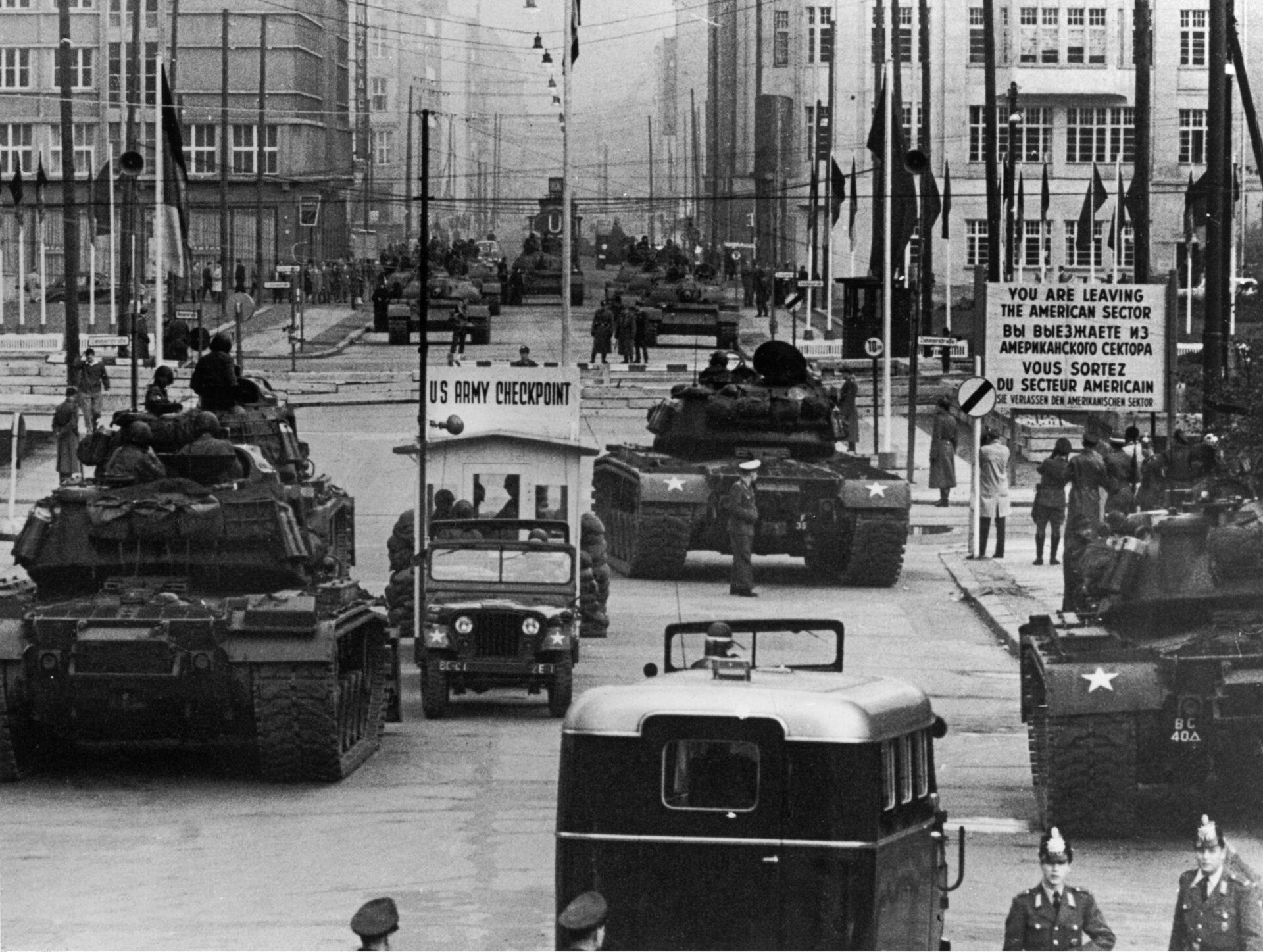
On October 27, 1961, at Checkpoint Charlie in Berlin, American and Soviet tanks stood less than a hundred metres apart, barrels aimed at each other, for sixteen hours.
It was the closest the two superpowers' armies ever came to firing on each other in more than forty years of Cold War. Nobody fired the first shot — not for lack of reason, but because both sides could do the arithmetic: after the first shot, there would be no second day.[8]
The Cold War was a war of that kind. From 1947 to 1991, the United States and the Soviet Union never fought each other directly, yet they turned the whole world into a chessboard. At their peak, their nuclear arsenals held more than 60,000 warheads — enough to destroy human civilisation several times over. The war never broke out, not because the hatred ran shallow, but because the destruction was too certain.
This is the story of how humanity walked along the edge of a cliff for more than forty years — and why, in the end, it was the side that let go that walked off the cliff first.
Chapter OneOne Speech Divides the World
On March 5, 1946, the former British prime minister Winston Churchill spoke in Fulton, Missouri: "From Stettin in the Baltic to Trieste in the Adriatic, an iron curtain has descended." He was not prophesying. He was describing what was already happening: one Eastern European country after another falling under Soviet control, the wartime alliance turning into rivalry.[5]
A year later, America answered. On March 12, 1947, President Harry Truman asked Congress for aid to Greece and Turkey, declaring that the United States would support all free peoples resisting subjugation — the Truman Doctrine. On June 5 that same year, Secretary of State George Marshall proposed the European Recovery Program at Harvard University: between 1948 and 1951, sixteen countries received more than thirteen billion dollars in aid, helping Western Europe rise from the rubble.[1][2]
Moscow answered in kind. In September 1947 it founded the Communist Information Bureau; in January 1949, the Council for Mutual Economic Assistance. Each camp now had its own political, economic, and military organisations — NATO, founded on April 4, 1949, with twelve founding members, and the Warsaw Pact, signed on May 14, 1955, binding the Soviet Union to seven Eastern European states. The bipolar order was complete.[5]
What matters is that the Cold War was never, from the start, a quarrel between two men. It was a confrontation between two systems. In July 1947, the American diplomat George Kennan published the famous "X Article" in Foreign Affairs: Soviet expansion, he argued, sprang from an inner sense of insecurity, and America did not need war — only a long policy of containment, waiting for the other side to exhaust itself. Containment became the master strategy of American foreign policy for the next forty years.[7]
The terrible thing about a confrontation between systems is that it runs without hatred. Two systems, each allied, each armed, each broadcasting its own story; neither dares strike first, neither will let go first — because the side that lets go fears it will never grip again.
Chapter TwoBerlin: One City, Two Trials
The Cold War's first direct test came in Berlin. On June 24, 1948, the Soviet Union cut all land access to West Berlin, trapping more than two million people in an island inside the Soviet occupation zone. The Americans and British neither yielded nor went to war. They chose the air: nearly 280,000 flights delivered more than 2.3 million tons of supplies over eleven months, until the blockade was lifted on May 12, 1949.[9]
The blockade's immediate consequence was the division of Germany: the Federal Republic of Germany was founded in September 1949, the German Democratic Republic the following October. People who shared one city and one language now lived under two systems. Berlin became the Cold War's shop window — bright lights on one side, slow decay on the other, and a line between them nobody dared to cross.
On August 29, 1949, the Soviet Union tested its first atomic bomb. From that day, the nature of the threat changed: war was no longer about "winning" but about "dying together." America's nuclear monopoly had lasted barely four years.
On August 13, 1961, East Germany built the Berlin Wall overnight. Between 1945 and 1961, some 3.5 million East Germans had fled to the West; the Wall was built to plug that hole. Two months later, American and Soviet tanks faced each other at Checkpoint Charlie for sixteen hours, and Kennedy and Khrushchev each stepped back. The standoff had no winner, only a lesson: at the edge of a cliff, even a probe must leave room to brake.
Berlin's first lesson to the world was this: the most dangerous moments of a standoff are often not when both sides resolve to fight, but when each believes the other dare not.
Chapter ThreeOther People's Battlefields
The superpowers did not fight each other directly, so they had others fight. The Korean War broke out on June 25, 1950, and ended in an armistice on July 27, 1953 — the line drawn at Panmunjom is still there today. American forces intervened massively in Vietnam in 1965; Saigon fell in 1975. In 1956, the Hungarian uprising and the Suez Crisis erupted in the same year; in December 1979, the Soviet Union invaded Afghanistan and sank into nine years of quagmire. Every proxy war was the two superpowers testing each other's limits on someone else's soil.[5]
The contest reached into space as well. On October 4, 1957, the Soviet Union launched Sputnik 1, the first artificial satellite; on April 12, 1961, Yuri Gagarin became the first human in space; in July 1969, America put men on the Moon. The space race was powered by missiles: whatever can carry a satellite into orbit can carry a warhead to the other side of the world. Scientific glory and the technology of destruction were two sides of the same coin.
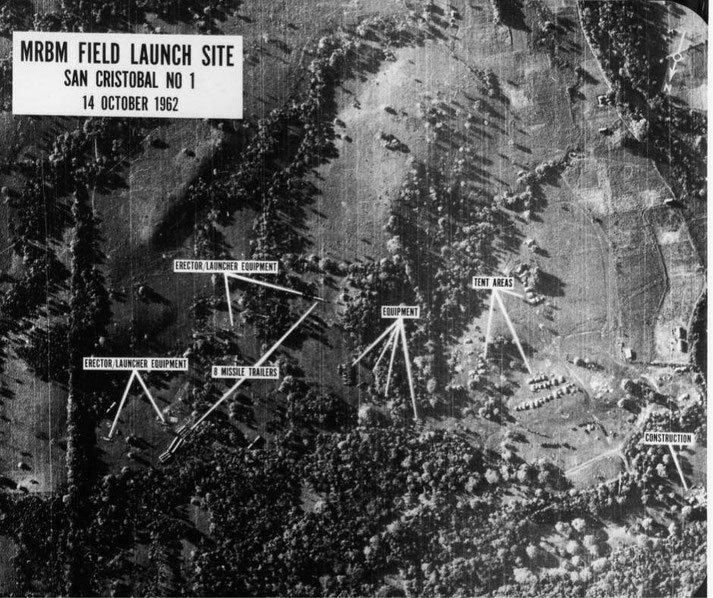
The most dangerous moment came in October 1962. American reconnaissance discovered Soviet missiles in Cuba, barely 145 kilometres from Florida. For thirteen days, Kennedy and Khrushchev confronted each other before the whole world; the US Navy blockaded the island, and Soviet ships sailed toward the line. The world was one misjudgement away from nuclear war. In the end, Khrushchev agreed to withdraw the missiles, America pledged not to invade Cuba, and quietly removed its missiles from Turkey.[3][10]
After the crisis, a hotline was installed between Moscow and Washington. Even enemies need a line they can speak across — the most practical lesson the Cuban Missile Crisis left behind.
Chapter FourSixty Thousand Warheads
The numbers of the arms race still chill the blood. In 1986, the world's nuclear stockpile peaked at about 64,500 warheads — more than 40,000 Soviet, more than 23,000 American. The American stockpile itself had peaked in 1967 at about 31,255 warheads, when the US population was roughly 200 million: on average, one warhead for every 6,400 people.[4]
Deterrence had a formal name: mutually assured destruction. It did not mean "I can win." It meant "if you strike, we die together." Absurd, but effective — precisely because it was so absurd, neither side dared to test whether it was real. Peace was not built on trust. It was built on the certainty of dying together.
Détente did appear, more than once. In 1972, the two sides signed the Strategic Arms Limitation Treaty and the Anti-Ballistic Missile Treaty; in 1975, thirty-five nations signed the Helsinki Accords. But the Soviet invasion of Afghanistan in 1979 ended the thaw. Ronald Reagan called the Soviet Union an "evil empire" and launched the Strategic Defense Initiative — nicknamed "Star Wars." The race returned to its starting point: whoever builds more, feels safer.
The most frightening story happened on September 26, 1983. A Soviet early-warning satellite falsely reported incoming American missiles. The alarm sounded, and duty officer Stanislav Petrov faced a choice: report it up the chain, and the machinery of retaliation would start moving. He looked at the data, judged it a system error, and did not report it. One man's judgement stopped a war that did not exist. The incident was not made public until the 1990s. The Cold War never turned hot, in part, because of sheer luck.[11]
Chapter FiveThe Man Who Let Go
In March 1985, Mikhail Gorbachev took power in the Soviet Union. The economy had stalled, technology lagged, and Afghanistan was still bleeding. He launched perestroika and glasnost, hoping to let a little air into the system — never imagining that once the air came in, the whole structure would begin to loosen.
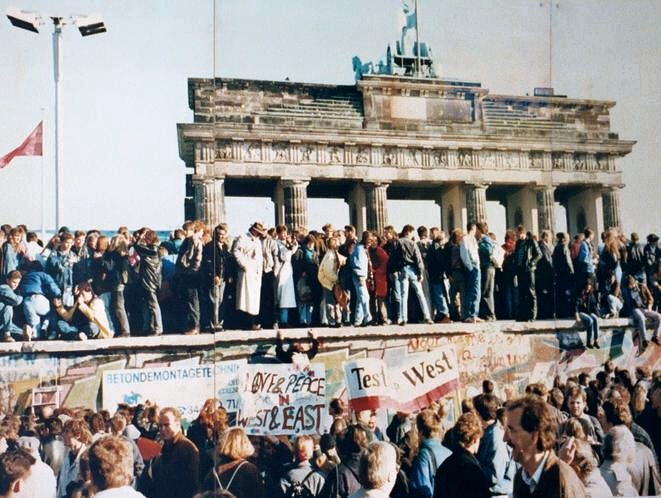
In December 1987, the two sides signed the Intermediate-Range Nuclear Forces Treaty, destroying an entire class of nuclear weapons for the first time. In 1989, Eastern Europe broke free: the communist regimes of Poland, Hungary, Czechoslovakia, and Romania fell one after another. On November 9, 1989, the Berlin Wall came down. On October 3, 1990, Germany reunified.
In August 1991, Soviet hardliners attempted a coup. It collapsed in three days — the army would not obey, the people took to the streets, and the plotters themselves no longer knew whom to arrest. On December 25, 1991, Gorbachev resigned. On December 26, the Soviet Union formally dissolved, and the red flag came down from the Kremlin. The Cold War ended.[12]
Why was it the Soviet side that let go first? Because in the end, the Cold War was not a contest of missiles. It was a contest of whether a system could feed its people, let them speak, and give them a reason to stay. The moment the Wall fell, East Germans did not rush the tanks — they rushed west. Voting with one's feet is the most honest ballot there is.
Gorbachev wanted to reform the system; the system collapsed instead. Many Russians later blamed him for burying an empire; many in the West thanked him for ending a war. Both are right — and that is exactly what makes history so hard to judge.
EpilogueThe Cliff Is Still There
The Cold War ended. The logic of confrontation did not. Nine countries hold nuclear weapons today, with a total of about 12,500 warheads. Great-power rivalry has new names — proxy wars, technology races, economic decoupling — but the cliff has not gone away. It has only moved.[4]
The Cold War left three lessons. First, the certainty of destruction preserves peace better than the hope of victory — but it is peace on a tightrope, with no net below. Second, the contest between systems is ultimately a contest of daily life: whichever system lets people live better and speak more freely, wins. Third, even enemies need a way to talk: the thirteen days of 1962 proved that the most dangerous standoff still needs a hotline.
In those sixteen hours of October 1961, the tank barrels never fired. Thirty years later, the Wall fell, the Soviet Union dissolved, and humanity walked off the cliff — not because the cliff had vanished, but because someone let go first. Letting go takes more than courage. It takes the judgement that no grip, however tight, can hold a system that cannot keep its own people.