PrologueMarch 25, 1911, 4:40 p.m.
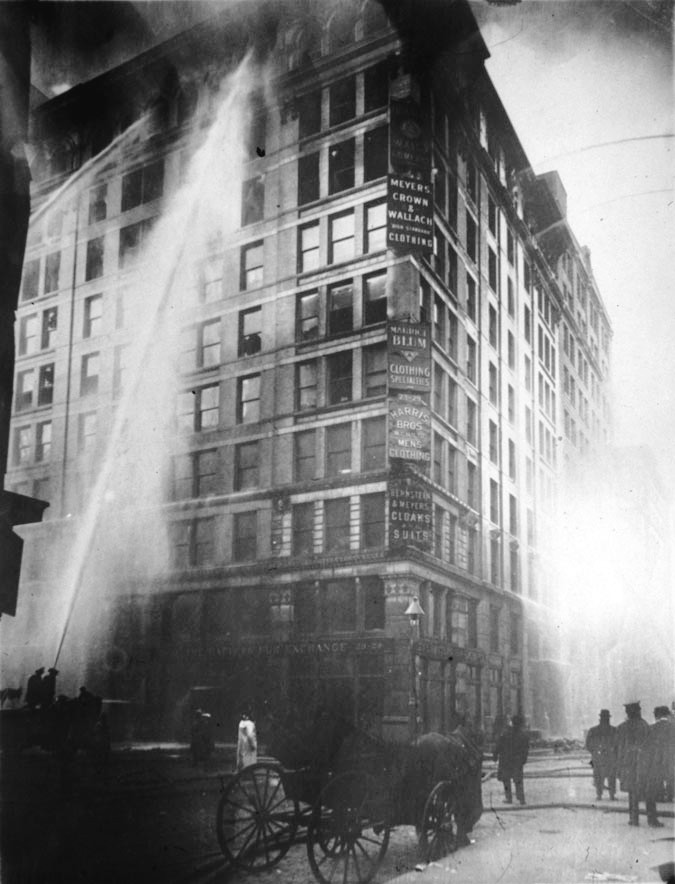
Saturday, March 25, 1911, 4:40 p.m. In the Asch Building, just east of Washington Square in Greenwich Village, Manhattan, the sewing machines were about to stop. The Triangle Shirtwaist Company rented the 8th, 9th and 10th floors of the 10-story building, and some 500 workers were packing up for the weekend — most of them Jewish and Italian immigrant women in their teens and early twenties.[2]
A scrap bin caught fire on the 8th floor, in the northeast corner. It held two months of accumulated cuttings, and a match — or a cigarette butt — dropped under a cutter's table was enough. The fire climbed through cotton cloth and paper patterns, from the 8th floor to the 9th, then the 10th. Eighteen minutes later, 146 people were dead: 123 women and girls, 23 men; the youngest 14, the oldest 43.[1]
The building was advertised as "fireproof." Steel-framed, completed in 1901, it was one of the most modern factory buildings in New York. The fire burned for 18 minutes. The building survived. The people inside did not. This book asks about the distance between those two facts.
Chapter OneOne Blouse, One Sweatshop
Start with the garment. The shirtwaist — a women's blouse that buttoned down the front and tucked into a skirt — was the best-selling women's garment in America in the 1900s: clean, smart, cheap. Cheap is the key word in this whole story.
In 1900, two Jewish immigrants from Eastern Europe — Max Blanck and Isaac Harris — founded the Triangle Shirtwaist Company. In 1902 they moved into the Asch Building, a year after it opened, at 23–29 Washington Place. The firm soon became one of the largest shirtwaist makers in the city, with about 500 workers across three floors.[2]
The people at the sewing machines were mostly fresh off the boat. Jews fleeing persecution in Russia, Italians fleeing poverty in the south, starting work at 14. The 1910 census counted them: of the 7,444,787 working women aged 10 and over in the United States, 865,086 worked in the garment trades.[1] The garment industry was the largest employer of American women — and the most crowded, filthiest, most dangerous one.
The Asch Building's fireproofing was real — steel does not burn. But the floors were wood, the doors and windows were wood, the tables and chairs were wood, the floors were piled with cotton cloth and the walls hung with paper patterns. A building that would not burn, filled with things that would. Worse still was something else: the stairwell doors were locked every working day. Locking the doors was standard practice across the trade, and the reason was stated plainly — to prevent theft, and to prevent workers from taking unauthorized breaks. A shirtwaist was small enough to roll up and hide under a coat, so the owners would rather lock the doors than lose a blouse.[2]
On an ordinary day, a locked door is only an inconvenience. On the day of a fire, it is a sentence.
Chapter TwoThe Winter of 1909: They Had Already Said It
The fire came with a warning. Sixteen months earlier, these same women had laid out every problem, one by one, in a great strike.
Triangle's workers struck first, in September 1909. On the evening of November 22, the union called a mass meeting at Cooper Union's Great Hall, where male leaders talked for two hours and still urged everyone to "think it over." Clara Lemlich, 23, could not stand it any longer — a sewing-machine operator who had already had six ribs broken on the picket line and been arrested 17 times. She took the floor and said, in Yiddish, that she had no more patience for talk, and moved for a general strike at once. The whole hall rose to its feet.[6][8]
The next morning, about 20,000 women walked out of the factories — the strike that became known as the "Uprising of the 20,000." It lasted 13 weeks, through a New York winter, and more than 600 young women were arrested. By February 1910, most manufacturers had signed an agreement: higher wages, shorter hours, union recognition. The Triangle Shirtwaist Company refused to sign the industry-wide agreement.[5]
One detail is often told wrong: Lemlich herself did not work at Triangle, and she was not in the burning building on March 25, 1911.[6] But the demand she had led in the winter of 1909 — unlock that door — was exactly what, 16 months later, 146 people proved with their lives.
Chapter ThreeEighteen Minutes
At 4:40 p.m. on March 25, 1911, the scrap bin on the 8th floor caught first. The fire marshal later concluded that someone had dropped an unextinguished match or cigarette butt into a bin holding two months of cuttings.[2]
Most of the 8th-floor workers got out — the fire started at their feet, and they could see it. But by the time the 9th and 10th floors knew, the stairwells were already a wall of flame. The stairway door on the Washington Place side was locked — locked every day, so a foreman could check every worker's bag at the single open exit. The Greene Street door stood open, but fire and smoke blocked the way.[2]
People ran for the only fire escape: a rusted iron frame bolted to the outside wall, long neglected. The crowd surged onto it, and the heat and the weight twisted it until it broke, dropping about 20 people from nearly 100 feet up.[7]
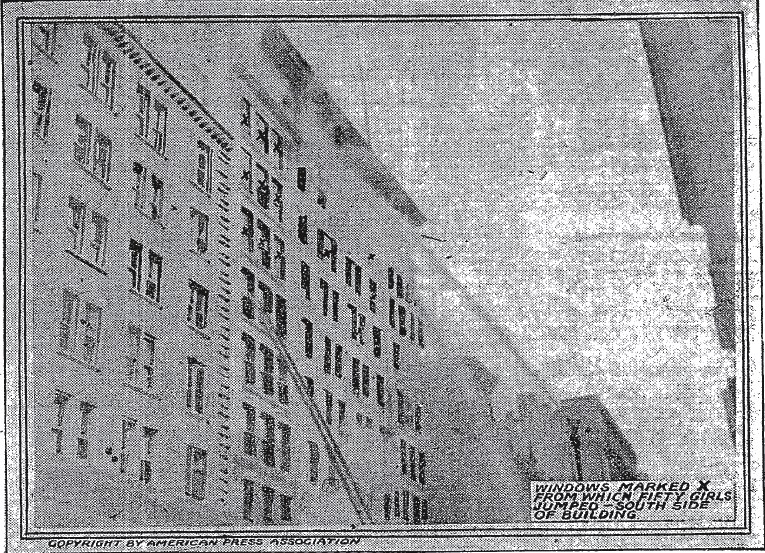
The fire department below could do nothing either. Its ladders reached only as high as the 6th floor, and the hoses had no pressure to reach the 8th.[7] In Washington Square, onlookers watched figures at the windows drop one by one — 62 people jumped or fell to their deaths from the 8th, 9th and 10th floors. From the first cry of "Fire!" to the moment the blaze was under control: about 18 minutes.[3]
Of the 146 dead, six remained nameless for nearly a century. Only in 2011 — the centenary of the fire — did researcher Michael Hirsch identify each of them.[3] All 146 finally had names.
Chapter FourOne Locked Door
The fire was out; the reckoning began. But the reckoning took two years, and it taught a bitter lesson: the law could handle fire, but it could not handle the words "they knew."
On April 11, 1911, a grand jury indicted Blanck and Harris on seven counts of manslaughter. The trial opened on December 4; on December 27, after 1 hour and 45 minutes of deliberation, the jury acquitted both men on all counts.[1][3] The crux was the judge's instruction to the jury: the prosecution had to prove the two owners "knew" the Washington Place door was locked. That the door was locked was a fact everyone knew; the word "knew" was the distance between 146 deaths and an acquittal.
The civil suit, settled two years later, awarded $75 per victim. Seventy-five dollars — about a few weeks' wages for a garment worker. That was the price of a life.[10]
On the afternoon of the fire, Frances Perkins happened to be visiting a friend near Washington Square. Hearing the engines and the screaming, she ran toward the building and watched the girls fall from the windows.[10] Twenty-two years later she became President Roosevelt's Secretary of Labor — the longest-serving in American history. She later said that day was the day the New Deal began. Not because she worked anything out that afternoon, but because what she saw that day she could never forget.
Chapter FiveThirty-Six Laws
The trial disappointed; the legislature moved. What 146 lives bought was not the owners' conviction, but a whole new body of law.
On June 30, 1911, the New York State Legislature created the Factory Investigating Commission, chaired by State Senator Robert F. Wagner, with Assemblyman Al Smith as vice-chairman. The commission toured factories across the state, held hearings and took testimony, and within two years pushed through 36 new state laws: mandatory sprinkler systems, minimum standards for fire exits, limits on the working hours of women and children — including the 54-hour law of 1912. That October, the Sullivan–Hoey Fire Prevention Law took effect, aimed directly at the failures the fire had exposed.[1][3][10]
Those laws became the template for factory safety legislation across the United States. Membership in the International Ladies' Garment Workers' Union surged after the fire — what the strike could not do, death did.[2]
Someone has done the cruel arithmetic: 146 lives, 36 laws — about 4 lives per law. It is a cruel way to keep accounts, but it was how that era kept them. The deeper change was in the idea itself: before the fire, a death in a factory was called an "accident," the price of having a job; after it, at least in law, a death began to be called "preventable" — something someone was responsible for.
EpilogueA Building Still Standing
The Asch Building is still there. It is now the Brown Building, a New York University building and a National Historic Landmark. Every March 25, someone leaves flowers at the door.[2]
But what the fire really left behind was not a building, and not 36 laws. It was a question: cheap has a price. And the price is never paid by the person who buys the cheap thing.
What March 25, 1911 taught the world was not that "fire is dangerous." Fire was always dangerous. What it taught was this: a locked door locks away more than 146 people — it locks away an equation, the question of whether a worker's life is worth the price of a lock. That question, 115 years on, has not expired.