PrologueApril 14, 1935, 4:20 p.m.
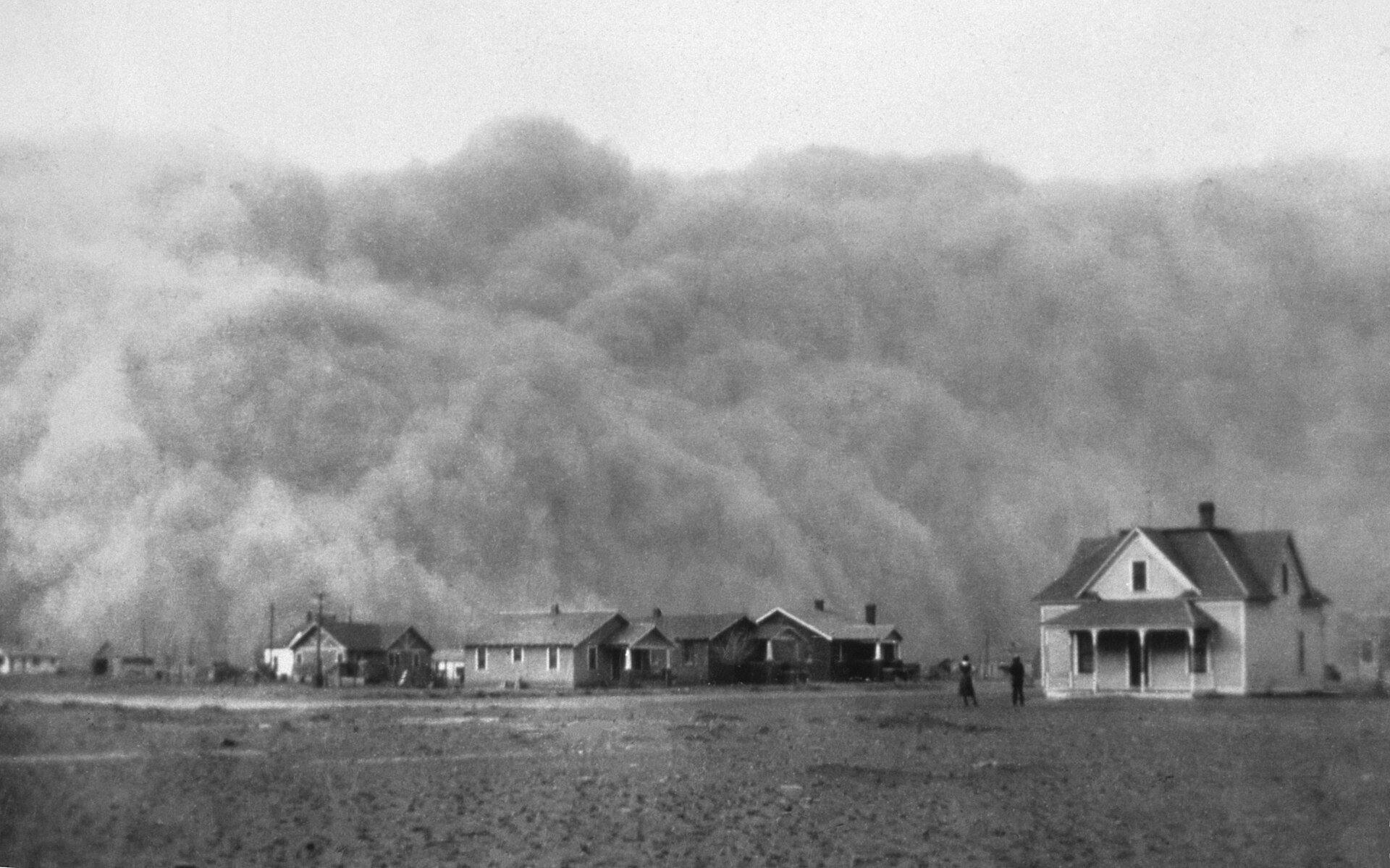
Sunday, April 14, 1935. At 4:20 in the afternoon, Ralph Guy, the Weather Bureau observer in Kenton, Oklahoma, wrote in his log: a severe dust storm had hit, turning the afternoon's brightness instantly into midnight darkness, with absolutely zero visibility.[9] That morning the weather on the Great Plains had been strangely fine — clear, warm, almost windless. By afternoon, a wall of earth rising from the ground to the sky was bearing down from the north at 60 miles an hour.
The National Weather Service later recorded the storm like a marching timetable: the wall swept past Beaver, Oklahoma, at 4 p.m., reached Boise City at 5:15, and swallowed Amarillo, Texas, at 7:20. Winds topped 60 miles an hour, visibility fell to zero, and the temperature plunged by more than a dozen degrees in minutes. The Weather Bureau would later call it "a storm of terror."[1]
Associated Press reporter Robert Geiger and photographer Harry Eisenhard happened to be six miles north of Boise City that day. The storm caught them, and they sat trapped in their car for two hours. The next day, Geiger's dispatch carried a phrase the world had never seen before: the Dust Bowl. From then on, the whole of the Great Plains in the 1930s had a name.[1]
But Black Sunday was not the beginning of a natural disaster. It was the climax of a man-made one.
Chapter OneThe Men Who Turned the Prairie Over
The Great Plains were never meant to fly. The native grasses that covered them — buffalo grass, blue grama — wove root systems metres deep, locking the topsoil to the ground for thousands of years. When the wind came, the grass bent and the soil stayed put. The prairie fed herds of bison, and the peoples who hunted them.
In 1862 the Homestead Act took effect: anyone who paid a small filing fee and agreed to settle and farm the land could claim 160 acres of public land for free. Over the next 40 years the federal government gave away some 270 million acres under the act, about 80 million of them to homesteaders and small farmers.[2] Train after train carried settlers in; plough after plough turned the prairie over.
The real frenzy began with the First World War. The war sent wheat prices soaring, and growing wheat became a shortcut to riches. In the 1920s tractors replaced horses, and one man could break in a day ten times the land he had managed before. Tens of millions of acres of native sod were ploughed under and planted with wheat. By the early 1930s, one-third of the region's farmland lay exposed, with no grass roots left to hold it.[2]
There was a saying at the time: "rain follows the plough" — turn the soil and the rain will come along. A whole era's optimism had been written up as a law of nature. Nobody asked: what if the rain does not come?
It did not come.
Chapter TwoDrought Was Only the Trigger
The drought arrived in three waves: 1934, 1936, and 1939–1940. In some places there was no proper rain for eight years running. By 1934 alone, some 35 million acres of once-fertile farmland had been rendered useless.[7]
Between 1934 and 1935, later studies estimate, the Great Plains lost about 1.2 billion tons of topsoil across 100 million acres — some 400,000 square kilometres.[2] The soil was not washed away by water; it was peeled off, layer by layer, by the wind. Farmers woke to find only the tops of their fences still showing, barn doors blocked shut by sand, and a finger's depth of dust on the table overnight.
In May 1934 a dust storm carried the Plains' soil all the way to the East Coast, and the skies over New York and Washington took on the colour of earth. For the first time, people on the Atlantic seaboard saw with their own eyes that the land of the middle of the country was flying through the sky.[7]
The storms had their own name: "black blizzards." They did not fall quietly like snow — wind drove grains of dirt against the windows, static electricity made the lights flicker and the radios crackle, and car engines choked on dust and died. The deadliest thing was dust pneumonia: fine particles breathed into the lungs, inflaming them until people suffocated, many of them in their own beds.[7]
Drought was the trigger, but the gun was one men had built themselves. Without the ploughed-up prairie, a drought is only a drought; with it, a drought becomes a disaster that can fly.
Chapter ThreeThe People Who Took to the Road
By 1940, some 2.5 million people had left the Plains states, more than 200,000 of them bound for California.[2] They tied everything they owned onto battered trucks and drove west along Route 66. The influx into California was second only to the Gold Rush of 1849.[2]
They shared a single name: Okies. Whether they came from Oklahoma, Texas, Arkansas or Missouri, once they reached California they were all Okies. What began as a place name became an insult — lazy, filthy, stealing jobs. In the Texas Panhandle alone, 34 percent of farmers left their land between 1935 and 1937.[2]
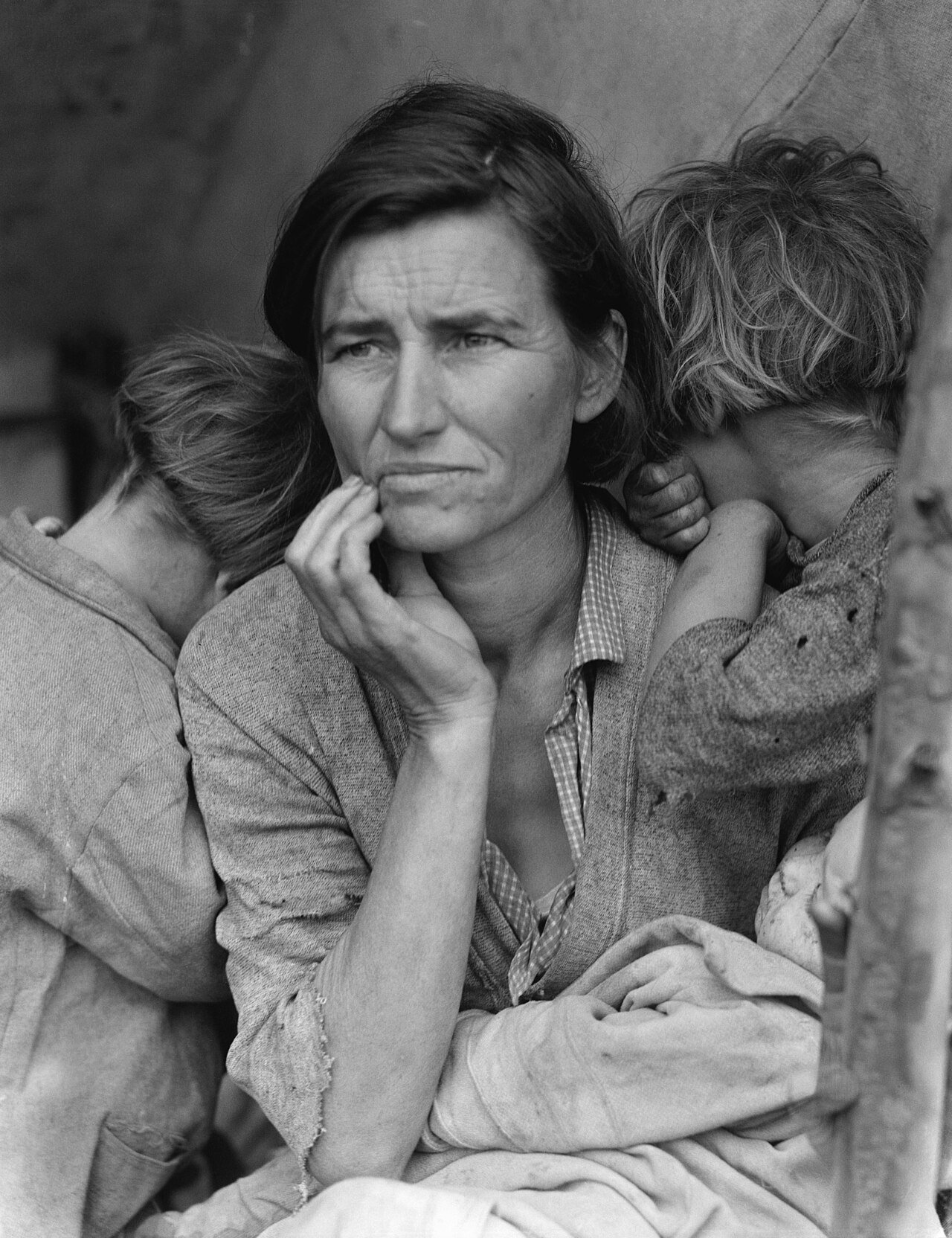
In March 1936, photographer Dorothea Lange stopped at a pea pickers' camp in Nipomo, California, and photographed Florence Owens Thompson: 32 years old, a mother of seven, whose family had sold the tires off their car to buy food.[5] The picture became known as "Migrant Mother," the most famous face of the whole Great Depression.
In 1939 John Steinbeck published The Grapes of Wrath, the story of a family driving from Oklahoma to California. It won the Pulitzer Prize the following year. For the first time, Americans read in a novel that disaster does not fall from the sky — it grows out of the ground.[7]
But there was no promised land waiting in California. What waited was lower pay, more crowded camps, and hostility written on roadside signs. Many discovered only after arriving that they had not fled a place but a condition — and the condition had come along for the ride.
Chapter FourThe Performance Over Washington
Hugh Hammond Bennett was a soil scientist with the U.S. Department of Agriculture, surveying soil erosion across the country from 1903 onward.[4] For 30 years he told Congress the same thing: America was losing its land. Congress listened for 30 years and did very little.
On Friday, April 19, 1935, Bennett walked into Room 333 of a Senate office building to testify for a funding bill.[6] As he spoke, he stalled for time — he had been tracking a dust storm moving east from the Great Plains and had calculated that it would reach Washington while he was still testifying.
The sky began to turn copper. Bennett walked to the window and threw it open; the smell of soil drifted in. "Gentlemen, this is what I am talking about," he said. "There goes Oklahoma."[6] The senators watched the sky darken over the Capitol. After that testimony, the bill passed unanimously.
Eight days later, on April 27, 1935, Roosevelt signed the Soil Conservation Act, creating the Soil Conservation Service, with Bennett as its first chief — a post he held until his retirement in 1951.[3] For the first time in American history, a federal agency existed for one purpose only: to keep the soil where it belonged.
Bennett's performance is often retold as an anecdote. But it says something else: a disaster has to be seen before it is treated as a disaster. The soil had been flying over the Plains for five years and no one legislated; the day it flew over the heads of Congress, the bill passed.
Chapter FivePlanting a Wall Against the Wind
Roosevelt had another, bolder idea: plant trees. In July 1934 he authorised the Great Plains Shelterbelt — a belt of trees 100 miles wide, running from the Canadian border all the way to Texas, to break the wind with living wood.[8]
Between 1935 and 1942, crews from the Civilian Conservation Corps and the Works Progress Administration planted some 220 million trees on more than 30,000 farms, forming 30,233 shelterbelts.[8] The species were chosen for what could survive on the Plains, planted row after row, mile after mile, like a wall built out of trees.
A shelterbelt does not stop the wind; it breaks it up. A mature row of trees can cut wind speed on its sheltered side, protecting ground as far as twenty times the height of the trees. Together with contour ploughing, terracing, crop rotation and fallowing, the wind erosion began to slow. By the late 1930s the rains returned; by about 1940 the Dust Bowl years were over.[7]
Many of those tree belts still stand along the edges of farms today. Drive through Nebraska or Kansas and the neat rows of trees along the road are relics of the 1930s — scenery that a disaster grew.
EpilogueThe Land Keeps Accounts
Ninety years have passed since the Dust Bowl ended. Its lesson has not expired; it has only changed its name.
Soil is slow capital. The topsoil of the prairie took thousands of years to accumulate, and one generation spent it in 30. The generation that ploughed the prairie was not wicked — they believed wheat prices would keep rising, that rain would follow the plough, that the land was infinite. Their error was not one of motive but of time: they treated something thousands of years old as a single season's harvest.
The Soil Conservation Service later became the Natural Resources Conservation Service, which still operates today, and the soil conservation district system spread across the country. Farmers plough along contours, leave grass strips and plant windbreaks — practices that seem obvious now, but before 1935 needed a disaster that turned the sky black to get passed.[3][4]
The land does not speak, but it keeps accounts. Whatever one generation borrows from the soil, the next repays with interest. The last word of the Dust Bowl years is not about weather; it is about people: the way we treat the land eventually becomes the way the land treats us.